The Bias Archipelago: Why the Mind’s Errors Are Not Islands
Curated explanatory model · survey edition 01
The Bias Archipelago
Lower the water beneath the names.
Separate peaks. Shared ground.
Functional resemblance shapes the land. Academic lineage is a lens laid over it, never an ingredient in the geography.2 guided soundings
Decisions happen in coalitions
Scroll normally. As each passage enters the reading line, the survey illuminates its sequence; no single peak is accused of causing the whole outcome.Decision cascade
The project that refuses to die
A team is reviewing a project that has missed several milestones. The evidence about its future is mixed, the original sponsors remain accountable for it and stopping now would make the earlier expenditure feel final.
This is a coalition of compatible pressures, not a claim that one bias causes continued investment. Incentives, contracts, careers, power, switching costs and genuine option value can be at least as important, so a diagnosis requires the decision record and the organisation's context.
Decision cascade
The objective observer
Two colleagues disagree about a late handover. Each experiences their own account as a straightforward reading of the facts and the other's account as evidence of temperament or agenda.
This scenario is a comparison of related attribution and objectivity constructs, not a diagnosis or a claim that either colleague is wrong. The broad actor–observer asymmetry is context-sensitive, and actual responsibility still requires evidence about roles, constraints, incentives and the sequence of events.
Illuminated peaks accumulate across the passage. The sequence describes a plausible coalition—not a causal diagnosis.
Uses the speech voice supplied by your browser or device.
There are several ways to organize human foolishness
Alphabetical order is certainly one of them.
It has the advantage of administrative calm. Anchoring effect goes near authority bias. Confirmation bias is safely separated from sunk cost by several pages and a great many consonants. The entire unruly carnival is made to stand in a queue like applicants outside a government office.
It also conceals nearly everything interesting.
A bias is rarely an independent creature with its own private burrow in the mind. Many are different names for overlapping effects. Some share an underlying mechanism but operate on different material. Some produce the same visible mistake by different routes. Others are stages in a procession: one bias selects the evidence, another interprets it, a third repairs the memory afterwards, and a fourth assures us that this is what we had sensibly believed all along.
An alphabetical list puts the crocodile beside the crow because both begin with C. What we need is ecology.
The atlas above treats every named bias as a mountain rising from a partly submerged landscape. At high tide, the names remain separate while most of their shared ground lies submerged. Lower the water and connections emerge. Confirmation bias acquires neighbours. Sunk cost develops a coastline. The gambler’s fallacy and the hot-hand belief, which seem to predict opposite futures, turn out to be standing on the same human hunger for patterns.
The map is not claiming to reveal the one true arrangement. Psychology has no universally agreed atlas of cognitive bias. Researchers have organised biases by mental mechanism, experimental task, practical consequence, stage of reasoning, social function, and several other schemes. One task-oriented survey assembled 154 biases into seven broad categories; it was designed to support information-visualisation research, not to become the final metaphysics of bias. Dimara and colleagues describe both its scope and purpose.
That disorder is not merely a nuisance. It tells us something.
The names were coined by different people asking different questions in different laboratories. A memory researcher, a social psychologist, a physician studying diagnostic error, and a behavioural economist can approach the same stretch of mental coastline from four directions and plant four flags. Sometimes they have discovered distinct phenomena. Sometimes they have discovered neighbouring peaks. Occasionally they have renamed the same goat.
The geography therefore uses a declared feature model—mechanisms, tasks, triggers, targets, manifestations, and temporal stage—and never research lineage. The Lineage lens is laid over the finished land afterwards. Two constructs can share a ridge while retaining separate survey marks and separate names.
Shared bedrock is not a synonym machine
Move the tide control towards Related families.
The islands around confirmation bias begin to join. Myside bias appears nearby: the tendency to evaluate arguments partly according to whether they support one’s existing position. Selective exposure sits along the coast, concerned with which information one chooses to encounter. Belief perseverance describes the survival of a belief after its original support has been weakened. Motivated reasoning occupies higher ground where desires and identities influence which arguments seem plausible.
They belong together, but not in one undifferentiated puddle.
Confirmation bias does not always require a burning emotional wish. A person may preserve an initial hypothesis simply because it organises the search for evidence. Motivated reasoning more explicitly concerns goals influencing which memories, arguments, and standards of proof become available or persuasive. Ziva Kunda’s account describes motivation acting through strategies for accessing, constructing, and evaluating beliefs. A map should show shared bedrock without erasing the differences between summits.
That distinction governs every relationship in the atlas. A line appears only when a short explanation can accompany it. Near-overlap is not identity. A cascade is not an inevitable cause. A mirror relationship can connect tendencies that press in opposite directions. A similar outcome may conceal a different engine.
The sectional comparison is built for precisely this problem. It asks for shared bedrock, different geology, why two names are confused, and a case where only each one applies. The displayed similarity is a reproducible output of the declared feature weights. It is not a confidence score and it does not tell us how susceptible a particular person might be.
The project that refuses to die
Travel to the peninsula of previous investment.
A software project began with a six-month estimate. Eighteen months later, it has eaten two budgets, three managers, and the expression of hope from everyone assigned to it.
The original estimate still acts as an anchor. The resources already spent feel relevant even when they cannot be recovered. Closing the project would transform a blurred possibility of rescue into a crisp acknowledged loss. Continuing is the default. The people who publicly defended it must explain why they were right then but wrong now.
No single bias need take command. Sunk cost, loss aversion, status-quo bias, anchoring, consistency pressure, self-justification, and escalation of commitment can form a coalition government, and coalition governments are famously difficult to remove.
This is why a dictionary is insufficient. It gives us suspects but not conspiracies.
The relationship between sunk cost and escalation deserves particular care. Both allow prior investment to influence continuation. Escalation usually adds repeated commitment, personal responsibility, reputation, or institutional pressure. Treating the terms as perfect synonyms discards the extra machinery; drawing a causal arrow from one to the other would claim more than the map knows.
The pattern in six coin tosses
Farther north lie the pattern highlands.
In 1974, Amos Tversky and Daniel Kahneman described three influential heuristic families—representativeness, availability, and adjustment from an anchor—and showed how useful shortcuts could create systematic errors under uncertainty. Their paper remains a canonical starting point.
Representativeness asks, roughly, “What familiar sort of thing does this resemble?” It is often efficient. It also tempts us to neglect base rates, trust small samples, and prefer a detailed plausible story to a duller but more probable one.
Consider six coin tosses:
H H H H H H
One observer predicts another head. The coin is plainly on a streak.
Another predicts a tail. The universe, having accumulated an embarrassing imbalance, must surely straighten the books.
The first response resembles the hot-hand belief. The second resembles the gambler’s fallacy. They point in opposite directions but share the assumption that a short random sequence is announcing more than it knows. One expects persistence; the other expects compensation. Both have appointed six coin tosses as spokesmen for the cosmos.
The agreeable headline
A headline agrees with its reader. It receives more attention because it is congenial. Its claim is examined less aggressively. It is easier to remember. Repeated appearances make it familiar. Familiarity begins masquerading as independent corroboration.
The guided sounding moves through selective exposure, myside bias, confirmation bias, processing fluency, illusory truth, and availability. These are not six diagnoses of one reader. They describe points at which an information process can be altered: what is encountered, what is attended to, how it is scrutinised, how easily it is processed, and what memory later supplies.
Mere exposure and illusory truth illustrate why the visible outcome is not enough. Familiarity can increase liking in one case and perceived truth in the other. Similar recipe; different judgment. Repetition may contribute to both, but it does not make them one construct wearing two hats.
The memory marshes
To the west are the memory marshes, where the ground shifts after every visit.
Memory is not a courthouse archive with a clerk retrieving a sealed folder. It is reconstruction. Later knowledge can alter how earlier uncertainty is remembered. Hindsight bias makes an outcome feel more foreseeable after it has occurred. Outcome bias judges the quality of a past decision using information that was unavailable when the decision was made. Rosy retrospection, fading affect, consistency effects, source confusion, and suggestibility each alter a different part of the reconstruction.
That distinction matters. A sound decision can produce a bad result. A foolish decision can get lucky. Treating outcome and decision quality as identical is an excellent method for rewarding gamblers and dismissing cautious people who encountered weather.
Hindsight bias and outcome bias therefore share post-event knowledge without asking the same question. One changes how predictable the event now seems; the other changes how good the earlier decision now appears. The cross-section holds those common and different layers at once.
The objective observer
The social regions are more crowded.
Here one person’s judgment becomes input for another person’s judgment. Familiarity becomes popularity; popularity becomes evidence; evidence becomes conformity; conformity produces visible consensus; visible consensus makes private doubt feel eccentric. Bandwagon effects, social proof, authority bias, pluralistic ignorance, groupthink, in-group favouritism, and out-group homogeneity may enter at different points.
These are not merely faults inside solitary skulls. They are properties of interacting people. A room can produce a pattern that no individual entered intending to create.
A disagreement makes the problem personal. Each participant experiences the other’s position as biased by loyalty, temperament, ideology, or self-interest. Each experiences their own conclusion as something reluctantly extracted from reality itself. Naive realism, attribution effects, asymmetric insight, self-serving interpretations, and the bias blind spot gather on this coast.
Research introducing the bias blind spot found that people often recognised cognitive and motivational biases more readily in others than in themselves. Pronin, Lin, and Ross reported that pattern across several studies. Knowing a bias name is not a vaccination. It may instead furnish a pleasing new instrument for diagnosing everybody else.
Nor should this atlas pretend that structural injustice is simply a larger cognitive bias. Institutions remember through policies, databases, budgets, precedents, neighbourhoods, inherited wealth, and rules about who must prove what to whom. Individual prejudice matters, but racism, sexism, caste discrimination, and institutional inequity also involve history, incentives, laws, procedures, resource distribution, and power. A discriminatory system can continue operating when every participant describes themselves as fair-minded.
The archipelago reaches the shoreline of structural bias; it does not claim the ocean beyond it is merely another collection of mental shortcuts.
Lower the tide all the way
At Shared mechanisms, the individual labels recede and fewer recurring pressures become legible.
Attention is limited. Memory is reconstructive. Evidence is noisy. The mind completes patterns under uncertainty. Reference points turn comparable gains and losses into asymmetrical experiences. Familiar things are easier to process. Other people are both information sources and social threats. Existing beliefs provide a scaffold for thought but can become a fortification. Time and computation are finite, while action usually refuses to wait.
This last point prevents the atlas from becoming a smug catalogue of defects.
Heuristics are not simply broken versions of formal statistics. They are economical procedures for making judgments with limited information, computation, and time. In suitable environments, ignoring information can sometimes improve rather than degrade accuracy. The proper question is therefore not “How do we abolish shortcuts?” but “Which shortcut is being used, in what environment, and does that environment reward or punish it?” Gigerenzer and Gaissmaier review that ecological question.
A person who hears a crash in a dark house does not need to perform a Bayesian model comparison before becoming alert. Availability, salience, and rapid pattern matching have earned their keep over a rather long evolutionary employment contract. The trouble begins when machinery adapted to one structure of information is used in another: vivid anecdotes substitute for population rates, familiarity substitutes for truth, confidence substitutes for calibration, or loyalty substitutes for evidence.
Select Bias blind spot and its small set of curated connections becomes legible—not because the blind spot causes those tendencies, but because it can supply them with a favourite disguise. Other people have motives. Other people follow crowds. Other people defend their identities. We, meanwhile, have inspected the evidence with the clean white gloves of objectivity and reached the regrettably unavoidable conclusion that we were right.
The weather, as usual, is happening over somebody else.
How this geography was made
The committed map does not ask a language model to invent coordinates from definitions. Each entry has controlled fields for mechanisms, tasks, triggers, targets, manifestations, temporal stage, scale, associated conditions, lineages, evidence status, dates, and sources.
Geographic similarity starts with the following declared weights:
| Feature overlap | Weight |
|---|---|
| Shared mechanisms | 35% |
| Shared task or processing stage | 20% |
| Shared triggers | 15% |
| Shared manifestation | 15% |
| Shared target | 10% |
| Shared temporal orientation | 5% |
Research lineage contributes 0% to the position.
A fixed-seed deterministic embedding provides a starting chart. Curated pins then keep the important regions coherent and inspectable. The final coordinates, nearest neighbours, family labels, mechanism labels, and Gaussian elevation grid are generated during development and committed to the repository. The browser performs no force simulation and no dimensional reduction, so the coastline does not wriggle between visits.
Each peak adds a Gaussian elevation field; nearby fields sum into ridges and peninsulas. D3 derives contour geometry from that field. Canvas draws water, shaded relief, and bathymetry, while SVG supplies labels, focus targets, selected relationships, and the line between compared peaks.
The vertical relief has one deliberately narrow meaning:
Terrain height means density of related constructs—not severity, prevalence, irrationality, or empirical importance.
The map supports four analytic colour lenses—Mechanism, Task, Lineage, and Scale—plus an optional Conditions simulation. Colour always arrives with marker shapes and a textual key. Conditions may brighten constructs associated with uncertainty, time pressure, cognitive load, identity threat, emotional intensity, repetition, public commitment, asymmetric losses, or sparse evidence. It never announces that a visitor is “73% susceptible” to anything because it is neither a psychological test nor a machine for manufacturing decimal confidence.
The useful idea beneath the names
The finished atlas is intended as an explorable scientific essay, not a gamified personality quiz.
Ambiguous constructs retain their ambiguity. Related peaks do not become synonyms merely because the tide reveals a land bridge. A selected line arrives with prose before it arrives with implication. The Lineage lens shows how different research traditions surveyed neighbouring ground without allowing those traditions to manufacture the ground. The static index keeps definitions, examples, and evidence notes readable without the interactive instrument.
The visitor need not leave remembering one hundred definitions. A more useful idea is enough:
Biases are often not isolated defects. They are recurring landscapes assembled from a smaller set of cognitive pressures—and the same landscape may have been surveyed, named, and argued over by several different sciences.
Sources and further reading
- Buster Benson, “Cognitive bias cheat sheet”, on the practical problem of overlapping, non-exclusive categories.
- Evanthia Dimara, Steven Franconeri, Catherine Plaisant, Anastasia Bezerianos, and Pierre Dragicevic, “A Task-Based Taxonomy of Cognitive Biases for Information Visualization”, IEEE Transactions on Visualization and Computer Graphics 26(2), 2020.
- Ziva Kunda, “The Case for Motivated Reasoning”, Psychological Bulletin 108(3), 1990.
- Emily Pronin, Daniel Y. Lin, and Lee Ross, “The Bias Blind Spot: Perceptions of Bias in Self Versus Others”, Personality and Social Psychology Bulletin 28(3), 2002.
- Amos Tversky and Daniel Kahneman, “Judgment under Uncertainty: Heuristics and Biases”, Science 185(4157), 1974.
- Gerd Gigerenzer and Wolfgang Gaissmaier, “Heuristic Decision Making”, Annual Review of Psychology 62, 2011.
Free exploration
Survey the whole terrain
Keyboard: Tab to a peak, arrow between precomputed neighbours, Enter to open it. Choose “Compare this peak”, then a second peak, without using a pointer.
Select a peak
The sheet will show its definition, street-level example, recipe, research lineage, evidence note, sources, and only those relationships that can be explained in ordinary language.
Textual chart companion Open the complete 90-entry field guide Definitions, examples, mechanisms, and evidence notes
Complete reference
Searchable bias index
All 90 entries and their definitions are present in the server-rendered page. Search is an enhancement; the native disclosure and every entry still work when JavaScript is unavailable.
Availability heuristic attention and salience
The availability heuristic estimates frequency or probability from how easily relevant examples come to mind. Retrieval ease can be informative, but vividness, recency and rehearsal can make memorable cases unrepresentative.
Example: After several reports about dengue fill the Calcutta news, a family judges it more likely than a quieter but statistically common illness.
Recipe: associative-retrieval · salience-weighting · attribute-substitution
Evidence: Broadly supported as a family of judgements based on retrieval, although ease, amount and content of recall can have different effects.
Also called: availability bias
Recency effect attention and salience
The recency effect gives the latest items or experiences disproportionate accessibility in memory and judgement. It is a robust part of serial-position memory, but its size and interpretation depend on delay, task and retrieval conditions.
Example: A manager lets one bad week dominate an appraisal despite eleven months of solid work.
Recipe: associative-retrieval · finite-attention · reconstructive-memory
Evidence: Well established in list memory; extending the label to every overweighting of recent real-world evidence requires care.
Also called: recency bias
Primacy effect attention and salience
The primacy effect gives early items or first impressions greater influence on recall or later judgement. Extra rehearsal, interpretation of later evidence through an initial frame and task order can each contribute.
Example: The first confident speaker in a hiring panel sets a favourable frame that later reservations struggle to dislodge.
Recipe: finite-attention · associative-retrieval · prior-belief-preservation
Evidence: Serial-position primacy is well established, while first-impression effects vary with task structure and opportunities to revise.
Also called: first-impression advantage
Vividness effect attention and salience
The vividness effect occurs when concrete, emotionally engaging or imageable information exerts more influence than pallid statistical information. Vividness can aid comprehension, so the term denotes bias only when prominence outruns diagnostic value.
Example: One neighbour's dramatic story about a failed operation outweighs a hospital's much larger outcome table.
Recipe: salience-weighting · affect-as-information · associative-retrieval
Evidence: Concrete anecdotes often carry extra weight, but reviews find substantial dependence on relevance, presentation and the judgement being made.
Also called: concreteness effect in judgement
Attentional bias attention and salience
Attentional bias is a systematic tendency for certain kinds of stimuli to capture or hold attention more readily than others. The content of the bias depends on goals, learning and emotional state rather than reflecting one universal direction.
Example: An anxious patient scanning a test report notices every alarming phrase while repeatedly overlooking the reassuring qualifiers.
Recipe: finite-attention · salience-weighting · affect-as-information
Evidence: Supported across dot-probe, eye-tracking and related paradigms, with reliability and clinical specificity varying by measure.
Also called: selective attention bias
Salience bias attention and salience
Salience bias overweights information that stands out perceptually or socially relative to its context. It overlaps with attention and availability, but concerns prominence at encounter rather than ease of later retrieval alone.
Example: During a post-mortem, the loudest production outage dominates discussion while numerous quieter process failures receive little weight.
Recipe: salience-weighting · finite-attention · causal-attribution
Evidence: Salience effects are broad and well supported, but the umbrella label overlaps heavily with several more specific attention and attribution constructs.
Also called: perceptual salience effect
Isolation effect attention and salience
The isolation effect improves memory for an item that differs from otherwise similar surrounding items. Distinctiveness is relational, so an unusual item is not automatically memorable outside the comparison set that makes it unusual.
Example: A single handwritten expense in a page of printed figures is the one item an auditor later recalls.
Recipe: salience-weighting · finite-attention · associative-retrieval
Evidence: A durable laboratory finding, although accounts based on attention, encoding distinctiveness and retrieval cues remain distinguishable.
Also called: von Restorff effect
Focusing illusion attention and salience
The focusing illusion exaggerates the effect of whichever aspect of life is currently drawing attention on an overall evaluation. Other determinants fade from view during judgement even though they will still shape actual experience.
Example: While considering a job in Bengaluru, someone treats the salary difference as if it will determine all future happiness and underweights commute, friends and daily routine.
Recipe: finite-attention · salience-weighting · attribute-substitution
Evidence: Supported in well-being forecasts and related judgements; the size of the illusion depends on the focal question and available comparison information.
Also called: focus illusion
Availability cascade attention and salience
An availability cascade is a collective process in which repeated public attention makes a claim easier to recall and increasingly plausible. Its growth combines informational repetition with social and reputational pressures rather than proving that the claim is true or false.
Example: A rumour repeated across neighbourhood WhatsApp groups starts to feel independently corroborated even when every post traces back to one message.
Recipe: associative-retrieval · social-imitation · norm-coordination · processing-fluency
Evidence: An influential explanatory model of public belief formation rather than a single standardized laboratory effect.
Also called: social availability cascade
Mere-exposure effect familiarity and affect
The mere-exposure effect is an increase in liking after repeated encounter with a stimulus, even without new substantive information. The relationship is not unlimited, because boredom, prior dislike and exposure pattern can weaken or reverse it.
Example: A song that seemed unremarkable on its first play becomes a favourite after appearing repeatedly during the commute.
Recipe: processing-fluency · associative-retrieval · affect-as-information
Evidence: Meta-analytic evidence supports a generally positive, often curved relation between exposure and liking with important stimulus and timing moderators.
Also called: familiarity preference effect
Illusory-truth effect familiarity and affect
The illusory-truth effect makes repeated statements feel more true than comparable new statements. Familiarity and processing fluency can influence truth judgement even when repetition supplies no independent evidence.
Example: A false claim seen on several different news feeds begins to feel verified although each feed copied the same wire story.
Recipe: processing-fluency · associative-retrieval · attribute-substitution
Evidence: Robust across many statement types, though prior knowledge, source recollection and exposure conditions moderate the effect.
Also called: repetition-induced truth effect, truth effect
Affect heuristic familiarity and affect
The affect heuristic uses a rapid positive or negative feeling as a shortcut for judging risk, benefit or value. Feelings can summarize genuine experience, but they can also substitute for separate analysis of the attributes being judged.
Example: Because a familiar company feels trustworthy, an investor rates both its expected return as high and its risk as low without examining the balance sheet.
Recipe: affect-as-information · attribute-substitution · processing-fluency
Evidence: Well supported in risk-benefit judgements, especially when time or analytic resources are limited.
Also called: affect-as-information shortcut
Processing-fluency effect familiarity and affect
Processing fluency is the experienced ease with which information is perceived or understood, and that ease can alter evaluation. People may misattribute fluency to truth, familiarity, beauty or safety rather than to typography, repetition or prior exposure.
Example: A proposal in clear type and familiar language feels better reasoned than an equivalent proposal with awkward formatting.
Recipe: processing-fluency · affect-as-information · attribute-substitution
Evidence: A broad, well-supported mechanism whose behavioural direction depends on what people believe the experienced ease signifies.
Also called: fluency heuristic, ease-of-processing effect
Halo effect familiarity and affect
The halo effect lets a salient favourable impression of one attribute spill into judgements of other, weakly evidenced attributes. It is an impression-formation pattern, not proof that every correlated rating is irrational or caused by attractiveness.
Example: A charismatic founder is assumed to be a careful financial manager even though the pitch provides no evidence about accounting discipline.
Recipe: affect-as-information · causal-attribution · attribute-substitution
Evidence: A long-established rating and impression effect, with multiple mechanisms and substantial dependence on information structure.
Also called: halo error
Mood-congruent judgment familiarity and affect
Mood-congruent judgement makes information matching a person's current mood easier to retrieve or more influential. It can operate through memory accessibility and through treating mood as evidence about the object being judged.
Example: After a miserable commute, a team lead recalls mainly recent frustrations and judges the whole project more harshly.
Recipe: affect-as-information · associative-retrieval · reconstructive-memory
Evidence: Supported across memory and judgement tasks, but effects vary with mood intensity, awareness and the material being evaluated.
Also called: mood congruence effect
Negativity bias familiarity and affect
Negativity bias gives adverse events or information greater psychological weight than comparably positive material. The umbrella term covers attention, learning, impression and memory effects that need not share a single mechanism.
Example: One cutting remark in an otherwise warm performance review occupies the employee's thoughts for the rest of the week.
Recipe: salience-weighting · affect-as-information · associative-retrieval
Evidence: Broad evidence supports many bad-is-stronger effects, but the label joins several tasks and exceptions rather than naming one uniform law.
Also called: negative information bias
Identifiable-victim effect familiarity and affect
The identifiable-victim effect increases concern or giving for a specific known person relative to statistically described people at comparable risk. Identifiability can engage affect and perceived responsibility, but its effects vary with group size, blame and presentation.
Example: A fundraiser for one named child attracts more donations than a spreadsheet describing many children who need the same treatment.
Recipe: affect-as-information · salience-weighting · attribute-substitution
Evidence: Supported in charitable and risk judgements, with notable moderators and no guarantee that a named victim always increases helping.
Also called: identifiability effect
Hindsight bias memory reconstruction
Hindsight bias makes an outcome seem more foreseeable after the outcome is known. Knowledge of what happened can reshape remembered predictions, perceived inevitability and the story told about earlier evidence.
Example: After a product launch fails, colleagues insist the warning signs were obvious although their dated forecasts were mixed.
Recipe: reconstructive-memory · pattern-completion · causal-attribution
Evidence: A well-replicated family of retrospective distortions with separable memory, inevitability and foreseeability components.
Also called: knew-it-all-along effect
Outcome bias memory reconstruction
Outcome bias evaluates the quality of an earlier decision partly from how the outcome turned out. It confuses information available after the fact with the evidence and process that were available when the choice was made.
Example: A careful medical decision is called foolish after a rare complication, while the same reasoning is praised when the patient recovers.
Recipe: causal-attribution · salience-weighting · reconstructive-memory
Evidence: The classic effect has been reproduced across decision-evaluation settings, although responsibility and outcome type moderate its size.
Also called: resulting
Consistency bias memory reconstruction
Consistency bias reconstructs past attitudes, traits or behaviour as more similar to the present than they were. The distortion follows beliefs about personal stability and can reverse when people instead expect a particular kind of change.
Example: After changing political views, someone remembers having held roughly the same position years earlier despite old messages showing otherwise.
Recipe: reconstructive-memory · prior-belief-preservation · identity-protection
Evidence: Supported for autobiographical attitudes and traits, with direction governed by implicit theories about stability and change.
Also called: reconstructive consistency effect
Misinformation effect memory reconstruction
The misinformation effect occurs when misleading information encountered after an event alters later reports of that event. It can reflect source confusion, response processes or changes in accessible memory rather than a simple erasure of the original trace.
Example: After witnesses discuss a collision, one later remembers a red taxi mentioned by another witness but absent from the scene.
Recipe: reconstructive-memory · source-monitoring · social-imitation
Evidence: A robust eyewitness-memory phenomenon, while the relative contributions of trace impairment, source error and test demand depend on method.
Also called: post-event misinformation effect
Source-monitoring error memory reconstruction
A source-monitoring error assigns a memory, idea or feeling to the wrong origin. Familiar content may be remembered while the distinction between seeing, hearing, inferring or imagining it is lost.
Example: A designer confidently repeats a suggestion as their own, forgetting that it came from a client's earlier email.
Recipe: source-monitoring · reconstructive-memory · processing-fluency
Evidence: A central and well-supported framework for several memory errors rather than a single narrow experimental effect.
Also called: source misattribution
Choice-supportive bias memory reconstruction
Choice-supportive bias remembers a selected option more favourably and rejected options less favourably than the original information warrants. Misattributing features between options has stronger support than some broader claims about invented or selectively forgotten details.
Example: Months after buying a laptop, its owner assigns the chosen model features that actually belonged to the rejected model.
Recipe: source-monitoring · reconstructive-memory · commitment-consistency
Evidence: Solid evidence supports source misattribution favouring chosen options; other proposed forms of choice-supportive memory are less consistent.
Also called: choice-supportive misremembering
Rosy retrospection memory reconstruction
Rosy retrospection evaluates a past experience more positively than it was evaluated while it unfolded. Transient annoyances lose prominence, leaving a summary that can differ from moment-to-moment experience.
Example: A traveller remembers a monsoon holiday as delightful while forgetting the daily complaints recorded in messages sent during the trip.
Recipe: reconstructive-memory · affect-as-information · salience-weighting
Evidence: Demonstrated for meaningful experiences, with timing and the balance of anticipated, experienced and remembered affect shaping the pattern.
Also called: rosy view effect
Fading-affect bias memory reconstruction
The fading-affect bias describes unpleasant emotion attached to autobiographical memories fading faster than pleasant emotion. It concerns the emotional intensity linked to remembered events, not necessarily forgetting the negative facts themselves.
Example: The embarrassment of a failed presentation weakens faster than the pleasure attached to a successful one from the same year.
Recipe: reconstructive-memory · affect-as-information · self-enhancement
Evidence: Repeatedly observed in autobiographical memory, with reduced or altered patterns under dysphoria and in some event domains.
Also called: fading affect effect
Telescoping effect memory reconstruction
The telescoping effect misplaces events in time, often pulling older events forward into a recent reporting window. Boundary cues, retention and increasing dating error can produce the pattern without a general compression of subjective time.
Example: Asked about the last six months, a patient reports a fall that actually happened nine months ago.
Recipe: reconstructive-memory · source-monitoring · probability-simplification
Evidence: Well documented in autobiographical dating and survey recall, with forward and backward errors shaped by the reporting interval.
Also called: temporal displacement
Memory conformity memory reconstruction
Memory conformity occurs when another person's account changes what someone later reports remembering. The report can shift through informational influence, social compliance or source confusion, which should not be treated as identical mechanisms.
Example: Two colleagues compare recollections of a tense meeting, and one later remembers a remark heard only in the other's version.
Recipe: social-imitation · source-monitoring · reconstructive-memory
Evidence: Supported in co-witness and collaborative-memory studies, with effects moderated by confidence, discussion and source access.
Also called: social contagion of memory
Representativeness heuristic pattern and probability
The representativeness heuristic judges probability from how much a case resembles a prototype or an expected process. Resemblance can be useful, but it can displace base rates, sample size and the logic of how evidence was generated.
Example: A quiet, meticulous applicant is judged more likely to be an archivist than a salesperson without considering how many sales jobs exist.
Recipe: representativeness · pattern-completion · attribute-substitution
Evidence: A foundational and extensively studied heuristic, though resemblance can be normatively relevant in some environments.
Also called: similarity heuristic
Base-rate neglect pattern and probability
Base-rate neglect gives too little weight to the prior frequency of a category when interpreting case-specific evidence. People do not always ignore priors, and use improves when rates, likelihoods and reference classes are made meaningful.
Example: A rare disease is treated as likely after a positive test without combining the result with how uncommon the disease is.
Recipe: representativeness · probability-simplification · finite-attention
Evidence: Well established, but strongly affected by information format, causal relevance and how the reference class is understood.
Also called: base-rate fallacy
Conjunction fallacy pattern and probability
The conjunction fallacy judges a detailed combination of events more probable than one of its constituent events. A coherent, representative story can feel more plausible even though adding a condition cannot increase mathematical probability.
Example: A detailed description makes colleagues rate it more likely that a new hire is both a designer and an environmental activist than that the person is a designer.
Recipe: representativeness · pattern-completion · probability-simplification
Evidence: Replicated across many tasks, while wording, pragmatics and frequency formats can reduce or alter responses.
Also called: conjunction error
Gambler's fallacy pattern and probability
The gambler's fallacy expects a run in an independent random process to be followed by compensating reversal. It treats local balance as if a fair process must quickly repair short sequences.
Example: After six heads in a row, a bettor insists the next independent toss is more likely to be tails.
Recipe: representativeness · sample-size-insensitivity · pattern-completion
Evidence: A robust judgement pattern for processes believed to be random; beliefs about the generating mechanism strongly moderate it.
Also called: negative recency in random sequences
Hot-hand belief pattern and probability
Hot-hand belief expects recent success to continue because it is read as evidence of a temporarily elevated success rate. Real performance can contain serial dependence, so the error is unwarranted inference from a short run rather than belief in every possible streak.
Example: A sales team assumes a representative who closed three deals today is now intrinsically more likely to close the next independent lead.
Recipe: representativeness · sample-size-insensitivity · pattern-completion
Evidence: Belief in continuation is well documented, but the classic claim that observed sports streaks are wholly illusory has been substantially revised.
Also called: hot-hand fallacy, belief in streak shooting
Belief in the law of small numbers pattern and probability
Belief in the law of small numbers expects small samples to resemble their parent population more closely than sampling variation allows. It produces overconfidence in patterns, differences and replications drawn from limited observations.
Example: After two customers from one district cancel, a shopkeeper concludes that the whole neighbourhood has lost interest.
Recipe: sample-size-insensitivity · representativeness · confidence-miscalibration
Evidence: A foundational account of sample-size insensitivity with continuing relevance to intuitive statistics and research practice.
Also called: small-sample representativeness
Clustering illusion pattern and probability
The clustering illusion perceives meaningful bunches or streaks in data that can plausibly arise from random variation. Randomness itself contains runs, so visual irregularity is not sufficient evidence for a changing process.
Example: A support lead sees three outages on Fridays and declares a weekly pattern before checking the full multi-year distribution.
Recipe: pattern-completion · sample-size-insensitivity · representativeness
Evidence: The tendency to underestimate natural clustering is well supported, but any particular observed cluster may still reflect a real process.
Also called: illusory pattern perception in random data
Regression neglect pattern and probability
Regression neglect fails to expect extreme observations to be followed, on average, by less extreme observations when measurements are imperfectly correlated. The resulting change is often given a causal story even when ordinary statistical regression is sufficient.
Example: A student sent to tutoring after an unusually poor test improves next time, and the entire improvement is credited to the intervention without a comparison group.
Recipe: representativeness · causal-attribution · probability-simplification
Evidence: A well-established statistical reasoning error, especially when extreme cases are selected for attention or intervention.
Also called: regression-to-the-mean neglect
Denominator neglect pattern and probability
Denominator neglect gives insufficient weight to the size of the reference set when comparing ratios or risks. Larger numerators can therefore feel more compelling even when the corresponding proportion is smaller.
Example: A patient prefers a treatment described as helping 20 of 200 people over one helping 2 of 10, although the second rate is higher.
Recipe: probability-simplification · finite-attention · attribute-substitution
Evidence: Supported across ratio and risk tasks, with numeracy, visual format and gist-based instruction affecting susceptibility.
Also called: ratio bias, numerator bias
Confirmation bias prior preservation
Confirmation bias seeks, interprets or remembers evidence in ways that favour an existing belief, expectation or hypothesis. It is an umbrella construct spanning several processes and does not always require a desired conclusion or strong identity stake.
Example: A developer convinced that the database is at fault repeatedly inspects slow queries and overlooks logs pointing to a network timeout.
Recipe: prior-belief-preservation · finite-attention · associative-retrieval
Evidence: Broadly supported across many paradigms, but the label joins positive testing, selective search, biased evaluation and memory effects that should not be treated as one process.
Also called: confirmatory bias
Myside bias prior preservation
Myside bias evaluates or generates arguments in a way that favours one's own prior position. It is closely related to confirmation bias but is defined around a person's stated side of an issue rather than any hypothesis currently under test.
Example: Two readers apply strict sourcing rules to an opposing editorial and accept a supportive editorial with only a quick glance.
Recipe: prior-belief-preservation · identity-protection · directional-motivation
Evidence: Observed across argument generation and evaluation tasks and often only weakly related to conventional measures of intelligence.
Also called: own-side bias
Selective exposure prior preservation
Selective exposure is a preference for encountering information that supports an existing attitude or choice over information that challenges it. Accuracy goals, usefulness and curiosity can counter the preference, so avoidance of disagreement is not automatic.
Example: An investor subscribes to channels praising a stock already owned and quietly removes analysts who question it.
Recipe: prior-belief-preservation · directional-motivation · finite-attention
Evidence: Meta-analysis supports a moderate preference for congenial information with substantial variation by commitment, quality and utility.
Also called: congenial information selection
Belief perseverance prior preservation
Belief perseverance is the survival of a belief after the evidence that originally supported it has been discredited or removed. Explanations generated around the belief can provide new support even when the initiating evidence is gone.
Example: A hiring manager keeps thinking an applicant is unreliable after learning that the damaging reference was sent for the wrong person.
Recipe: prior-belief-preservation · pattern-completion · commitment-consistency
Evidence: Established in debriefing and correction paradigms, although persistence depends on the belief, explanation and corrective information supplied.
Also called: belief persistence
Motivated reasoning prior preservation
Motivated reasoning describes goals influencing which memories, arguments and standards of proof are accessed, constructed or accepted. Directional motivation favours a desired conclusion, whereas accuracy motivation can instead increase careful reasoning.
Example: A founder who needs a funding round to succeed treats optimistic market assumptions as realistic and identical pessimistic assumptions as absurd.
Recipe: directional-motivation · identity-protection · prior-belief-preservation
Evidence: A well-supported theoretical framework spanning many domains; motivation changes reasoning through multiple constrained processes rather than unlimited wishful thinking.
Also called: directional reasoning
Attitude polarization prior preservation
Attitude polarization is movement towards more extreme positions after considering evidence or discussion. Biased assimilation can produce it when opposing sides evaluate the same mixed evidence by different standards, but polarization also has other social mechanisms.
Example: Supporters and critics of a policy read the same inconclusive report and each leaves more certain that their original position is correct.
Recipe: prior-belief-preservation · directional-motivation · identity-protection
Evidence: Polarization occurs reliably in some attitude and group contexts, but identical mixed evidence does not always increase extremity.
Also called: belief polarization
Disconfirmation bias prior preservation
Disconfirmation bias subjects belief-incongruent evidence to more counterargument and stricter scrutiny than congenial evidence. It concerns unequal evaluation after exposure, unlike selective exposure, which concerns what evidence is encountered.
Example: A manager demands flawless methodology from a survey criticising a favoured initiative but accepts a supportive survey without checking its sample.
Recipe: directional-motivation · prior-belief-preservation · identity-protection
Evidence: Demonstrated in politically charged evaluation tasks; generalisation depends on attitude strength, sophistication and domain.
Also called: motivated scepticism
Belief bias prior preservation
Belief bias makes the believability of a conclusion influence judgement of whether an argument is logically valid. A believable conclusion can be accepted from invalid premises, while an unbelievable conclusion can make a valid argument harder to endorse.
Example: A plausible claim in a board memo is accepted as logically entailed even though the stated evidence does not actually support it.
Recipe: prior-belief-preservation · attribute-substitution · finite-attention
Evidence: A robust reasoning effect with an interaction between logical validity and conclusion believability.
Also called: belief-bias effect
Continued-influence effect prior preservation
The continued-influence effect is the persistence of misinformation in reasoning after a correction has been accepted. Retractions may leave a gap in the event model or fail to make the corrective account as retrievable as the original claim.
Example: Residents accept that an electrical fault did not start a fire but still cite the fault when explaining why the building burned.
Recipe: prior-belief-preservation · reconstructive-memory · associative-retrieval
Evidence: Replicated and widely reviewed, although effect sizes and successful correction strategies vary across materials and designs.
Also called: continued influence of misinformation
Anchoring effect reference dependence
The anchoring effect pulls a numerical estimate or judgement towards an initially encountered value or position. Insufficient adjustment is one account, but selective accessibility, conversational inference and scale construction can also produce anchoring.
Example: A flat first advertised at ₹80,000 a month makes a later quote of ₹60,000 feel reasonable before comparable rents are checked.
Recipe: reference-dependence · prior-belief-preservation · finite-attention
Evidence: A robust effect across many estimation tasks, with several mechanisms and sensitivity to expertise, relevance and incentives.
Also called: anchoring-and-adjustment
Framing effect reference dependence
A framing effect changes judgement or choice when equivalent or closely matched information is described in different ways. Risky-choice, attribute and goal framing are related paradigms rather than one unitary mechanism.
Example: Patients respond differently when the same operation is described with a ninety per cent survival rate instead of a ten per cent mortality rate.
Recipe: reference-dependence · salience-weighting · affect-as-information
Evidence: Meta-analytic evidence supports reliable framing effects with marked variation across frame type, task and response mode.
Also called: choice framing effect
Loss aversion reference dependence
Loss aversion gives losses relative to a reference point greater weight than comparable gains. It is a property of choices and valuations under specified conditions, not a fixed personal coefficient or a claim that every loss always dominates every gain.
Example: The prospect of losing ₹1,000 from an existing account feels more consequential than the prospect of gaining ₹1,000 feels attractive.
Recipe: loss-asymmetry · reference-dependence · affect-as-information
Evidence: Influential and supported in many designs, while magnitude, boundary conditions and some common demonstrations remain actively debated.
Also called: loss-gain asymmetry
Endowment effect reference dependence
The endowment effect raises the valuation of an object after it becomes part of a person's endowment or is treated as owned. Loss aversion is one explanation, while attachment, transaction framing and market experience can also matter.
Example: Someone demands much more to sell a concert ticket already held than they would have paid to buy the same ticket that morning.
Recipe: ownership-attachment · reference-dependence · loss-asymmetry
Evidence: Observed in many ownership and exchange tasks, with substantial effects of design, experience, goods and transaction framing.
Also called: ownership valuation effect
Status-quo bias reference dependence
Status-quo bias favours an existing state over changing to an alternative beyond what switching costs or evidence alone justify. The current state acts as a reference and change can evoke uncertainty, anticipated regret or loss.
Example: A company renews an expensive vendor contract because replacing it requires a meeting, even though a reviewed alternative is clearly better.
Recipe: default-inertia · reference-dependence · loss-asymmetry
Evidence: Well established in choice experiments and field settings, with rational switching costs needing separate measurement.
Also called: status-quo preference
Sunk-cost effect reference dependence
The sunk-cost effect lets irrecoverable past investment influence whether to continue an action. Past cost can be psychologically relevant through waste aversion or self-justification even when only future costs and benefits should guide the current choice.
Example: A family sits through a dreadful film because the tickets were expensive, although leaving would not recover the money.
Recipe: commitment-consistency · loss-asymmetry · mental-accounting
Evidence: A well-replicated tendency with effect size varying by responsibility, framing, experience and whether future benefits remain genuinely uncertain.
Also called: sunk-cost fallacy
Escalation of commitment reference dependence
Escalation of commitment is repeated investment in a failing or uncertain course after negative feedback. It overlaps with sunk cost but adds dynamics such as personal responsibility, reputation, public defence and organizational incentives.
Example: A manager who publicly championed a delayed software project secures another budget rather than reopen the decision from current evidence.
Recipe: commitment-consistency · identity-protection · loss-asymmetry
Evidence: Well established across organizational and experimental research, but no single mechanism explains every escalation episode.
Also called: commitment escalation, self-justifying escalation
Default effect reference dependence
The default effect increases selection of an option that is preselected or takes effect without active choice. Defaults can work through effort, implied endorsement, reference dependence and procrastination rather than through inertia alone.
Example: Employees are much more likely to join a pension plan when enrolment is automatic and opting out requires a form.
Recipe: default-inertia · authority-deference · reference-dependence
Evidence: Strong laboratory and field evidence shows defaults matter, while mechanisms and ethical interpretation depend on transparency and context.
Also called: default bias
Mental accounting reference dependence
Mental accounting assigns money, costs and outcomes to separate psychological accounts rather than treating all fungible resources alike. Those accounts can support useful budgeting while also creating inconsistent spending and valuation across frames.
Example: Someone refuses to use savings for an urgent repair but pays costly credit-card interest because the savings are mentally reserved for a holiday.
Recipe: mental-accounting · reference-dependence · commitment-consistency
Evidence: A broad, influential framework with many supported manifestations rather than one uniform error.
Also called: mental budgeting
Self-serving bias self protection
Self-serving bias attributes favourable outcomes more to one's own qualities and unfavourable outcomes more to external circumstances. Motivational self-protection and differences in information or expectations can both contribute to the asymmetry.
Example: A manager credits a successful release to leadership but blames a failed release entirely on the market and suppliers.
Recipe: self-enhancement · identity-protection · causal-attribution
Evidence: A widely supported attributional pattern, with cultural, informational and motivational moderators.
Also called: self-serving attributional bias
Better-than-average effect self protection
The better-than-average effect rates one's abilities or traits more favourably than those of an average peer. Ambiguous trait definitions and selective comparison can produce the pattern, which can reverse for difficult tasks or unfavourable attributes.
Example: Nearly everyone in a team rates their communication as better than the team's average communication.
Recipe: self-enhancement · attribute-substitution · social-imitation
Evidence: Well replicated, with task difficulty, trait ambiguity, comparison group and culture shaping direction and magnitude.
Also called: illusory superiority, above-average effect
Optimism bias self protection
Optimism bias expects personally favourable outcomes to be more likely, or adverse outcomes less likely, than evidence supports. Absolute optimism and comparative optimism are related forms and should not be collapsed into one personal optimism score.
Example: A household assumes it is less likely than similar households to face a financial emergency and keeps no contingency fund.
Recipe: self-enhancement · control-inference · directional-motivation
Evidence: A robust comparative judgement pattern with marked variation by controllability, experience, event valence and reference group.
Also called: unrealistic optimism, comparative optimism
Overconfidence effect self protection
Overconfidence is excessive confidence relative to an appropriate accuracy or uncertainty benchmark. Overestimation, overplacement and overprecision are distinct forms that can move differently across easy and difficult tasks.
Example: An engineer gives a one-day estimate with near certainty even though similar integrations have varied from one to ten days.
Recipe: confidence-miscalibration · self-enhancement · finite-attention
Evidence: Extensively studied, but the umbrella label must preserve the distinction among overestimation, overplacement and overprecision.
Also called: confidence miscalibration
Illusion of control self protection
The illusion of control overestimates personal influence over outcomes substantially governed by chance or other agents. Choice, competition, familiarity and active involvement can make random outcomes feel more controllable.
Example: A trader believes personally choosing a lottery-like asset makes its random return more manageable than an equivalent asset assigned by a system.
Recipe: control-inference · self-enhancement · causal-attribution
Evidence: Well established in chance and control paradigms, while perceived control can be calibrated or even underestimated in other settings.
Also called: perceived-control illusion
Planning fallacy self protection
The planning fallacy underestimates how long or how much a future task will require despite relevant experience with past overruns. People often focus on the current plan's imagined steps and underuse the distribution of comparable completed cases.
Example: A software team predicts a six-week migration while treating three previous six-month migrations as exceptional.
Recipe: pattern-completion · self-enhancement · prior-belief-preservation
Evidence: A well-supported forecasting error, especially for own projects; strategic misrepresentation and organizational incentives can coexist with cognitive mechanisms.
Also called: planning optimism
Bias blind spot self protection
The bias blind spot sees cognitive and motivational bias more readily in other people than in oneself. People often inspect their own intentions while judging others from behaviour, and the absence of a felt motive is mistaken for evidence of objectivity.
Example: During a family argument, each person identifies the other's loyalty and emotion while describing their own position as the plain reading of facts.
Recipe: self-enhancement · causal-attribution · finite-attention
Evidence: Replicated in self-other bias ratings, although measurement partly overlaps better-than-average judgement and introspection effects.
Also called: bias asymmetry
Naive realism self protection
Naive realism is the tendency to experience one's own view as a direct, objective reading of reality. Disagreement is therefore easily explained by the other person's ignorance, irrationality or bias rather than by different information and construal.
Example: Two neighbours interpret the same housing dispute differently, and each concludes that only personal interest could explain the other's reading.
Recipe: causal-attribution · self-enhancement · prior-belief-preservation
Evidence: An influential framework connecting several self-other asymmetries, not one standardized task effect with a single magnitude.
Also called: naive realism in social perception
Dunning–Kruger effect self protection
The Dunning–Kruger effect describes lower performers in a task showing especially poor calibration of their relative performance. Popular claims that novices are always more confident than experts overstate findings that also reflect task difficulty, measurement error and regression towards the mean.
Example: Novices on a spreadsheet test substantially overrank their performance, while experienced users estimate their relative rank more accurately.
Recipe: confidence-miscalibration · self-enhancement · finite-attention
Evidence: Task-specific miscalibration is supported, but the size, mechanism and familiar internet caricature are contested and partly sensitive to statistical artefacts.
Also called: unskilled-and-unaware effect
In-group bias social alignment
In-group bias evaluates or allocates resources more favourably towards people categorised as members of one's own group. Minimal categorisation can be sufficient in experiments, but real intergroup behaviour also reflects institutions, norms, status and material interests.
Example: A committee gives familiar alumni the benefit of the doubt while reading identical gaps in an outsider's application as warning signs.
Recipe: in-group-protection · identity-protection · social-imitation
Evidence: Well established from minimal-group studies through field research, with culture, status, norms and competition moderating expression.
Also called: in-group favouritism, ingroup bias
Out-group homogeneity effect social alignment
The out-group homogeneity effect perceives members of another group as more alike than members of one's own group. Familiarity, comparative context and identity can weaken, remove or sometimes reverse the asymmetry.
Example: Members of one department describe another department as all thinking alike while easily listing differences within their own team.
Recipe: in-group-protection · finite-attention · pattern-completion
Evidence: Supported across intergroup paradigms, with important familiarity, size, status and comparative-context moderators.
Also called: outgroup homogeneity bias
Bandwagon effect social alignment
The bandwagon effect increases support for an option as it appears more popular or widely adopted. Popularity may be read as information about quality or as a cue to social belonging, making it related to but broader than direct conformity pressure.
Example: A restaurant queue attracts more customers because the queue itself is taken as evidence that the food must be good.
Recipe: social-imitation · norm-coordination · associative-retrieval
Evidence: Popularity effects occur in markets, politics and social choice, while the label often overlaps loosely with conformity and informational cascades.
Also called: popularity effect
Conformity effect social alignment
Conformity changes a judgement or action towards a group norm or majority position. Informational uncertainty and normative concern about acceptance are distinct motives, and effects depend strongly on unanimity, task and culture.
Example: A meeting participant privately doubts a deadline but endorses it after every earlier speaker says it is realistic.
Recipe: norm-coordination · social-imitation · finite-attention
Evidence: A foundational and widely replicated social-influence effect with substantial task, unanimity and cultural moderation.
Also called: majority conformity, Asch conformity effect
Groupthink social alignment
Groupthink is a proposed pattern in which pressures for concurrence within a cohesive decision group impair critical evaluation of alternatives. Popular usage often means any bad group decision, while the original model specifies antecedents and symptoms that empirical research supports unevenly.
Example: A leadership team suppresses objections to a risky launch because questioning the shared plan is treated as disloyalty.
Recipe: norm-coordination · identity-protection · commitment-consistency
Evidence: Influential but debated: reviews find heuristic value alongside inconsistent support for the original model's complete causal sequence.
Also called: groupthink model
Pluralistic ignorance social alignment
Pluralistic ignorance occurs when people privately reject a norm but incorrectly believe that most others accept it. Each person's public compliance then becomes misleading evidence that sustains the perceived consensus.
Example: Most employees dislike an always-on messaging norm, yet everyone replies at midnight because each assumes colleagues expect it.
Recipe: norm-coordination · social-imitation · sample-size-insensitivity
Evidence: Well supported in norm-perception research; the construct requires a documented gap between private attitudes and perceived group attitudes.
Also called: collective misperception of norms
Group polarization social alignment
Group polarization moves a group's post-discussion position towards a more extreme version of its members' initial tendency. Persuasive arguments, social comparison and identity processes can all contribute, so the direction follows the starting distribution rather than always becoming riskier.
Example: A mildly enthusiastic investment club becomes strongly committed to a speculative stock after members mainly exchange supporting reasons.
Recipe: norm-coordination · prior-belief-preservation · in-group-protection
Evidence: A well-established group-discussion effect whose mechanisms and magnitude vary with argument pools, identity and communication structure.
Also called: risky-shift and cautious-shift generalization
False-consensus effect social alignment
The false-consensus effect overestimates how common one's own choices, beliefs or behaviours are among other people. Selective exposure, ambiguity and using the self as a sample can each contribute without implying that every estimate from personal experience is unreasonable.
Example: A commuter who cycles assumes most colleagues would prefer secure bicycle parking over improved bus service.
Recipe: sample-size-insensitivity · self-enhancement · pattern-completion
Evidence: A robust social-estimation effect with domain, ambiguity and available comparison information influencing its size.
Also called: consensus overestimation
Fundamental attribution error attribution and impression
The fundamental attribution error describes overinferring stable dispositions from another person's behaviour or underweighting situational constraints. The correspondence-bias tradition substantially overlaps it, but effects are neither universal across cultures and tasks nor necessarily fundamental.
Example: A late colleague is labelled careless without considering the cancelled suburban trains that morning.
Recipe: causal-attribution · salience-weighting · finite-attention
Evidence: Situational underweighting is well documented, while the broad label covers several paradigms with meaningful cultural and methodological boundaries.
Also called: correspondence bias, disposition bias
Actor–observer asymmetry attribution and impression
The traditional actor–observer hypothesis says people explain their own behaviour more situationally and other people's behaviour more dispositionally. A large meta-analysis found little overall effect, although narrower asymmetries appear under particular valence, relationship and explanation conditions.
Example: A driver explains their own sharp turn by a hidden pothole but initially explains another driver's turn as recklessness.
Recipe: causal-attribution · self-enhancement · finite-attention
Evidence: The famous global formulation is not supported on average; moderator-specific self-other differences remain an active and more defensible research target.
Also called: actor-observer bias
Ultimate attribution error attribution and impression
The ultimate attribution error extends self-serving attribution to groups by explaining out-group harm dispositionally and in-group harm situationally. Favourable behaviour can receive the reverse treatment, but the exact pattern depends on identity, status and conflict.
Example: A team's own missed deadline is blamed on impossible requirements while a rival team's identical delay is blamed on incompetence.
Recipe: causal-attribution · in-group-protection · identity-protection
Evidence: An influential intergroup attribution model with support for several predicted patterns but no claim of universal group-serving attribution.
Also called: group-serving attribution bias
Illusory correlation attribution and impression
Illusory correlation perceives an association between variables that is absent or weaker than believed. Distinctive pairings, prior expectations and uneven memory can make rare group-behaviour combinations seem especially diagnostic.
Example: A supervisor remembers the few remote workers who missed deadlines and overlooks the many remote workers who delivered reliably.
Recipe: associative-retrieval · salience-weighting · pattern-completion
Evidence: A well-established covariation error with both expectancy-based and distinctiveness-based forms.
Also called: spurious association perception
Hostile attribution bias attribution and impression
Hostile attribution bias interprets ambiguous interpersonal behaviour as intentionally hostile. It is especially studied in developmental and aggression research and predicts reactive responses without implying that every perceived threat is mistaken.
Example: A child whose classmate bumps a desk accidentally assumes the act was deliberate and retaliates.
Recipe: causal-attribution · affect-as-information · prior-belief-preservation
Evidence: Associated reliably with reactive aggression across diverse samples, with developmental history and context affecting interpretation.
Also called: hostile intent attribution
Just-world hypothesis attribution and impression
Belief in a just world assumes that people generally get outcomes they deserve and deserve the outcomes they get. When confronted with innocent suffering, it can support victim derogation or invented responsibility that restores a sense of order.
Example: After hearing about a fraud victim, a listener searches for careless choices that would make the loss feel preventable and deserved.
Recipe: identity-protection · causal-attribution · control-inference
Evidence: A well-established belief and attribution research programme, not merely a momentary shortcut or an inevitable response to every misfortune.
Also called: belief in a just world, just-world bias
Stereotype-based judgment attribution and impression
Stereotype-based judgement applies group-linked expectations to an individual when individuating evidence is absent, ambiguous or underweighted. This cognitive process cannot by itself explain racism, sexism, caste discrimination or institutional inequity, which also involve history, law, incentives, procedures, resources and power.
Example: A recruiter treats an applicant's neighbourhood as evidence about reliability instead of evaluating the person's record.
Recipe: pattern-completion · finite-attention · prior-belief-preservation
Evidence: A large research domain rather than one unitary bias; category effects vary with goals, information, control and social structure.
Also called: stereotyping, category-based social judgment
Naive cynicism attribution and impression
Naive cynicism overestimates how much other people's judgements are distorted by self-interest or strategic bias. It is a counterpart to naive realism because one's own account feels principled while another person's account is discounted as motivated.
Example: Two project leads each regard the other's budget forecast as political while treating their own forecast as a neutral reading of need.
Recipe: causal-attribution · self-enhancement · identity-protection
Evidence: Supported in responsibility and interpersonal-judgement studies, though the construct has a smaller independent literature than attribution's major families.
Also called: biased assumptions of bias
Illusion of asymmetric insight attribution and impression
The illusion of asymmetric insight makes people feel they know others better than others know them. Observable behaviour is treated as revealing of the other person, while one's own private complexity is treated as hidden from outside view.
Example: Each partner in a negotiation believes they can read the other's motives while insisting their own real priorities remain invisible.
Recipe: causal-attribution · self-enhancement · finite-attention
Evidence: Demonstrated across interpersonal and intergroup studies, with conceptual overlap with naive realism and introspection-based self-other asymmetry.
Also called: asymmetric insight illusion
Present bias bounded choice and action
Present bias gives outcomes available now disproportionate weight relative to outcomes at later dates. It can create dynamically inconsistent plans, while hyperbolic or quasi-hyperbolic discounting are models of the pattern rather than exact synonyms for every impatient choice.
Example: Someone plans all week to save a bonus but spends it on a same-day sale when the money arrives.
Recipe: temporal-discounting · affect-as-information · finite-attention
Evidence: Strong experimental and field evidence supports present-focused discounting, with domain, stakes and commitment devices shaping behaviour.
Also called: immediacy bias, quasi-hyperbolic discounting
Omission bias bounded choice and action
Omission bias judges harmful inaction as less blameworthy or risky than comparably harmful action. Responsibility, regret and perceived causation can differ between action and inaction even when expected outcomes are matched.
Example: A parent rejects a low-risk vaccination because harm from the injection would feel more blameworthy than the same harm from leaving the child unprotected.
Recipe: action-omission-asymmetry · causal-attribution · affect-as-information
Evidence: Reliable in many moral and health scenarios, with intent, regret, causality and baseline norms moderating the action-inaction asymmetry.
Also called: inaction preference in harm
Ambiguity aversion bounded choice and action
Ambiguity aversion prefers options with known probabilities over options whose probabilities are uncertain or underspecified. Ambiguity seeking also occurs in some domains, so the construct describes a common choice pattern rather than a universal dislike of missing information.
Example: An investor chooses a lower-yield deposit with known terms over a potentially better product whose risk model is opaque.
Recipe: probability-simplification · affect-as-information · finite-attention
Evidence: The Ellsberg pattern is foundational, while ambiguity attitudes vary with domain, competence, framing and whether outcomes are gains or losses.
Also called: Ellsberg preference
Certainty effect bounded choice and action
The certainty effect gives the change from probable to certain outcomes more weight than a comparable probability change among uncertain outcomes. It is a prospect-theory choice regularity, not a claim that certainty is preferred in every context.
Example: A shopper gives up a much larger possible voucher to secure a modest voucher guaranteed today.
Recipe: probability-simplification · reference-dependence · affect-as-information
Evidence: A central, well-supported risky-choice pattern with boundaries set by framing, outcome domain and probability representation.
Also called: certainty overweighting
Disposition effect bounded choice and action
The disposition effect sells assets showing gains more readily than comparable assets showing losses. Reference prices, regret, tax rules, beliefs about reversal and portfolio rebalancing can all contribute, so loss aversion is not its sole engine.
Example: An investor quickly sells a share that has risen but keeps a deteriorating share to avoid recording the loss.
Recipe: reference-dependence · loss-asymmetry · mental-accounting
Evidence: Well documented in investor records, with multiple behavioural and institutional mechanisms and meaningful market variation.
Also called: sell-winners-hold-losers pattern
Decoy effect bounded choice and action
The decoy effect increases preference for an option when a clearly inferior alternative is added near it in attribute space. The decoy changes the comparison context even though it is unlikely to be chosen itself.
Example: A café adds an almost-as-expensive smaller drink, making the large drink appear like the obvious bargain.
Recipe: reference-dependence · attribute-substitution · finite-attention
Evidence: A well-established context effect, with magnitude sensitive to attribute structure, expertise, incentives and presentation.
Also called: attraction effect, asymmetric-dominance effect
Compromise effect bounded choice and action
The compromise effect increases preference for an option when it becomes the middle alternative on salient attributes. The same option can therefore gain appeal after a more extreme alternative is added to the choice set.
Example: A middle-priced phone sells better after the shop adds a premium model above it, even though the middle phone is unchanged.
Recipe: reference-dependence · attribute-substitution · finite-attention
Evidence: A replicated context effect whose size and reliability vary with attribute trade-offs, presentation and real versus hypothetical choice.
Also called: extremeness aversion
Choice overload bounded choice and action
Choice overload occurs when a larger option set reduces selection, satisfaction or decision quality because comparison becomes difficult. More choice is not uniformly harmful, and meta-analysis finds strong heterogeneity rather than a universal overload threshold.
Example: A shopper leaves without choosing mobile data after trying to compare dozens of nearly indistinguishable plans.
Recipe: finite-attention · attribute-substitution · affect-as-information
Evidence: The original effect is influential, while meta-analysis finds a near-zero average with important moderators and substantial heterogeneity.
Also called: overchoice
Action bias bounded choice and action
Action bias favours doing something over waiting when action provides a sense of agency or signals effort despite no improvement in expected outcome. The effect is domain- and framing-dependent and is not the opposite of omission bias in every setting.
Example: After one quiet sales week, an executive launches a disruptive reorganisation mainly to demonstrate that management is responding.
Recipe: control-inference · affect-as-information · action-omission-asymmetry
Evidence: Demonstrated in several applied tasks, but the direction depends on norms, perceived agency and whether action or inaction is the salient default.
Also called: preference for action
Quick reference and FAQ
Bias names are not a box of unrelated defects. This atlas treats them as peaks in shared terrain: lower the explanatory tide to see recurring mechanisms, then use separate lenses to ask where each construct arose, which task it affects, and at what social scale it operates.
Key Terms
- Cognitive bias
- Heuristic
- Functional similarity
- Research lineage
- Construct overlap
- Bathymetric contour
- Curated taxonomy
Frequently asked questions
Is this the definitive scientific taxonomy of cognitive biases?
No. Psychology has no universally agreed factor structure or final taxonomy for these constructs. The map is a curated explanatory model based on declared functional features, with overlapping or contested constructs left visibly overlapping or contested.
What does a high mountain mean?
Only density of related constructs in the declared feature model. Height does not mean that a bias is more severe, prevalent, irrational, important, or strongly supported.
Does a relationship line claim that one bias causes another?
No. Every displayed line has an ordinary-language rationale and a relationship type such as overlap, shared mechanism, cascade, mirror, or similar effect from a different mechanism. Cascade language is deliberately cautious unless causal evidence exists.
Why is research lineage excluded from the geography?
The land is meant to show functional resemblance, not university departments. Lineage is a separate lens so that constructs developed in different research traditions can appear on the same ridge without the traditions secretly determining their positions.
Word Cloud
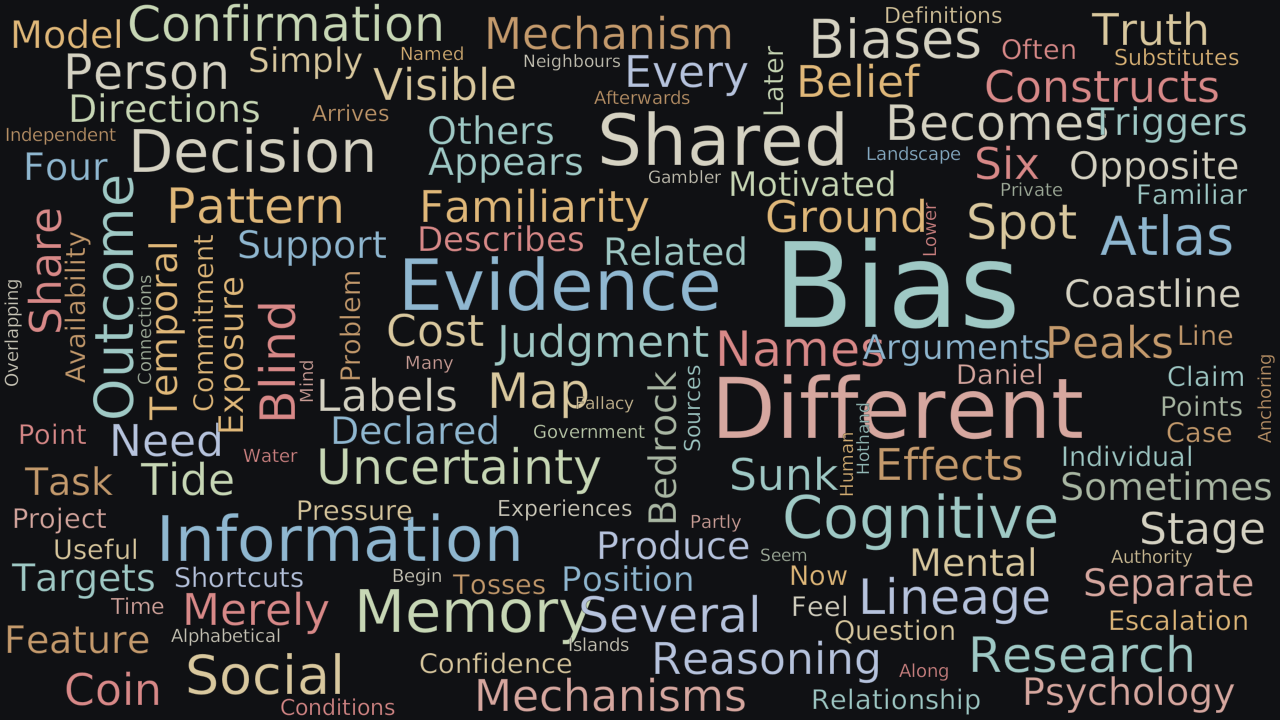
Related reading
Selected by shared topics and section, with closer publication dates breaking ties.