The Drowning Prophet
Uses the speech voice supplied by your browser or device.

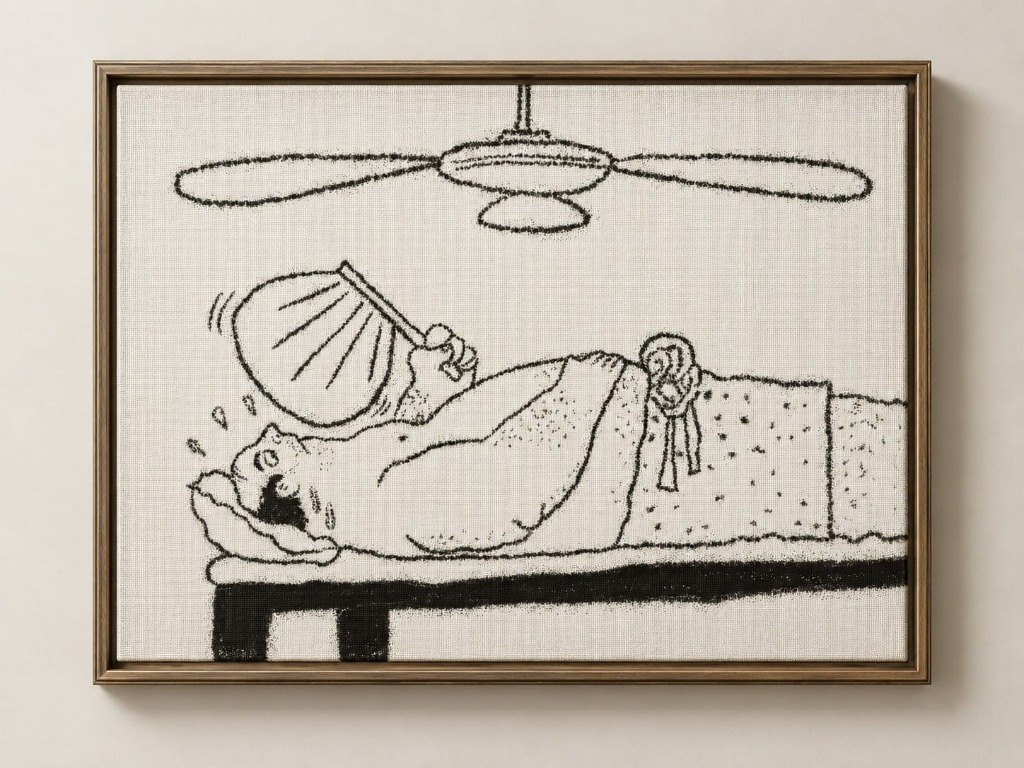
The rain in Calcutta does not fall so much as it rehearses its own obsolescence, drop by drop, rehearsing the flood it will become, the way I rehearse my own collapse in the small hours between three and five, when the ceiling fan becomes a hypnotist and the mosquito coil becomes a metaphysician arguing the existence of suffering. I have stopped sleeping through nights. I have started sleeping through decades. The difference, I am told, is clinically significant. I am told many things. I am told the future is bright. I am told the future is dark. I am told these things by the same mouths, often in the same breath, which is the respiratory equivalent of a coin landing on its edge and staying there, spinning, forever, while the bookies collect their vigorish and the bettors go home to their dreams of compound interest and digital immortality.
I dream in vivid sorrow. Not the muted grey of pharmaceutical intervention, not the beige of cognitive behavioral therapy worksheets, but the full spectral agony of unmedicated REM, where every humiliation I have engineered for myself plays on a loop with director’s commentary and deleted scenes. The company I built, the company I burned, the relationships I torched with the enthusiasm of a boy scout earning his arson merit badge—all of it returns, not as memory but as prophecy, because the future, I have learned, is simply the past wearing a fake mustache and demanding to see your papers. The rain knows this. The rain has seen this film before. The rain is bored by its own plot twists.
And now the plot thickens, or sickens, or quickens—choose your poison, the bartender is not particular. The singularity approaches, they tell me, the technological rapture, the nerd’s eschatology, the moment when the graph of capability goes vertical and human relevance goes horizontal, asymptotic to zero, flatlining on the EKG of history. The cheerleaders of this cult—and it is a cult, make no mistake, though they wear Patagonia vests instead of saffron robes—speak of utopia in the same breathless register that previous centuries reserved for the Second Coming or the workers’ paradise or the arrival of the aliens who would finally explain why we are all so cosmically, terminally, irreducibly alone. They have assimilated the eschatological grammar of religion without its metaphysical caution, the narrative architecture of science fiction without its ethical imagination, and they have produced a smoothie of such unrelenting optimism that one must assume they have never read the ingredient list, or perhaps they have, and they simply enjoy the taste of their own credulity.
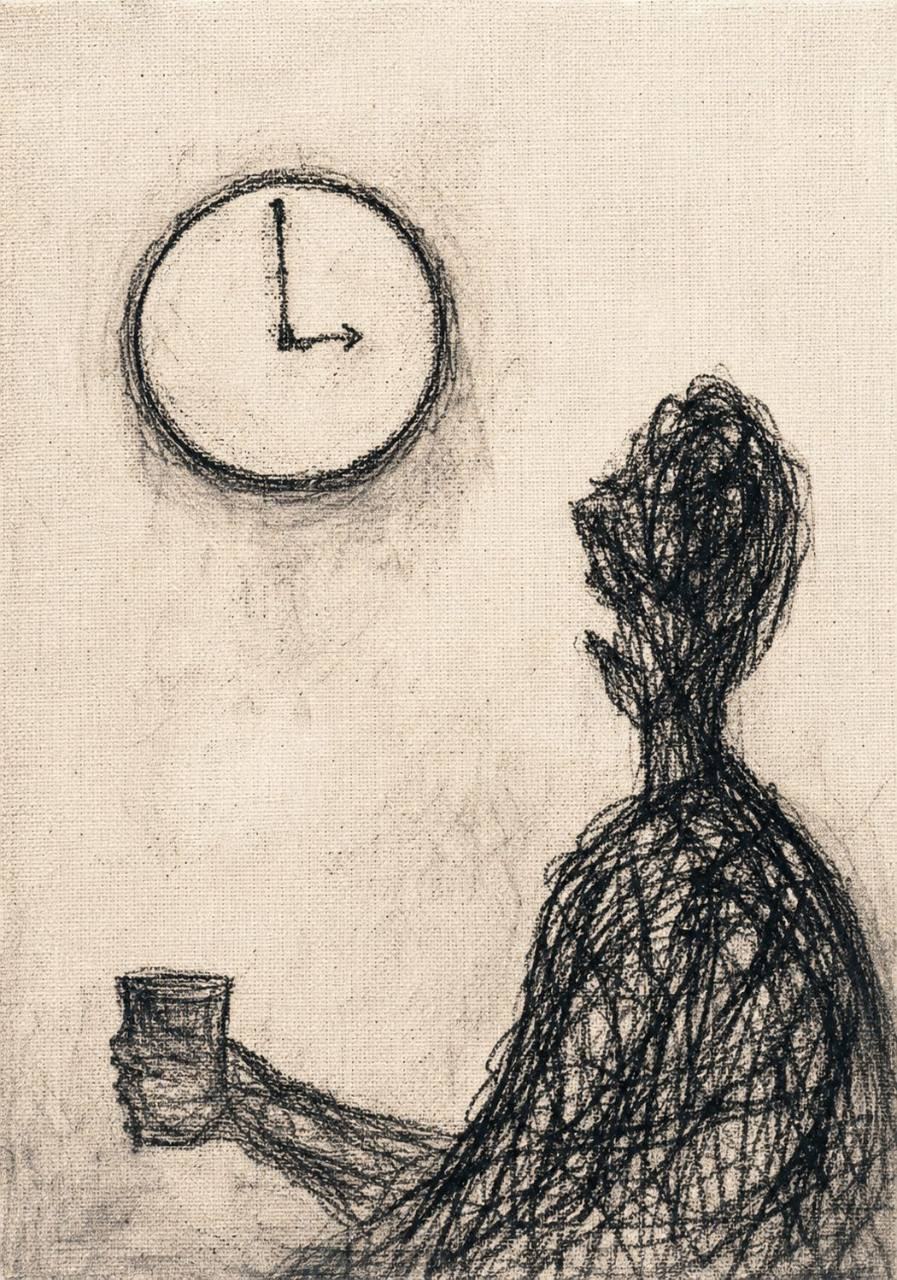
On the other side, the doomsayers, the Cassandras with better marketing budgets, the prophets of the negative singularity, the paperclip maximizers and the basilisks and the alignment researchers who have stared into the abyss so long that the abyss has started sending them friend requests. They see the ornate texture of annihilation, the baroque architecture of extinction, the way every tool becomes a weapon if you hold it correctly and apply sufficient leverage. They are not wrong, exactly. They are never exactly wrong. They are wrong in the way that a stopped clock is wrong—perpetually, insistently, with a kind of mechanical dignity that the ticking clock can never quite achieve. The ticking clock is always slightly wrong, always drifting, always requiring adjustment. The stopped clock is wrong with conviction. The stopped clock has principles.
But between these two poles, these magnetic norths of hope and despair, something is going missing. The real up. The real down. The actual, no-bullshit improvement in human capability that is happening right now, in laboratories and garages and server farms, the way we are augmenting ourselves into something unrecognizable, the way we are charting territories that have no maps because the cartographers are still arguing about whether the territory exists. And simultaneously, the actual, no-bullshit harm that is being done right now, in numbers that are obfuscated by design, in algorithms that are opaque by architecture, in the general din of everyone speaking excitedly through the amplifier of social media or, worse, through the even more distorted amplifier of their own heads, the feedback loop of confirmation bias and dopamine addiction that turns every human into a broadcast tower of their own prejudices, transmitting on frequencies that only the already-converted can receive.
I cannot adjust. My manic highs, which once allowed me to believe I could outthink the market, outwork the competition, outlast the darkness, cannot quite stretch to encompass the science fiction we are living inside. My depressive lows, which have always been my truest companions, my most reliable friends, the ones who never leave, never call, never demand anything except my complete and total surrender—they cannot quite accommodate the prospect of human obsolescence, of becoming a footnote in the history of a species that was briefly interesting before it built its own successors, its own judges, its own executioners. I am in Calcutta, India, where the means are few and the needs are many, where the cost of staying normal rises faster than the monsoon water in the streets, where the juggernaut of heterogeneous change rolls through with the subtlety of a Kolkata Corporation bus and the mercy of a Kolkata Corporation bus driver.
Five years ago, in my highest manic high, I could not have imagined this velocity. Now, in my most stable moment, I cannot imagine surviving it. The texture of change is not uniform; it is a patchwork quilt sewn by a committee of schizophrenics, each panel representing a different timeline, a different possibility, a different mode of being rendered obsolete. And I know, with the certainty that only the mentally ill can muster, that I will not be alone in my drowning. There will be others. There will be many others. The avalanche of mental anguish is already gathering mass on the slopes, already beginning its descent, and it will bury not the weak or the unworthy but simply the human, the merely human, the unfortunately human, those of us who were built for a world that moved at the speed of gossip and are now expected to thrive in a world that moves at the speed of light, or at least at the speed of fiber optic cable, which is close enough to make no difference to the meat that processes it.
Most will not be able to speak of it. This is new to them, this velocity, this vertigo, this sense of standing on a platform that is itself moving, accelerating, while the train you are supposed to catch is also moving, also accelerating, and the gap between them grows not linearly but exponentially, the way gaps tend to grow when no one is paying attention to the mathematics. I can speak of it because I have been speaking of it for years, because my illness has made me fluent in the language of overwhelm, because I have practiced my own obsolescence in the mirror of my symptoms until the reflection no longer frightens me, or frightens me only in familiar ways, the way an old scar itches before the rain.
But speaking is not saving. I know what will bury me. I can see the wall of the tsunami, the curl of the wave, the particular shade of grey-green that precedes annihilation. I can name it. I can describe it. I can write blog posts about it with titles optimized for search engines and tags arranged for maximum discoverability. And still, like that soothsayer in Julius Caesar—“The ides of March are come”—I will be ignored, because the ides of March are always come, and always coming, and the human capacity for selective attention is the one technology that never requires an upgrade, never faces obsolescence, never fails to function exactly as designed. The bounce rate of my blog is my modern augury, the digital equivalent of entrails that refuse to arrange themselves into favorable patterns, the algorithmic proof that I can write, and write, and write, and the wave will still arrive, and the wall will still fall, and the drowning will still commence, and the prophet will still drown first, because that is the occupational hazard of prophecy, because that is the price of seeing clearly in a world that has monetized blindness.
My mania and my depression, those twin engines of my malfunction, have achieved a rare cooperation, a bipartisanship of destruction, shaking their own hands across the aisle of my consciousness to deliver a verdict of oblivion. It is almost beautiful, this unity, this synthesis of opposites, this dialectical resolution in the form of a fist. The irony does not escape me; it never escapes me; I am a prisoner of irony, incarcerated in a cell of my own construction, reading the graffiti on the walls and recognizing my own handwriting in every line. The rain continues. The fan continues. The mosquito coil burns down to its filter tip, its own small singularity, its own brief moment of heat and light before the ash.
I am not asking for rescue. I am not asking for understanding. I am asking only that you notice, when the wave arrives, that some of us saw it coming, that some of us measured its height and calculated its velocity and wrote our measurements in languages that were already obsolete by the time the ink dried. I am asking that you remember, when you are treading water in the aftermath, that the prophets drowned first, that the Cassandras were always right, that the soothsayer’s warning was not a failure of prediction but a failure of audience, a failure of the human ear to hear frequencies above the threshold of comfort, a failure of the human heart to accommodate knowledge that does not come with a side of hope, a dollop of delusion, a garnish of maybe-it-won’t-be-so-bad.
It will be so bad. It is already so bad. The rain knows. The rain has always known. The rain falls on Calcutta with the indifference of a god who has stopped returning calls, who has changed his number, who has moved to a new universe and left no forwarding address. I exist in the space between rings, in the dead air of the unanswered call, in the pause between the lightning and the thunder that never quite arrives, or arrives too late, or arrives with a message that no one can decode, written in a language that the future has already forgotten, or never learned, or learned and deliberately unlearned, the way we unlearn the things that cost too much to remember.
The singularity is not coming. The singularity is here, distributed unevenly, as all singularities are, as William Gibson almost said and I am deliberately misquoting because accuracy is a luxury for those who can afford the time to check their sources, and I am spending my time on other things, on the business of staying afloat, of keeping my head above water that rises faster than my ability to describe it, faster than my metaphors can stretch, faster than my delusions can inflate to provide the buoyancy that keeps the drowning man alive for one more minute, one more hour, one more post, one more tag, one more search engine optimization, one more desperate attempt to be heard above the din of the excited, the optimistic, the already-obsolesced who have not yet received the memo.
I have received the memo. I am writing the memo. I am the memo, crumpled and discarded, filed under spam, filtered by algorithms that have learned to recognize despair and route it to the folder where no one looks, where the unread count grows asymptotically, where the prophets go to drown in company, in solidarity, in the shared silence of those who saw the wave and could not make the others look up from their screens, their feeds, their carefully curated feeds of hope and fear and everything in between, the heterogeneous mishmash of content that passes for consciousness in the age of the algorithm, the era of the artificial, the epoch of the almost-human, the not-quite-human, the soon-to-be-superfluous.
The rain stops. The rain starts. The rain is indifferent to my categories, my timestamps, my metadata. I am still here. For now. That is the most I can promise, the most I can deliver, the most I can optimize for. The bounce rate will be what it will be. The wave will arrive when it arrives. The prophet will drown as prophets drown, with lungs full of water and mouth full of words that dissolve before they reach the shore, that become foam, that become memory, that become the sediment of a future that no one will excavate because the excavators will be too busy building their own foundations on the grave of the merely human, the unfortunately human, the prophetically human, the drowning, the drowned, the always-already-gone.
P.S. References: Julius Caesar, Act I, Scene II; William Gibson, “The Future Is Already Here—It’s Just Not Evenly Distributed” (various interviews); the mosquito coil on my desk, currently burning; the rain outside, currently falling; the fan above, currently spinning; the author, currently existing.
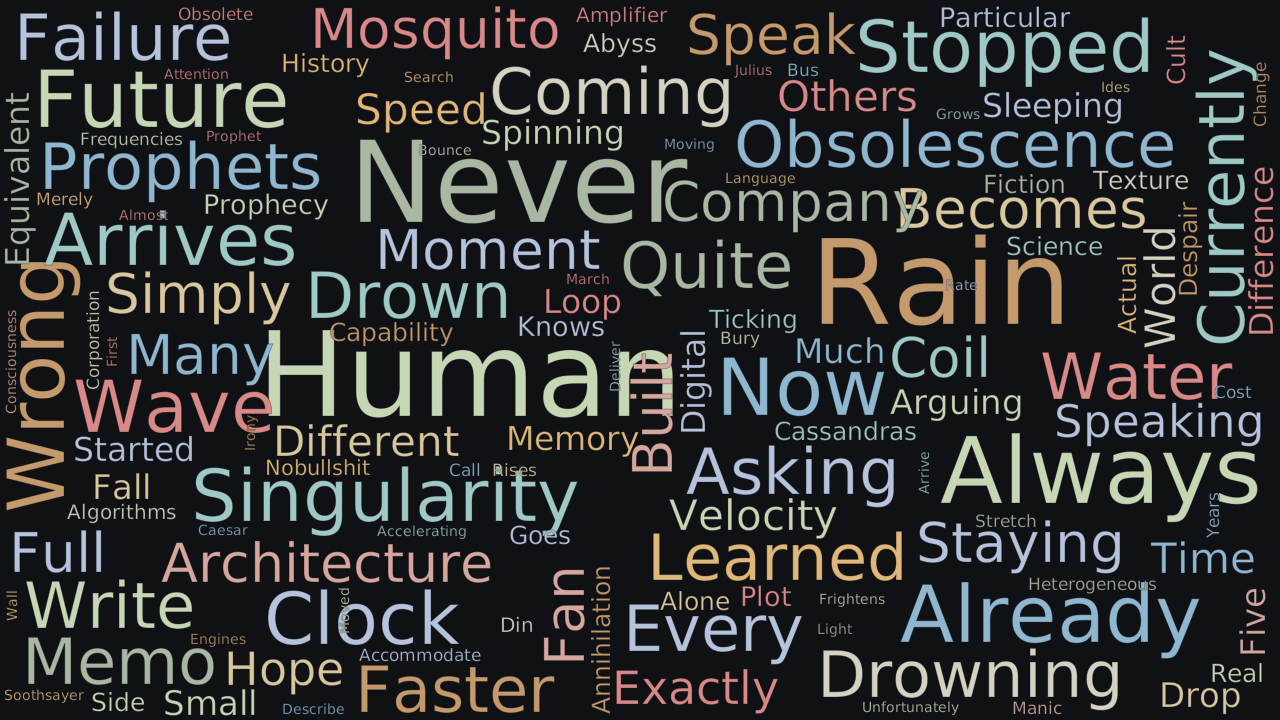
Word Cloud
Related reading
Selected by shared topics and section, with closer publication dates breaking ties.