Every essay
has a body.
Paragraphs become organs.
Sentences grow ribs.
A thought acquires a pulse.

Opening the specimen cabinet…
Checking article narration…
Updated .
Every essay has a body
Some essays walk briskly from one point to the next. Others arrive with three bags, stop to inspect a shop window, remember an uncle, and spend forty-seven words explaining why the uncle was wrong. Both can be worth reading. Their movement is different.
This atlas gives that movement a visible body. A paragraph becomes a chamber. Its sentences become ribs. A sentence that keeps going develops a coil, occupying rather more of the available anatomy than its neighbours might consider reasonable.
The body comes from the writing. Choose a specimen and read beside it. As you reach a paragraph, its chamber lights up. Select a rib or coil to find the sentence that gave it shape. The inspector keeps the original words close to their measurements.
Follow one rib
Begin with the short perceptron article. Its job is to introduce a small learning machine and explain how to read the accompanying notebook. Look at the spacing of its chambers and the relative lengths of its sentences.
Then open the Calcutta weather report. Follow one of its long coils into the text. The sentence may be carrying a room, a list, a complaint and a small bureaucracy. You can inspect the actual wording instead of guessing what an elaborate shape means.
The reflective essay on reading offers another rhythm: a long explanation followed by a short sentence, then a fresh explanation. The atlas lets those changes remain visible while you read.
These are complete source-article prose samples after the documented exclusions. The notebook’s executable cells and the articles’ image components do not become additional organs.
Six ways to look
The layer controls make one system easier to follow at a time. Organs represent paragraphs; ribs represent sentences. Branching vessels represent an estimate of nesting. Repeated words gather into neural clusters whose occurrences remain inspectable. Explicit references create citation struts. Long sentences produce coils once they cross the same threshold used for every specimen.
The reading-order spine has a separate job: it keeps the paragraphs in sequence. It remains present when the source has no citations.
Dissect separates the layers slightly, revealing how they occupy the same body. Reassemble returns them to their shared position. This is a drawing of relationships in prose, with just enough physicality to make those relationships enjoyable to explore.
Compare the same measurements
Put two specimens beside one another. The default comparison uses shared scales and thresholds so that a larger text does not quietly become the same size as a smaller one. A normalized view, when selected, is explicitly labelled and helps you compare shape.
The measurements beside the bodies explain the visible differences: word count, sentence lengths, variation, estimated nesting, repeated words and references. They describe the text you can inspect.
A short sentence can be incisive or empty. A long sentence can be exquisite or in need of a chair. The atlas cannot settle that argument. It gives you another way to notice the construction before making your own judgment.
Grow your own specimen
Paste a passage into Grow a specimen and analyse it locally. Give it enough paragraphs for a rhythm to emerge. Try splitting one long sentence, then grow it again and observe what changes.
Pasted text stays in browser memory. The atlas does not send it to a language model or add it to a public gallery. The field’s counter is bounded at 60,000, with additional limits of 2,000 paragraphs and 6,000 sentences. Exporting produces a file on your device.
The portrait is generated by the same drawing rules as the interactive body. Its SVG keeps the lines sharp; PNG makes it convenient to share. The landscape version supplies a specimen composition suited to a social preview.
A fingerprint with its workings exposed
The same text and model version produce the same portrait. This makes the image useful as a visual fingerprint: a recognisable object attached to a particular piece of writing.
For the three public specimens, the source analysis and portraits are generated during development and checked into the site. An explicit allowlist controls which articles participate. Extending that list is a deliberate publishing choice; the atlas does not automatically replace the artwork of every post.
An essay has always had a structure. Here it has somewhere to put its ribs.
Quick reference and FAQ
An essay's paragraphs, sentences and punctuation give it a visible body. Read alongside that body, inspect a sentence, compare two essays or paste your own text. Your pasted text stays in your browser.
Key Terms
- Paragraph structure
- Sentence length
- Estimated nesting
- Word recurrence
- Deterministic portrait
Frequently asked questions
Does the anatomy tell me whether an essay is good?
It describes selected structural features of the text. Sentence length, repetition, punctuation and references do not establish literary quality, accuracy or the writer's state of mind.
Does this visualization upload my pasted text?
No. The Grow a specimen action analyses pasted text in browser memory. The text is not added to the URL, sent to a text-analysis service or automatically saved.
Is the branching an exact grammatical analysis?
No. Estimated nesting uses transparent punctuation and connective rules. It provides a visual approximation and is shown as unavailable when the language is unsupported.
Why do some essays have no citation bones?
Citation struts represent recognized explicit references in the source. Ordinary links remain distinct. An essay with no recognized references has no citation struts; its reading-order spine still shows the sequence of paragraphs.
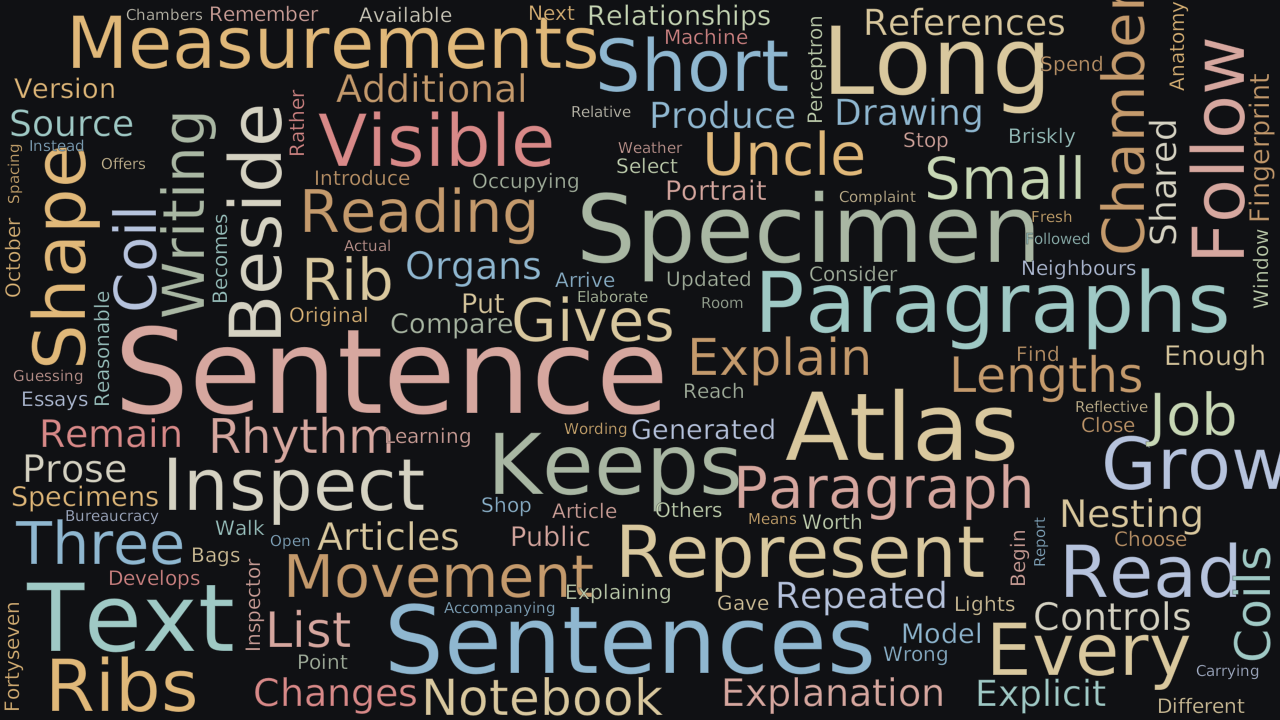
Word Cloud
Related reading
Selected by shared topics and section, with closer publication dates breaking ties.
Comments
Read the conversation or leave a thought for review. Comments load when this section is in view.