Schooling in Calcutta
Uses the speech voice supplied by your browser or device.

Acronyms used: ICSE — Indian Certificate of Secondary Education, the school examination many English-medium students in India take around Class 10. WWA — Women’s Welfare Association, part of the old school name, grand in sound if not always visible in daily welfare. US — United States, the country where I studied, worked, bought too many books, and learned that distance can come with central heating. AI — Artificial Intelligence, software that can imitate, generate, color, polish, and occasionally behave like a clerk who has swallowed the internet. LLM — Large Language Model, the text-generating kind of AI that has made everyone suspect everyone else of being automated.
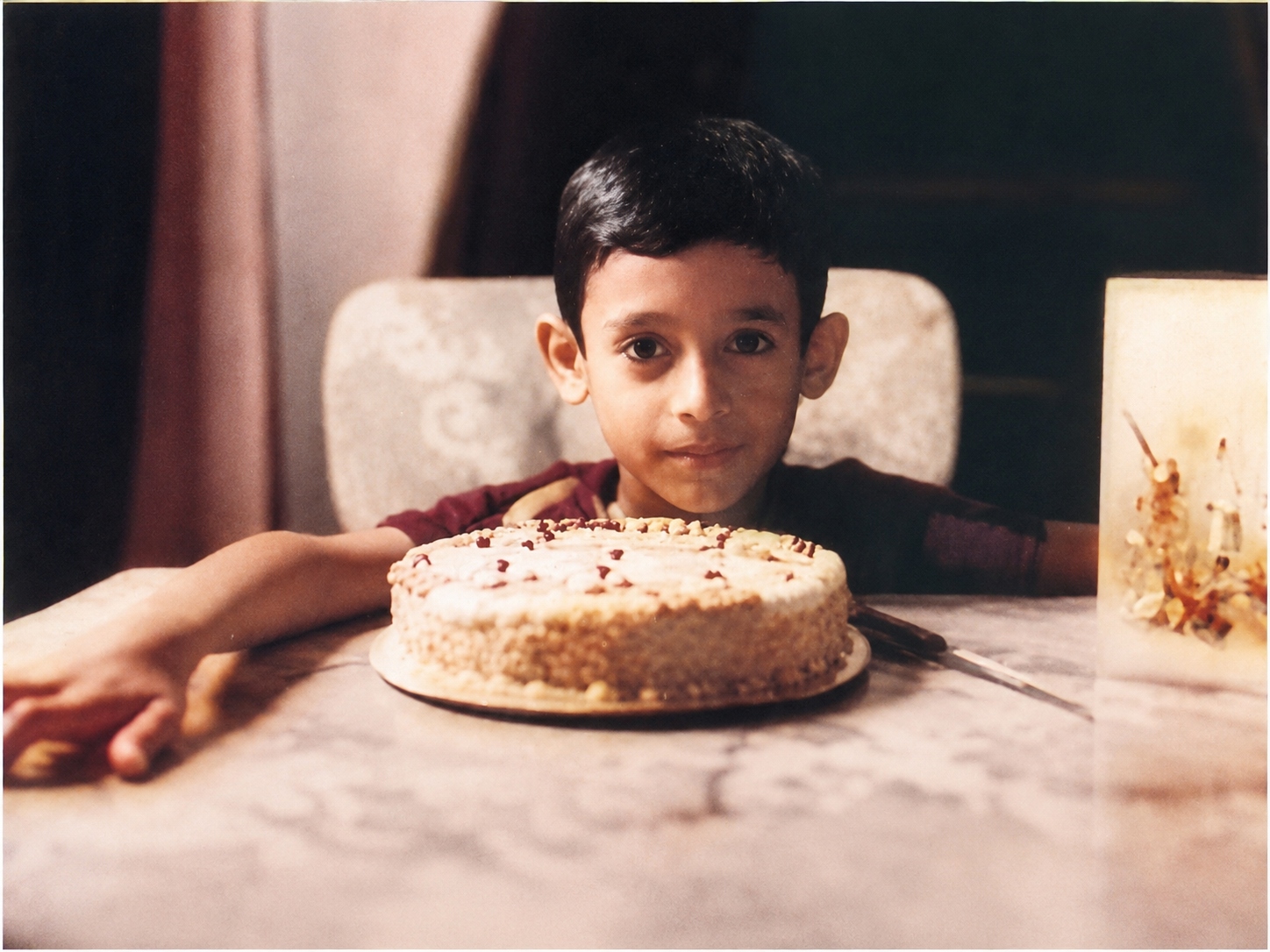
The old school photograph has me fixed in the middle row, left-most, a thin child with thick glasses and the expression of someone already suspicious of the syllabus.

School is where this story begins, because school is where a Bengali middle-class child is first told, with chalk, prayer, punishment, and sharpened pencils, that life has a syllabus and failure has handwriting.
Mine began in Cossipore, or Kashipur, depending on whether one was speaking as a Bengali, an English-medium hopeful, or a colonial ghost still mispronouncing local geography from the afterlife.

Cossipore sounded to me like coughing, which was suitable. My lungs had a theatrical temperament. As a child I nearly disappeared into whooping cough, then returned through the professional confidence of Dr. Bhaskar Mani and care strong enough to make microbes reconsider their career plans. I survived. The lungs did too, though Calcutta air still makes them behave like two elderly uncles examining an electricity bill.
The name Cossipore, alas, does not come from coughing Bengalis, though the air quality has worked hard to support the theory. It is tied to Kashinath and to older estate history involving Mulakchand Dewan Kashinath-ji and Lord Clive. Kashipur became Cossipore after the English did what they often did with Indian names: picked them up, dropped them, stepped on them, and wrote the result into official paper.
My school name had WWA attached to it, which gave the institution an air of public virtue. I cannot say I saw much welfare being distributed. I saw classrooms, uniforms, discipline, water bottles, chalk dust, fear, and teachers who seemed enormous to my thin, coughing, bespectacled self.
One teacher, Ira Paul, our English teacher, had grace.
Children notice grace. They may not know the word, but they know when an adult enters a room without making the room smaller.

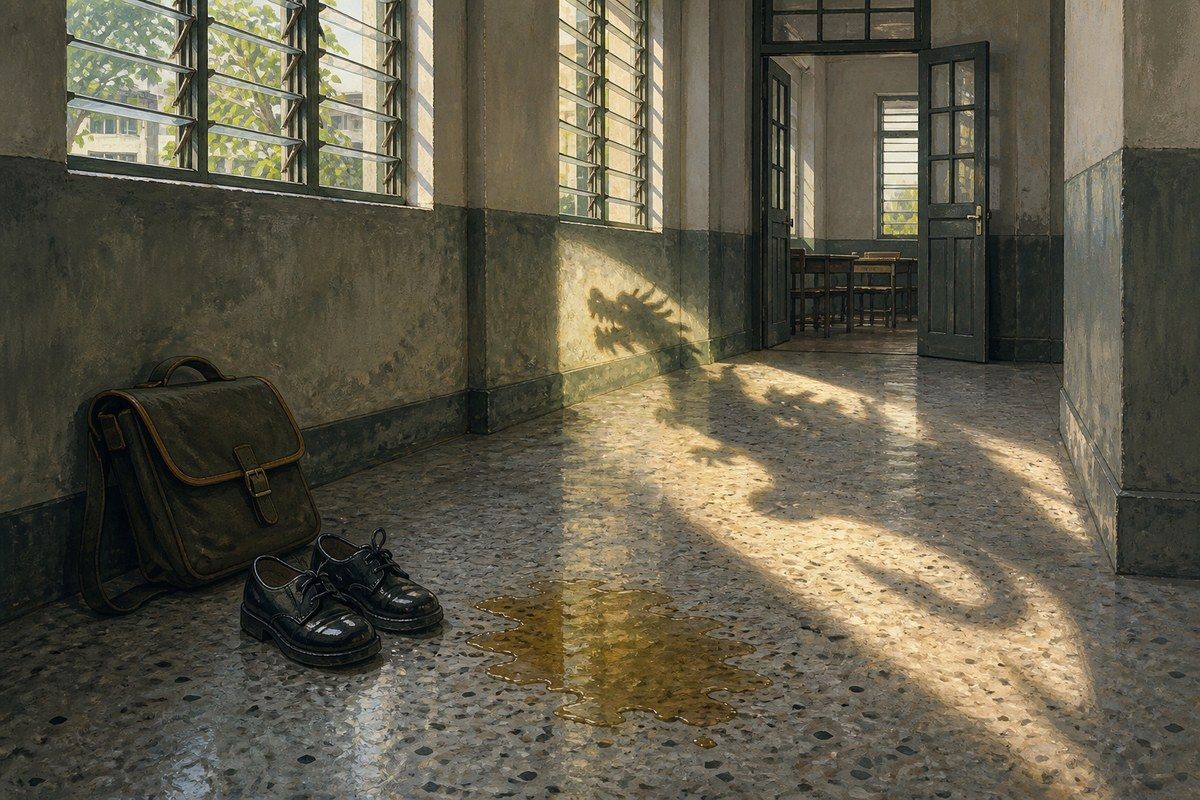
The building smelled of wet walls, old wood, ink, and the faint panic of examinations. This was not the golden school of sentimental songs. No slow-motion sunlight. No violin. No gentle voiceover saying those were the days. Those were days of ambition, shame, cough, digestive emergencies, bookish escape, and the early suspicion that the world had been built by people who had forgotten the evidence of childhood.
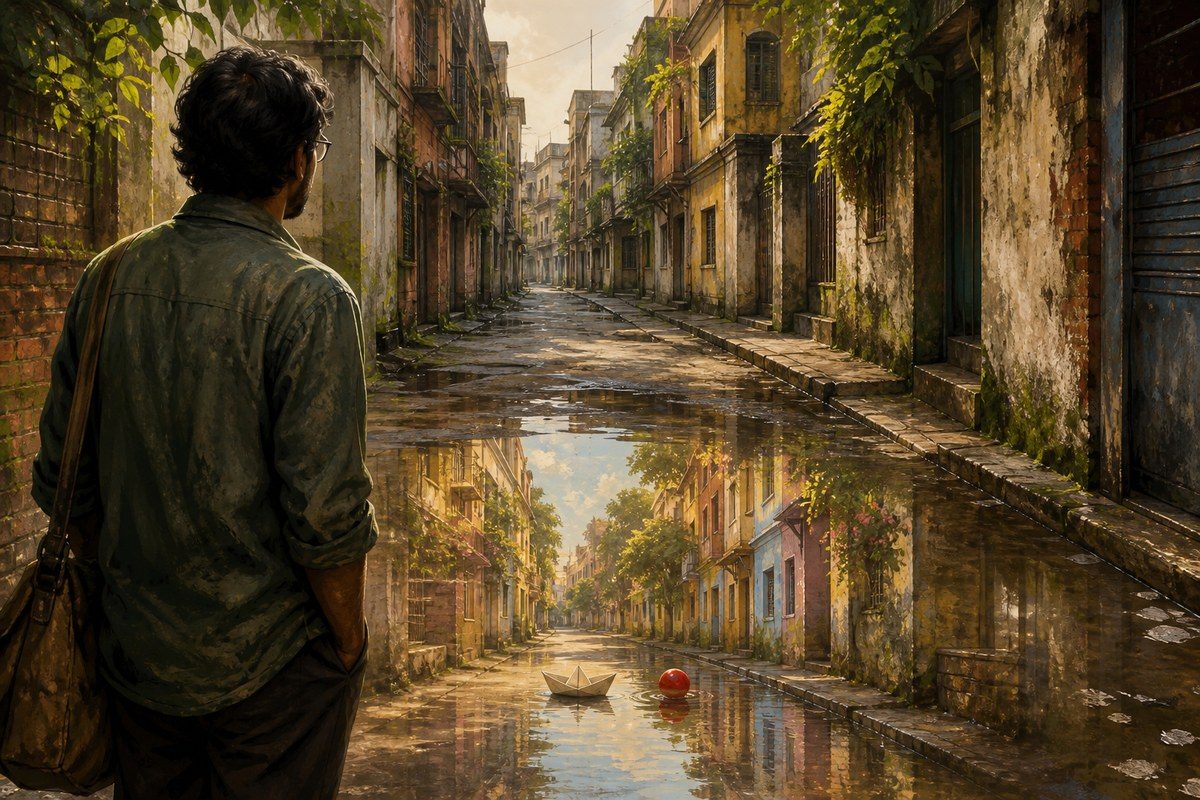
Calcutta itself is a name with too many ancestors. Some connect it to Kalighat and the Shakti Peeth story, where grief becomes geography. Some connect it to Kalikshetra, the field or region of Kali. Some argue for dug canals, burnt shell lime, flat land, or older local words worn smooth by time. In Bengal, etymology is not a straight road. It is a para lane after rain: god, mud, empire, gossip, scholarship, devotion, and tea-stall certainty flowing together with confidence and poor drainage.
Memory works the same way.
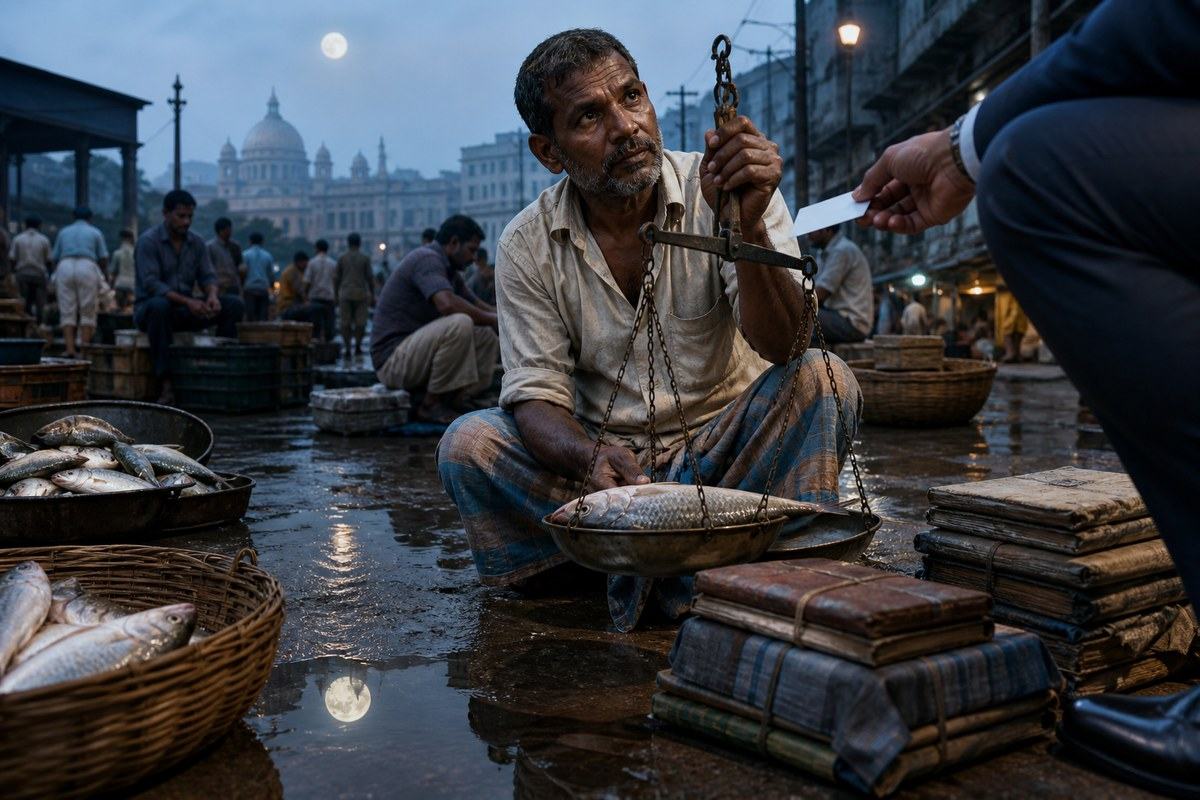
You think memory is a cupboard. Actually it is a fish market at closing time. You go in looking for one clean childhood scene and come out holding a rickshaw ride, a school corridor, a cough syrup bottle, a cracked wall, a teacher’s voice, a shame you never told anyone, and the smell of wet socks.
Memory is not a museum. It is a badly run godown where the embarrassing boxes are always easiest to find.
One of my earliest discoveries was that the body is unruly. Adults sell childhood as innocence, but childhood is when the body first starts sending unsigned notices: hunger, fear, stomach pain, comparison, smell, and shame without dictionary. You are a small citizen inside a republic you do not govern.
The school toilet was my first lesson in Indian public infrastructure. It taught me more about civilization than civics did. It was a place where water was theoretical, smell was democratic, and courage had to be summoned at the door. I learned, too early, that respectability is often the art of pretending bodies do not happen.

There was also the College Street incident, which deserves a small brass plaque in the museum of childhood embarrassment. I was there with other children, all apparently equipped with superior internal plumbing. I had to use a makeshift arrangement in an English bookstore. The flush had vanished from history. When I asked for water, the shop clerk suggested I carry a leaking bucket across the street in my school uniform. I fled instead, not heroically, but practically.
Some escapes are not from war or prison. Some are from sanitation.
Respectable people edit out such details. I understand why. But small humiliations teach powerful lessons. They teach secrecy. They teach observation. They teach that shame becomes large when hidden in a corner and fed regularly. So I name it now, not to shock, not to perform bravery, simply to remove its crown.
I was small, thin, myopic, nervous, and watchful. The world entered through thick glasses and then went into the brain for excessive processing. Other children seemed to run. I interpreted. Other children played. I noticed hierarchy, smell, gesture, tone, unfairness, size, beauty, money, accent, and confidence.
It is a nuisance to be a child with an adult-sized suspicion of the world. Nobody thanks you for it.
The Calcutta middle class gave its children a ladder and called it destiny. The ladder was education. The wall was life. The instruction was simple: climb, do not look down, do not ask who built the wall, and do not embarrass the family.
If you were not tall, fair, handsome, rich, athletic, smooth-spoken, well-connected, or blessed with the social confidence some people wear like imported perfume, you compensated. You studied. You read. You memorized. You tried to become valuable by examination. This was the Bengali middle-class version of bodybuilding. Some boys developed shoulders. We developed vocabulary.
I learned to read early and became, almost immediately, a problem. I asked questions. Not cute questions. Not the sort that make adults smile and pat your head. I asked why. Then why again. Then why the answer contradicted something said last week.
Adults dislike this. A child is expected to be intelligent in the ornamental sense, not in the cross-examination sense.
Books became my unauthorized door out. Tintin, science, Bengali fiction, history, and later the American abundance of Half Price Books, Barnes & Noble, and Borders in Texas. In San Antonio and Austin, I stood among shelves like a refugee who had found not food exactly, but permission.
Did reading make me rich? No.
Did it produce a magnificent career arranged in clean marble steps? Also no.
Reading did something less marketable and more dangerous. It gave me private freedom.
A book allows time to be stopped. You can pause inside a sentence. You can stare at a word until it becomes a room. You can go back three pages because your attention wandered. Try doing that to a pompous man speaking at a public event. He will not permit footnotes. A book permits everything.
Reading is one place where the weak person can control the strong one. The author may be a genius, a laureate, a dead Russian, a scientist, a poet, or a philosopher with eyebrows like shrubbery. Still, when he becomes difficult, you can close him. You can reopen him. You can make him repeat the argument. You can drag the idea down to the tea stall and ask, “Fine, but what does this mean if the milk is watery and the biscuit has fallen in?”
That is why I still read.
I read because the world lies fast, but books can be slowed down.
The education system I passed through was not designed to create free minds. It was designed to create answer-producing organisms. English-medium schooling carried the perfume of status. Behind it stood the old colonial machinery: clerks, exams, hierarchy, neat handwriting, obedience, and the idea that pronunciation could become morality. We were trained to sound employable before we were allowed to think dangerously.
India has a special talent for mixing brilliance with bunkum. We produce mathematicians, doctors, coders, philosophers, and poets, then seat them next to astrologers on television as if the universe were a family debate. We have subtle philosophies, ancient arguments about logic and consciousness, and still millions will forward nonsense before breakfast with the confidence of someone who has audited Saturn personally.
The Bengal of my childhood wore Marxism like an old cotton kurta: faded, argumentative, sometimes noble, sometimes full of holes. There was atheism in the air, but superstition in the walls. Darwin could be treated as optional while fish farming received practical respect. Astronomy often meant horoscope. The stars, those magnificent furnaces of physics, were reduced to advice about domestic compatibility.
I went to the US in August 1998 with about sixteen hundred dollars in my pocket, bought with my father’s salaried rupees. The plane was a Boeing 747-400, the Queen of the Skies. It sounds glamorous now. At the time I was a nervous Bengali boy with a suitcase, ambition, fear, and the suspicion that the world had made a clerical error by allowing me to travel that far.
The rupee then was in the lower forties to the dollar. Today the number feels like a slow obituary for middle-class arithmetic.
America gave me work, books, libraries, highways, central heating, and the knowledge that foreignness does not end when a passport is stamped. It also gave me distance from Calcutta. Distance is useful. From too close, a city is noise, sweat, errands, and power cuts. From far away, it becomes pattern. From very far away, it becomes myth. Then you return and realize it is still also the same leaking tap.
Now I live again in the less decorative edges of Calcutta, a man who worked in healthcare IT in the US and now often has to coax the day into motion. Some mornings begin like a court case. The toothbrush is Exhibit A. Tea is pending. The laptop sits there like a creditor with a black screen.
This blog is partly my refusal to be quietly filed away.
It is also not a wellness brochure. If you want scented wisdom arranged beside a stock photo of pebbles, you have taken a wrong turn near Ultadanga. I write because my mind sometimes becomes unbearable unless given a shape. A sentence is a small rope bridge. A paragraph is a temporary railing. A joke is a match struck inside a dark staircase. Not enough to renovate the building, but enough to see the next step.
Sketching does the same. The line drawings are mine. Some are colored or shaded with AI, but the figures began in my hand and head. I do not claim gallery-level craft. I draw because certain thoughts look like crooked people. Some moods have noses. Some hypocrisies deserve a belly and bad posture.
A lot of my odd imagination comes from Bengali children’s literature, especially Shirshendu Mukhopadhyay and his Odbhuture world, where oddness does not need apology. Add George Carlin, Robert Crumb, underground comics, Calcutta cynicism, American misanthropy, Bengali para humor, and the daily sight of respectable absurdity walking around in polished sandals, and you get my little circus.
I lean left, though the word has been damaged by parties, slogans, television, WhatsApp, and people who cannot discuss politics without turning into pressure cookers. My simpler instinct is this: when I see a can of worms, I prefer the left boot.
Religion, politics, media, family, market, school: all these institutions teach people to lie politely. The costume changes. In school it is discipline. In family it is respect. In politics it is nationalism. In business it is opportunity. In media it is balance. The structure remains familiar: someone above declares reality, someone below must nod.
This is why I became suspicious early. I noticed adults did not always answer questions. They managed them. If logic failed, tone arrived. If tone failed, authority arrived. If authority failed, guilt arrived. If guilt failed, the child was called arrogant. The whole arrangement was like a badly repaired umbrella: every rib bent in a different direction, but everyone insisting it was shelter.
Meanwhile the ordinary day continues. The price of fish rises. The local drain smells philosophical. Someone’s scooter blocks the lane. A neighbor discusses geopolitics while spitting paan. A young man scrolls job listings with the face of a condemned poet. The country may be arguing about civilization on television, but in the para the real question is whether water will come before the pump gives up.
I live in that scale now. Not the scale of grand speeches. The scale of tea, rent, dust, electricity, deadlines, and the daily effort to remain employable while the mind tries to resign from the committee.
And yet I read.
That is the stubborn miracle. Not a large miracle. More like finding one green chili in the fridge when the dal is dull. Reading still returns me to myself. Writing still proves I have not entirely disappeared. Sketching still lets me laugh at the monsters before they become landlords.
This blog, then, is not a brand. It is not a temple. It is not a clean autobiography. It is a table in a small room, with books, unpaid worries, cracked humor, political suspicion, old school shame, and a man trying, with uneven success, to make something before the day folds him back into bed.
There may be disguise here. There may be compression, rearrangement, blurred details, fictional stitching. That is not fraud. It is survival. We live in an age where every sentence can be scraped, searched, modeled, quoted, misquoted, and presented back to you by some solemn fool as evidence. A little fog is not cowardice. Sometimes fog is how a small boat crosses a river without being seen from both banks.
The truth does not always require GPS coordinates.
What I want is simple enough. I want to leave a record of one mind that read, failed, argued, laughed, doubted, worked, broke down, got up badly, sat down again, watched Calcutta from its less decorative edges, and kept trying to describe the machinery of being alive.
Not nobly. Not neatly. Just honestly enough.
If a younger child somewhere in Calcutta, or anywhere, is sitting with thick glasses, private shame, family pressure, strange questions, and the suspicion that the adult world is mostly bluff wrapped in clean clothes, I would like that child to find this and feel less alone.
Not rescued.
Less alone.
There is a difference. Rescue is rare. Less alone is a cup of tea passed across a dark room.
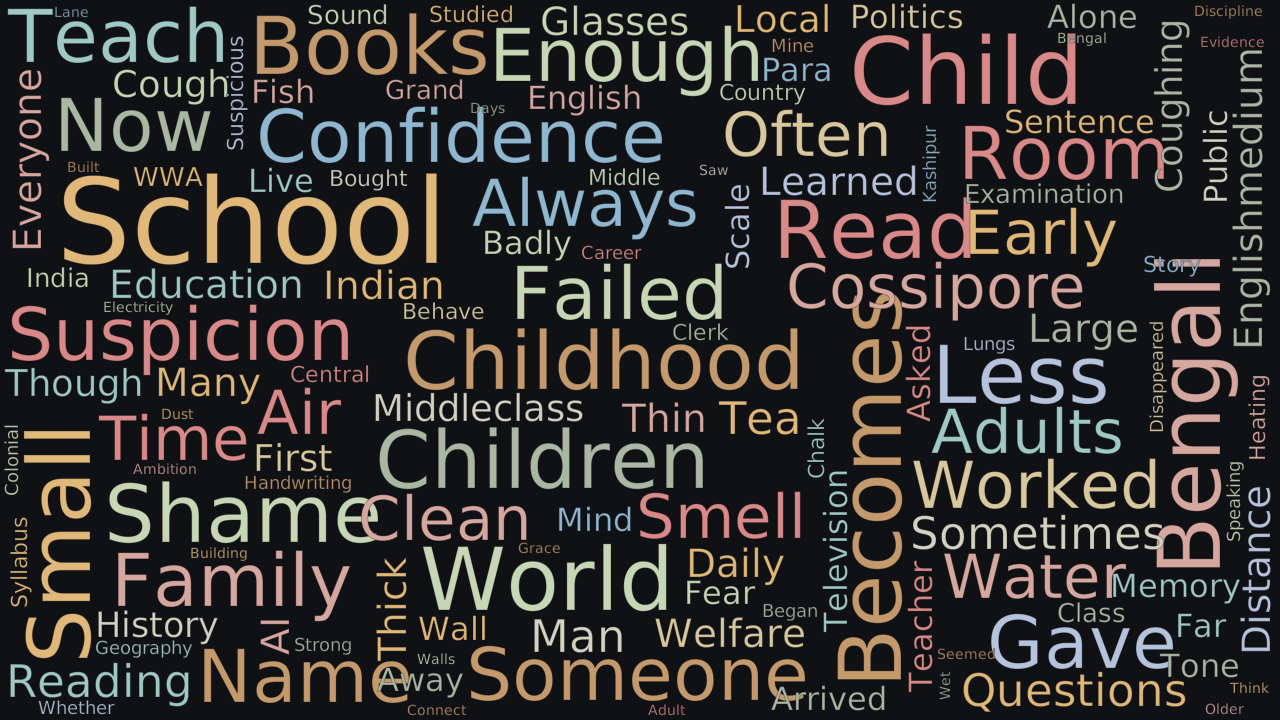
Word Cloud
Related reading
Selected by shared topics and section, with closer publication dates breaking ties.