This Blog's History
Uses the speech voice supplied by your browser or device.

SEO [Search Engine Optimization, the practical art of helping search engines and readers discover a page without turning the writing into boiled cabbage].
This blog began in the air, which is a dangerous place to begin anything except a nap.
I was flying from Los Angeles toward Fiji, carrying a laptop, a head full of plans, and the kind of fragile optimism that should probably be wrapped in newspaper before travel. Below me was the Pacific, that large blue creature pretending to be calm. Ahead of me was Fiji. Behind me was a life that had become difficult to explain in small talk.
The blog had started. That was the main thing. A few posts existed. They had not conquered the internet, no. They had not caused editors to faint, agents to call, or strangers to fight over the subscription button. But they were alive. For a man sitting alone with his own thoughts, that is not nothing.
Fiji was beautiful. Of course it was. Fiji is one of those places that looks as if the planet, after a long week of producing parking lots and income tax forms, suddenly remembered beauty and overdid it. The water was blue enough to make you suspicious. The air had manners. Even the light seemed to have taken a bath.
Then came kava.
Kava, to my uncultured mouth, tasted like someone had persuaded a respectable patch of earth to become a beverage. I understood the ritual. I respected the hospitality. I admired the cultural weight of it. But my tongue, that small disloyal clerk, stamped the file: not approved.
Still, I wrote. A few decent pieces came out of me, which is always a surprise, like finding money in an old shirt pocket. I thought, foolishly but sweetly, why stop now?
So I went to New Zealand.
Now, New Zealand has a serious problem. It is too scenic. This sounds like praise, but for a mildly disillusioned man it can become a public safety issue. You look at a mountain, then a lake, then a sky doing theatrical work for free, and suddenly a drink seems not like a drink but like a philosophical companion. A good view and a beer go together very smoothly.
Too smoothly.
Alcohol is not gentle when the mind is already wobbly. Add loneliness, disappointment, and a sleeping pill somewhere in the machinery, and you are no longer a traveler. You are a kettle left on the stove while everyone has gone to the market.
I got drunk. Not poetically. Not with the elegant sadness of a man in a black-and-white French film. I got drunk like a Bengali uncle at a wedding reception who has discovered the free counter and forgotten the existence of knees. After that, travel became less of a plan and more of a series of airport-shaped incidents.
Somehow, eventually, I reached Abu Dhabi.
Abu Dhabi looked orderly in the way certain rich places do, as if chaos had been given a visitor badge and told not to touch anything. I looked around and told myself the sentence every drifting man says when the mirror catches him unexpectedly.
Suvro, focus.
Go back to the blog.
This was excellent advice. Therefore I avoided it.
I was busy working on dreams that were not mine, which is one of the most common unpaid jobs in the world. Other people have grand schemes. You bring your little bucket of hope. You pour it into their machinery. The machine makes impressive sounds. Then, one morning, you realize you are standing there with an empty bucket and no receipt.
That is how detours happen.
Then I went to Dubai.
Dubai is a city that appears to have looked at the desert and said, “Nice, but where is the chandelier?” Everything shines. Buildings rise like ambition with elevators. Malls sit there like weather systems with escalators. Perfume, glass, gold, watches, handbags, indoor waterfalls, outdoor heat, and the constant whisper of money rubbing its hands together.
And what did I do there?
I bought second-hand books.
This was not the approved Dubai activity. People looked at me as if I had gone to a buffet and asked for plain muri. Around me, human beings were buying luxury objects, shiny objects, branded objects, objects designed to inform other objects that they were poor. I was standing beside a small second-hand bookstall, happily inspecting used paperbacks with cracked spines.
There are few pleasures more sincere than an old book in a rich place.
An old book does not flatter you. It sits there like a retired schoolmaster and says, “Read me if you dare.” In Dubai, that felt almost revolutionary. The city was selling the future by the square foot. I was buying somebody else’s abandoned past for a modest price.
That, too, is part of this blog’s history.
This blog has never been just a website. It has been a room. A small room, badly ventilated some days, but mine. A room where sketches, essays, technical thoughts, jokes, anger, memory, despair, and occasional common sense could sit together without needing to impress a committee.
For a long time I could not make it look right. The categories behaved like goats. The design sulked. The writing arrived wearing one shoe. Some posts were personal, some technical, some half-mad, some nearly decent, and the whole thing felt like a Calcutta cupboard in summer: useful, overcrowded, and faintly dangerous if opened too quickly.
But lately, I think it is getting closer.
Not famous. Not grand. Not the Taj Mahal of blogs. More like a small tea stall with a clean kettle, a working bench, and a proprietor who may argue with you but will not serve you nonsense knowingly.
The next problem, of course, is readers.
You may think writing is the hard part. It is not. Writing is hard, yes, but it is an old kind of hard. You sit, you think, you scratch, you delete, you curse privately, you make tea, you come back, you remove the sentence that thought it was very clever. Eventually something readable appears, blinking like a newborn goat.
But getting people to read?
That is a different animal.
The internet now is a bazaar where everyone is shouting, singing, selling, posing, threatening, dancing, explaining, lying, branding, optimizing, reacting, and holding up a ring light to the face of civilization. Somewhere in that bazaar you are standing with a blog post, saying, “Excuse me, I have written something.” Naturally, nobody hears you. A man nearby is explaining how to become rich in twelve minutes. A woman is reviewing a spoon. A cat has done something morally superior. You are finished.
This is where SEO enters, wearing practical shoes.
SEO is supposed to help readers find you. It is useful. It is necessary. It is also slightly comic, because it means the writer must now think not only about truth, rhythm, image, memory, and human feeling, but also whether the invisible machines of the world have properly sniffed the page. One writes for people, but first one must pass through bots, rankings, snippets, keywords, crawlers, and the mysterious digestive tract of search engines.
The old dream was simple. Write something good, publish it, and readers will come.
Charming.
That belief belongs in a museum beside telegrams, fountain pens, and people who answered unknown phone calls. Today attention is not found lying on the road. Attention is hunted, rented, bought, tricked, borrowed, begged for, or obtained because someone already famous sneezed in your direction.
And money helps.
Money helps with design. Money helps with promotion. Money helps with networking. Money helps with hiring people who claim to understand growth, some of whom actually do and many of whom merely understand invoices. Money helps you appear serious before anyone has checked whether you are worth taking seriously.
I do not have that kind of money.
This is a small difficulty, like not having a boat during a flood.
From my little edge of Calcutta, where the day begins with tea, traffic noise, neighborhood quarrels, and the suspicious stare of unpaid bills, the whole machinery of online success looks both magnificent and absurd. A man may have ideas. He may have experience. He may have worked in America, seen systems from the inside, read books, broken his head over software, written through sadness, and still, on the internet, he is just another small blinking dot unless distribution blesses him.
The tragedy is not that people do not read.
People do read. They read messages, captions, headlines, outrage, menus, comments, gossip, medical reports, loan reminders, cricket scores, political insults, and the tiny emotional weather reports of strangers. What they do not easily read is a long piece by an unknown man unless the first few seconds convince the brain that staying is worth the effort.
The brain is a miser. It saves attention like a lower-middle-class father saves electricity. One unnecessary tube light, and the shouting begins.
So the writing must earn every second. It must open a little door. Then another. It must give the reader a question, then delay the answer just enough. It must make the next paragraph feel like the next bend in a lane you have never walked down. It must be clear enough to enter and interesting enough not to leave.
This is not manipulation. This is hospitality.
If you invite someone into your house, you do not make them climb over furniture, solve a crossword, and eat dry muri in darkness. You switch on a light. You offer a chair. You give them something hot. Then, once they trust you, you may take them to the back room and show them the strange machine.
Books have their own sadness now. Many people still buy books, but a book has become, for some, an interior decoration with pages. It sits on a shelf saying, “The owner of this house may one day become the sort of person who reads me.” This is a very popular modern emotion: deferred intelligence.
We buy the future self.
The future self reads. The future self exercises. The future self wakes early, drinks water, understands history, and does not lose temper over slow internet. The present self orders the book, photographs it, arranges it near a lamp, and returns to scrolling.
I am not innocent. I too own books that look at me with disappointment.
A blog cannot even become furniture. Nobody sees it unless they open it. It cannot decorate the living room. It cannot impress guests unless the guests are unusually patient and the Wi-Fi is working. A blog behind an obscure address is not unread in the ordinary sense. It is hidden like a small fish in a large muddy pond.
Then there is the matter of friends.
When I had money, I had many friends. This is one of those scientific truths that requires no laboratory. Money produces smiles. Money oils the hinges of affection. Money makes your jokes funnier, your plans more promising, your defects more charming, and your phone calls more answerable.
Back then, people told me the blog would be big. Viral, even. I love that word. We borrowed it from disease and turned it into praise, which explains our era better than many thick books. They smiled, nodded, advised, predicted, encouraged. Their faces arranged themselves into enthusiasm.
Then came the rough patch.
The smiles did not exactly disappear. They changed species. The same teeth remained, but now they belonged to a different animal. Replies slowed. Encouragement thinned. People who once had time became busy in a way that suggested not employment but spiritual escape.
This is not a complaint. Not entirely. Life is hard for everyone. People have families, bills, illnesses, ambitions, private disasters, and their own sinking boats to row. Still, there is a particular education in watching warmth cool exactly when your usefulness declines.
It teaches you the market price of affection.
Some friendships are friendships. Others are weather. They gather when the pressure is right and vanish when the season changes. You only learn the difference when the roof starts leaking.
Meanwhile the blog remained.
Ridiculous, stubborn thing.
It sat there while I lost focus, traveled too much, drank too badly, bought books in the wrong city, trusted the wrong smiles, and returned to Calcutta with a head full of unfinished plans. It waited while I tried to repair the design, repair the writing, repair my finances, repair my confidence, repair the small inner engine that keeps a man from becoming furniture himself.
Some days I look at the blog and think, why bother?
Then some other part of me, older and meaner and more useful, answers: because this is the one thing that still sounds like you.
Not the polite you. Not the employable you. Not the passport-stamped, LinkedIn-combed, client-facing version. The actual you. The man who has lived in America and Calcutta, who has seen airports and bookstalls, who knows the smell of expensive hotel lobbies and damp local lanes, who can discuss technology one minute and the price of eggs the next, who has no talent for pretending that things are fine when they are not.
That man needs a place.
This blog is that place.
I want people to read it, yes. I want traffic. I want subscribers. I want the little graph to rise like a well-behaved child’s exam marks. I want the work to travel beyond my immediate circle of exhausted acquaintances and polite avoiders. I want the blog marketed to posterity, if my contemporaries are too busy feeding their schadenfreude with a silver spoon.
But I also know the catch.
The world does not reward effort automatically. It barely notices effort. Effort is the background noise of the planet. Every fruit seller, nurse, coder, mother, driver, clerk, cook, guard, cleaner, and tired man on a bus is making effort. The universe does not hand out medals for sweating.
So the blog must become sharper. Clearer. Easier to enter. Harder to forget.
It must carry the smell of tea, airport carpet, old books, monsoon drains, hotel soap, cheap anxiety, expensive cities, and the private comedy of a middle-aged man trying to build something without a proper budget. It must tell the truth without wearing a funeral shawl. It must be serious without becoming a government circular. It must be funny because otherwise what is the point of surviving the joke?
And yes, I will keep irritating people.
This is my marketing department for now: irritation, persistence, and occasional decency. I will ask someone to read a post. They will say, “Yes, yes, send it.” I will send it. They will disappear into the same ancient cave where people store unread links, unpaid favors, and exercise plans. After a while I will ask again, gently at first, then with the mild desperation of a man selling umbrellas after the rain has stopped.
Perhaps one person will read.
Perhaps one person will forward it.
Perhaps one person will know another person who knows a bona fide person who understands how to move a small independent blog from darkness into at least a modest streetlight.
Or perhaps not.
Still, I keep returning to that second-hand bookstall in Dubai. I remember the absurdity of it. All that glitter around me, and there I was, happy among used books. That is the clue. That is the tiny mystery. Maybe the blog is not meant to compete with the glitter. Maybe it is meant to be the bookstall.
Small. Odd. Findable by the right wanderer.
A place where someone, tired of shine, stops for a minute and says, “What is this?”
That is enough for now.
A blog does not need to begin as a monument. It can begin as a stubborn little stall beside the noise, with a few cracked spines, a sharp sentence or two, and one middle-aged Bengali man from the edge of Calcutta still arranging his thoughts before the next bill arrives.
And if nobody comes?
Then I will keep the kettle on a little longer.
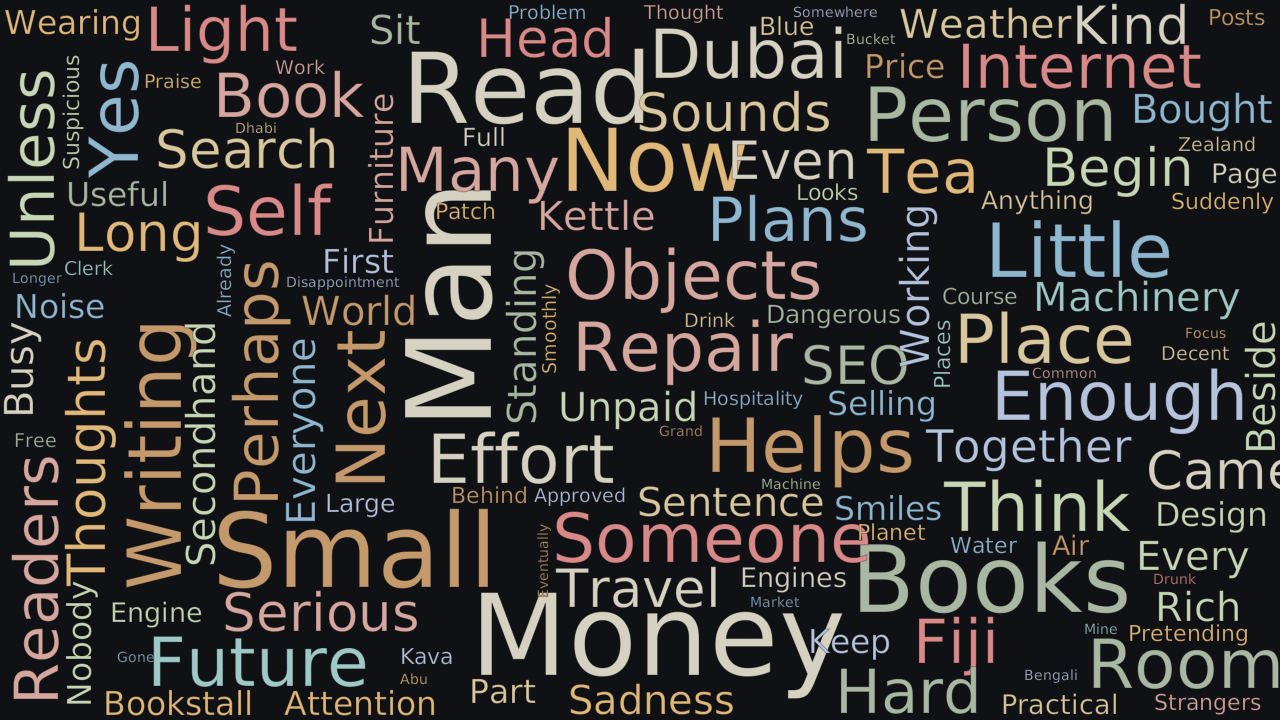
Word Cloud
Related reading
Selected by shared topics and section, with closer publication dates breaking ties.