Can't Go Back to Childhood—Except as a Misremembering Ghost
Uses the speech voice supplied by your browser or device.

Childhood is not a place you can go back to. It is a small, badly lit theater inside your head where the same old film keeps playing, except every few years the brain changes the dialogue, improves the lighting, cuts out the boring parts, and adds background music without asking your permission.
This is why a broken lane from childhood looks magical at fifty-one.
At ten, it was just a lane. It had drains, dogs, dust, one permanently irritated uncle, and a shopkeeper who behaved as if selling one lozenge was a personal insult. At fifty-one, the same lane becomes literature. The drain becomes “monsoon memory.” The dog becomes “old Calcutta character.” The irritated uncle becomes “a man of his time.” Even the bad smell acquires, with enough distance, a kind of cultural importance.
Time is a shameless interior decorator.
Your brain helps. It sits inside the skull like a soft, fatty, electrical committee, wearing no tie and keeping no minutes. It does not store childhood the way a careful school clerk stores mark sheets. It stores pieces. A smell. A sound. A slap of summer heat on the neck. A metal tiffin box. Chalk dust. Coconut oil. A torn football. A mother shouting from another room. A tram bell somewhere far away. A crow who seems to know more family secrets than any crow should.
Then, much later, when you ask, “What was my childhood like?” the brain does not give you the truth.
It gives you a production.
And the terrible thing is, the production is often better than the truth.
Nostalgia is homesickness with decorative lighting. The word comes from the idea of returning home and the pain of not being able to. But that is the polite version, the version wearing clean clothes. The ordinary version is this: nostalgia is the mind taking an old, sweaty afternoon and turning it into a framed painting.
You remember the old house.
But which old house?
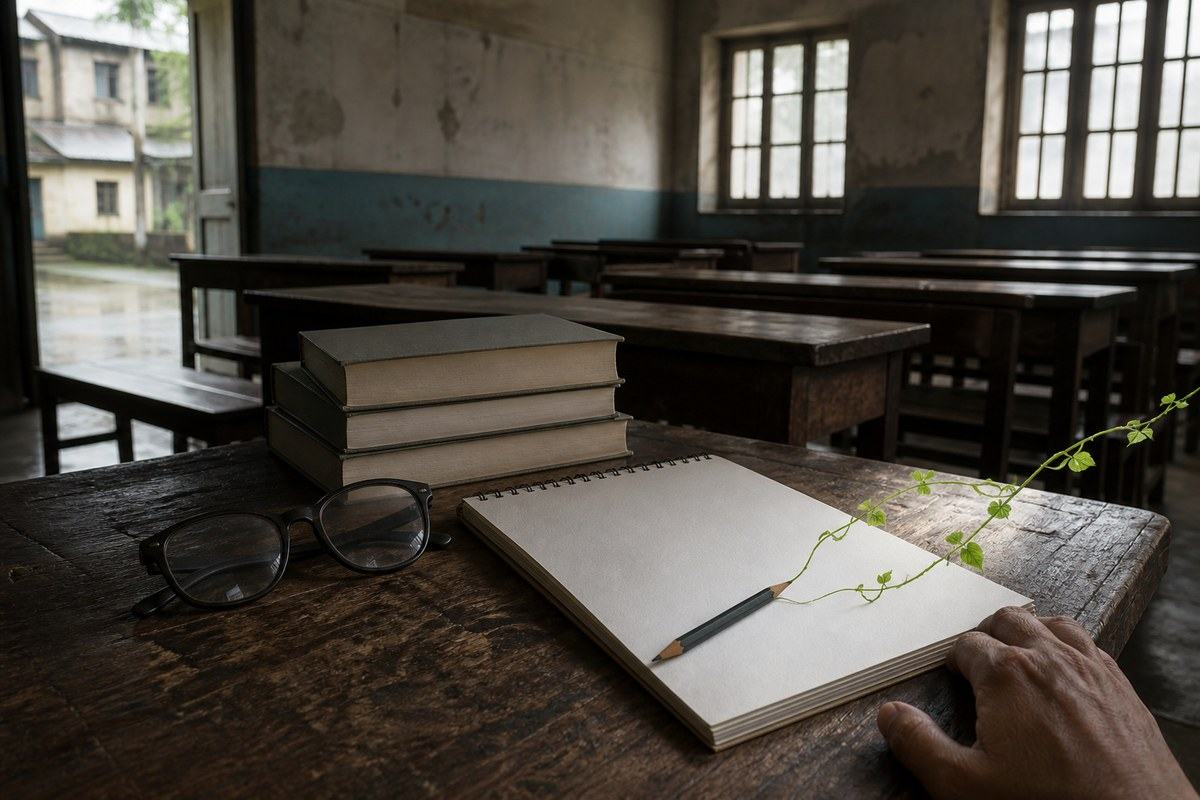
The actual house had damp walls, cracked plaster, a lizard behind the calendar, and one fan that turned with the moral enthusiasm of a retired government employee. The remembered house has golden light. The actual school had fear, boredom, unfair teachers, arithmetic, and children capable of great cruelty before lunch. The remembered school has bells, friends, rain, and the noble smell of exercise books. The actual childhood had stomach upsets, scoldings, loneliness, mosquito bites, small humiliations, and the horror of being sent to buy something and forgetting what it was halfway down the lane.
The remembered childhood has magic.
We are fraud victims.
But we are also the fraudsters.
Every time you remember something, you slightly remake it. This is not because you are dishonest. Not necessarily. It is because memory is not a locked cupboard. It is more like soft clay. You touch it, it changes. You remember the past while standing in the present, and the present has dirty fingers.
If you are lonely today, the past looks warmer. If you are ashamed today, the past looks cleaner. If money is tight today, the cheap joys of childhood look like pure wisdom. A two-rupee ice candy becomes a lost civilization. A shared bottle of orange soda becomes evidence that human society once worked properly. A small fish fry from a roadside shop becomes almost philosophical, though at the time you only wanted the bigger piece.
This is the catch.
The clearer the memory feels, the more suspicious it may be.
A memory repeated for thirty or forty years is not only a memory anymore. It is a rehearsed stage performance. You have told it to friends, edited it for relatives, softened it for yourself, sharpened it when angry, made it funnier when the audience looked bored, and removed the parts where you looked foolish. After enough retelling, the memory stands up, clears its throat, and pretends to be evidence.
It is not evidence.
It is family theater.
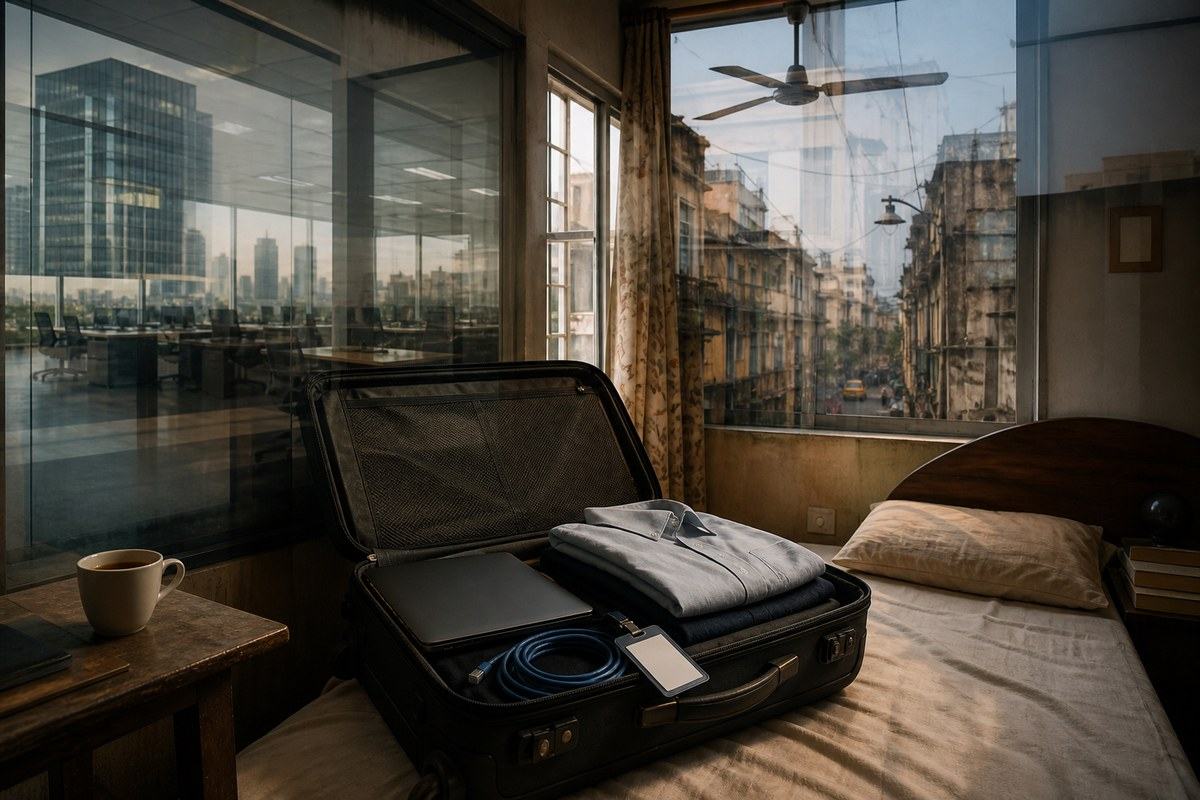
I know this because I have my own ghosts. They arrive without invitation, usually on a bad day. I may be sitting in my little corner of the Calcutta outskirts, wondering how to stretch consulting money over bills, food, medicines, internet, electricity, and the thousand small expenses that breed at night like cockroaches. The ceiling fan is making its tired helicopter noise. Outside, someone is arguing with a vegetable seller as if the future of democracy depends on coriander pricing. My mind is not exactly a garden.
Then, suddenly, childhood walks in.
Not grandly. Not like a hero.
It comes wearing half-pants, dusty knees, and an expression of complete useless confidence.
It brings a lane, a voice, a smell of rain on hot concrete. It brings the memory of running without checking blood pressure first. It brings the old belief that adults knew what they were doing. This, of course, was childhood’s greatest fairy tale. Adults did not know what they were doing. They merely had taller bodies, louder voices, and better access to keys.
Still, we believed them.
We believed everything directly. Not accurately. Directly.
The moon followed us. Trains went somewhere meaningful. Summer vacation was a form of immortality. A new pencil box could change academic destiny. A chocolate smelled like personal wealth. The world was not yet fully explained, which made it larger. Wonder often enters through the door marked “missing information.”
Then life explains things.
This is not always an improvement.
You learn rent. You learn interest rates. You learn medical reports. You learn that the body is not a loyal servant but a unionized department with demands. You learn that work is not merely work; it becomes identity, proof, shame, negotiation, survival. You learn that sleep can be broken by thoughts with no manners. You learn that the mind has moods like Bengal weather: sultry, sudden, theatrical, and occasionally determined to flood the ground floor.
So childhood begins to shine behind you.
Not because it was perfect.
Because it was before.
Before the invoices. Before the diagnoses. Before the humiliating arithmetic of middle age. Before you had to pretend, in public, that you were coping. Before every decision carried ten invisible consequences tied to its ankle like noisy tin cans.
But the old days were not innocent in the way we claim.
They were simply less documented.
If someone had followed us with a camera all day, childhood would look less like a poem and more like a municipal report with occasional mangoes. We were bored often. We were frightened often. We misunderstood everything. We cried over things we now cannot name. We were selfish, tender, silly, cruel, loyal, greedy, brave for three minutes, cowardly for three hours, and deeply concerned with snacks.
That is not an insult.
That is childhood.
A child is not a small saint. A child is a small storm wearing sandals.
The Bengali mind knows something about this. Give any ugly wall enough moss and suddenly people start calling it atmospheric. A cracked courtyard becomes heritage. A leaking roof becomes memory. A cramped room becomes “those days.” Even hardship, once it stops actively biting you, may be invited back as character.
Nostalgia is moss.
It softens stone.
But moss also hides cracks.
That is where the danger lies. A little nostalgia is seasoning. Too much becomes a full meal of sweetened fog. It makes us say foolish things like “people were better then,” when often they were merely less searchable. It makes old poverty look simple, old fear look dramatic, old confusion look pure. It turns the past into a hand-pulled rickshaw in a postcard, forgetting the sweating man pulling it.
The brain is not evil. It is practical. It cannot carry the whole past in raw form. Nobody can. Imagine storing every childhood afternoon exactly as it happened: every mosquito, every dull conversation, every failed sum, every smell from every drain, every quarrel over marbles, every relative’s advice, every minute of waiting for lunch. The mind would collapse like a cheap plastic chair under a large wedding guest.
So it compresses.
Like a JPEG, it throws away detail and keeps the shape. But emotional compression has its own mischief. It does not preserve truth equally. It preserves what still hurts, what still glows, what still explains us, what still excuses us, what still accuses us.
This is why childhood can feel like both shelter and courtroom.
You go there to rest, and suddenly some old shame is sitting in the corner, tapping its foot.
You go there for sweetness, and an old loneliness opens one eye.
You go there for innocence, and find yourself, small and confused, trying to understand why adults shouted, why money mattered, why someone left, why someone changed, why love could be present and still not enough.
Then the ghost smiles.
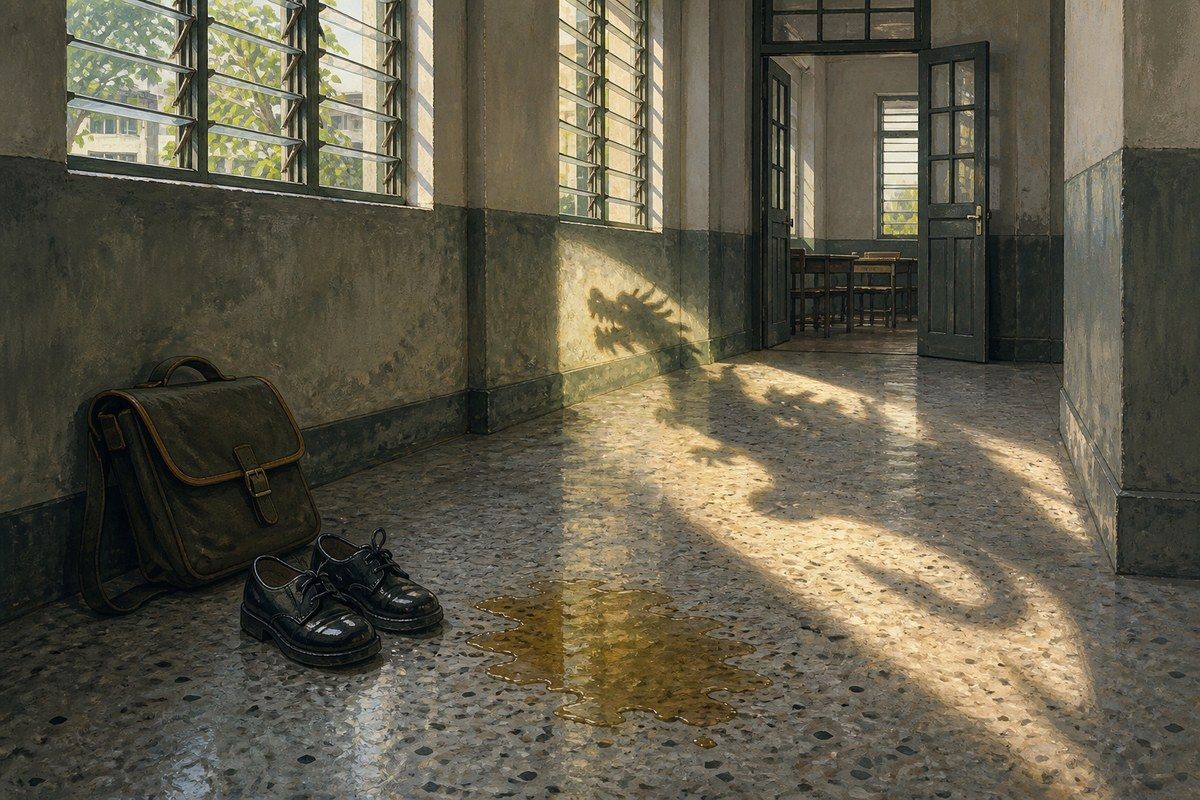
Because childhood is not one thing. It is not only the mango tree, the rain, the schoolbag, the para cricket match, the Durga Puja lights, the smell of new books. It is also fear, smallness, dependence, misunderstanding, and the terrible powerlessness of being young in a world run by people who themselves were improvising badly.
That is the part nostalgia edits out first.
It wants the taste without the toothache.
Still, I will not scold nostalgia too much. I am not made of stainless steel. Some evenings, when the city is tired and the sky looks like old aluminum, I too want the past to come and sit beside me. I want the child I was to return for ten minutes and explain how he managed to wake up every day without thinking of mortality, bank balance, blood sugar, and whether the world is being quietly eaten by billionaires, algorithms, wars, heat waves, and people on television shouting as if volume were evidence.
He would not understand the question.
That would be his gift.
He would ask instead whether there is something to eat.
That too is wisdom.
The child is gone, of course. Not in a tragic violin way. Gone in the ordinary way all our earlier selves are gone. They became us and then disappeared into the mixture. The ten-year-old did not die. He was folded into the fifteen-year-old, who was folded into the thirty-year-old, who was folded into this middle-aged man sitting under a fan, trying to write something honest without making it sound like a medical pamphlet or a funeral notice.
We are layered creatures.
Like an old wall in Calcutta with five colors of paint, two political slogans, one lost poster, and damp coming through from behind.
Scratch the surface and some earlier version appears.
Scratch too hard and plaster falls off.
So what should we do with childhood?
Remember it, but do not worship it.
Smile at it, but do not obey it.
Let it visit, but do not give it the house keys.
The past is allowed to be beautiful without being accurate. A song from childhood may still move you even if the singer was out of tune. An old lane may still matter even if it was dirty. A lost afternoon may still glow even if the glow was added later by a tired brain trying to comfort itself.
That does not make the memory useless.
It makes it human.
The mistake is not misremembering. Everyone misremembers. The mistake is building a temple on top of the misremembering and then charging yourself entry fee every evening.
You cannot go back to childhood.
You can only meet its ghost.
And if you are lucky, the ghost will not lecture you. It will arrive quietly, smelling of dust, rain, chalk, coconut oil, and cheap orange ice. It will sit beside you while the fan turns overhead and the city mutters outside. It will show you one small scene, not because the scene was perfectly true, but because some part of you still needs it.
Then it will run off around the corner.
Naturally, you will follow.
Naturally, you will be too late.
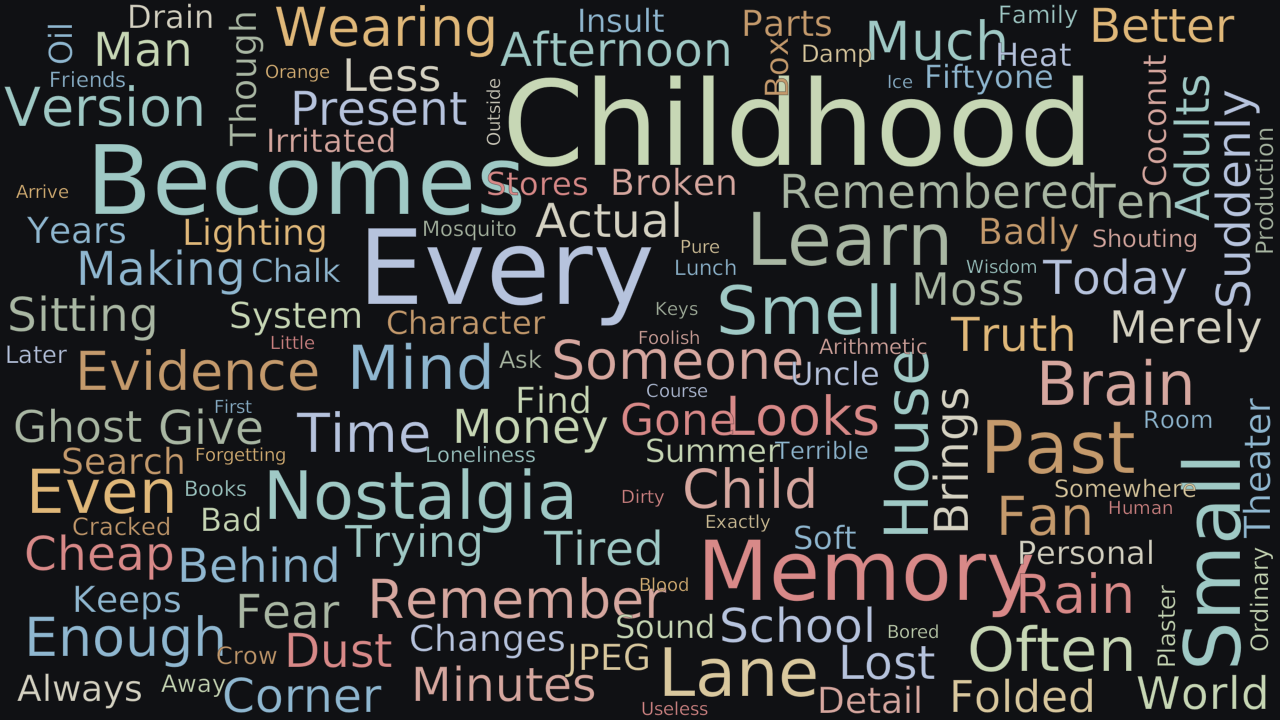
Word Cloud
Related reading
Selected by shared topics and section, with closer publication dates breaking ties.