The Bengali Baby
Uses the speech voice supplied by your browser or device.

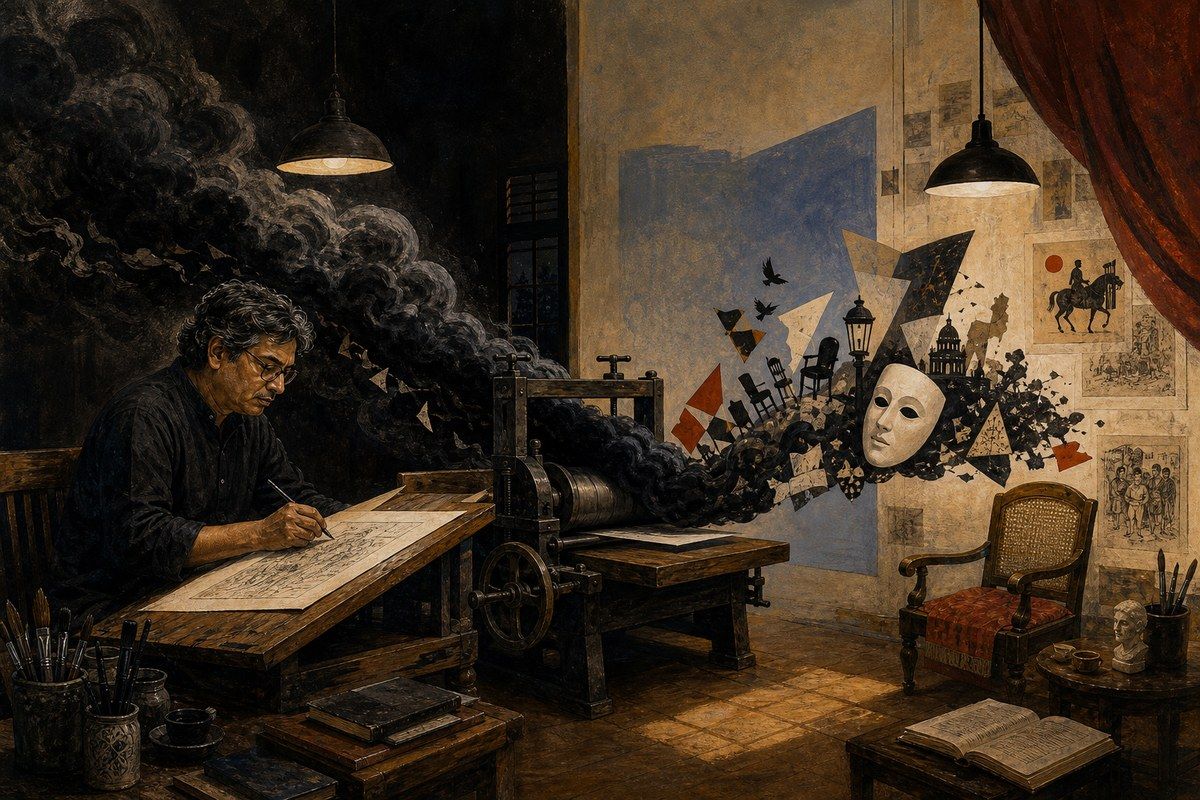
The afternoon sun in Calcutta does not set so much as bargain with the dirt in the air.
By four o’clock in winter, the city begins to look as if someone has poured honey over a black-and-white photograph. The edges sharpen. The wires become calligraphy. The water tanks on rooftops become small, ugly temples to municipal uncertainty. Even the broken walls acquire dignity. This is one of Calcutta’s cheaper miracles. We do not always get clean footpaths, drinkable drains, working promises, or public common sense, but once in a while the smog and the sun collaborate like two old criminals and produce beauty.
I watch it too long.
That is my weakness. Other men my age watch cricket scores, gold prices, blood sugar numbers, election gossip, apartment leaks, YouTube pundits shouting like pressure cookers. I watch the afternoon light until it turns the city into a silhouette and makes the world briefly forgivable.
Briefly.
The sun comes through the brown winter haze like an elderly relative who has walked across three neighborhoods to say something important and then forgotten what it was. It reaches my window after passing over buses, frying oil, damp clothes, half-built dreams, garbage fires, political flags, and the stubborn smell of a city that refuses both death and repair. By the time it reaches my eyes, it feels personal.
Not sentimental. Personal.
As if it knows I am here.
As if it knows the man standing in this small room at the fringe of Calcutta, fifty-one years old, single, lower-middle-class by arithmetic and downwardly mobile by temperament, with enough education to understand the trap and not enough money to buy a ladder. It knows the books. It knows the unpaid bills. It knows the years in America, the years back here, the consulting income that arrives like a shy guest and leaves like a pickpocket. It knows the private negotiations one conducts with despair while the neighbor’s mixer grinder screams through the wall.
One day, of course, the sun will come looking and I will not be at the window.
That sounds dramatic until you remember it is merely the most ordinary fact in the universe. Everyone leaves the window. The sun continues. It has practice. It has watched kings, fishmongers, philosophers, clerks, lovers, tax defaulters, poets, and people who forwarded motivational messages before breakfast. It is not easily shocked.
Still, I imagine it pausing.
Where is that fellow? The Bengali with the tired eyes. The one who stared at me as if I were a government office finally about to open.
Then it will move on and find another hopeless romantic. Bengal manufactures them in bulk. Give us one winter afternoon, one cracked balcony, one tea cup, one old song, and we will immediately begin discussing mortality with the seriousness of men who have misplaced both the rent receipt and the meaning of life.
Nature is odd that way. The part of it we can still touch asks nothing from us. A tree does not need our opinion. A cloud does not care whether we have wasted our talent. The sun does not ask if our career made sense. It simply appears, does its job, and leaves. If only we could learn that little trick.
But human beings are not built so cleanly. We are not trees. We are not clouds. We are small, argumentative bundles of memory and appetite, forever asking whether we matter in a world that continues to boil rice, sell fish, honk buses, and hold political meetings without our consent.
Some days the self feels like fiction.
Not a grand novel. More like a badly stapled local magazine printed on cheap paper. The “I” becomes suspicious. Who is this person I keep defending? Who authorized him? Why does he want so much from a world that clearly has other appointments?
You may know this feeling.
You stand in a room and suddenly the room seems more real than you. The chair is confident. The table has purpose. Even the plastic bucket knows what it is for. You, meanwhile, are standing there like a philosophical error in a lungi.
This is where language begins to fail. We say loneliness, but the word is too small. We say failure, but the word arrives wearing a clean shirt and does not smell of the thing. We say exile, but exile may happen without crossing a border. You can be exiled from money, from confidence, from your own generation, from the future you were promised by your marksheets, your parents, your teachers, and your foolish young self who thought talent was a kind of railway ticket.
It is not.
Talent is only a matchstick. Useful, yes. But the room must still have oxygen.
The deepest feelings are usually the least obedient. They refuse to stand still while we describe them. The moment we speak, they change shape. The moment we write, they put on borrowed clothes. This is why a stranger’s song can ambush us in the afternoon. Someone else writes one line, sings one phrase, and suddenly it has the smell of our own locked room. We enter that line like a house we once lived in.
Alienation is not special. Everyone has tasted it, the way everyone has tasted fever. But some people do not merely visit it. They rent there. They learn the local shops. They know which corner floods first when the rain comes.
Those are the people who write.
Or drink.
Or vanish.
Sometimes all three, depending on the season and the electricity bill.
That day I saw three planes climbing out of the Calcutta haze. They looked absurdly clean, silver and determined, like fish escaping a pond where everyone had been washing clothes, politics, and old resentments. I could not stop thinking that in a few months it might be me again, under another sky, in another country, looking at another sun.
Would that sun know me?
Would it arrive sharper, cleaner, less filtered by the brown soup of our winter air? Would it say, ah, you again, the Bengali who keeps trying to make life behave like an argument with structure? Or would I have to introduce myself from the beginning, like a provincial uncle at a foreign wedding, smiling too much and wondering where to keep his hands?
I have served the sentence given to me. That is not self-pity. That is bookkeeping.
On paper, I am a failure in several recognized formats. I do not have the polished success story. I do not have the large house, the correct car, the correct waistline, the correct cheerful lies. I have experience, education, memory, some stubborn skill, and a mind that still refuses to become furniture. This is not nothing, though the market often prices it like old newspaper.
People who know, know.
That sentence may sound vain. It is not. It is the last dry matchstick in a damp kitchen. Some people know effort when it has no audience. Some people know what it costs to think clearly in a place that rewards slogans, obedience, family theatre, and the moral flexibility of a wet biscuit. Some people know that not every ruin is caused by laziness. Some ruins are inherited. Some are engineered. Some are maintained lovingly by committees.
And Bengal, my Bengal, has become a committee of delay.
The tragedy is not simply that Bengal is poor. Poverty is brutal, but poverty can be fought. The deeper tragedy is that Bengal became frightened of adulthood. Once there was a creature here that read, argued, translated, invented, rebelled, sang, organized, and drove everyone mad in the magnificent way of a people who believed thought mattered. Not all of it was noble. Much of it was vain, quarrelsome, caste-ridden, class-ridden, and male in the tiresome way of old rooms full of old furniture. But there was motion. There was hunger. There was a tiger somewhere in the mind.
Now too often we meet the Bengali baby.
Not a sweet baby. Not a soft baby smelling of talcum powder and milk. A large, educated, sulking baby with a degree, a grievance, a political slogan, and a permanent excuse. A baby that wants progress without discipline, dignity without risk, prosperity without enterprise, culture without reading, revolution without courage, and comfort without responsibility.
A baby that cries because the diaper is wet but refuses to stand up.
This is not a pretty metaphor. Good. It is not a pretty condition.
We have learned the vocabulary of modern life while keeping the habits of dependency. We say development, but mean a flyover. We say culture, but mean nostalgia. We say politics, but mean tribal loyalty. We say intellectual life, but often mean three people agreeing loudly in a room where the fan is wobbling and the tea is overboiled.
Meanwhile, the world moves.
Not always wisely. Not always morally. But it moves.
The West, which we often use as a shiny shorthand for money, is misunderstood in Bengal with impressive consistency. It is not paradise. Anyone who has lived there knows the loneliness, the bills, the cold systems, the private exhaustion behind the clean pavements. But it has one thing we must study without either worship or resentment: many of its institutions have learned how to function even when the people inside them are mediocre.
That is civilization.
Not greatness. Function.
A society becomes livable not when everyone becomes noble, but when ordinary selfishness is fenced by rules, systems, shame, and consequences. The traffic light works not because people are saints. It works because enough people believe stopping is not optional. The line moves because the line is respected. The file is found because losing it has a cost. The pipe is repaired because water supply is not treated as a philosophical suggestion.
In Bengal we often admire the result but refuse the discipline that produced it. We want the clean city without the civic habit. We want the opportunity without the risk. We want the respect without the work. We want the airport but not the sewage map. We want the English sentence but not the difficult thought inside it.
This is why our progress looks itchy.
Like diaper rash.
A little red, a little swollen, loudly discussed, poorly treated, and somehow everyone’s fault except the baby’s.
I do not claim to know how to change Bengal. Any man who says he knows should first be handed one clogged lane drain, one local school committee, one hospital queue, one municipal counter, and one family WhatsApp group. If he survives those five laboratories, then perhaps we may permit him a speech.
Countries are not repaired by opinion. They are repaired by habits. By incentives. By shame. By competence. By boring continuity. By people who show up on Tuesday after making a promise on Monday. This last item is so rare in our public life that it should be declared a protected species.
What I do know is that we must first see clearly.
Not loudly. Clearly.
We must see through the decorated web of lies we have spun around ourselves. We must stop tuning the radio to the wrong station and then complaining that the song is bad. We must admit that some of what we call culture is fear wearing a silk kurta. Some of what we call caution is cowardice. Some of what we call ideology is laziness with a vocabulary. Some of what we call realism is merely surrender with better pronunciation.
This is not a call for rage. Rage is easy. Bengal has plenty. Rage is available wholesale, retail, and in family packs.
The harder thing is adulthood.
To say: yes, the world was unfair.
Then get up.
To say: yes, history damaged us.
Then repair one hinge.
To say: yes, the powerful lied.
Then stop lying to yourself.
That is where the Bengali baby starts screaming. Because self-pity is warm. Responsibility is cold. It touches the skin like December water from a municipal tap.
No one reads much of what I write. I say this without melodrama. It is merely a fact, like the price of onions or the sudden disappearance of a plumber after taking advance payment. The internet is full of men with urgent thoughts and almost no readers. I am one more candle in a city of power cuts.
Still, I write.
Not because I expect to change Bengal by posting an essay from a room on the edge of Calcutta. That would be a level of optimism requiring medical supervision. I write because silence has its own cost. I write because if I do not put the thought somewhere, it begins roaming inside me like a stray dog in a closed market.
I write because I have tried.
I have failed.
Then I have tried again.
There is dignity in that, even if it does not trend.
The sun, meanwhile, keeps teaching the same lesson with insulting simplicity. Twilight here is not the death of light. It is light arriving somewhere else. The same sun that leaves my window goes on to touch another wall, another country, another pair of eyes waiting for rescue and receiving instead a golden reminder: move.
That is the small mercy hidden inside physics.
Somewhere, evening is not ending. Somewhere, morning is beginning. Somewhere, the light is new.
So perhaps the goal is not to win in the dramatic way young men imagine winning. No trumpet. No grand return. No balcony scene. No garland. Perhaps the goal is smaller and harder: do not give up while choice remains. Keep thinking. Keep working. Keep leaving the baby’s cot. Keep refusing the comfortable nap of helplessness.
And if one winter afternoon the sun comes through the brown Calcutta haze and does not find me at this window, let it not be because I disappeared into defeat.
Let it be because I finally moved.
Word Cloud
Related reading
Selected by shared topics and section, with closer publication dates breaking ties.