The Machine Can Explain Everything Except How I Get Paid
Uses the speech voice supplied by your browser or device.

The machine can explain everything except how I get paid, which is a neat trick, because payment is the one miracle I would actually like to see performed without incense, PowerPoint, and a committee of men who say “circle back” while backing away from the circle. I sit in Calcutta with a laptop glowing like a pocket-sized Veda, and it will hand me regression diagnostics, database schemas, Sanskrit roots, legal clauses, medical ontology jargon, a website skeleton, a business plan, a poem, a proof, a diagnosis-adjacent explanation, and the etymology of “etymology” if I ask nicely and pretend not to notice the little digital smirk. It is a very good student of civilization. It has swallowed the library, digested the syllabus, and burped up footnotes. And yet, when I ask it how Tuesday afternoon becomes ₹5,000, it becomes suddenly spiritual, like a monk who has taken a vow of poverty and wants me to admire the vow.
This is the part nobody puts on the brochure. Brochures prefer thunder. They say transformation, disruption, acceleration, intelligence, scale, leverage, the future arriving early with its shoes off and its invoices hidden. I have heard all that choir music. I have also heard my own bank account clear its throat with the delicacy of a ruptured tuba. The strange historical moment is not that the machine knows so much. The strange historical moment is that I can know more than I knew when I was salaried in America and still be economically weaker than a wet paper lantern in a monsoon gutter. Knowledge has become abundant. Access to the person who signs the cheque remains a feudal romance.
There is a Bengali expression, roughly the sort of thing one mutters while watching relatives discuss property, that a full stomach makes a fine philosopher but an empty wallet makes a theologian of despair. I will translate more politely than my ancestors deserve: understanding is not income. I can ask the machine to explain backpropagation, Bayesian updating, ICD-10 hierarchies, FHIR resources, SQL normalization, contract boilerplate, or why my last business proposal had all the erotic charge of a damp affidavit, and it will comply with the tireless obedience of a butler who has read too much. But the machine cannot introduce me to the procurement officer. It cannot make the client stop treating “exposure” as a currency accepted by landlords. It cannot transform my cleverness into cash unless the old greasy machinery of trust, reputation, timing, proximity, and shameless acquaintance decides to rotate in my favor.
People love to say knowledge work will be replaced, as if knowledge were ever the whole economy. Knowledge was the visible tip. The iceberg beneath was customers, distribution, permission, capital, contracts, favors, memory, and the sacred art of being in the room when the room decides. The economy has always run less on truth than on introductions. This is not cynicism. This is plumbing. I have worked in healthcare research through enough spreadsheets to know that the most sophisticated model in the world still dies politely when the data owner says no, when the IRB drags its feet, when the budget line migrates to a vice president’s nephew, or when the “stakeholder” discovers a sudden religious objection to paying for the thing he requested in three meetings and a dream. Intelligence is cheap now. Access remains handcrafted.
And oh, how the machine flatters me. It says, “You are building a compelling offering.” It says, “This positioning is strong.” It says, “Your differentiated expertise could address a valuable niche.” Wonderful. I feel like a man being complimented on his bone structure by a vulture. The compliments are not false; they are merely useless in the specific way that a map is useless to a man on fire. I can generate a consulting framework before my tea cools. I can produce a deck, a prototype, a memo, a market map, a taxonomy, a risk register, a pitch, a poem, a limerick about procurement, and a five-year plan with the oily confidence of a man who has never met a payroll. The machine gives me the sword, the shield, the saddle, the strategy, the slogan, and the ceremonial trumpet. It does not give me the war. It does not even give me a battlefield with decent drainage.
The etymology here is almost insulting. English “consult” came through French consulter from Latin consultare, to deliberate, take counsel, consider carefully, itself a frequentative form of consulere, to take counsel or deliberate. How dignified. How marble-bust. How completely innocent of the modern reality in which advice is abundant and payment is a rumor circulated by optimists. For most of history, specialized counsel came with friction. Books and records were harder to obtain, communication moved slowly, travel moved slower, and expertise often had to be carried from place to place inside an actual human being, presumably with hemorrhoids. Now counsel is a subscription service, and the sacred relic has been digitized, compressed, and served with autocomplete. The scarcity moved. It packed its bags in the night and went to live where it always lived: near power, near budgets, near people who can say yes and make the yes stick.
I do not say this to weep into my keyboard. I say it because the truth has a habit of standing naked in the doorway while everyone else is discussing curtains. AI may democratize expertise while doing almost nothing to democratize access to buyers. That sentence should be printed on the wall of every co-working space where men with laptops drink coffee and call themselves ecosystems. AI-assisted expertise is beginning to resemble a public utility. Buyers remain a private club with a dress code written in invisible ink. The scarce resource of the AI economy may not be intelligence at all. Intelligence is becoming cheap, cheerful, and everywhere, like plastic bags in the wind. The valuable things may be the old things, only more so: trust, relationships, capital, distribution, permission, reputation, timing, and the ancient art of being remembered by the right person on the right afternoon.
There is a verse in the Hitopadeśa, that splendid old warehouse of practical cynicism, which makes a nastier and more interesting point than the usual sermon against money: renounce the thirst for wealth and the distinction between pauper and lord begins to lose its power; let the thirst run loose and you become its servant. Charming. Very ascetic. Very easy to say when the rent has not arrived wearing the face of a landlord. I prefer the other lesson hiding in the same tradition: artha matters. Not as greed, but as gravity. A man may have ideas like monsoon clouds, but clouds do not pay bills unless they break over somebody’s field. And fields, I notice, tend to belong to people.
So I sit here, absurdly empowered and absurdly broke, a Calcutta man with American work scars and a laptop full of genies. I can diagnose a data model before breakfast. I can sketch a healthcare architecture before lunch. I can explain a paper, rewrite a proposal, generate code, interrogate a concept, and still end the day with the same question rattling around my skull like a coin in a beggar’s bowl: who pays, when, and why should they pay me rather than the other clever bastard glowing in the dark across town? The machine can explain everything except that. It can tell me how the world works. It cannot make the world hire me. It can illuminate the staircase. It cannot climb it for me, and it certainly cannot stop the landlord from standing at the bottom asking whether I have considered “value-based invoicing.”
Perhaps that is the real education. Not that intelligence is power, but that intelligence was never the whole of power. The rest is contact, memory, trust, and the grim comedy of human preference. The machine has swallowed the encyclopedia. The wallet remains on a hunger strike. And I, bilingual in Bengali and bad luck, educated in America and uneducated in the local art of getting paid, remain here between the two, laughing the laugh of a man who understands everything except the invoice.
P.S. References: the Hitopadeśa; Latin lexicography, for the respectable etymology; general observation of procurement behavior; and my own bank statement, which remains the most brutal realist in the room.
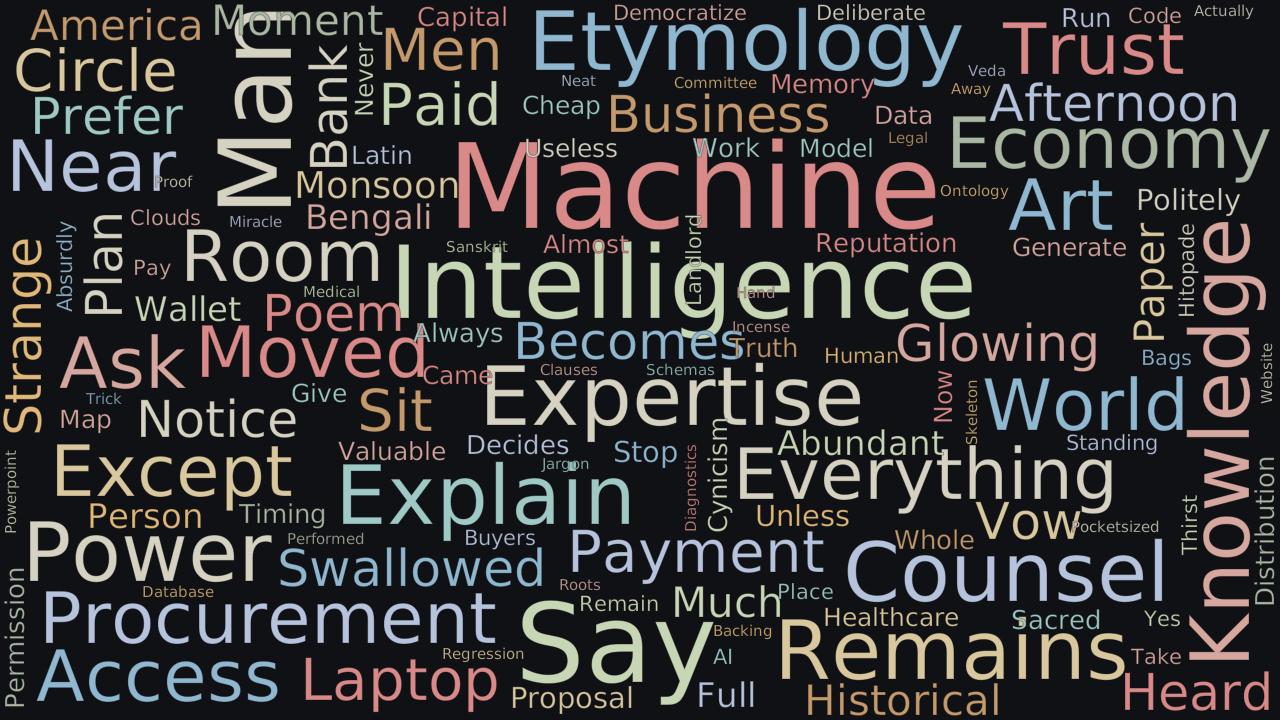
Word Cloud
Related reading
Selected by shared topics and section, with closer publication dates breaking ties.