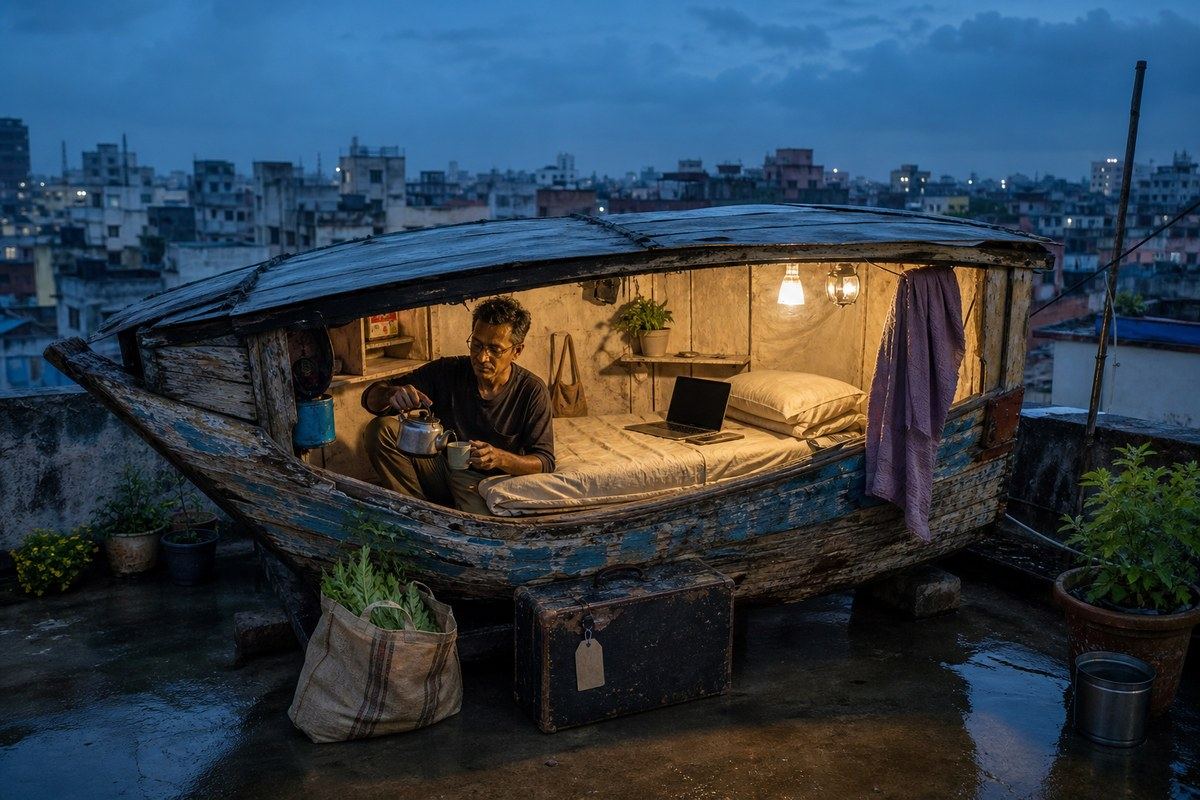
The year on the calendar can be the same while the world outside the window is entirely different. Follow two ribbons across an ocean: Calcutta on one side, America on the other, and twenty years passing between them.
Two calendars.
One life.
Calcutta & America
THE SAME YEARS.DIFFERENT WORLDS.
Time passed everywhere.
It did not feel the same everywhere.
1947Meanwhile…
CalcuttaBengal · India
15 August 1947
India · Bengal divided · Citizenship
Freedom, with a border through Bengal
India became independent as British India was partitioned. The Independence Act divided Bengal into East and West Bengal, placing the provinces within different dominions. The new national calendar therefore began with both political freedom and a frontier through a shared region.
This date marks India’s independence and the Act’s appointed day; it does not compress Partition’s consequences into one day.
AmericaCities · States · A nation
15 April 1947
Brooklyn, New York · Major League Baseball · Belonging
Number 42 steps onto the field
Jackie Robinson debuted for the Brooklyn Dodgers, breaking Major League Baseball’s modern colour barrier. He faced hostility as well as public attention. A change within one immensely visible American institution became a civil-rights milestone; it did not mean the country’s other barriers had disappeared.
In the same year, India became independent through Partition and Robinson crossed a colour barrier in Brooklyn. Their scale, causes and consequences differ. The shared-year thread asks what a public breakthrough changes, and which barriers remain outside its reach.
Every dot opens a record. Threads show labelled comparisons; they do not establish causation. The day grid is a calendar motif, not a count of events.
History happens
in the plural.
Five ways through the calendars.
Scroll to follow a different thread.
CALCUTTA / INDIAFreedom, with a border through Bengal15 August 1947
UNITED STATESNumber 42 steps onto the field15 April 1947
The war reaches the table
What does “wartime” ask of an ordinary day?
A global war enters local routines through service, a damaged street, a shopping list, the search for food. The ribbons share a chronology, but their burdens cannot be weighed as equivalents. Follow a thread between American rationing and hunger visible in Calcutta; read the gap as carefully as the connection.
1943
Hunger arrives in the city
A US diplomatic memorandum described starving villagers reaching Calcutta and people dying in its streets.
Read record & sources ↗1943
A ration book beside the shopping list
Food rationing and the war, a 1943 government pamphlet, explained a system that had entered household routines.
Read record & sources ↗The shape of freedom
A new border. An old barrier crossed.
Pause in 1947. India becomes independent through Partition; in Brooklyn, Jackie Robinson enters the Major Leagues. These are not versions of the same event. Together they ask a more useful question: how does a public breakthrough reach the people who must live on the other side of it?
15 August 1947
Freedom, with a border through Bengal
India became independent as British India was partitioned.
Read record & sources ↗15 April 1947
Number 42 steps onto the field
Jackie Robinson debuted for the Brooklyn Dodgers, breaking Major League Baseball’s modern colour barrier.
Read record & sources ↗A future under construction
Plans become institutions; people cross the ribbons.
The new decades take material form: a republic, classrooms, elections, plans for a river valley. Compare public commitments without treating an enactment as an accomplished future. Then follow the one thread that is a documented encounter: Ray and Renoir’s work around the making of The River.
27 March 1948
A river valley becomes a public project
The Damodar Valley Corporation Act provided a legal framework for developing a valley shared by West Bengal and Bihar.
Read record & sources ↗22 June 1944
A postwar future is written into law
The GI Bill offered veterans education, unemployment and housing support while the war was still being fought.
Read record & sources ↗The public and the intimate
Who enters a classroom, a house, a screen?
Law reaches the school gate and the family home. Moving images give domestic life another public form: Lucy’s fictional household, Apu’s rural family. Some threads cross several years because they compare ideas. Their labelled dates keep resemblance from becoming a false claim of simultaneity.
26 January 1950
A republic’s calendar begins
India’s Constitution came into force and the country became a sovereign democratic republic.
Read record & sources ↗17 May 1954
The school gate becomes a constitutional line
In Brown v.
Read record & sources ↗More than one rhythm
History is also made at the scale of attention.
The decade closes with a space agency and another state on the American map. It also closes with a film about the work of loving and a jazz record that gives distinct voices room. Select a year, inspect what this small atlas includes, and make a postcard of one encounter.
1959
A marriage, a room, a whole world
Apur Sansar completed Ray’s Apu trilogy.
Read record & sources ↗1959
Another way of inhabiting time
Miles Davis’s Kind of Blue was recorded and released in 1959.
Read record & sources ↗A small postcard.
Two whole worlds.
Your selected records, their actual dates, and the thread between them. A small piece of this atlas to keep or pass along.
Change the year or comparison ↑1600 × 1000 · Sources included · Replayable selection

Two Calendars, One Life · 1947: a year in two worlds. Calcutta / India — 15 August 1947: Freedom, with a border through Bengal. America — 15 April 1947: Number 42 steps onto the field. Shared time: In the same year, India became independent through Partition and Robinson crossed a colour barrier in Brooklyn. Their scale, causes and consequences differ. The shared-year thread asks what a public breakthrough changes, and which barriers remain outside its reach. https://suvroghosh.in/blog/visualizations/two-calendars-one-life?year=1947
The evidence
behind the threads.
A selective atlas, with an open notebook.
Sources & selection 35 references ↗
This is a curated comparison of 1940–1959, not a complete account of either place. Each record identifies its geographic scope. A city, a region and a country are different scales of experience.
The shared axis uses civil dates, months and years. Point-date precision, documented duration and uncertainty are distinct. Thematic threads are editorial comparisons; a documented link requires supporting evidence. Gaps mean no record was included.
All skyline drawings are original schematic illustrations. Calendar grids are visual motifs. No archival images, fabricated clock times or private family records are used.
- Nobel Foundation / Nobel PrizeRabindranath Tagore — Biographical ↗
Nobel Lectures, Literature 1901–1967, edited by Horst Frenz, 1969; death date and range of work.
- Imperial War MuseumsIndian Movietone News No. 9 (INR 9) ↗
Production date: February 1943. Item VI and Tom Rice’s catalogue analysis distinguish propaganda from evidence.
- Ministry of Tourism, Government of IndiaHowrah Bridge ↗
History section gives the inauguration date, 3 February 1943.
- US Department of State, Office of the HistorianMemorandum from Wallace Murray to the War Commodities Division, 28 August 1943 ↗
Foreign Relations of the United States, 1943, volume IV, document 337, pp. 297–298. A contemporary diplomatic report, not a complete explanation of famine causes.
- The National Archives, UKCalcutta riots, part one ↗
Contemporary colonial account of violence on 16–17 August 1946. Its language and viewpoint require critical reading.
- UK Parliament / The National ArchivesIndian Independence Act 1947, original text ↗
Printed pp. 1–3, sections 1–3: appointed day, new dominions and division of Bengal.
- SatyajitRay.orgCalcutta Film Society ↗
The 1947 founding, early screenings and the circulation of Hollywood films in Calcutta.
- India Code, Legislative DepartmentThe Damodar Valley Corporation Act, 1948 ↗
Act 14 of 1948; enactment 27 March 1948. This record marks the law, not completion of the valley works.
- Society for the Preservation of Satyajit Ray ArchivesSatyajit Ray: Script Writer ↗
Opening paragraphs date Renoir’s location scouting and Ray’s involvement to 1949.
- Supreme Court of IndiaHistory of the Supreme Court of India ↗
The Constitution came into force on 26 January 1950; the Court’s ceremonial inauguration followed on 28 January.
- Indian Institute of Technology KharagpurHistory of IIT Kharagpur ↗
Formal inauguration: 18 August 1951. The institution began in 1950; its first academic session began in August 1951.
- Election Commission of IndiaECI Atlas: First General Election, 1951–52 ↗
Printed p. 86 (viewer p. 104); Lok Sabha and state assembly elections, 1951–52. The interval is deliberately year-level.
- British Film InstitutePather Panchali (1955) ↗
Production year, adaptation, rural setting and the emergence of Calcutta-centred art cinema.
- India Code, Legislative DepartmentThe Hindu Succession Act, 1956 ↗
Printed p. 3: enactment date and purpose. The linked consolidated text includes later amendments; those are not attributed to 1956.
- British Film InstituteThe World of Apu (Apur Sansar): programme notes ↗
Pages 1–3 discuss the fictional family; p. 4 gives India, 1959. The plot is not a record of events in 1959.
- US National ArchivesSelective Service Records ↗
Historical background dates the first US peacetime draft to 1940.
- US National ArchivesExecutive Order 8802: Prohibition of Discrimination in the Defense Industry ↗
Original order dated 25 June 1941, with context on A. Philip Randolph’s organising and limits of enforcement.
- US National Park Service, World War II MemorialPearl Harbor ↗
Japanese attack on 7 December 1941 in the then US Territory of Hawaii.
- US National ArchivesExecutive Order 9066: Resulting in Japanese-American Incarceration ↗
Order dated 19 February 1942; context distinguishes the order’s wording from its discriminatory implementation.
- Library of Congress“Rationing Safeguards Your Share” ↗
Library research on ration books, consumer goods and public education, with digitised wartime examples.
- US Office of War Information / Library of CongressFood rationing and the war (1943) ↗
Contemporary publication by Elmer Davis. The date is the publication year, not a single day of rationing.
- US National ArchivesServicemen’s Readjustment Act (1944) ↗
22 June 1944; educational and housing benefits, with explicit discussion of discrimination faced by Black veterans.
- US Government Publishing OfficePublic Law 483, 79th Congress: naturalisation and admission ↗
60 Stat. 416, 2 July 1946: racial eligibility for naturalisation. Commonly called the Luce–Celler Act.
- US Government Publishing OfficePublic Law 483, continuation: immigration quota ↗
60 Stat. 417, section 4: immigration from India remained allocated to a quota.
- Library of CongressJackie Robinson breaks the color line ↗
Major League debut for the Brooklyn Dodgers on 15 April 1947; the Library specifies the modern-era context.
- US National Park ServiceMissouri: The Shelley House ↗
Shelley v. Kraemer, 3 May 1948: courts could not enforce racially restrictive housing covenants; the ruling did not erase housing discrimination.
- British Film InstituteThe River (1951) ↗
The BFI identifies the film as USA, 1951, and describes its Indian location shoot and British-family viewpoint.
- The Film FoundationThe River: restoration screening resource guide ↗
Documents Renoir’s friendship with Ray during location scouting in Calcutta.
- Library of CongressI Love Lucy: An American Legend ↗
Exhibition overview: first broadcast on 15 October 1951; performers, production and recording for reruns.
- US National ArchivesBrown v. Board of Education (1954) ↗
Opinion dated 17 May 1954. The contextual essay discusses subsequent resistance and Brown II.
- Library of CongressThe Bus Boycott — Rosa Parks: In Her Own Words ↗
Parks’s arrest on 1 December 1955 and the organising context of the Montgomery boycott.
- US Federal Highway AdministrationHistory of the Eisenhower Interstate System ↗
The 29 June 1956 law authorised a 41,000-mile network; authorisation is distinct from construction and completion.
- NASA, Johnson Space CenterNASA begins operations ↗
NASA began operating on 1 October 1958, after the July legislation that created it.
- US National Archives, Center for Legislative ArchivesHawaii Statehood, August 21, 1959 ↗
Statehood records include the Queen’s earlier protest against annexation, supporting a reading attentive to contested sovereignty.
- Library of Congress, National Recording Registry“Kind of Blue” — Miles Davis (1959) ↗
George Grella Jr.’s Registry essay, pp. 1–2: the 1959 recording and release, modal approach and the different voices of the ensemble.
Read all historical records 32 records ↓
Peacetime acquires a draft
United States · federal policy · War
The Selective Training and Service Act created the first peacetime military draft in US history. Before the country formally entered the war, the federal government was already organising men for service. A calendar of work and family could now also contain military obligations.
A poet’s life ends; the work stays
Calcutta · Bengali cultural life · Culture
Rabindranath Tagore died on 7 August. Poetry was only part of his life’s work: songs, fiction, drama, painting and an experimental school also belonged to it. This calendar begins with a cultural inheritance, as well as a war.
The right to a wartime job is contested
United States · defence employment · Work
After pressure from A. Philip Randolph and other Black leaders, Roosevelt prohibited discrimination in defence employment and created a Fair Employment Practice Committee. Wartime job creation did not automatically make work equally accessible; organised demands helped force a federal response.
The order and its enforcement were different things; the National Archives discusses the committee’s limited reach.
A Sunday becomes a national rupture
Pearl Harbor, Territory of Hawaii · War
Japan attacked the US naval base at Pearl Harbor, in the then Territory of Hawaii. The following day Roosevelt asked Congress for a declaration of war. The Pacific conflict entered American public life through a particular place that was not yet a state.
Citizenship fails to protect a home
US West Coast · Japanese American communities · Belonging
Executive Order 9066 authorised military exclusions and led to the forced removal and incarceration of Japanese Americans. Families lost liberty, homes and property; many of those confined were US citizens. The wartime home front included state-imposed dispossession as well as shared mobilisation.
This is the order’s date. Removal, confinement and losses occurred over subsequent months and years.
A camera shows the city after raids
Calcutta · wartime newsreel · War
A government-sponsored newsreel showed Calcutta after Japanese air raids: damaged buildings, repairs and traffic resuming. Its reassuring account was an attempt to shape wartime feeling. The museum’s catalogue asks us to read that confidence as propaganda, rather than a complete portrait of the city.
February 1943 dates production of the newsreel; it is not the date of the first air raid.
A new way across the Hooghly
Calcutta–Howrah · Hooghly crossing · Movement
The new Howrah Bridge opened across the Hooghly, replacing the earlier pontoon crossing between Howrah and Calcutta. A structure now inseparable from the city’s image entered everyday use in the middle of wartime. Infrastructure and catastrophe occupy the same year.
Hunger arrives in the city
Bengal · famine visible in Calcutta · Food
A US diplomatic memorandum described starving villagers reaching Calcutta and people dying in its streets. It urged consideration of rice relief. The document makes hunger visible inside wartime official correspondence, while leaving the famine’s larger causes and human experience beyond a single report.
A year-level famine record. The supporting memorandum is dated 28 August; no single day contains the catastrophe.
A ration book beside the shopping list
United States · household rationing · Food
Food rationing and the war, a 1943 government pamphlet, explained a system that had entered household routines. Coupons accompanied purchases of goods such as sugar, coffee and meat. Managing wartime supply became a task carried out at the shop counter and in the kitchen.
The year belongs to the pamphlet. Rationing began earlier and did not create conditions equivalent to the Bengal famine.
A postwar future is written into law
United States · returning veterans · Home
The GI Bill offered veterans education, unemployment and housing support while the war was still being fought. It widened opportunities for millions, but discriminatory lending and housing practices obstructed many Black veterans. The promise of a home depended on who could actually obtain the benefit.
Neighbours become vulnerable
Calcutta · neighbourhood violence · Belonging
Communal violence spread through Calcutta in August. A contemporary account preserved by the National Archives describes attacks on Hindu and Muslim residents and the difficulty of reaching affected streets. Its colonial vocabulary also reminds us that an official witness never supplies the whole history.
Month-level selection; the cited account describes 16–17 August. It is not an estimate of the full death toll.
A narrow door to naturalisation opens
United States · immigrants from India and the Philippines · Citizenship
The law commonly called Luce–Celler removed a racial barrier to naturalisation for people of Indian and Filipino origin. Immigration from India still operated through a quota. The statute opened a route to citizenship while preserving the wider system’s restrictions on entry.
A change in legal eligibility, not automatic citizenship and not unrestricted immigration.
Freedom, with a border through Bengal
India · Bengal divided · Citizenship
India became independent as British India was partitioned. The Independence Act divided Bengal into East and West Bengal, placing the provinces within different dominions. The new national calendar therefore began with both political freedom and a frontier through a shared region.
This date marks India’s independence and the Act’s appointed day; it does not compress Partition’s consequences into one day.
A room for watching the world
Calcutta · film society · Culture
Satyajit Ray and friends co-founded the Calcutta Film Society. Their first screening was Battleship Potemkin. Hollywood films were also circulating in the city. Watching, discussing and writing about cinema became part of Calcutta’s own creative life, rather than merely an encounter with distant entertainment.
Number 42 steps onto the field
Brooklyn, New York · Major League Baseball · Belonging
Jackie Robinson debuted for the Brooklyn Dodgers, breaking Major League Baseball’s modern colour barrier. He faced hostility as well as public attention. A change within one immensely visible American institution became a civil-rights milestone; it did not mean the country’s other barriers had disappeared.
A river valley becomes a public project
West Bengal and Bihar · national legislation · Work
The Damodar Valley Corporation Act provided a legal framework for developing a valley shared by West Bengal and Bihar. In the new state, rivers and regional development were subjects of public planning. This mark records a legislative commitment, before the work of construction.
Enactment date of the Act; the corporation’s establishment and completion of individual projects have separate dates.
A family contests the boundary of home
St Louis, Missouri · US Supreme Court · Home
The Shelley family’s fight over a St Louis home reached the Supreme Court. In Shelley v. Kraemer, it ruled that courts could not enforce racially restrictive housing covenants. A property dispute became a constitutional question about who could live where.
The ruling barred court enforcement of the covenants; it did not itself eliminate private housing discrimination.
Ray meets Renoir in Calcutta
Calcutta · international film encounter · Culture
Jean Renoir came to Calcutta to scout locations for The River. Ray accompanied him. The Ray Archives Society describes the encounter as strengthening Ray’s resolve to become a filmmaker: a specific exchange of people and ideas across the apparently separate ribbons.
A republic’s calendar begins
India · constitutional change · Citizenship
India’s Constitution came into force and the country became a sovereign democratic republic. The Supreme Court came into existence that day; its ceremonial inauguration followed two days later. Constitutional institutions gave independence a new legal structure, with a continuing life beyond the founding ceremony.
A former detention camp, a new classroom
Kharagpur, West Bengal · technical education · Education
IIT Kharagpur was formally inaugurated at Hijli. Its first academic session began that August with classrooms and laboratories in the former detention camp. An institution initially based in Calcutta made technical education part of the region’s post-independence ambitions.
The inauguration was in 1951; the institute’s organisational beginnings were in 1950.
Democracy takes more than a day
India · national and state elections · Citizenship
India’s first general elections extended across 1951–52. Voters elected the Lok Sabha and state assemblies through a vast common exercise. The Election Commission’s account places 489 parliamentary seats and about 3,283 assembly seats within that first electoral undertaking.
A documented duration shown at year precision. The outer year boundaries express the source’s precision; polling did not continue on every day of both years.
An American production looks towards Bengal
US-produced cinema · filmed in Bengal · Culture
Jean Renoir’s The River, classified by the BFI as a US film, was shot entirely in India. Its coming-of-age story followed a British family beside the river. An American production context, a French director and Indian locations came together in one film.
Placed on the American ribbon for production context; the filming took place in India and the viewpoint is that of a British household.
A fictional household enters the living room
United States · television broadcast · Culture
I Love Lucy began broadcasting, with Lucille Ball and Desi Arnaz playing Lucy and Ricky Ricardo. Filming before a studio audience also made reruns possible. A carefully constructed domestic world could return to viewers again and again, becoming part of television’s shared cultural memory.
A programme’s debut, not evidence that every US household owned a television or resembled the Ricardos.
The school gate becomes a constitutional line
United States · public school segregation · Education
In Brown v. Board of Education, the Supreme Court held state-imposed racial segregation in public schools unconstitutional. The unanimous ruling changed the legal foundation of schooling. Resistance and the later struggle over implementation meant that a judgment’s date and a child’s experience could remain far apart.
Ordinary life fills the cinema
Bengal · Calcutta-centred filmmaking · Culture
Ray’s first feature, Pather Panchali, followed a rural Bengali family through discovery, pleasure and loss. Adapted from Bibhutibhushan Bandopadhyay, it helped establish a Calcutta-centred art cinema. The small incidents of a family’s life could carry the scale of a film.
The production/release year is the historical record; the fictional family is not a representative survey of Bengal in 1955.
A bus ride becomes a public stand
Montgomery, Alabama · segregated transport · Movement
Rosa Parks was arrested after refusing to surrender her bus seat to a white passenger. Her action came within an existing civil-rights organising community and helped set the Montgomery boycott in motion. Everyday transport was a place where unequal citizenship was imposed and challenged.
Family property enters a new legal chapter
India · communities covered by Hindu personal law · Home
The Hindu Succession Act recast the law of inheritance when a person died without a will. The family home and other property were matters of statute as well as custom. Its defined personal-law coverage must not be mistaken for one inheritance law for every Indian.
The linked text contains later amendments. This record makes no claim that later equal coparcenary rights already existed in 1956.
Distance gets a federal blueprint
United States · interstate highway programme · Movement
Eisenhower signed the Federal-Aid Highway Act, authorising a 41,000-mile interstate network. The country committed to a new scale of road infrastructure. This point marks a decision about future movement, rather than the day on which a completed system suddenly appeared.
The horizon becomes an institution
United States · civilian space programme · Work
NASA began operations, bringing the existing National Advisory Committee for Aeronautics into a new civilian space agency. Its establishment followed legislation signed in July. The space programme’s future was being assembled through laboratories, staff and administrative decisions before its better-known journeys.
A marriage, a room, a whole world
Bengal · a film about family life · Culture
Apur Sansar completed Ray’s Apu trilogy. A young writer’s marriage, grief and relationship with his son provided its intimate scale. Alongside public histories, cinema preserved another way of imagining a life: through affection, responsibility and the difficult work of returning to others.
1959 is the film’s year, not the date of the fictional events it depicts.
The map acquires a fiftieth state
Hawaii · US statehood · Citizenship
Hawaii became the fiftieth US state. The National Archives preserves records of the long statehood campaign alongside Queen Liliuokalani’s earlier protest against American annexation. The date changes a national map while inviting attention to the different meanings of belonging and sovereignty within it.
Another way of inhabiting time
United States · recorded jazz · Culture
Miles Davis’s Kind of Blue was recorded and released in 1959. Its exploration of modal jazz gave distinct musical voices room within a shared recording. The Registry essay treats it as a particular artistic moment, rather than the single direction of American music.
Year-level record; this experience includes no audio playback or unlicensed album artwork.
Published · Updated
Checking article narration…
How to read the threads
Begin with a chapter, or choose a year and follow what the atlas has selected on either side. Every record carries a place and a date at the precision its evidence supports. Open its sources to follow the claim back to the archive.
A thread is an invitation to look across. Shared time places records beside one another in a common period. Thematic comparison is an editorial pairing. A documented relationship requires evidence of an actual connection. The first two do not quietly become the third.
Calcutta is the centre of the left ribbon; Bengal and India enter as explicitly named context. The American ribbon identifies national, state or city scope where appropriate. These are selected windows into lived worlds. Empty space records a gap in this selection.
Dates have edges
The common spine uses Gregorian chronology. A precise day, a month, a year and a documented span make different claims. An event known only to a year has broader date precision; it has not thereby continued from January to December. Uncertainty about a date is separate from the duration of an event.
The historical edition makes comparisons at the resolution the sources allow. It does not manufacture an hour of the day, or apply a modern time-zone offset to an earlier period. A postcard preserves the precision and relationship of its selected comparison. Its caption belongs to that evidence.
A life need not become a dataset
This edition is history, not an invented memoir. A future Calcutta–Texas edition could follow publicly chosen personal memories across the same instant, but that would require the author’s explicit choices about what belongs in public. A marriage, a hospital shift, an illness or a period of silence is never owed to a visualization.
Here, the calendars offer a smaller invitation: pause inside a year, look across, and notice how much a date can hold.
Quick reference and FAQ
Two ribbons follow the same twenty years in Calcutta and the United States. Their threads let you compare historical moments while keeping the dates, places and evidence visible. Sharing a year does not mean sharing an experience, and a comparison does not establish a cause.
Key Terms
- Chronology
- Historical context
- Date precision
- Duration
- Thematic comparison
- Primary source
- Geographic scope
Frequently asked questions
Is this an autobiography?
This edition is a historical comparison of 1940–1959. It does not invent a personal life or imply that its author witnessed these years.
Do connected events cause one another?
A thread has an explicit meaning: shared time, an editorial thematic comparison, or a documented relationship. Sharing a date or theme alone is not evidence of causation.
Does every mark represent an exact date?
No. Records retain day, month or year precision, and documented durations remain distinct from uncertain dates. The atlas does not invent clock times or turn a year-only date into a year-long event.
Does the American ribbon represent every American experience?
No. Each record identifies its geographic scope. A local example is a local example; neither ribbon is a complete account of everyone who lived there.
Can I read it without JavaScript?
Yes. The opening comparison, historical records, explanations and source links are server-rendered. JavaScript adds selection, scroll-linked emphasis and downloadable postcards.
Word Cloud
Related reading
Selected by shared topics and section, with closer publication dates breaking ties.