The Sacred Circle-Jerk of Model Version Numbers
Uses the speech voice supplied by your browser or device.

Here is a thing I have noticed, and I notice it with the same queasy fascination with which one watches a street dog in Calcutta discover a half-rotted hilsa head and proceed to roll in it with operatic abandon: the internet has become a colosseum where grown humans, presumably in possession of opposable thumbs and the frontal lobe capacity to operate a toaster without swallowing the fork, compete with one another over which large language model has the bigger, throbbing, more numerically impressive parameter count. It is not enough that these models exist, that they do things, that they sometimes fail to do things, that they hallucinate citations with the same breezy confidence of a PhD candidate who has not read the paper. No. What is required, what is demanded, what is ejaculated across every platform from the bowels of LinkedIn to the septic tank of X, is a performance of filial devotion so cloying, so stomach-turning, so utterly bereft of critical faculty that I find myself wondering whether the entire species has collectively decided that the frontal cortex was, on balance, a bit of a bother and best left to the pigeons.
I scroll, and I see them. The influencers. The thought leaders. The people who have, in some cosmic joke I am not privy to, been granted the authority to tell me that Claude 4.5 Sonnet Whatever-The-Blazes is “absolutely crushing it” on some benchmark that was designed by a team of researchers who have not seen sunlight since the Obama administration, and I think: crushing what, exactly? A grape? My will to live? The last vestige of my faith that human beings might, under certain conditions, choose not to behave like rhesus monkeys fighting over a juice dispenser?
And the version numbers! Oh, the version numbers. They multiply like amoebas in a petri dish left too long in the Calcutta humidity. 3.5, 4, 4o, 4o-mini, 4.5, 5, 5-pro, 5-ultra, 5-ultra-pro-max-turbo-xtreme. Each one heralded with the solemnity of a papal encyclical, each one accompanied by screenshots of responses that prove absolutely nothing to anyone who has spent more than twelve minutes actually using these things, each one followed by a comments section that reads like the transcript of a support group for people who have mistaken brand loyalty for personality. “Gemini absolutely destroyed GPT on this coding task,” writes someone whose entire understanding of software engineering consists of asking ChatGPT to write Python scripts that print “Hello World” in increasingly baroque fonts. “No, Claude is clearly the winner here,” replies another, and I can practically hear the spittle hitting their screen through the wifi. Winner of what? A race to the bottom of a barrel that has no floor?
The etymology of “benchmark,” since I promised myself I would drag at least one word through the mud of its origins, comes from the surveyor’s mark, a chiseled horizontal line in stone used as a reference point for measuring altitude. From the Old English “benc” (bench) and “mearc” (mark). A thing of stone. A thing of permanence. A thing that did not change every fourteen days because a marketing department in Menlo Park decided that what the world really needed was another decimal point. We have taken this word, this solid Anglo-Saxon thing, and we have stretched it over frameworks so contrived, so gerrymandered, so obviously designed to make Product A look better than Product B that the word itself has become a kind of intellectual fraud, a semantic sock puppet worn by corporations who want you to believe that their particular arrangement of matrix multiplications represents a quantum leap in human understanding rather than what it actually is: a slightly different arrangement of matrix multiplications, trained on slightly different slurry of the internet’s collective unconscious, producing slightly different flavors of confident-sounding gibberish.
But here is what truly pickles my prunes, what really sends my colon into spasms of existential dread: the simultaneous, the concurrent, the perfectly synchronized existence of two narratives that should, by all rights, annihilate each other like matter and antimatter. On one side, the hype. The utopia. The “this changes everything” chorus, sung by people who have apparently never read a history book and do not realize that “this changes everything” has been the rallying cry of every technological huckster since the invention of the electric corset. On the other side, the doom. The “AI will kill us all” brigade, the people who have watched one too many episodes of Black Mirror and decided that the appropriate response to a statistical language model is to stockpile canned goods and learn which mushrooms are safe to eat in the post-apocalyptic wasteland. And these two groups, these two armies of the credulous and the paranoid, they do not cancel each other out. They do not look at each other and say, “Well, if it’s going to save humanity AND destroy humanity, perhaps we should examine our premises.” No. They coexist. They intermingle. They are, in many cases, the exact same people, posting “wow, this new model is incredible, the future is here” at 9 AM and “we need to pause AI development before it’s too late” at 9:15, and I am left staring at my screen with the same expression I wear when I discover that the fish curry I ordered has been garnished with a cockroach that is, itself, garnished with a smaller cockroach.
What are we doing? What are we actually doing? We are gaslighting each other into believing that the most important question facing humanity is whether Model A scores 0.3% higher on some benchmark named after a mathematician whose work none of us have read, while the actual, the tangible, the pressing issues of our time—the Pareto distribution of wealth that has turned every economy into a K-shaped horror show, the unhinged, the gleeful, the almost erotic firing of human workers by executives who could not explain what a neural network is if you held a gun to their stock options, the slow erosion of basic human rights in everyday situations that makes the Universe 25 experiment look less like a cautionary tale and more like a weather forecast—we discuss these things, when we discuss them at all, with the same energy we reserve for commenting on the weather. “Oh, yes, terrible about the layoffs, anyway have you seen what Gemini can do with PDFs now?”
Universe 25, for those who have not had the pleasure of this particular nightmare, was John B. Calhoun’s behavioral sink experiment, where mice placed in a utopia of unlimited resources eventually collapsed into violence, withdrawal, and extinction not from scarcity but from overcrowding, from social stratification, from the breakdown of normal behavior in a world that had technically solved all material problems. The beautiful ones, he called them—the mice who withdrew completely, who groomed themselves obsessively, who refused to mate, who died alone in corners while the world around them rotted. I look at the comment sections, I look at the influencer feeds, I look at the endless, the infinite, the cosmically tedious debate over which model is “best,” and I see the beautiful ones. I see us. Grooming our digital fur while the cage fills with our own waste.
And the influencers, the influencers with their infantile tests, their “I asked ChatGPT to write a poem about a blockchain and it was AMAZING” posts, their incoherent drivel that mistakes verbosity for insight, their constant, their unceasing, their almost religious need to treat every minor software update as if it were the Second Coming filtered through a TED Talk—they are not stupid, not all of them, though God knows there is enough stupidity to fill the Howrah Bridge and still have enough left over to pave the EM Bypass. No, many of them are smart, which is worse, because smart people performing stupidity for an audience of the stupider is a spectacle that makes me want to swallow my own teeth. They know. They must know. They must, on some level, understand that they are participating in a circus where the lions have been replaced by spreadsheets and the ringmaster is a venture capitalist who has never written a line of code but has very strong opinions about “the future.” But they do it anyway, because the algorithm rewards it, because the engagement metrics demand it, because in the economy of attention, which is the only economy that matters to anyone under thirty anymore, sincerity is a liability and performative enthusiasm is the only currency that spends.
I am tired. I am so tired. I am tired in my bones, in my teeth, in the spaces between my neurons where the dopamine used to live before it got evicted by the constant, the unrelenting, the deliberately engineered anxiety of watching human beings treat software updates like religious schisms. I have bipolar type II, which means I am professionally, clinically, medically familiar with the experience of one’s own brain manufacturing crises that do not exist, and let me tell you: the AI discourse has the same energy. The same breathless urgency. The same conviction that THIS THING, this specific thing happening RIGHT NOW, is the most important thing that has ever happened or will ever happen, and if you are not paying attention, if you are not panicking, if you are not pivoting, if you are not learning to code or learning to prompt or learning to whatever-the-hell the verb of the week is, then you are missing out, you are being left behind, you are the dinosaur watching the asteroid with a bemused expression while the mammals scurry past with their little mammalian briefcases.
But here is the secret, the thing no one wants to say because it does not generate clicks, the thing that sits at the bottom of this particular barrel like a truth so ugly we have all agreed to pretend it is not there: the world is not going to change drastically. The world is also not going to not change. What is going to happen is what always happens. The rich will get richer. The poor will get poorer. A few people will make a lot of money. A lot of people will lose their jobs. Some new jobs will be created. Some old jobs will be destroyed. The technology will be used for good things and bad things and mostly mediocre things that no one will remember in ten years. And the influencers will have moved on to the next thing, the next version number, the next thing to be breathlessly excited about and then breathlessly afraid of, because that is the business model, that is the grift, that is the perpetual motion machine of modern discourse where the product is anxiety and the customer is you, and me, and everyone we know, scrolling endlessly through a feed that feeds on us.
So stop. Please. For the love of whatever deity or statistical process you worship. Stop treating these models like they are your children competing in a talent show. Stop pretending that your preference for Claude over Gemini or Gemini over GPT or GPT over whatever comes next is a personality trait rather than a consumer choice roughly equivalent to preferring Coke over Pepsi. Stop gaslighting each other. Stop gaslighting yourself. The models are tools. They are interesting tools. They are sometimes useful tools. They are also, frequently, tools that confidently tell you things that are not true, that reproduce the biases of their training data, that consume energy at a rate that would make a Bangladeshi sweatshop owner blush. They are not saviors. They are not demons. They are software. And the sooner we remember that software is something we are supposed to use rather than worship, the sooner we might actually get around to addressing the things that are real: the hunger, the precarity, the slow collapse of the social contract, the beautiful ones grooming themselves in corners while the cage fills with waste.
The Sanskrit has a word, “maya,” माया, which does not simply mean illusion but the power by which the world is brought into apparent existence, the magic show that is so convincing you forget it is a show. The influencers are maya. The benchmarks are maya. The version numbers, multiplying like bacteria in warm milk, are maya. The whole goddamn circus is maya, and we are the audience who has forgotten we bought tickets, who has forgotten there is an outside, who sits in our seats applauding the shadows on the cave wall while the fire burns down to embers and the cave fills with smoke.
I am going to make some tea now. The old kind, the kind that requires boiling water and leaves and patience, none of which can be optimized by a large language model. I am going to sit on my balcony in Calcutta, where the humidity has turned the air into something you could spread on toast, and I am going to watch the crows fight over garbage, which is at least an honest competition, unbenchmarked, unbranded, un-influenced. The crows do not pretend that the garbage is a paradigm shift. They do not write threads about how the 2026 garbage is absolutely crushing the 2025 garbage on the rot-per-bite metric. They just eat, and fight, and fly away, and shit on things from a great height, which is, when you think about it, a more dignified response to existence than anything I have seen on LinkedIn this week.
P.S. Calhoun, J. B. (1962). “Population density and social pathology.” Scientific American, 206(2), 139-148. Read it. Weep. Then go outside.
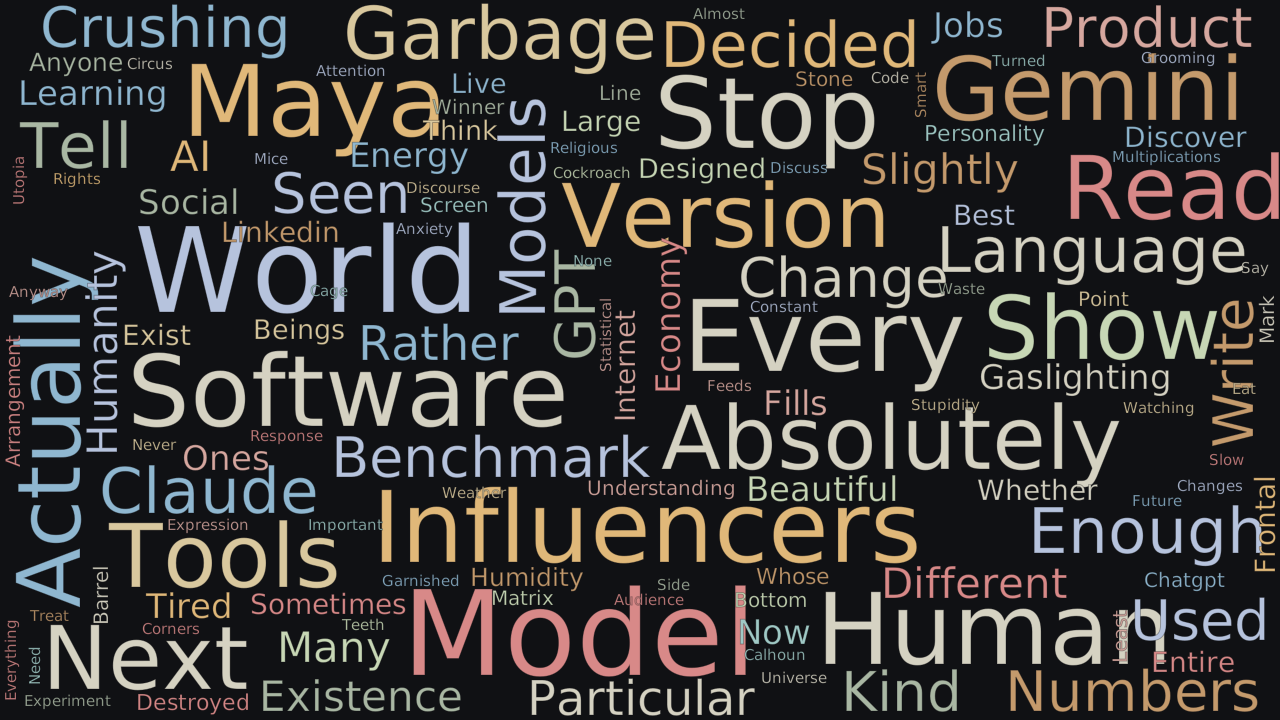
Word Cloud
Related reading
Selected by shared topics and section, with closer publication dates breaking ties.