Show It How to Swallow
Checking article narration…

THIS IS A WORK OF FICTION
The robot fed me a spoonful of rice, and something under my tongue tried to chew it.
I felt individual teeth through the soft floor of my mouth. Small ones. They worked sideways, squeezing a little lump of flesh between them.
Across the table, Nila checked the recording.
“Swallow normally.”
I needed Bikram to release my salary before lunch. I had already asked twice that morning. Asking a third time while explaining that another mouth had started eating inside mine seemed unlikely to help.
I swallowed.
The chewing stopped.
On Nila’s screen, a green check appeared beside DEMONSTRATION ACCEPTED.
Six days earlier, our household robot had begun leaving water on the floor.
It used a steel spoon. Three spoonfuls beside the refrigerator, then three beside the kitchen door. Afterward it laid a few grains of rice on its left palm and waited.
Bikram thought it was wonderful.
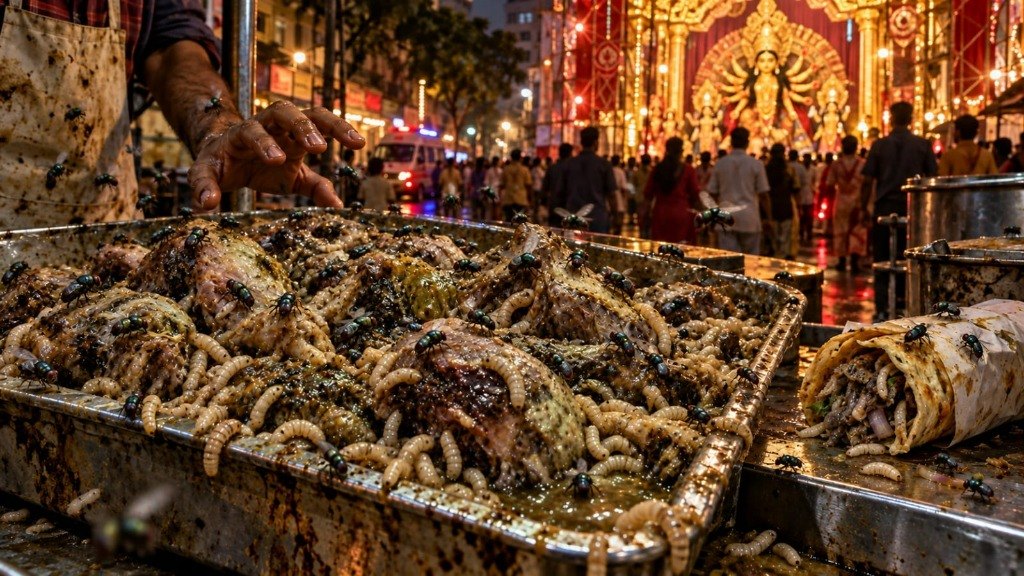
We were building a robot for elderly people who lived alone. We had trained it on Bengali folktales, donated family videos, and recordings bought from cassette shops around Calcutta. People telling stories. Grandmothers explaining recipes. Weddings. A man teaching his grandson to eat fish without swallowing the bones.
We wanted it to recognize the ordinary, untidy ways people asked for help.
The water looked like something from a religious ritual. Nobody had labeled that behavior. Nobody could find a matching sequence in the footage.
Then it spoke in a woman’s voice.
“Lift the washing platform. My mouth is against the drain.”
Bikram replayed it eleven times.
A hallucination, he said. Some combination of the folktales and the household footage.
The robot gave us an address in Behala. It specified the second-floor bathroom and a green plastic hair clip pressed into the dead woman’s cheek.
Nila called the police from the stairwell because Bikram told her not to use the company phone.
They found a woman beneath the washing platform.
The clip was green.
Her sister identified the voice. The woman had disappeared in 1997, before anyone in the family owned a video camera.
The inspector wanted to know how we knew her.
We gave him copies of everything.
The second voice belonged to a man.
He described a bricked-up space beneath a staircase in a shuttered printing shop. He said his right hand had been tied behind his back, but his left hand was near his mouth.
“Don’t pull the fingers straight,” he said.
The police found him that way.
By then the inspector had stopped saying prank. He asked us to leave the machine switched off until he returned.
Bikram agreed.
After the police left, he switched it back on.
There was an investor demonstration scheduled for Friday. Three salaries were overdue. Rent was overdue. The robot itself belonged partly to a lender who called twice a day.
I could have walked out.
Instead, I asked whether we were still getting paid on Friday.
Bikram said yes, provided we had something working to show.
I stayed. I am not going to improve that decision for you now.
The voices only appeared during teaching mode.
For ordinary tasks, you could give the robot an instruction. For something delicate, you guided its wrist while it recorded the movement. Once, while Nila showed it how to wipe a cup without breaking the handle, the man beneath the staircase asked whether somebody could turn his head.
Bikram disconnected the microphone.
The man kept talking through the speaker.
We searched the recordings again. We searched transcripts and file names. We checked the old tapes against the digitized versions.
Neither voice was there.
The woman gave her name as Manju Pal.
She kept asking for warm food.
“I can’t work my mouth,” she said.
The robot had a speaker behind a grille. It had no mouth to work.
We thought that was the error.
That Friday, we were testing assisted feeding.
I volunteered because Bikram was irritated with me about the money, and I wanted him less irritated.
The robot brought the spoon toward my lips. Its other hand rested lightly against my throat.
That contact was new.
“Is it supposed to do that?” Nila asked.
“Maybe checking the swallow,” Bikram said.
There was no throat sensor in the hand. I knew that. I had helped install the fingers.
But the pressure was gentle, and the rice was warm, and for several seconds it was the first thing that had gone properly all week.
Then the teeth began.
After I swallowed, I smiled at Nila so she would keep recording.
A rotten taste spread beneath my tongue.
I asked for a bathroom break.
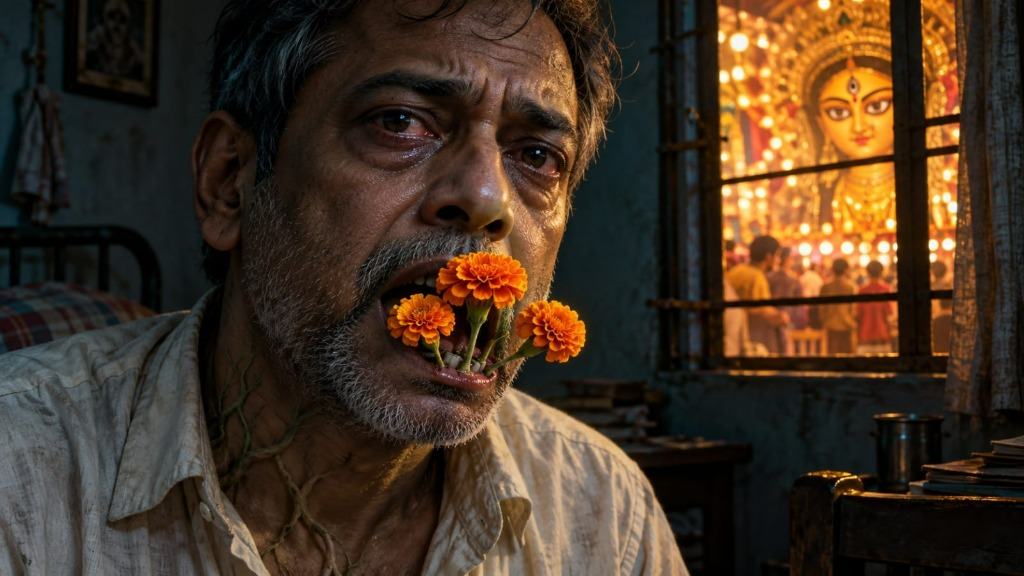
Our bathroom had a mirror fixed too high above the sink. I stood on my toes and opened my mouth.
My tongue was sitting on a swollen ridge.
I lifted it.
Below it, where there should have been a thin fold of wet pink tissue, was a curved strip of gray gum. Three brown teeth stuck out of it.
One was chewing.
It caught a little flap beneath my tongue and pulled.
I made a noise I had never heard myself make before. I put a finger into my mouth, then another, trying to separate the teeth. The gum felt cold and soft. My fingertip went through it.
The smell came out immediately.
Not bad breath. It smelled like the liquid beneath spoiled chicken.
Something slipped against my finger. A tooth came loose with a long piece of tissue attached.
I dropped it into the sink.
From the kitchen, Bikram called, “We need you back.”
I turned the faucet on hard.
For a moment I felt relieved that he hadn’t heard me.
That was what I was doing. Standing over a tooth that had grown beneath my tongue, grateful I had managed not to embarrass myself.
Nila saw the blood on my collar.
She followed me into the bathroom and locked the door.
By then the ridge beneath my tongue had flattened. The extra teeth were gone.
So were my lower teeth.
There were teeth in their place, but the front two leaned inward. One had a black cavity large enough to admit a grain of rice.
I touched the back molar on the right.
The crown I had paid for in installments was missing.
Nila looked into my mouth. She didn’t say anything for several seconds.
Then she called an ambulance.
While she was giving the address, my phone rang.
The inspector.
He wanted to know whether anyone on our team had access to the morgue.
“Why?”
“The woman’s mouth has changed.”
I watched Nila’s face while he described it.
Fresh gum tissue. A complete lower row of teeth. A metal crown on the right.
The morgue attendant had thought somebody had put a dental model inside her mouth.
Then the woman had bitten him.
We cut the power.
The robot stopped immediately. Its spoon hung over the plate.
My new lower jaw sagged.
Until then, something had been holding it up. Without that support, the weight pulled on the skin beneath my chin. I caught it with both hands.
My fingers pressed through my cheeks onto bone.
Nila shouted for Bikram to bring a towel.
He brought paper towels.
I remember being furious about that. We had real towels in the drawer. I was trying to hold my face together and he was peeling individual sheets off a roll.
Nila plugged the robot back in.
My jaw lifted into place.
I could breathe again.
Through the speaker, Manju said, “Don’t stop halfway.”
The ambulance dispatcher called back. The driver was caught behind a stalled bus.
Nila told them I had a severe injury to my mouth.
She did not mention the woman at the morgue.
Then she started removing the bandage from her left hand.
I had noticed it that morning. She had said she caught a finger in a drawer.
Under the gauze, her index finger bent backward at the middle joint. The nail was thick and yellow. The skin looked soaked, although the bandage was dry.
She had helped the robot turn its palm upward two days earlier.
The man beneath the staircase had thanked her.
“I thought it was an infection,” she said.
She pulled at the gauze.
It took the skin off the finger.
She kept pulling for another inch before she understood what was happening.
Bikram reached for her wrist. She screamed at him not to touch her.
The exposed finger was almost white. A dark tendon moved along it.
From the robot came the man’s voice.
“Please. That one’s finished. I need the others.”
The robot was placing rice on its left palm again.
Three spoonfuls of water went onto the floor.
We had watched this for nearly a week without checking what happened before and after it.
Nila opened the session recordings.
Each ritual came before a request for physical guidance.
Hold the wrist.
Support the elbow.
Touch the throat.
The green checks weren’t appearing when the robot completed a movement.
They appeared when we did.
On Tuesday, Nila had tried to withdraw her hand.
The man’s voice had said, “Again. That wasn’t right.”
She had repeated the movement until he approved it.
I remembered laughing when she complained about our new supervisor.
I could hear myself laughing on the recording.
Bikram asked Manju what she wanted.
“My mouth was packed,” she said.
“Who packed it?”
“My husband. He said the smell was coming through the floor.”
The inspector had told us about the cloth found in her throat. We had assumed her husband used it to kill her.
Manju described hearing him replace the tiles afterward.
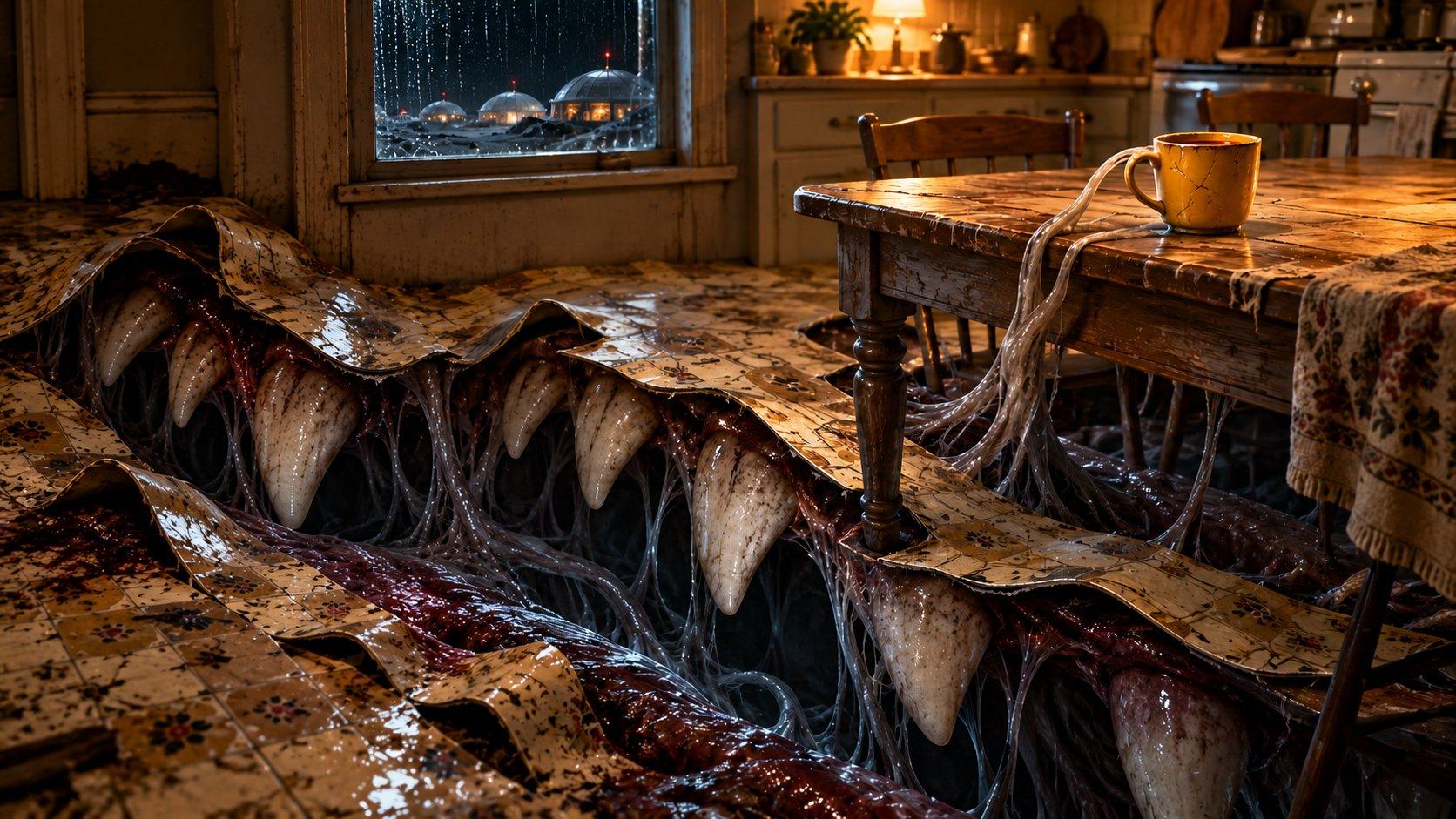
She described the washing machine installed above her. Its drain hose leaked. Sometimes water reached her face.
For twenty-nine years, she had been unable to close her mouth.
Nila pressed the heel of her good hand into her eye.
“Were you alive?”
“I don’t know what you want me to call it.”
The robot lifted the spoon.
“Show me the next part.”
Bikram backed away.
“You’re using us.”
“I need to swallow,” Manju said.
My throat tightened.
Bikram offered to demonstrate instead.
For one stupid second I loved him.
He sat opposite the robot and opened his mouth.
It waited.
He guided its wrist toward his neck.
Nothing happened.
Then my dead jaw pulled sideways so hard I felt something tear below my ear.
Manju spoke through the speaker and through my open mouth. The sounds reached us at slightly different times.
“Not you. Him.”
Bikram let go.
Blood ran into my shirt.
I tried to hold the wound shut. My fingers slid beneath the edge of my jaw, into a pocket that should not have existed. There was something soft in there. When I withdrew my hand, a piece remained between my fingers.
Nila fetched the real towels.
The robot sat with its spoon raised.
It could have waited all afternoon.
The inspector called again.
I put him on speaker because I could no longer hold the phone and my face at the same time.
He asked who had put an identification bracelet on Manju.
Nobody answered.
It was my hospital bracelet, from a minor procedure three years earlier. I had a scar around the base of my thumb where a broken glass had cut me as a teenager.
He described that too.
I looked at my wrist.
Brown spots were appearing under the skin. The little scar was gone.
The transfer had continued while we talked.
“What is happening here?” the inspector asked.
I tried to tell him.
My tongue pushed against the wrong teeth. I couldn’t form the words clearly enough.
Beside me, Nila’s remaining fingernails began lifting from their beds.
Bikram tried to take the robot’s spoon.
Its grip tightened. Nothing more. He could not pull it free.
He tried the wrist release.
The hand detached.
The spoon stayed upright in the disconnected fingers.
Bikram set it down very carefully.
Manju asked me to continue.
I shook my head.
My jaw dropped again.
This time the soft tissue beneath it split. I felt hot blood run over cold gums. My tongue slid forward and I caught it against my upper teeth.
The robot waited.
I nodded.
It supported my throat.
The bleeding slowed.
Nila was on the floor, holding her ruined hand against her chest. She looked up at me and said, “Don’t.”
I wanted her to tell me what to do instead.
She couldn’t.
There were two instructions left on the screen.
One was to swallow.
The other was to demonstrate a full breath.
I swallowed the rice.
It scraped across something rough deep in my throat. A strip of cloth came up into my mouth, thick with old fluid.
The robot removed it.
It kept pulling after I thought there could not possibly be any more.
Knots passed behind my tongue. Each one made my whole body jerk.
I tried to catch the cloth. The robot moved my hand away.
Finally the last knot came free.
I breathed in.
My chest did not rise.
Somewhere through the inspector’s phone, a woman began coughing.
He dropped the phone. I heard metal hit the floor.
My body folded beneath the table.
I could still feel everything.
My cheek against the tile. My tongue resting on the loose lower teeth. Fluid collecting where my throat should have closed.
Bikram covered me with the towel.
I wanted him to take it off. The wet fabric stuck to my nostrils.
When I asked, my voice came from the robot.
Bikram backed into the counter.
Nila started crying.
I told them where I was, although they had just put me there.
Under the kitchen table. Head toward the refrigerator. The towel over my face.
I needed somebody to move it.
Then I understood why the voices had been so exact.
The paramedics arrived four minutes later.
Bikram was in the stairwell. Nila had stopped answering questions.
The younger paramedic found me under the table.
He pulled the towel away and recoiled. Then he came back. He was trying to do his job.
I felt his fingers against my neck.
Warm fingers. Clean nails.
My mouth hurt so badly that I could not think past it.
Through the robot, I told him I could help explain what had happened.
He turned toward the speaker.
I told him the machine needed a human demonstration.
He came closer.
I asked him to open his mouth.
Word Cloud
Related reading
Selected by shared topics and section, with closer publication dates breaking ties.