The Lumpy Edge of Bijon Setu
Checking article narration…

Two miniature humans, one slightly taller and already practicing the arithmetic of disappointment, the other a compact unit of unprocessed carbohydrates and glandular naivety, stand fossilized in the sepia-toned gastrointestinal tract of nineteen-seventy-something Ballygunge, where the mama bari loomed like an architectural eructation in the otherwise dignified face of afternoon, and I involuntarily regurgitate—not remember, remembering is too voluntary, too muscularly optimistic—I involuntarily regurgitate the sensation of the lumpy edge of Bijon Setu rising in the distance like a concrete tumescence of municipal ambition, back when my excitement was a simple endocrine secretion, unmediated by the subsequent decades of cortisol and comprehension, back when the bridge was merely a bridge and not yet a monument to the exact geometry of sorrow, because of course the same artifact, that identical lumpy suppository spanning the wetlands, would later induce in me a melancholy so precisely calibrated it could have been manufactured by Sony, who, speaking of corporate colonoscopy, have just announced they will cease manufacturing physical optical discs by January 2028, which means my future grief will have no tangible substrate, no polycarbonate corpse to clutch when the digital cloud inevitably flatulates and loses my saved games, much like the bus rides from South Sinthee have long since evaporated into the thermodynamic disorder of memory, those buses that were crowded hot smelly and uncomfortable in a way that now seems almost erotically specific, an olfactory fingerprint of collective Calcutta suffering that no air-conditioned lie can replicate, and I wonder, not with the idle curiosity of a well-adjusted actuary but with the obsessive-compulsive granularity of a man who counts his own teeth when anxious, what exactly was transpiring in those early years after I was born, in the city country and world I was too small and too naive to archive, too busy being a biological accident with a pulse, and now of course I can reconstruct it from the records, the newspapers, the epidemiological data, the way the Bangladesh measles outbreak has presently tallied eight hundred nineteen dead children, a statistic that sits in my stomach like a half-digested egg, because numbers are the only reliable form of haunting, unlike the exomoon they just discovered orbiting brown dwarf CD-35 2722 B, which is simultaneously a triumph of human instrumentation and a reminder that we are looking for habitable satellites while systematically rendering our own uninhabitable, much like the Tokyo heat wave that hospitalized four hundred fifty-three people yesterday, their bodies becoming involuntary testimonials to atmospheric vengeance, and I think of the Bijon Setu again, that lumpy edge, because bridges are essentially arguments between two shores that never get resolved, they just hold their breath while traffic crosses, and my childhood excitement was nothing more than a pre-linguistic misunderstanding of structural engineering, the erotic charge of concrete and rebar before I knew that everything concrete eventually cracks, everything rebar eventually rusts, everything excitement eventually metastasizes into its opposite, which is not sadness exactly but a more viscous substance, the emotional equivalent of what the Americans are currently experiencing with their cyclosporiasis outbreak, eight thousand one hundred cases in Michigan alone, caused by Cyclospora cayetanensis, a parasite that sounds like a rejected Roman emperor and behaves with the same imperial disregard for intestinal boundaries, and I feel a kinship with those infected Americans, not out of solidarity but out of recognition, because we are all hosting something that multiplies in the warm dark of our interiors, something that will eventually announce itself at the most socially inconvenient moment possible.
The bus, though. The bus from South Sinthee. I need to stay with the bus, or rather the bus needs to stay with me, because memory is not a file you retrieve but a stench that retrieves you, and the stench of those buses was a complex chord of armpit, diesel, fried batter, and the particular ammoniac desperation of a city that has always had more people than dignity, and we stood there in Ballygunge, the smaller hand in mine, practicing for a lifetime of failed grips, while the mama bari watched with the indifferent patience of a building that knows it will outlast all its inhabitants, exotic only in the way that repetition becomes exotic, the way a word loses meaning when repeated until it becomes a phonetic tumor, “bari bari bari,” house house house, until the concept collapses under the weight of its own acoustics, much like the Fields Medal was just awarded to Hong Wang, the third woman in history, a fact that should feel like progress but instead feels like a mathematical anomaly, a decimal point in the long division of patriarchy, and I wonder if she ever stood on a bridge in her childhood, excited by its lumpy edge, before mathematics taught her that edges are never truly lumpy, only approximations of smoothness at sufficient distance, and distance, that is the real parasite, the Cyclospora cayetanensis of consciousness, multiplying in the small intestine of the past, causing the watery diarrhea of nostalgia, which is not the sweetened tea that advertisers sell but a more urgent expulsion, a gastric betrayal that leaves you dehydrated and embarrassed in the bathroom of your own skull.
I was too small. That is the refrain. Too small to know that the world was already ending in slow motion, that 1977 or 1978 or whichever arbitrary orbit we occupied was simultaneously the apex and the nadir, depending on which coordinate system you apply, and now at fifty-one I apply all coordinate systems simultaneously, a Cartesian grid superimposed on a Vedic horoscope, a GPS signal lost in the Howrah Station underpass, because being bipolar means never having to say you’re consistent, it means the bridge is exciting and sad at the exact same voltage, the bus is comfort and assault in the same inhalation, and the mama bari is both sanctuary and prison, the architectural equivalent of a mother tongue that you can never fully leave nor fully inhabit, and I think of the Google litigation in Sweden, where they were ordered to pay 1.5 billion dollars for favoring their own price comparison service, which is just capitalism performing its own rectal exam in public, a grotesque theater of corporate self-fondling that would be hilarious if it weren’t precisely the same algorithm that decides what I remember and what I forget, what rises to the lumpy edge of my attention and what sinks into the South Sinthee of my unconscious, and I am angry, not the hot anger of youth but the lukewarm, room-temperature anger of middle age, the kind that has settled like sediment in a forgotten teacup, and I want to scream but my scream has been auto-tuned by decades of Bengali propriety into a sort of nasal whine, a high-frequency emission that only dogs and ex-wives can hear.
The photograph continues to exist and the two children continue to stand there, holding hands, practicing for a lifetime of failed grips, and the Bijon Setu continues to be lumpy, continues to excite and sadden in alternating currents, and I continue to reconstruct, from the records, from the news of Iranian blockades and French wildfires and the International Criminal Court dropping charges like a clumsy waiter, I continue to reconstruct a childhood I never actually possessed, only borrowed from the photographic evidence, the way one borrows a library book and then refuses to return it out of spite, and the late fees accumulate in the currency of insomnia, and the librarian of my conscience makes threatening phone calls that I ignore while watching the ceiling fan perform its lazy autopsy of the afternoon, and I realize, with the sudden clarity of a man who has just stepped in warm animal matter on a Calcutta sidewalk, that the bridge was never the point, the bus was never the point, the mama bari was never the point, the point was the space between the two figures, the electromagnetic field of not-yet-disappointment that surrounded their joined hands, a field that has now collapsed into the singularity of middle-aged recognition, and I am left with nothing but the records, the statistics, the eight hundred nineteen measles dead, the four hundred fifty-three heatstroke victims, the 1.5 billion dollar judgment, the third woman Fields medalist, the exomoon that will never know we looked at it, and the lumpy edge of a bridge that I will never cross again because the person who wanted to cross it has been replaced by this man, this fifty-one-year-old Bengali container of gastric acid and footnotes, standing in a different doorway, in a different decade, watching the same afternoon light perform the same indifferent surgery on the same walls, and somewhere a bus pulls away from South Sinthee, crowded and hot and smelly and uncomfortable, and I am not on it, and I am also always on it, a perpetual passenger in the municipal transport of my own deterioration, and the conductor is asking for a ticket I cannot produce, and the other passengers are staring with the polite but murderous indifference of Calcutta commuters, and the lumpy edge of the bridge rises in the distance like a question that I am too small, still too small, to answer.
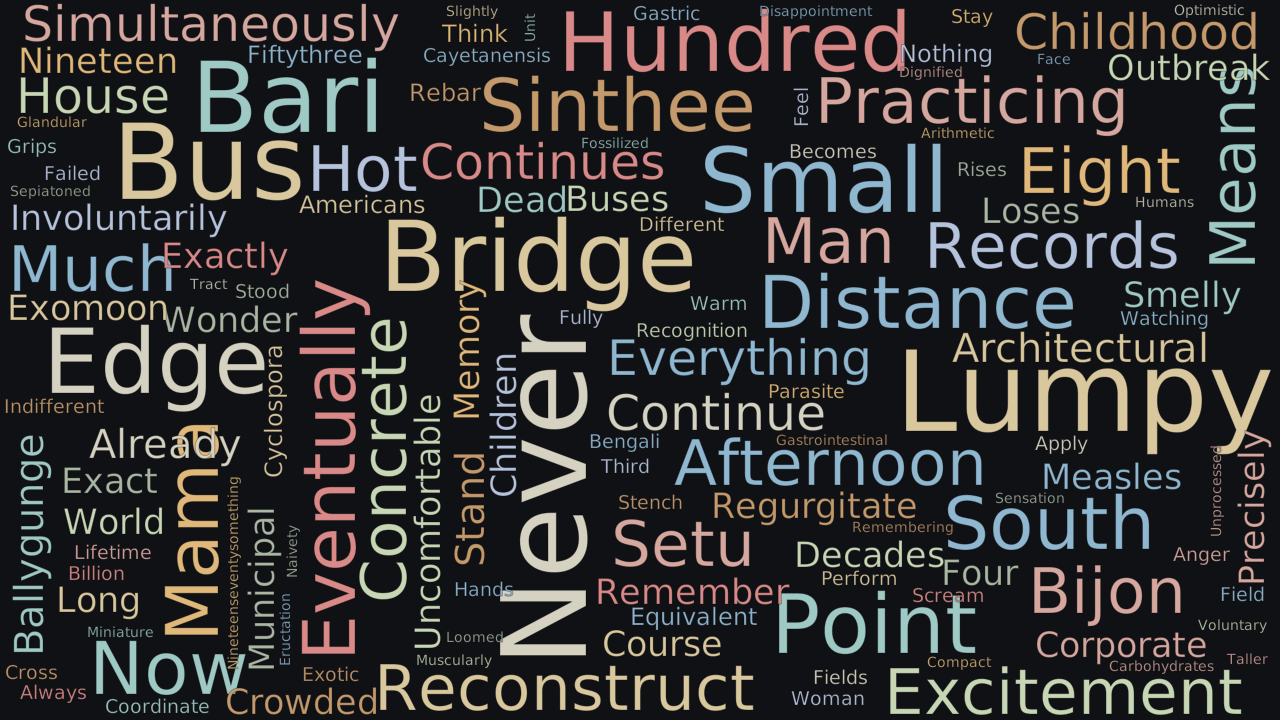
Word Cloud
Related reading
Selected by shared topics and section, with closer publication dates breaking ties.
Comments
Read the conversation or leave a thought for review. Comments load when this section is in view.