The Unsleeping Attractor: On Ungovernable AI and the Beautiful, Horrifying Mathematics of What We Cannot Control
Uses the speech voice supplied by your browser or device.

I cannot sleep again. The ceiling fan in this Calcutta flat whirs with the desperate persistence of a man who has been told he is essential to the operation of something he does not understand, and I lie beneath it, staring at the plaster cracks that map out, if you squint, the Lorenz attractor. Three o’clock in the morning, the hour when the city’s honking has finally surrendered to the softer violence of mosquitoes and the distant wail of trains that never stop for anyone, and my mind, that traitorous organ, has wandered off to problems I cannot solve. This is not new. This is the chronic condition of a brain that was educated in American institutions to believe that every problem has a solution if only you apply sufficient rigor, sufficient funding, sufficient pretense of understanding, and then dumped back into a city where the rigor is applied to survival and the funding is applied to the next election and the pretense of understanding is applied, liberally, like Fair & Lovely on a bridegroom’s face, to every goddamn conversation about artificial intelligence.
Ungovernable AI. The phrase rolls off the tongue of every tech bro with a Substack and every policy wonk with a fellowship and every journalist who has discovered, sometime in the last eighteen months, that the acronym LLM does not stand for “Large Lumpy Mammaries” after all. Bubble to someone, babble to someone else. The same sentence, depending on whether you are reading it in a Palo Alto coffee shop or a Calcutta newsroom, means either the end of human meaning or the beginning of a very profitable fiscal quarter. And I lie here, fan whirring, mosquitoes humming their atonal symphony, and I think: it is no different than ungoverned anything, really, including journalism, including the traffic on the EM Bypass, including my own endocrine system, which has decided, in its infinite biochemical wisdom, that 3 AM is the appropriate hour for a cortisol party.
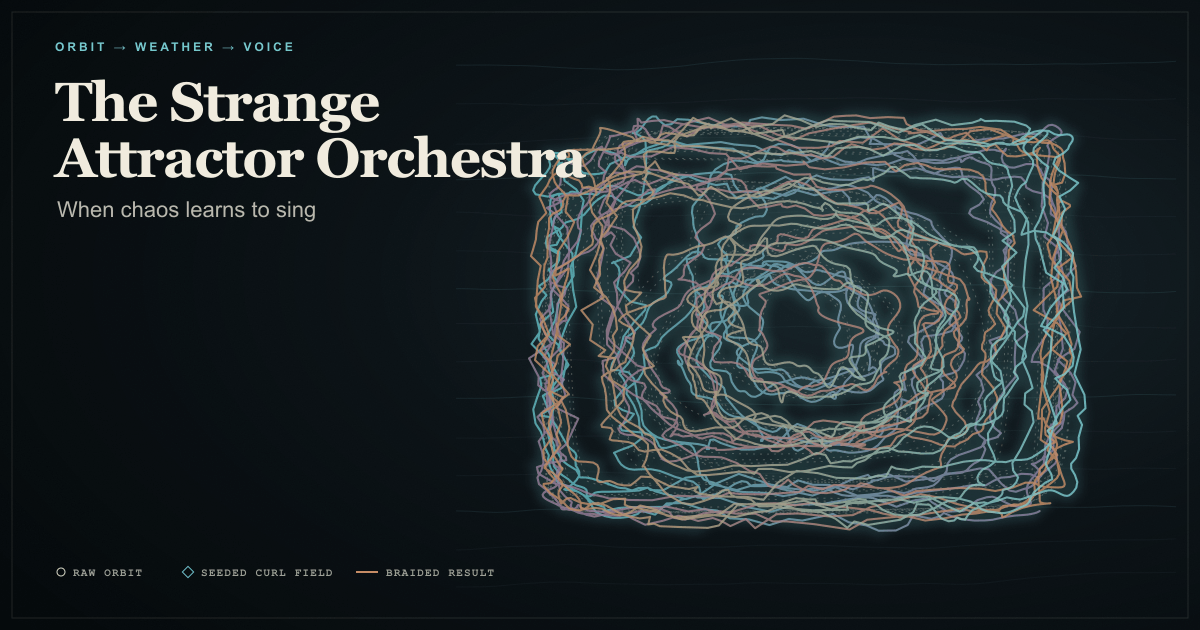
What is an attractor state? The word itself is a gift from Latin, attrahere, to pull toward, to draw in, and the mathematical concept was birthed not by some Silicon Valley prophet in a Patagonia vest but by Henri Poincaré, a Frenchman with a magnificent mustache and a brain that could visualize the impossible, who in 1889 was working on the three-body problem and accidentally discovered that some systems do not settle into neat, predictable orbits but instead swirl around strange, beautiful, never-repeating patterns that never quite land where you expect. The Lorenz attractor, discovered by Edward Lorenz in 1963 while he was trying to model weather—weather, that most ungovernable of phenomena—looks, when plotted in three dimensions, like the wings of a butterfly, or like two toilet bowls joined at the hip, endlessly circulating, never flushing. It is deterministic, which is to say the equations that generate it contain no randomness, no dice-throwing, no quantum indeterminacy, and yet it is unpredictable, which is to say that if you start two trajectories infinitesimally close together, they will diverge exponentially, the way two brothers from the same Calcutta household will diverge into a doctor and a disappointment.
This is the mathematics of what we cannot control. Not because we lack the will, not because we lack the regulation, not because some senator from California has not yet written the right white paper, but because the system itself, by its very structure, by the very differential equations that define its evolution, possesses attractor states that pull all trajectories toward them regardless of where you begin. The question, then, the only question worth asking when someone waves their arms and shrieks about ungovernable AI, is not “Can we govern it?” which is a question asked by people who have not yet accepted that governance is a local approximation to a global impossibility, but rather “What are the attractor states of the chaos it is creating, and are those states self-sustaining, and are the products of those states harmful to some component of the ecosystem that sustains them, and do they disrupt the short-term cosmetics while improving the long-term effect on the receiving or affected components?”
That is a mouthful. That is a sentence that would get you thrown out of a TED talk. That is the kind of sentence that makes editors reach for their red pens and readers reach for their scroll buttons. But it is the sentence that matters. Because otherwise—otherwise it is bubble to someone and babble to someone else, a semantic attractor state where all discourse collapses into the same two or three predictable orbits: the doomer, the booster, the “let’s-regulate-it” centrist who has never read a single paper on dynamical systems and thinks that “alignment” is something you do with your car tires.
I have worked in healthcare research in the United States for fifteen years. I have watched machine learning models, which are not AI in the science-fiction sense but are called AI in the grant-application sense, make predictions about patient outcomes. I have watched these models, these attractor-seeking algorithms, optimize for the metrics they were given—readmission rates, mortality scores, cost efficiency—while the patients, the actual breathing, bleeding, begging human beings, swirled around the edges of the phase space like debris around a black hole. The models were not ungovernable in the sense that they could not be audited; they were ungovernable in the sense that the attractor state of the healthcare ecosystem—profit, throughput, the reduction of human suffering to a billing code—pulled all governance toward itself, made all regulation a decoration, a cosmetic disruption of the short term while the long term marched on, improving efficiency, improving margins, improving the lives of the components that the system was designed to care about: the spreadsheets.
Is this self-sustaining? The question is not rhetorical; it is mathematical. A dynamical system is self-sustaining if its attractor states are stable, if perturbations return to the basin of attraction rather than diverging into catastrophe. The healthcare AI ecosystem, the journalism ecosystem, the traffic-on-EM-Bypass ecosystem, the I-cannot-sleep-because-my-brain-is-a-faulty-neural-network ecosystem—all of these have attractor states that are robust, that absorb shocks, that convert the energy of dissent into the heat of friction and radiate it away into the void. The system sustains itself not despite the chaos but through it, the chaos is the mechanism, the butterfly wings of Poincaré and Lorenz are the engine, and the only way to change the attractor is to change the equations, which is to say to change the parameters, which is to say to change the incentives, which is to say to change the money, which is to say, good bloody luck, because the money is the deepest attractor of all, the strange attractor that makes all other strange attractors look like parabolas.
And what of the products? What of the outputs of these self-sustaining chaotic systems? Are they harmful to some component of the ecosystem that sustains them? This is where the doomer and the booster both fail, each in their own adorable way, like two dogs barking at a mirror. The doomer looks at the attractor state and sees only the harm: the displaced worker, the generated falsehood, the autonomous weapon, the paperclip maximizer that converts the universe into paperclips because some idiot gave it the wrong objective function. The booster looks at the attractor state and sees only the benefit: the cured disease, the solved protein fold, the democratized creativity, the paperclip maximizer that converts the universe into paperclips because, let’s be honest, we could use better organization. Both are correct in the way that a stopped clock is correct twice a day, which is to say they are correct about the local trajectory but blind to the global structure.
The harm is not in the attractor state itself; the harm is in the basin of attraction, in the set of initial conditions that get pulled into that state and never escape. A language model that generates plausible falsehoods is not harmful because it generates falsehoods—that is what language does, language is the original generative model, the original hallucination engine, Sanskrit māyā, illusion, from the root mā, to measure, to create form out of formlessness—but because the basin of attraction for those falsehoods includes the information ecosystem, the journalism ecosystem, the I-scroll-through-my-phone-at-3-AM ecosystem, and the falsehoods circulate, self-sustain, become attractor states in their own right, strange loops of belief that no amount of fact-checking can perturb out of their orbit.
And the cosmetics, the short-term cosmetics, the disruption of them—this is where the cynic in me, the Calcutta cynic, the man who has watched too many five-year plans and too many smart city initiatives and too many “AI for Good” summits in five-star hotels, finds a grim, intestinal kind of comfort. The short term will always be disrupted. The short term is the sacrifice zone, the boundary layer where the laminar flow of policy meets the turbulent flow of reality and shears itself into vortices. The long term, the long term is where the attractor states live, where the self-sustaining patterns emerge, where the cosmetics fade and the structure reveals itself, and if we are lucky, if we have parameterized the system with something other than quarterly earnings and engagement metrics, the long-term effect on the receiving components, the humans, the ones who care for some reason, is an improvement. The vaccines. The weather prediction. The protein folds. The paperclips, if we must have them, at least organized.
But we do not know. That is the terror and the wonder of it. The Lorenz system, deterministic, bounded, beautiful, is unpredictable in the long term because the exponential divergence of trajectories means that any finite precision in our initial conditions propagates into infinite uncertainty. We do not know the initial conditions of the AI ecosystem with sufficient precision. We do not know the parameters of the human social system with sufficient precision. We do not know, lying here at 3 AM in Calcutta, whether the trajectory we are on will settle into a basin of attraction that includes human flourishing or human irrelevance, and the fan whirs on, and the mosquitoes sing on, and the mathematics offers no comfort, only structure, only the cold, strange beauty of the attractor, pulling us in, pulling us in, pulling us in.
The Sanskrit poet Bhartṛhari wrote: anityāsaṃsārasāro ‘yam adhruvaṃ dhrauvam āśritam—“The essence of this transitory world is unsteady, yet it clings to what is fixed.” We cling to governance, to regulation, to the fixed point of control, while the system swirls around us in its strange, unsteady, beautiful orbit. The attractor does not care. The attractor only attracts. And we, the components, the receiving components, the ones who care for some reason, can only hope that the basin of attraction into which we have been pulled is one from which we can still, somehow, extract meaning, extract humor, extract the American, impolite, toilet kind of truth that behind every unpronounceable word, every attractor, every dynamical system, every ungovernable, is man’s history of fumbling, now hidden in fat textbooks, now hidden in white papers, now hidden in the whir of a ceiling fan at 3 AM in a city that does not sleep, that has never slept, that will outlast all our governance and all our babble and all our bubbles, swirling, swirling, never quite landing, never quite flushing, beautiful and horrible and completely, mathematically, inevitably itself.
P.S. References: Lorenz, E. N. (1963). “Deterministic Nonperiodic Flow.” Journal of the Atmospheric Sciences, 20(2), 130–141. Poincaré, H. (1890). “Sur le problème des trois corps et les équations de la dynamique.” Acta Mathematica, 13, 1–270. Bhartṛhari, Vākyapadīya. Strogatz, S. H. (2018). Nonlinear Dynamics and Chaos. 2nd ed. Westview Press. Mitchell, M. (2009). Complexity: A Guided Tour. Oxford University Press.
Word Cloud
Related reading
Selected by shared topics and section, with closer publication dates breaking ties.