The Sound of Calcutta at 3 AM: A Taxonomy of Night Noises
Uses the speech voice supplied by your browser or device.

The fan whirs. The UPS to my desktop hums its devotional drone, a mechanical om that never finds enlightenment, only heat. My feeble air conditioner starts, stops, starts again—an asthmatic beast gasping through the Calcutta humidity, and I lie there, a man reduced to his auditory nerve endings, a fleshy antenna tuned to frequencies no one else seems to hear, or perhaps everyone does but no one admits it because admitting it would mean admitting that the city never sleeps, only pretends to, and pretends badly, like a child with its eyes squeezed shut who thinks invisibility is a matter of will.
Three in the morning. The witching hour, they called it in medieval Europe, the hour when demons were thought to be most active, which tells you everything you need to know about medieval Europeans and their spectacular gift for missing the point entirely, because the real demons do not come at three AM with horns and pitchforks and theatrical smoke; they come as tinnitus, that constant ringing in my left ear that has set up permanent residence like a squatter who knows the law better than the landlord, and I have named it, because naming things is what we do when we cannot kill them, I have named it Ravana, after the ten-headed demon king of the Ramayana who would not stop talking, whose every head had its own opinion and its own monologue and its own unshakable conviction that it was right and the world was wrong, and Ravana the tinnitus is worse than Ravana the myth because at least the latter had the decency to be slain by a god and stay dead, whereas my Ravana regenerates every morning at three AM with all ten heads intact and all ten mouths open and all ten voices ringing in unison.
Etymology, since I promised you one and only one, and I am a man of my word even when my word is delivered at three in the morning through a haze of sleep deprivation and what the DSM-5 politely calls “bipolar II disorder” and what I call the eternal oscillation between wanting to build a cathedral and wanting to burn one down: tinnitus comes from the Latin tinnire, to ring, which itself comes from an imitative root, a word that sounds like what it describes, which is the linguistic equivalent of a dog chasing its own tail, and the Romans, those magnificent bastards, they knew what they were doing when they coined it, because there is something fundamentally circular about ringing, something that goes nowhere and arrives everywhere, a Möbius strip of sound that has no beginning and no end and certainly no off switch.
The fan whirs. I said that already. Anadiplosis, they call it in rhetoric, the repetition of the last word of one clause at the beginning of the next, and I use it deliberately, maliciously, because the fan does not care about my literary pretensions, the fan whirs and whirs and whirs and will continue to whir long after I have been reduced to ash and memory, and there is something simultaneously comforting and obscene about that, the indifference of machines, the way they outlast us, the way my grandfather’s ceiling fan in his Shyambazar apartment still spins thirty years after his heart stopped, still moves the same hot air around the same hot room where I sat as a child and listened to him tell stories about the famine of 1943, stories that I now realize were probably not meant for children but which he told anyway because who else was there to tell, because the dead do not listen and the living are too busy making their own noise to hear the noise of history.
Birds. There used to be birds. Crows, mostly, the great black philosophers of Calcutta’s dawn, the corvid cognoscenti who would gather on the telephone wires like a parliament of reproaches, cawing their judgments on the human condition with the moral authority of creatures who have seen us at our worst and found us wanting. But they are gone now, or nearly gone, from where I am, driven away by the same progress that brought us LED streetlights and air purifiers and the slow suffocation of everything that does not pay rent, and I miss them, I miss them with a grief that surprises me, because I never thought I would mourn crows, those garbage-eating, road-kill-feasting, opportunistic geniuses of the urban ecosystem, but here I am, lying in the dark, listening for a caw that does not come, and the silence where the caw should be is louder than the caw ever was, a negative space that draws the ear like a black hole draws light, and I wonder if this is what extinction sounds like, not a bang but an absence, not a roar but a whisper that grows louder the more you strain to hear it.
But there are other birds, or there were, or there will be, because nature is nothing if not persistent, a quality I admire in theory and resent in practice, the way I resent my own persistence, my own refusal to simply lie down and stop, to let the darkness have its way, to surrender to the siren song of permanent sleep that my depression sings in its lower registers, a bass note that vibrates in the sternum and makes the teeth ache. The gecko, now, the gecko is persistent, the gecko is the Tom Thumb of reptilian tenacity, and it makes its tik-tik-tik noise against the wall, a sound like a very small person typing a very angry email, and I have never been able to determine whether this is a mating call or a territorial warning or simply the gecko equivalent of humming while you work, and I have decided that I prefer not to know, that some mysteries should remain mysteries, that the gecko’s tik-tik-tik is more beautiful when it is meaningless, when it is pure sound without semantics, the way music is supposed to be before we ruin it with lyrics and narratives and the desperate human need to make everything mean something.
The distant train. The Howrah line, probably, or one of its tributaries, the arterial railways that pump commuters through the city’s body like blood through a heart that has seen better days, a heart that smokes too much and drinks too much and eats too much fried food and yet refuses to stop beating, refuses out of sheer Bengali stubbornness, that quality that we possess in such abundance that it has become our defining characteristic, the thing that makes us simultaneously insufferable and indispensable. The train horn is a low moan, a basso profundo that travels through the humid air like a message from another world, a world where people are awake at three in the morning because they have somewhere to be, because their lives have purpose and direction and momentum, and I lie there and listen to it and feel a jealousy that I know is irrational, that I know is the product of a brain chemistry that swings between poles like a pendulum with a broken escapement, but knowing does not help, knowing never helps, knowing is the consolation prize they give you when they cannot give you peace.
Stray dogs. Stray cats. The dogs and cats in conversation, a interspecies symposium conducted in growls and hisses and the occasional yelp of surprise or pain, and I cannot tell if they are fighting or flirting or simply negotiating the terms of their coexistence, these urban survivors who have adapted to the city the way the city has never adapted to them, who have learned to navigate traffic and garbage dumps and the casual cruelty of humans who see them as pests rather than as fellow travelers on this overheated, overcrowded, overcomplicated planet. The dog’s bark is a staccato punctuation, a series of exclamation marks that demand attention, that insist on being heard, and the cat’s meow is a liquid question, a rising inflection that asks without expecting an answer, and together they compose a duet that is at once comic and tragic, a Beckett play performed by animals who do not know they are performing, who do not know that their every utterance is being analyzed by a sleepless man lying in a dark room, a man who has nothing better to do at three in the morning than to eavesdrop on the nocturnal confessions of creatures who would not care even if they knew.
Insects. Constant chirping. I do not know what they are. Cicadas, perhaps, though I thought cicadas were diurnal, though what do I know, what does anyone know, knowledge is a sandcastle that the tide of ignorance erodes grain by grain, and I have long since stopped building sandcastles. The insect chorus is a high-frequency whine, a needle-thin sound that pierces the ear and lodges in the brain, and I have tried to count the chirps, to find a pattern, a rhythm, a mathematical structure that would transform noise into music, chaos into order, and sometimes I find it, sometimes the chirps arrange themselves into a sequence that seems almost intentional, almost composed, and then the pattern breaks, the sequence falters, and I am left with randomness again, with the terrible freedom of a universe that does not care whether I understand it or not.
No mosquitoes, though. I keep them out. This is my one victory, my single achievement in the ongoing war against the natural world, the war that I am losing on every other front but which I win, temporarily, locally, against the mosquito, that flying syringe of disease and discomfort, that tiny vampire that has killed more humans than all the wars in history combined, and I lie there in my mosquito-net fortress, my citadel of mesh and paranoia, and I feel a pride that is disproportionate to the achievement, because keeping mosquitoes out is not difficult, it is merely tedious, it requires vigilance and attention to detail and a willingness to seal every crack and crevice, and these are not heroic qualities, they are the qualities of a man who has too much time on his hands, a man who has made a virtue out of necessity, a man who lies in the dark and listens to the sounds of the city and tries to find meaning in the meaningless, pattern in the patternless, structure in the chaos.
The insomniac neighbor’s television. I do not know his name. I have never seen his face. He is a voice through a wall, a flicker of blue light through a window, a presence defined by absence, by the things I do not know about him. His television murmurs at three in the morning, a low-frequency rumble of dialogue and laughter and the occasional explosion, and I wonder what he is watching, whether it is news or sports or some interminable Bollywood melodrama, and I wonder why he is awake, whether he too suffers from the same affliction that keeps me staring at the ceiling, whether he too lies in the dark and listens to the sounds of the city and feels the slow erosion of his sanity, grain by grain, chirp by chirp, tik by tik by tik. We are comrades in sleeplessness, my neighbor and I, brothers in the fraternity of the three AM wakefulness, and yet we have never spoken, never acknowledged each other’s existence, because that is the Calcutta way, the urban way, the way of cities everywhere, to be surrounded by millions and to know no one, to be pressed against bodies in the metro and to feel utterly alone, to hear your neighbor’s television at three in the morning and to never ask why.
Street hawkers. Even at this hour, even in this darkness, there are those who peddle, who cry their wares with voices hoarse from repetition, who carry their goods on bicycles and pushcarts and the sheer force of their own desperation. Some have recordings now, electronic voices that blare from cheap speakers, looped announcements that repeat until they become a kind of mantra, a prayer to the god of commerce who never sleeps and never forgives and never gives anything for free. “Sabji le lo, sabji le lo,” the recording says, or “Machh machh, fresh machh,” and the voice is always female, always cheerful, always utterly indifferent to the fact that it is three in the morning and no one in their right mind is buying vegetables or fish, and yet the hawker plays it anyway, because hope is the last thing to die, because the possibility of a sale, however remote, however absurd, is enough to keep the speaker blaring and the bicycle moving and the dream of a better tomorrow alive for one more night.
And then there are the recyclers, the old men with their calls of “kabaadi, kabaadi,” a word that means scrap, that means the detritus of lives lived and discarded, the newspapers and bottles and broken appliances that we throw away without thinking, that these men collect and sort and sell, turning our waste into their wages, our garbage into their gold. Their voices are guttural, ancient, the voices of men who have been doing this for decades, who have seen the city change around them and have changed with it, adapting, surviving, persisting, and I lie in my bed and listen to them pass and I feel a shame that I cannot quite name, a shame that comes from the recognition of my own privilege, my own comfort, my own ability to lie in a room with a fan and an air conditioner and a computer that hums its devotional om while men twice my age push carts through the dark, calling out for scrap, for the leavings of lives like mine.
Arguments. Shouts. Guttural groans of relief or pleasure that carry through the humid air with a clarity that seems almost deliberate, almost performative, as if the city itself is staging a drama of which I am the unwilling audience, the captive spectator who cannot leave because leaving would require getting out of bed, and getting out of bed would require energy, and energy is a currency I do not possess at three in the morning, when my bipolar brain has swung to the depressive pole and everything feels heavy, everything feels impossible, everything feels like a task designed by a sadistic god to test the limits of human endurance. The shouts rise and fall, the arguments crescendo and decrescendo, the groans arrive and depart, and I listen to them all, I catalog them, I file them away in the mental taxonomy that I am constructing, this taxonomy of night noises, this Linnaean system of insomnia, and I wonder if Linnaeus ever lay awake at night, if the father of modern taxonomy ever found himself unable to sleep, counting species instead of sheep, classifying the darkness instead of surrendering to it.
My breathing. Sometimes my heartbeat. The internal sounds, the sounds that are always there but which we only hear in the silence, in the absence of external noise, in the moments when the city pauses, when the fan stops, when the air conditioner rests, when the gecko takes a break from its tik-tik-tik and the insects pause their chirping and even Ravana the tinnitus seems to lower his voice for a moment of respectful silence. My breathing is a bellows, an accordion of air that expands and contracts my chest with a regularity that I find both reassuring and oppressive, because it reminds me that I am alive, that this machine of bone and blood and tissue is still functioning, still pumping, still processing oxygen into carbon dioxide with a efficiency that would be admirable if it were not so utterly automatic, so completely beyond my control. I can hold my breath, yes, I can slow it or speed it, but I cannot stop it, cannot choose not to breathe, and this is the fundamental condition of existence, this lack of choice, this compulsion to continue, to persist, to go on breathing and beating and being whether we want to or not.
And my heartbeat, that drum in the chest, that percussion section of the body orchestra, it has its own rhythm, its own tempo, its own unpredictable accelerations and decelerations that correspond to thoughts I cannot control and emotions I cannot name. Lub-dub, lub-dub, the sound of a valve opening and closing, of blood rushing through chambers and vessels, and I have listened to it so many times at three in the morning that I have come to know its moods, its variations, the way it speeds up when I think of the past, slows down when I think of nothing at all, skips a beat when I remember something I would rather forget. The heart is a liar, they say, but they are wrong, the heart is the most honest organ we have, it tells the truth when the brain is still constructing its elaborate fictions, it reveals what we really feel when the face is still smiling, and at three in the morning, in the dark, with only the sounds of the city for company, I listen to my heart and I hear things I do not want to hear, truths I do not want to know, and I wish, I wish with a fervor that borders on prayer, that I could be deaf to it, that I could silence it the way I silence the world, with earplugs and white noise and the sheer force of my own denial.
Earworms. If I hear something during the day, some snippet of song, some fragment of melody, it sets up shop in my head and refuses to leave, a squatter more persistent than Ravana the tinnitus, more demanding than the gecko’s tik-tik-tik, and at three in the morning it plays on repeat, an infinite loop of sound that I cannot stop, cannot change, can only endure. Today it is something my mind dredged up from the sediment of decades, not a real song, not anything I could name or identify, just a faint resemblance to a voice and a tune, the ghost of a ghost, a melody that might have been or might never have been, and it is not pleasurable, it is not the comfort of recognition, it is the discomfort of almost-recognition, the irritation of a word on the tip of the tongue that refuses to be spoken, and I try to replace it with something else, something classical, something complex, a Bach fugue or a Beethoven sonata, but the earworm is stronger, the earworm has dug in its heels and refuses to be dislodged, and so I lie there and listen to the same four bars, the same phantom voice, the same not-quite-melody that my brain manufactured from scraps and fragments, from radio static and elevator music and the half-heard jingles of advertisements, and I wonder if this is what memory is, not a photograph but a forgery, not a song but a simulacrum, not something you remember but something your brain invents to fill the silence, over and over, in the dark, at three in the morning, when everyone else is asleep and the city is pretending to be silent.
Static. The sound of nothing, which is not nothing at all but rather the sound of everything at once, the white noise of the universe, the background radiation of existence that fills the spaces between the stars and the atoms and the thoughts that we think we are thinking but which are really just electrical impulses firing in a three-pound lump of tissue that has the audacity to call itself a brain. I hear static when everything else stops, when the fan dies, when the air conditioner rests, when the city holds its breath for a moment, a second, a heartbeat, and in that static I hear everything, I hear the birth of stars and the death of cells, I hear the Big Bang and the heat death of the universe, I hear my own thoughts before I think them and my own fears before I feel them, and it is terrifying, it is beautiful, it is the sound of being alive in a universe that does not care, that has never cared, that will never care, and yet continues, and yet persists, and yet makes noise, constant noise, eternal noise, the noise of existence itself.
And in all of this, in this cacophony of internal and external sound, in this symphony of sleeplessness, I feel small. Not small in the way that looking at the stars makes you feel small, not small in the way that standing before the ocean makes you feel small, but small in a way that is specific and particular and personal, small in the way that a man feels when he lies in a dark room and listens to the world go on without him, when he realizes that the city does not need him, that the fan will whir whether he is there or not, that the train will moan its basso profundo whether he hears it or not, that the gecko will tik-tik-tik its ancient song on walls that will outlast him by centuries. I feel small, and in feeling small I feel something else, something that is not quite despair and not quite peace but something in between, something that has no name in English or Bengali or Sanskrit, something that can only be described as the sound of a man listening to the world and finding, in that listening, a kind of belonging, a kind of connection, a kind of communion with the noise that is everywhere and always and forever.
The fan whirs. The UPS hums. My air conditioner starts, stops, starts again. Ravi rings his eternal ring. The gecko tiks against the wall. The insects chirp their chirp. The distant train moans its moan. The neighbor’s television murmurs. The hawkers hawk. The recyclers recycle. The dogs bark. The cats meow. The arguments argue. The groans groan. My breathing breathes. My heartbeat beats. The earworm worms. The static states. And I, I lie here, a man in a room in a city in a country in a world in a universe that does not know my name and does not care to learn it, and I listen, I listen with every fiber of my being, I listen because listening is all I have, because at three in the morning, in the dark, in the sound of Calcutta, I am not small, I am not large, I am not anything at all except a pair of ears and a heart that beats and a mind that thinks and a soul, if I have one, that floats on the ambient noise like a leaf on a river, carried along by currents I cannot see, toward a destination I cannot know, and I let it float, I let it float, I let it float.
P.S. The etymology of taxonomy, since I promised one and gave you tinnitus instead: from Greek taxis, arrangement, and nomos, law. The law of arrangement. The arrangement of law. The classification of chaos. The chaos of classification. Chiasmus. I promised. I delivered. I lied. I delivered anyway. This is the Calcutta way.
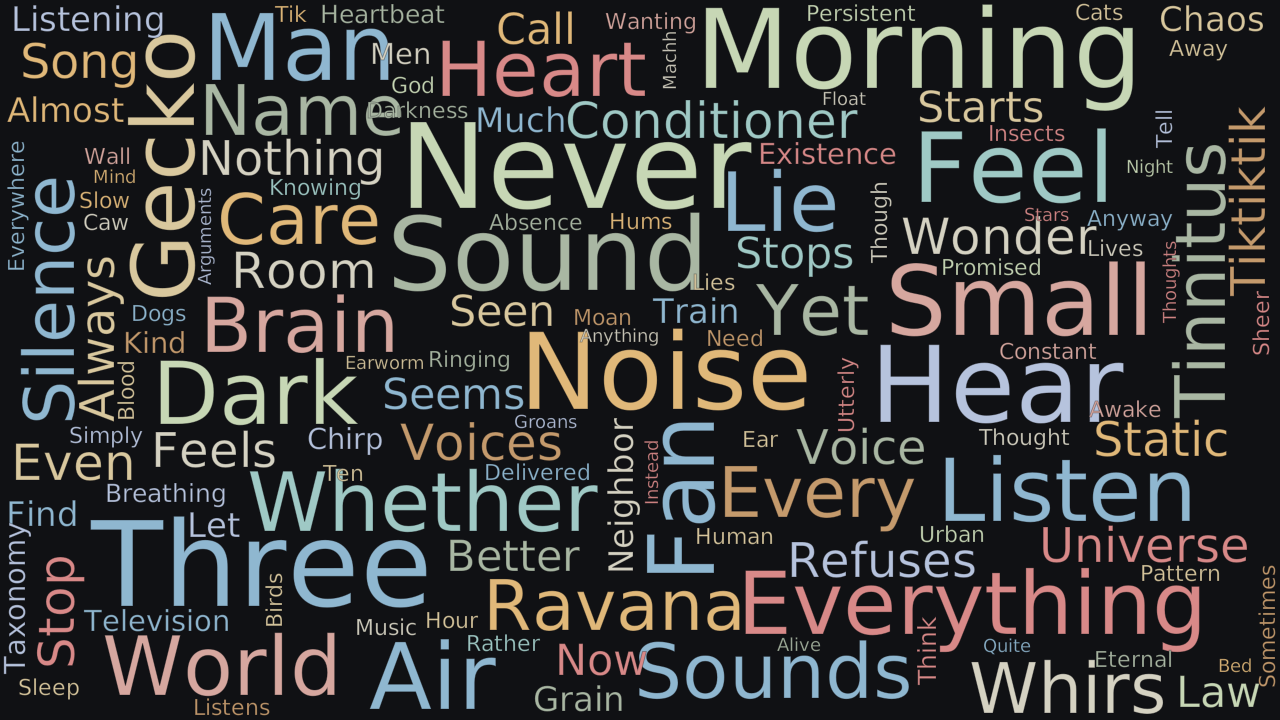
Word Cloud
Related reading
Selected by shared topics and section, with closer publication dates breaking ties.