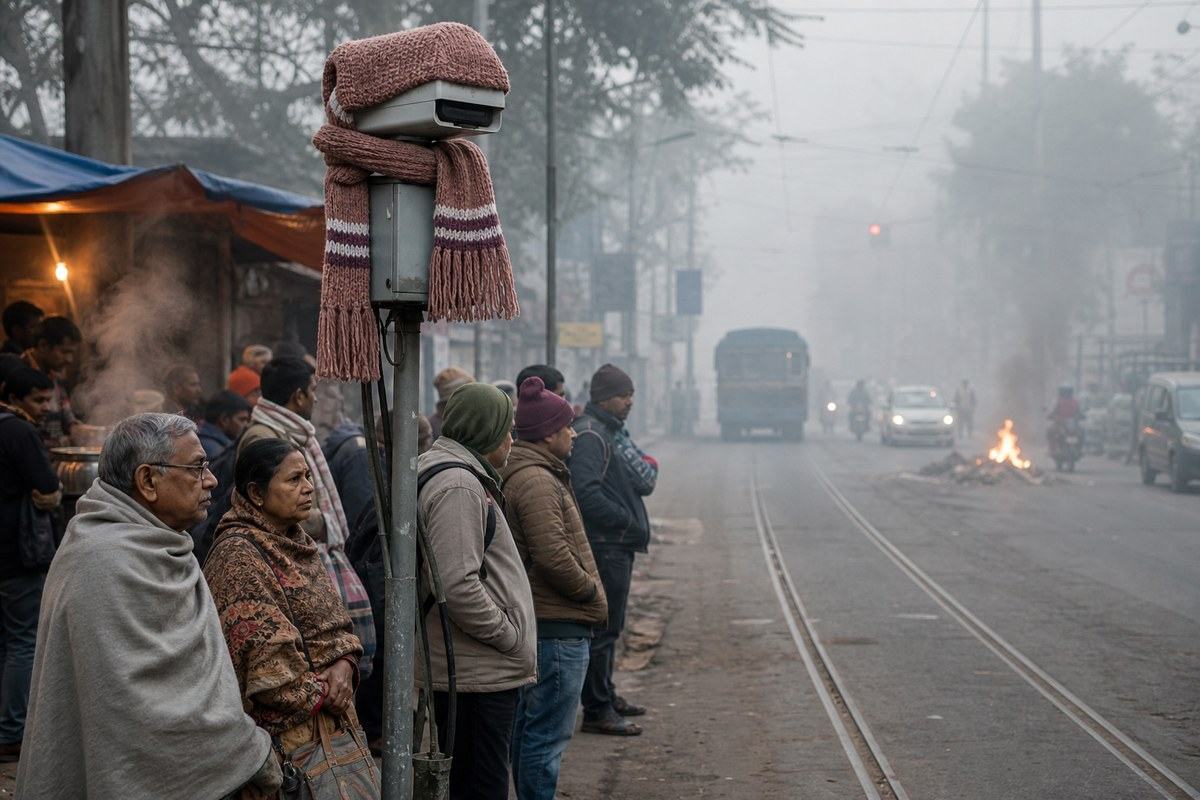
Wet-Bulb, Dry-Bulb, and Kolkata Heat
Uses the speech voice supplied by your browser or device.

The weather app says 38°C. Fine. We have seen 38°C. We are not delicate Swiss pastry. We are practical Calcuttans. We have stood near Esplanade buses, eaten phuchka beside drains of uncertain biography, and survived power cuts with one hand-fan and ancestral stubbornness. So why does one 38°C day feel merely unpleasant, while another 38°C day feels like being slowly steamed inside a municipal idli cooker?
The answer is that temperature is not one thing. Weather reports use several kinds of temperature, and each one is measuring a different part of the heat story. Dry-bulb temperature is what the air is. Wet-bulb temperature is what evaporation can do. “Feels like” temperature is what your body is likely to suffer.
Dry-bulb temperature is the ordinary temperature. This is the number you see on a normal thermometer, the number your phone shows, the number people quote while wiping their neck with a gamchha and saying, “Aaj toh bhalo-i gorom.” It is called “dry-bulb” because old thermometers had a little bulb of liquid at the bottom, and in this case the bulb is dry. Nothing fancy. No wet cloth. No cooling trick. Just the air temperature.
If the dry-bulb temperature is 38°C, the air around you is 38°C. That is already hot. But it does not tell you whether your body can cool itself. This is the crucial bit, and Kolkata often hides its knife here.
Human beings are not cooled mainly by dignity, prayer, optimism, or WhatsApp forwards from school friends. Even at rest, the human body is already a small heater, roughly like an old 100-watt incandescent bulb. That means it is producing about 100 joules of heat every second while doing nothing more heroic than sitting, breathing, blinking, and wondering why Kolkata feels like a pressure cooker with tramlines. Start walking, climbing stairs, carrying groceries, arguing with an auto driver, or working outdoors, and that heat production rises. The body’s furnace burns harder.
So the body must constantly throw heat away. One of its best tricks is sweat. Sweat comes out through the skin, and if that sweat evaporates, it carries heat away with it. The little miracle is this: water needs energy to turn from liquid into vapor. That energy is pulled from your skin. Evaporation therefore steals heat from you, which is exactly the theft we want in May.
In the simplest useful formula, the heat removed is:
Here is heat carried away, is the mass of water that evaporates, and is the latent heat of vaporization, which is the energy needed to turn liquid water into vapor. Do not be frightened by the symbols. It only says what your grandmother already knew when she hung wet clothes under a fan: water evaporating makes things cooler.
Now imagine two rooms.
In the first room, the air is hot but dry, like the inside of an old metal trunk left in the sun. You hang a wet towel. The towel dries quickly. A fan helps. Water escapes into the air. Evaporation happens. Cooling happens.
In the second room, the air is hot and humid, like a bathroom after three people have taken long showers and nobody has opened the window. You hang the same wet towel. It remains wet. It becomes a damp moral accusation. The fan blows, but the towel refuses to dry. Why? Because the air is already holding plenty of water vapor. It has little appetite left.
Your skin behaves like that towel.
Wet-bulb temperature measures this evaporation story. Take a thermometer. Wrap its bulb in a wet cloth. Blow air over it. As water evaporates from the cloth, it cools the bulb, so the thermometer reading drops. The drier the air, the more water evaporates, and the more the temperature drops. The more humid the air, the less water evaporates, and the less the temperature drops.
That lower reading is the wet-bulb temperature.
So dry-bulb temperature asks, “How hot is the air?”
Wet-bulb temperature asks, “How much cooling can evaporation still give you?”
That second question is not academic. It is the question your body is asking while you stand at a bus stop near Gariahat in May, shirt pasted to your back like a court summons.
In low humidity, the gap between dry-bulb and wet-bulb can be large. Suppose the dry-bulb temperature is 38°C. If the air is dry, the wet-bulb temperature may be much lower because evaporation works well. Your sweat can do its job. The weather is hot, yes, but your body still has a cooling mechanism.
In high humidity, the wet-bulb temperature creeps closer to the dry-bulb temperature. That is bad news. It means sweat sits on your skin but does not evaporate efficiently. You are wet, but not cooled. This is one of nature’s more irritating betrayals: the body is producing sweat, the shirt is ruined, the face is shining like a newly varnished harmonium, and still the internal cooling system is failing.
This is why Kolkata’s heat can be more dangerous than the dry-bulb number suggests. The city is humid. The Hooghly is not just scenery. The monsoon does not arrive alone; it brings a wet blanket and throws it over the atmosphere. When the air is saturated with moisture, sweat loses its exit route. The body keeps producing heat, but cannot dump it fast enough.
This is where wet-bulb temperature becomes serious, not merely uncomfortable. Human survival depends on maintaining core body temperature within a narrow range. If the wet-bulb temperature gets too high, even a healthy person resting in shade with water may be unable to cool down properly. At extreme wet-bulb temperatures, the body’s main cooling mechanism runs out of road. It is like trying to drain a flooded lane into an already flooded canal.
Scientists often discuss 35°C wet-bulb as a theoretical danger line for human survival under sustained exposure. But do not treat that number like a magic switch. People can suffer heat illness at lower wet-bulb temperatures, especially if they are elderly, sick, working outdoors, poorly hydrated, taking certain medicines, living without ventilation, or trapped in a room where the air does not move. Reality rarely waits politely for a textbook threshold before becoming unpleasant.
Now comes the third character in this sweaty little drama: “feels like” temperature.
“Feels like” temperature is not the same as wet-bulb temperature. It is an estimate of how hot the day feels to the human body after combining several factors. Usually it includes air temperature and humidity. Some versions also include wind and sunlight. In hot weather, the common idea behind “feels like” is often called the heat index.
If the dry-bulb temperature is 38°C and humidity is low, the day may feel close to 38°C or only somewhat worse. If the dry-bulb temperature is 38°C and humidity is high, the same air temperature may feel like 45°C, 50°C, or worse. Your body is not reading the thermometer like a schoolboy reading marks from a report card. Your body is asking a more practical question: “Can I lose heat fast enough?”
Wind matters because moving air helps evaporation. This is why a fan can help even when the fan is not producing cold air. A fan does not magically reduce the room’s dry-bulb temperature. It moves air across your skin. If sweat can evaporate, the fan helps that evaporation and cools you. But in very humid conditions, or when the air is extremely hot, the fan’s benefit can shrink. Sometimes it becomes only a mechanical consolation prize.
Sunlight matters too. Standing in shade at 38°C is not the same as standing on an open pavement at 38°C with sunlight beating on your skull, concrete radiating heat from below, and a bus belching warm exhaust beside you like a prehistoric buffalo. The weather app may report air temperature measured in controlled conditions, usually away from direct sun. Your body lives in the bazaar version of physics, where roads, walls, rooftops, and metal railings all add their own enthusiasm.
The history is rather charming, in a damp, Victorian sort of way. Long before satellites and phone apps, weather observers used paired thermometers to understand air and moisture. One thermometer was dry. The other had a wet covering and was exposed to moving air. This instrument became known as a psychrometer, from a Greek root connected with cold. By the nineteenth century, meteorologists were using dry-bulb and wet-bulb readings to estimate humidity. It was a clever little machine: two thermometers, a bit of wet cloth, and enough physics to save lives if people paid attention.
The trick was not mystical. Evaporation cools. Humidity blocks evaporation. The difference between the two thermometer readings tells us how thirsty the air is for water vapor. Dry air is thirsty. Humid air is already full from lunch.
This also explains why the phrase “but it is only 34°C” can be dangerously silly. A 34°C day with very high humidity may punish the body more than a 40°C day in dry air. Not always, not for everyone, not in every situation. But often enough that the distinction matters. Heat is not merely a number. Heat is a negotiation between the air, your skin, your sweat, your blood circulation, your lungs, your clothing, your work, your age, your health, your room, your roof, your fan, your water bottle, and whether CESC has chosen that hour for a philosophical experiment.
Dry-bulb temperature is the headline.
Wet-bulb temperature is the body’s escape route.
Feels-like temperature is the warning label pasted on the whole mess.
For Kolkata, the lesson is simple but not small. Do not laugh off humid heat just because the dry-bulb number looks familiar. Drink water before you are desperate. Use shade as a tool, not a sign of weakness. Keep air moving. A fan, an open window, a cross-breeze, a wet cloth, a slower walking pace, and a pause in the afternoon can be practical physics, not pampering. Watch older people, children, outdoor workers, and anyone who looks confused, faint, unusually tired, or stops sweating in dangerous heat.
The old Calcutta instinct says, “We have survived heat forever.” True. But survival is not proof of invulnerability. It is often proof that people quietly suffered, adjusted, fainted, recovered, and called it normal.
On a dry hot day, sweat is a cooling system.
On a humid hot day, sweat can become only evidence.
That is the difference worth remembering.
Word Cloud
Related reading
Selected by shared topics and section, with closer publication dates breaking ties.