References Available
Uses the speech voice supplied by your browser or device.

THIS IS A WORK OF FICTION
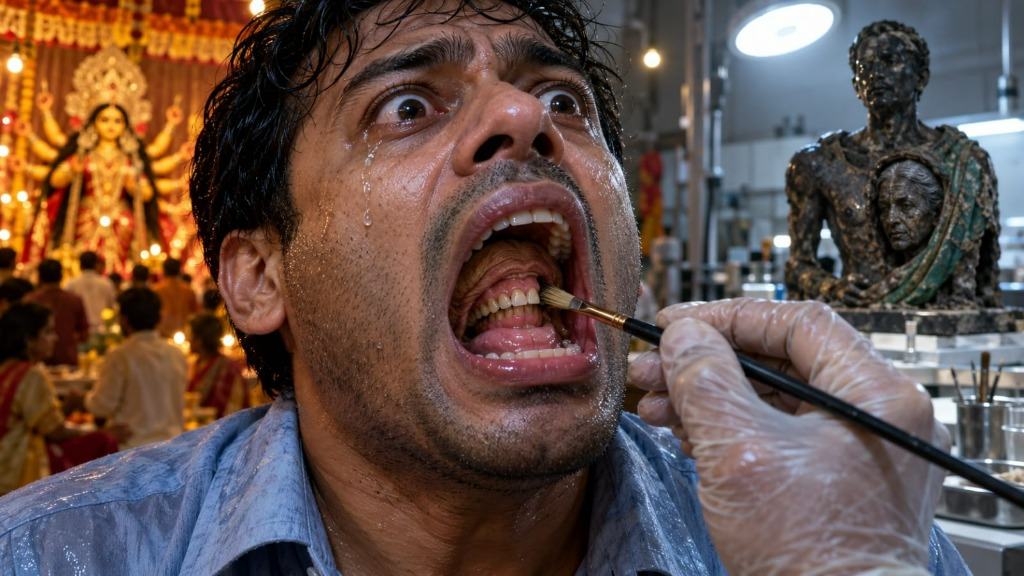
The piece of clay under my tongue straightened when the nurse asked my name.
It pushed against the soft floor of my mouth. I felt a point emerge under my chin, not through the skin yet, just lifting it. The nurse looked down to write and I pressed it flat with two fingers.
“Bijan Pal.”
I wanted her to remove it without asking how it had got there three hours before the goddess exploded.
“Which pandal?”
I named the one where they had found my wife.
“Wait there.”
I sat beside Mitali’s stretcher. They had cut her blouse open. A dressing below her collarbone lifted and settled, although her chest was moving at a different speed. When it lifted, she stopped breathing until it went down.
“Don’t look,” she said.
She meant her breast. Thirty-one years of marriage, and she was trying to cover herself in a corridor where a man was holding the skin of his scalp against his head with a paper plate.
I pulled her sari up.
The dressing stopped moving.
She took a breath and smiled at me, grateful for the wrong thing.
That morning, Ashtami 2026, I had been trimming a spare hand at our Kumortuli workshop. A thin shaving broke off and I parked it between my gum and my last lower molar while I answered the phone. A filthy habit. Mitali had complained about it for years.
The caller was the student.
“Are the hands finished?”
“You have them.”
“I mean the spare.”
“Yes. Pay the balance.”
Twelve thousand rupees. I had rehearsed asking firmly, then almost apologized when I did.
His name was Ritwik Nandi. Fourth year at Jadavpur University. Robotics, he said, as if the word should make me sit up straight. He had approached us in July about movable idol hands. By August he was paying people to leave him alone with five commissions, all going to South Calcutta. By September I was telling the owners I had inspected his alterations.
I had inspected the money.
He talked constantly. Progress required breaking things. People who asked permission remained employees. He intended to become an evil mastermind. He actually said this, in English, standing beside a bucket in which someone had left a dead rat. No second in the world, he said. He would put it on his CV.
I thought he was a spoiled little shit. This did not stop me taking his money.
“Watch the news,” he told me that morning.
I asked again about the balance.
He disconnected.
The first video came from Mitali.
She had gone for anjali without me. On her phone the goddess’s sword fell, striking the lion. Then the trident dropped. People laughed. Someone near Mitali said it was an animation and told everyone to keep recording.
All ten hands turned outward.
Four fingers on each folded into the palm. The middle fingers remained upright. The American fuck-you finger, ten times, with painted red nails and gold bangles sliding toward the wrists.
The laughter thinned. Somebody shouted at the electrician.
There was a flat white frame. The phone struck the ground.
For several seconds I heard a woman making short, annoyed sounds, as if somebody kept stepping on her foot. Then she said, very clearly, “My face is coming off.”
It wasn’t Mitali.
I kept listening for my wife behind her.
The hospital television showed a map with five red circles. By evening the count had passed three thousand injured. The number kept increasing while the same footage repeated, the same man walking out of dust with his forearm open and looking behind him for whoever had done it.
I had reached Mitali through a stranger who answered her phone. Since then I had told four people I knew nothing about idols.
She put her hand on my knee.
“Your mouth is bleeding.”
“Bit my tongue.”
“Always rushing.”
The piece under my tongue curled. My tongue followed it down. For a moment I couldn’t lift it to swallow. Saliva filled my mouth, thick with blood, and I leaned forward as though studying a form.
It released.
I swallowed before anyone noticed. The relief was so complete that I almost forgot what I was sitting beside.
A doctor came with forceps.
“Something superficial here,” she said, lifting Mitali’s dressing.
There was a narrow wound with a brown edge showing inside it. I recognized the finish. I had mixed that color myself.
The doctor caught the edge.
Mitali’s left shoulder snapped forward.
Her hand struck her own mouth. A tooth landed on the sheet. The doctor let go, and Mitali’s arm dropped.
Nobody spoke for a second.
“I’m sorry,” Mitali said.
She was apologizing for making the doctor jump.
Blood collected in the empty tooth socket. She touched it, looked at her fingertip, then looked at me with an expression I had never seen on her before. She was waiting for me to explain her own hand.
The doctor examined the wound without touching it again.
“We need imaging. Keep that arm still.”
“I was.”
“I know.”
She said it quickly.
In the toilet I called Ritwik.
He answered on video. Behind him, the television showed the hospital entrance. He watched the casualty number change and smiled before noticing my face.
He was eating muri from a steel bowl.
“What have you put in them?”
“Which hospital?”
“What have you put in my wife?”
He stopped chewing.
For one stupid moment I thought this mattered to him.
“Show me.”
I opened my mouth instead.
He leaned toward the screen.
“You still do that? Hold things in your teeth?”
“Get it out.”
He put his bowl down. His chair squeaked. I could hear a television in the next apartment playing a comedy, people laughing at something, while he inspected the inside of my mouth.
“Don’t pull it.”
“The doctor pulled hers.”
“What happened?”
I told him.
He wrote something down.
I put my thumb and forefinger under my tongue and found the exposed edge. It was warm and slippery. When I pinched it, something moved farther back, below my jaw, where no finger of mine could reach.
The toilet door rattled.
“Hurry up.”
I pulled.
My tongue flattened against my teeth. The skin beneath it stretched into a pale cord. I felt something separating with tiny individual pops.
Ritwik shouted my name.
I let go.
For a few seconds I couldn’t get air past my own tongue. I stayed bent over the toilet, making a wet clicking sound, and the person outside stopped complaining.
Eventually I breathed.
“It needs somewhere to brace,” Ritwik said.
I wiped my chin. The towel came away with a thin string on it. I didn’t look closely enough to find out what kind.
“What needs somewhere?”
He didn’t answer.
A man sat on the toilet floor outside. He had been waiting to vomit. There was a dent below his right eye with something gold at the bottom.
“Are they taking them out?” he asked.
I said I didn’t know.
He touched the dent. The right corner of his mouth rose. His eye stayed frightened above it.
“It keeps doing this.”
He tried to press his lip down. The flesh beside his nose bunched harder. His upper lip split next to his nostril. The gap showed gum. He pushed the edges together, but the thing pulled them apart again, and he began to cry without being able to stop smiling.
I left him there.
Back in the corridor, Mitali had turned the television off. A woman across from her was holding a wad of gauze over her ear. Every few seconds the gauze twisted. She kept replacing it, assuming she hadn’t packed it properly.
Mitali whispered, “Something is knocking inside me.”
I sat down and held her wrist.
“Can you hear it?”
I couldn’t. I could feel it through her arm. Three slow movements, a pause, three more. Under the dressing the brown edge had disappeared. A pink ridge stood where it had been.
She asked if they would have to cut her open.
I said they would fix it.
I said it easily. I had become quite good at telling people things were all right inside things I hadn’t bothered to inspect.
My phone vibrated.
Ritwik had sent a video from the workshop, recorded in August.
I remembered that afternoon. In the video a broken finger lay in a basin. He pressed it with a stick. It unfolded, caught the stick, and held it against the bottom.
“There’s no motor in that,” I had said.
“There’s no room for one.”
I had asked whether he wanted the hand painted before or after fitting it.
That was what I had asked.
I watched myself ask it again.
When he called, I held the phone low beside the stretcher.
“It still moves when it’s broken,” I said.
“Yes.”
“How do you stop it?”
“Show me her injury.”
Mitali thought I was consulting somebody. She lowered the sari herself.
Ritwik looked for a long time. Then he turned his camera toward a clay hand on his desk. He touched a key out of view.
The hand closed.
Mitali’s shoulder drew forward. I felt her wrist turn in my grip.
He touched the key again.
The hand opened.
She sagged against the stretcher. The woman across the corridor stopped pressing her ear. From the toilet came a shout of relief.
I looked at the clay hand, then at the dressing.
“Do that again,” Mitali whispered.
He had become someone who could help her. It had taken less than a minute.
I carried the phone away.
“You put this in all of them.”
“The material is the mechanism. I’ve been telling you for months.”
“There are thousands.”
He nodded.
“They can’t take it out.”
“Not while it’s holding on.”
I remembered the hands letting go of their weapons. Each finger had opened cleanly, gently even. Then the gesture. Then the blast that had driven the pieces into people.
He had needed living people around the idols.
I watched him pick up his bowl and scrape the bottom with his fingernails.
“Why?”
“You saw the basin. You didn’t believe me.”
“I didn’t understand.”
“Nobody did.”
He sounded tired of having to explain himself.
I found a policeman near the elevators. He was helping a woman spell her husband’s name. She couldn’t remember whether he used a middle initial. She kept saying she knew his name, of course she knew his name, and then starting again.
I waited.
There was dried clay beneath my thumbnail. I scraped it against my trousers, stopped, looked at the flakes on the floor.
“Yes?” the policeman said.
I opened my mouth.
The point rose under my chin.
This time it broke the skin. I felt the warm drop run toward my collar. My tongue was pinned low and forward. I could breathe, barely, through the sides of my mouth.
From the corridor Mitali called my name.
She called it once normally. The second time she couldn’t finish.
Ritwik was still connected. He could hear everything.
The policeman reached for my elbow.
“Get a doctor,” I managed.
The pressure eased.
I went back to my wife. She had wet the stretcher. She was trying to pull the sheet over it with the arm that still belonged entirely to her.
“Don’t tell them,” she said.
I helped her cover it.
Ritwik sent me a document.
His name was at the top. Fourth-year student. Robotics. Below that, under a heading about original work, he had listed the five pandals and the current number of wounded.
He had left a space for verified results.
“I need someone independent,” he said.
“You paid me.”
“They don’t know that.”
He wanted a statement on video. My full name. My years in idol-making. Confirmation that the movements were real, that he had designed them, that I had seen them continue after the explosions.
“And then you stop?”
“I can relax the pieces.”
“All of them?”
“While they remove them.”
I looked at Mitali. She was watching my face for news.
“Hers first,” I said.
He smiled again.
There it was. I had managed to arrive at a price.
“You get thirty seconds,” he said. “Tell them to have the forceps ready.”
I recorded the statement beside her stretcher. I explained that I had worked with clay for thirty-eight years. My voice sounded respectable. I said I had never seen anything comparable.
Ritwik made me repeat that part.
The doctor returned during the third take. A space had opened for imaging. I finished the sentence before letting her interrupt.
Later, in a treatment bay, the doctor studied Mitali’s images and asked why I was staring at my phone. I said the specialist was about to call. I kept saying specialist until she stopped asking me which one.
Ritwik relaxed the piece.
Mitali let out a long breath. The doctor caught the exposed edge and drew it out slowly. More kept coming. Thin brown lengths unfolded from the wound, slick with blood, and Mitali began to make a low noise through her missing tooth. I held the tray. A strip of tissue stretched from the wound to the last bend. The doctor worked it free. It slipped back inside with a small sucking sound.
It lay in the tray, much longer than the wound.
Mitali moved her shoulder. She moved it again. She began to cry.
Back in the corridor, the doctor looked at the woman with the injured ear.
“We may be able to help her too.”
My phone vibrated.
There was another page beneath the statement. Names. Injuries. Contact details. A blank space for each person’s testimony.
I looked across the corridor at the gauze twisting in the woman’s hand.
Mitali squeezed my fingers.
“Thank him,” she whispered.
I opened the phone’s camera. The point inside my mouth lowered enough to let me speak.
I told the woman we could get hers out next, if she would say a few words about the young man who had helped my wife.
Word Cloud
Related reading
Selected by shared topics and section, with closer publication dates breaking ties.