What Is Left Is Love
Uses the speech voice supplied by your browser or device.

My mother was born in 1947, the year the country itself was being cut open and sewn back together under another name, but she knew none of that of course, she was only a child in Ladnun in Rajasthan, growing up between two brothers, one older and one younger, in the house of my grandfather, an esteemed physician, a man whose profession must have carried that particular kind of authority it once carried in small towns, when the doctor was not merely someone you visited but someone whose arrival at the door changed the temperature of the room, and somewhere inside that lost Rajasthan childhood there was my mother before she became my mother, before wife, before widowhoods of other kinds, before duty had acquired its long list of names, a girl who rode horses and camels under a sky so wide that Calcutta must later have seemed like somebody had taken the horizon away.
Then her father was murdered.
He was still in his forties.
There are events after which a family continues to exist but in another tense, and I imagine this was one of them, because a man’s death is entered in a register as a single fact while everything depending upon him dies slowly afterward—the security, the assumptions, the education that might have been, the leisurely decisions, the sense that tomorrow is allowed to remain tomorrow—and poverty begins not as a dramatic descent but as subtraction, first this cannot be afforded, then that cannot be postponed, then something is sold, somebody compromises, somebody says we have no choice, until the phrase becomes the architecture of the house.
And so she was married off hurriedly to my father in Calcutta.

Arranged marriage is the civilized phrase we use for these things because civilization enjoys putting lace around necessity, but I sometimes think of the girl who rode horses and camels being packed into a life already waiting for her hundreds of miles away, into another household, another set of expectations, another geography, and I cannot help seeing something almost carceral in it, not because my father was a jailer, but because marriage for women of her generation could itself become a kind of beautifully furnished incarceration, all obligations and no exits, the walls built not of brick but of custom, dependence, reputation, children, cooking, illness, compromise, what will people say, what will the family do, and what other life exactly was she supposed to go back to anyway.
My sister came first. Another boy who didn’t survive his infancy. In 1975, I arrived.
And after that I suppose I became one of the great occupations of her life.
Not in the grand sentimental language in which mothers are usually embalmed while still alive—sacrifice, devotion, unconditional love, all those polished words that have been handled so often they have lost their fingerprints—but in the daily expenditure of a human being, the invisible spending of herself, cup by cup, meal by meal, worry by worry, rupee by rupee, night after night, year after year, the better portion given away, the last portion given away, the new sari postponed, the sleep interrupted, the fear swallowed, the anger forgiven, then forgiven again, until decades have passed and everyone says what a wonderful mother she has been without quite asking what happened to the woman from whom all this motherhood was extracted.
That is what age makes visible.
The subtraction.
The inventory after the shop has closed.
She is old now and ill with age, and most of what could be given has already been given, which is perhaps the cruel mathematics of motherhood, that one spends the strongest years keeping other people alive and arrives at one’s own frailty with pockets turned out, having distributed the body, the attention, the money, the patience, the sleep, the strength, until what remains cannot be deposited in a bank or wrapped in paper or divided among heirs.
What remains is love.
And this month I did not even have enough money to go and see her.
There is no poetic way to improve that sentence.
I did not have the money.
Not for a gift, not even for the modest transportation required for a son to appear at his mother’s door, and anyone who has read these pages for any length of time knows the circumstances in which I now live, down close enough to the breadline that affection itself encounters arithmetic, where a visit has a fare attached to it and tenderness must first ask the bank account for permission.
There is a particular humiliation in being fifty-one and unable to buy something for your mother, because somewhere in the childish bookkeeping of the heart I still believe the direction of giving was eventually supposed to reverse, that after all those years when she paid, worried, fed, waited and forgave, there would come a dignified later chapter in which I would arrive carrying things, pay the bill without looking, arrange the doctor, replace the appliance, send the money, take some weight off the shoulders that carried mine.
Instead I have words.
Words, which are notoriously poor at purchasing medicine or groceries or comfort, words that cannot call a taxi or repair an old body or return a murdered father to a little girl in Rajasthan, words that cannot unmake the hurried marriage, restore the vanished horses, reopen the desert sky, or give back one hour of youth spent worrying about children.
But words are what I have.
So I will spend them.
I will write about the girl before she became Ma, because perhaps children commit a small injustice when we imagine our mothers beginning at our birth, as though they waited backstage for decades and entered the world only when we required them.

She had a life before me.
A father.
Two brothers.
A Rajasthan childhood.
Horses.
Camels.
Dust.
Distance.
A sky.
Then blood, poverty, displacement, marriage, Calcutta, children, age.
And somewhere through all of it the girl remained, though I suspect life gave her fewer and fewer places in which to appear.
I cannot give her much this month.
Perhaps next month will be different, perhaps not.
But I can at least do this one thing while she is still here to be written about in the present tense: refuse to let her life become merely the background scenery of mine.
She was here before me.
She carried more than I understood.
She gave more than I noticed.
And now, when almost everything else has been spent, what remains is the one thing she somehow never managed to run out of.
Love.
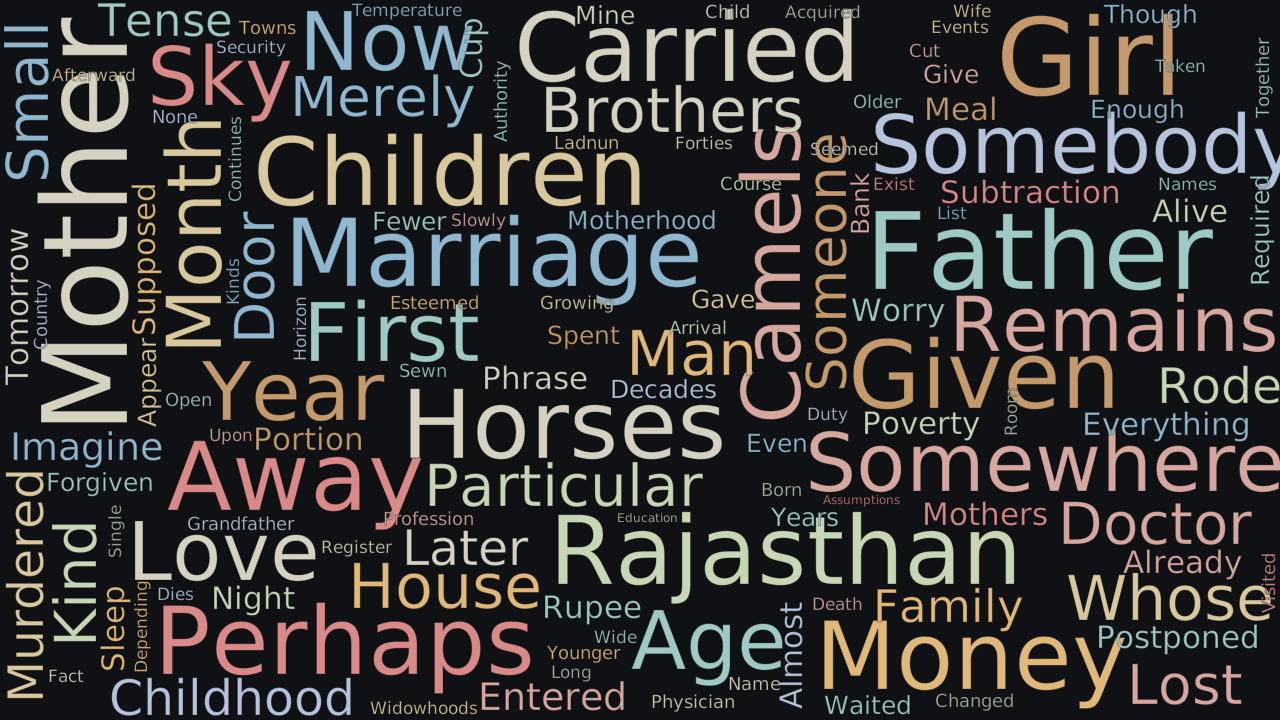
Word Cloud
Related reading
Selected by shared topics and section, with closer publication dates breaking ties.