Shashthi, With the Curtains Down
Uses the speech voice supplied by your browser or device.

To give full credit and support to the original creator, please click the video title and watch it on YouTube. Once you go to their channels, you will discover many more videos that are not here. My linking them here is not to take traffic away from them or YouTube where they make a few cents, but to introduce them to a wider world who may not have yet stumbled on them.
I am already at the dismantling.
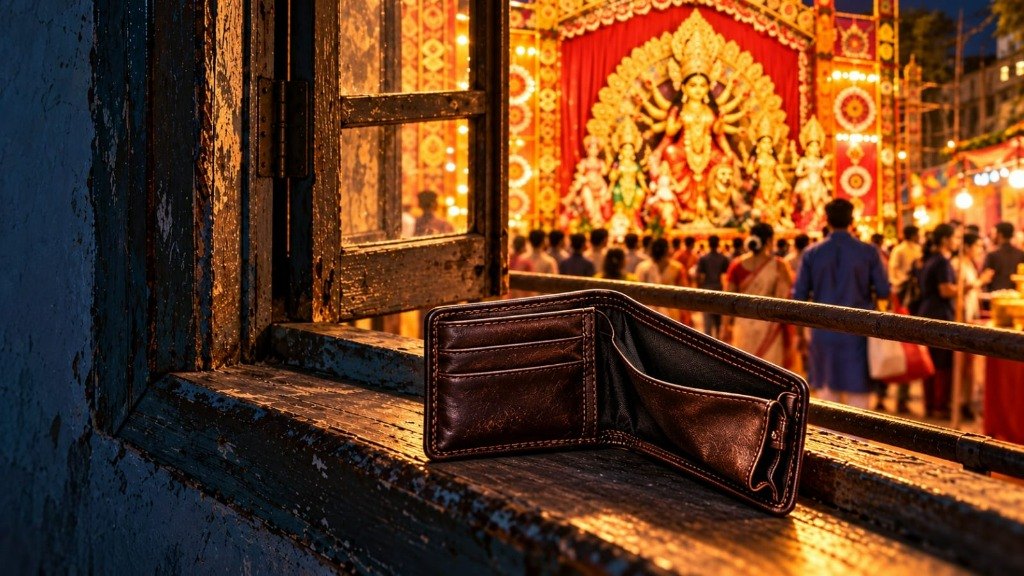
It is Shashthi, and my mind has somehow got through the entire festival, removed the lights, dismantled the pandals, disposed of the extraordinary, and returned me to the ordinary with all my original defects carefully accounted for. Nothing missing. Nothing repaired. A scrupulous inventory of the same old wreck.
I wanted to write something happy today.
People seem able to do that. Give them a reason, an occasion, a little borrowed brightness, and something in them answers. The evening is pleasant; they can have the evening. It need not submit a detailed proposal for improving the rest of their lives. They can enjoy a few hours without first obtaining a written guarantee from the following Tuesday.
I envy that permission.
My mind keeps asking what happens afterward.
The money will still be missing. The uncertainty will still be there. I will still have to inhabit myself, which is becoming a tenancy with several serious structural objections. The lights can blink until they develop neurological complications of their own; I cannot see how their blinking changes the life waiting for me when they stop.
And because I cannot see that change, some part of me resists the invitation.
This is how my bipolar depression is getting into Puja. It gets ahead of the pleasure and stands at the exit, showing me what I will be returning to. Before I have entered, I have already come back. Before the evening has happened, it has failed to improve the morning.
There. That is the miserable little mechanism.
The temporary begins to feel fraudulent.
I know a festival has not signed a contract promising to restore my finances, make me desirable company, or persuade my face to stop resembling an apology submitted after the deadline. I know what lights are. I understand decoration. Somewhere beneath this accumulated emotional sludge there must still be a man capable of enjoying a thing for the few minutes in which it exists.
Today I could not reach him.
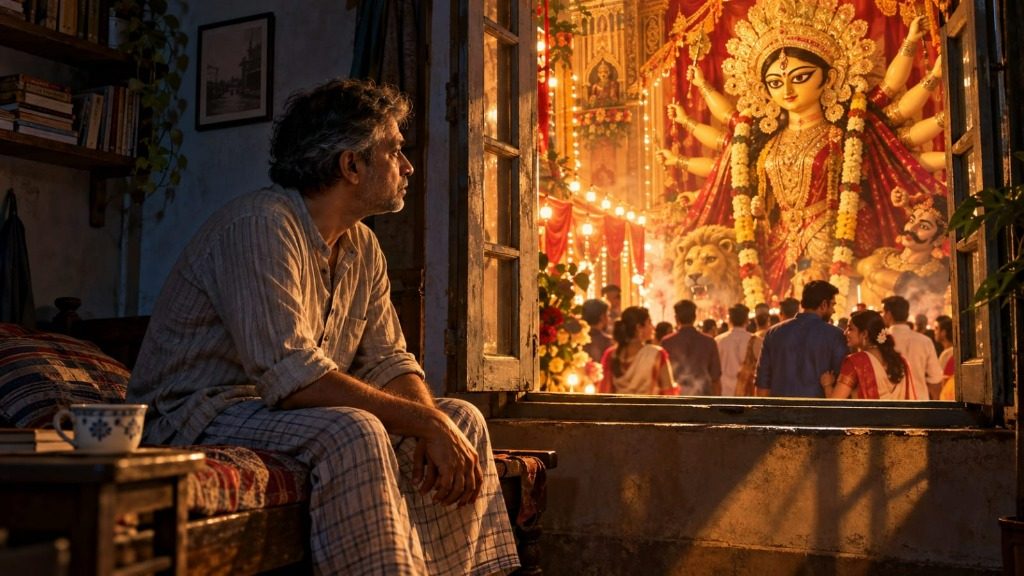
Today I sat in the dark with the curtains down and could not find enough energy to make tea. Then I had a headache as well, so I took a Brufen. Shashthi had arrived. My participation consisted of swallowing something and continuing to sit.
A modest procession. No traffic arrangements necessary.
I had promised to write a post every day during Puja, even if nobody read it. Consequently, the one obligation I managed to manufacture for myself was waiting patiently while all the faculties required to fulfill it lay around like employees of a bankrupt intestinal works.
Write something happy.
Yes, certainly. Let me extract some sunshine from the ceremonial sewer.
The problem is that I want the happiness. I resent wanting it. I resent being unable to take it when it is apparently lying around in such vulgar abundance. I resent the little additional humiliation of recognizing that somebody else could probably have made a perfectly tolerable evening out of what I am spending hours failing to feel.
I am broke, and I look, to myself, like the result of being broke for longer than the packaging was designed to withstand. Unkempt, ugly, old, a hobo with enough self-consciousness to make his own condition an ongoing public inquiry. I imagine trying to join a group for pandal hopping and immediately begin picturing the charitable rearrangement of their evening around the unwelcome object I have supplied.
Would they accept me? Would they merely endure me? Would I spend the whole outing monitoring the difference?
I have conducted this entire unpleasant excursion before leaving.
My situation does not speak the language of celebration. My appearance, as I see it, supplies no convincing translation. I cannot simply put myself among the festive and expect the contradiction to dissolve. I would take it along. It would walk beside me, ugly and attentive, asking whether I was having fun yet.
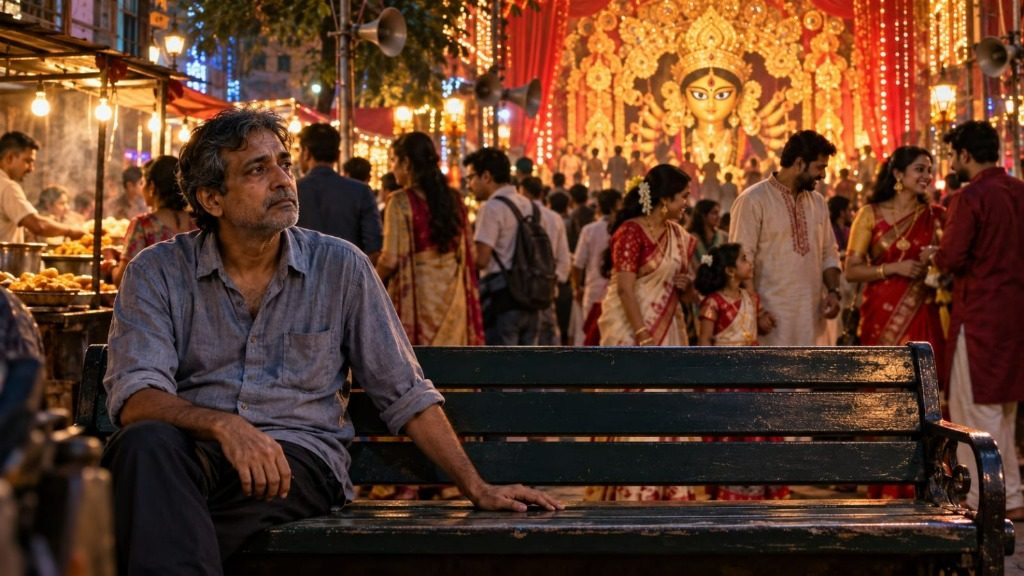
So I do my pandal hopping on the S9 tablet, through YouTube.
This should suit me. No social negotiation. No expense attached to moving from one pandal to another. I can look at the workmanship, the intricacy, the extraordinary things people have persuaded ordinary materials to become. I can understand why somebody would be delighted.
My attention wanders.
I bring it back. It wanders again.
The janky glitter keeps offering itself. Tubelights flash with the confidence of something that has never needed a reason to shine. The festive spectacle rolls on, all bustle and appetite, the galumphing children of prosperity apparently furnished with an inexhaustible supply of tomorrow, and I become this sour little creature outside the glass, examining the entertainment for evidence that it can be trusted.
Of course I cannot know anybody’s entire life from a festive appearance. My mind nevertheless reads the ease on display as a language everybody learned while I was absent.
They seem able to enter the evening.
I keep seeing through it to the days beyond.
This is why the report about Sanjay Mitra caught in me. It gave that refusal an external shape.
In Anandabazar Patrika’s account, Sanjay is fifty-nine. He had run his shop on the Sonarpur railway platform for thirty-seven years, since he was twenty-two. His father had begun by selling bread, cakes, and snacks from a bamboo basket. Sanjay added a showcase and kept the business going.
Thirty-seven years.
You can put that beside a few nights of illumination and feel the arithmetic turn ugly without writing down a single equation.
The report describes eviction notices issued in May. Sanjay says discussions with railway officials had left him expecting at least a few more months before eviction at Sonarpur. The family describes the demolition arriving without the further warning they had expected. He and his wife, Shikha Das Mitra, recount their pleas as the stalls were demolished.
Afterward, ration rice. Cheap produce left unsold at markets. Their son, Shuvankar, looking for odd jobs to help with household expenses. The report presents a family trying to manage the aftermath, without an immediate prospect of rehabilitation.
And Puja arrives.
What does its arrival alter?
Which flashing tube restores the shop? Which magnificent entrance returns the income? How many delighted spectators must pass beneath a themed arch before thirty-seven years of work become somewhere to stand again?
The questions are rude. They spoil the decorative atmosphere. They have arrived at the cultural banquet with the lid off the chamber pot.
They are still questions.
Sanjay shows packets of stock that have expired. He cannot bring himself to throw them away. They were supposed to be sold, eaten, replaced. Their very ordinariness depended on a future in which the shop continued functioning. Now he is left with the things that future was meant to consume.
I understand why those packets refuse to become ordinary garbage.
The festival cannot make them unexpired. Its magnificence cannot reassemble his livelihood. When the lights come down, the loss will remain available in its entirety.
That is what my mind recognizes.
I have no desire to appoint myself the noble guardian of everyone else’s pain. There is enough self-interest in this depression to grease a very large municipal pump. His circumstances and mine are different. What catches me is the persistence of the damage underneath the occasion, the fact that a calendar can announce celebration while the actual conditions of a life continue, unconsulted and unimproved.
I cannot stop noticing that persistence.
The festival asks for a few days. My mind brings the rest of the year.
Every illuminated entrance seems to have an ordinary exit behind it. Every invitation to forget for a while contains the unpleasant certainty that remembering has merely been postponed. I can already feel the return, and the anticipated return gets into the pleasure before the pleasure has had a chance.
People may call that overthinking.
Fine. The machinery is overproducing. Unfortunately, I have been unable to locate the management office, and the complaints department appears to discharge directly into the same intestine.
I know that temporary pleasure can be real. Hunger returns after a meal; the meal still happened. An evening need not cure a life to be worth having.
I can write that sentence.
I cannot make it do its work inside me.
That gap is exhausting. I can explain the possibility of enjoyment while sitting there unable to enjoy. I can identify my own unreasonable demand that happiness provide collateral against tomorrow, and the demand remains. My understanding arrives impeccably dressed, gives a short presentation, and leaves the machinery exactly as it found it.
Some part of me seems to think that joining the celebration would mean agreeing to a description of my life that I cannot honestly supply.
Happy Puja.
Happy according to what?
I would like to be distracted. Instead, I become conscious of attempting distraction. I would like a little relief. Instead, I start measuring how little of my situation the relief could touch. The festive interval shrinks before I can enter it, a brief bright blister on a much longer stretch of unchanged days.
I know how joyless that sounds.
I am the one having to live inside the sound.
The other Anandabazar Patrika report concerns Sonia and Priyanka, two young women who grew up on Kolkata’s pavements. Its title includes “আমরাও পারি”: “We can too.”
Their story resonates with me for a different reason. There are changes in it that continue after the camera stops.
The account describes childhood under leaking plastic coverings and periods of hunger. Sonia lived near the public toilet where her grandmother worked after a pavement clearance, enduring the fumes and sometimes hiding inside to avoid dangerous people. Priyanka describes domestic work, gathering leftover food from bins behind cafes, and collecting plastic bottles during festive days to help manage meals.
The celebration had a place for her in its aftermath.
Pick up what it leaves.
They wanted to learn. The report describes letters written on the pavement with pieces of red brick while other children went to school. An organization eventually helped them enter formal education, late, around class eight. They passed their Madhyamik examinations within two years and are now preparing for higher secondary examinations.
They also make garments and artwork from discarded textile pieces through the organization, earning from their work. Sonia has been able to move into rented accommodation away from the public toilet. Priyanka is still working toward a permanent home of her own.
These details matter to me because they survive the festive lighting.
School remains school the following morning. Earnings can pay for something when the music has stopped. Sonia’s move is a change in the circumstances to which she returns. Priyanka’s housing goal remains unfinished, and I want that unfinished part to remain visible too.
I can understand a reason for celebration there.
I can understand it without suddenly becoming happy myself.
That distinction keeps getting lost.
Recognizing that something good has happened does not automatically produce the corresponding feeling in me. I can want their progress to continue. I can see the importance of the help they received and the work they have done. I can be moved by the difference between writing on pavement and preparing for an examination.
My own darkness does not obediently withdraw.
The good news enters. It encounters the rest of me.
I am still broke. I still see myself as someone whose presence would have to be accommodated. I still look ahead and struggle to find a reason to expect that these few days will leave me anywhere different. Their gains are real, and I am glad those gains exist, but I cannot borrow the future they are building and wear it for an evening.
Nor do I want their story fed into that motivational mincer which turns someone else’s extraordinary effort into another accusation against the person still struggling.
They managed. Why haven’t you?
A little garnish of inspiration on a steaming plate of contempt.
What their account makes visible is the importance of something actually changing: access to learning, support, work, income, somewhere else to live. Sanjay’s account shows how devastating the removal of such things can be. These are the conditions underneath the lights. My mind keeps dragging them into view when I am supposed to admire the lights themselves.
Perhaps someone else can put those thoughts aside for an evening. I find myself unable to set them down even briefly, including the thoughts about my own life, which I would very much like to stop carrying without having to pretend they have become lighter.
The word fraudulent belongs to that feeling.
The pleasure other people have may be entirely real. The performance I would have to give feels false to me. I would be standing there supplying the expected expression while something inside kept asking what exactly had improved, and another part of me kept replying that nothing was required to improve, that I was being impossible again, that an evening was only an evening, and then the first part would ask why, if an evening was only an evening, I should spend the little energy I had impersonating somebody it could satisfy.
Round and round.
A philosophical digestive disorder with excellent verbal skills.
I wanted to write a happy post because it is Shashthi. The wish itself was sincere. I wanted to have something to offer besides another excavation of the same miserable ground. I wanted to look at the celebration and feel invited by it, rather than feel that I was being asked to step away from everything I knew about my circumstances and come back later to find it waiting.
The later is already here in my head.
That is the trouble with the blip. Everybody is pointing to its brightness. I can barely stop seeing its edges.
There is a cup of tea I have not managed to make, and a whole evening I am supposed to enter, and beyond it the days, those ordinary unlit days, asking what, exactly, I expect to have changed.
Word Cloud
Related reading
Selected by shared topics and section, with closer publication dates breaking ties.