Waking Up Depressed in Calcutta
Uses the speech voice supplied by your browser or device.

Acronyms and terms used in this post:
NSAID: Nonsteroidal Anti-Inflammatory Drug, a class of pain-relieving and anti-inflammatory medicines that includes ibuprofen. Brufen is a brand name for ibuprofen. Medicines like this can help pain, but they are not sweets from a para shop; they can irritate the stomach, affect the kidneys, and should be used carefully.
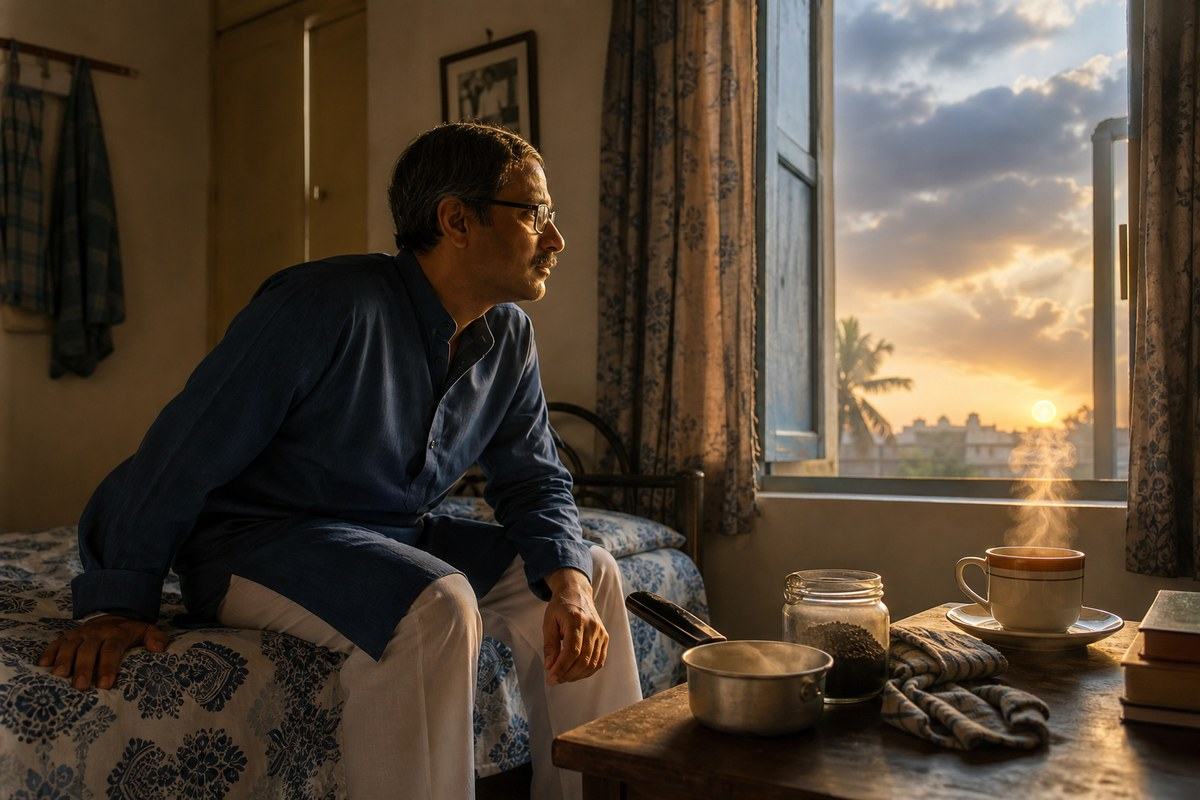
Some mornings I wake up and the day has already stolen my furniture.
Not the wooden furniture. That is still there, looking poor and faithful. The chair. The table. The bottle of water with its cap half-chewed by habit. The fan turning above me like a tired clerk stamping invisible files in Writers’ Building. Outside, Calcutta has begun without asking permission. A scooter coughs. A crow abuses civilization. Somebody’s pressure cooker announces breakfast with the emotional range of a small bomb.
But inside me there is no breakfast.
There is no “me” either, not properly.
I wake up empty. Not sad in a beautiful way. Not tragic like a hero in black-and-white cinema standing beside a river while the violin behaves shamelessly. Empty in the practical sense. As if some burglar entered before dawn and removed the basic equipment of being human: interest, memory, appetite, courage, irritation, even the small foolish hope that tea might improve matters.
That is the first trick depression plays. People think it begins with gloomy thoughts. It often does not. Thoughts require a working mind. On some mornings the mind is still lying in pieces, like a torn mosquito net after a long bad summer.
There is no doom yet.
That comes later.
At first there is only blankness.
This is hard to explain to the cheerful citizen. The cheerful citizen hears “depression” and imagines a man thinking, “My life is terrible.” No. That is an advanced feature. That requires language. That requires a narrator. That requires the mind to sit up, open its ledger, and begin its grim accounting.
On the worst mornings, there is not even accounting.
There is only the body on the bed in the shanty edge of Calcutta, trying to remember how to assemble a universe.
First, locate the ceiling.
Good.
Now the fan.
Good.
Now the headache.
Ah. There it is. Loyal as a bad relative.
The headache usually arrives with the depression, or perhaps the depression arrives wearing the headache like a cheap shawl. It is not always sharp. Sharp would be almost honest. This is a dull, municipal headache, the kind that feels as if someone has kept a wet government file inside the skull overnight and now expects me to sign it in triplicate.
So I take Brufen 400, because for my headaches that is the one medicine that usually works.
I say this carefully. I am not recommending a household religion. In Bengal we are very good at converting medicine into folklore. One uncle says this tablet is magic. One auntie says that syrup destroyed her neighbor’s liver. One pharmacist, with the confidence of a minor emperor, offers three substitutes and a digestive enzyme for no clear reason. Meanwhile the stomach waits quietly, like a tenant who knows the landlord is making bad decisions.
Still, when the head is pounding and the mind is a smashed window, one does not conduct a seminar.
One drinks water. One swallows the tablet. One waits.
Waiting sounds simple until depression teaches you otherwise. Waiting inside depression is not like waiting for a bus. It is like being the bus, the broken road, the annoyed passengers, and the traffic jam at the same time.
The day stretches ahead, but not in a useful way.
That is another thing people miss. A normal day opens. Even a boring day has doors. You can make tea, answer a message, curse the electricity bill, read the news, avoid the news, write one paragraph, wash a cup, pretend to become organized from Monday. The day has handles.
A depressed day has no handles.
It lies ahead like a long damp corridor in a house where the power has gone out and someone forgot to tell you where the stairs are.
The mind is foggy, but not in the romantic hill-station way. Not Darjeeling fog, not shawls and tea gardens and people saying, “How peaceful,” after paying too much for a room with plumbing from the British period. This is private fog. Sourceless fog. Fog without scenery. You can see the phone but not why the phone matters. You can see a message but it lands like a brick. You can think of work and the word “work” turns into a locked gate.
And through all this, outside life continues with vulgar confidence.
A fish seller shouts as if hilsa has national importance. A child cries because socks exist. A neighbor drags a plastic chair across the floor with the sound of civilization ending. The news app, if I am foolish enough to open it, offers its usual breakfast buffet: heat, politics, war, artificial intelligence miracles, artificial intelligence disasters, and some billionaire explaining the future while half the city wonders whether the water pump will run.
The world is not waiting for my mind to reboot.
That is the insult.
And yet I must reboot.
Slowly, absurdly, in pieces.
I do not wake into a mood. I wake into repair work. A man in a small room, middle-aged, single, not heroic, not ruined in any cinematic sense, just there, trying to gather himself like laundry blown off a line during a storm.
One sock from the neighbor’s roof.
One shirt from the drain.
One towel from a guava tree.
That is the self.
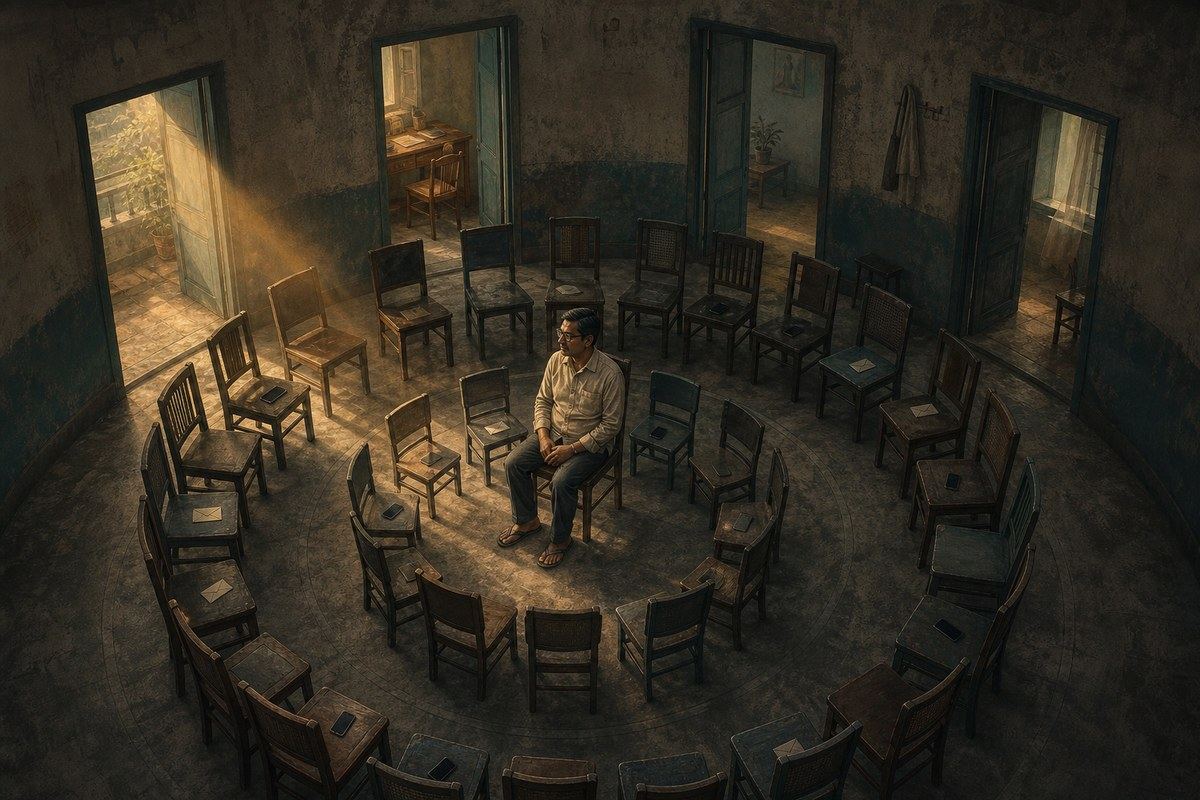
People imagine the self as a solid thing. It is not. On mornings like this, the self is a temporary arrangement. A committee. A bamboo scaffold. A little illegal construction beside the main road, surviving because nobody important has noticed it yet.
Eventually, if the medicine works and the head softens a little, if tea becomes possible, if the body accepts sitting up as a reasonable proposal, something like stability arrives.
Not happiness.
Let us not become ridiculous.
Stability.
A broken ceiling can also be stable if it has not fallen this minute.
This is when the doom comes.
Funny, no? The doom does not come first. The doom waits politely until the machinery starts. Then the apps open automatically.
Money.
Age.
Health.
Work.
Failure.
The future.
The past, of course. The past has a permanent pass. It enters any building without security checking.
One by one they appear, like black windows on a cheap computer. Some are nonsense. Some are exaggerated. Some are unfortunately accurate, which is the most dangerous kind. Depression is not powerful because it always lies. It is powerful because it takes one real difficulty, rubs it with poison, enlarges it to cinema-screen size, and says, “See? This is the whole truth.”
It is not the whole truth.
But at 8:17 in the morning, with a headache behind the eyes and the lane outside smelling faintly of frying oil, damp dust, and human persistence, it can feel like the whole truth.
This is why ordinary advice often sounds so foolish from inside depression. “Think positive.” “Go for a walk.” “Be grateful.” These are not evil sentences. They are just badly timed. They are like telling a drowning man to improve his handwriting.
Later, perhaps, walking helps.
Later, tea helps.
Later, sunlight helps, even the aggressive Calcutta kind that enters the room like a tax inspector.
Later, washing one cup helps. Not because the cup is spiritually profound, but because it is small, real, and obedient. Soap goes on. Dirt comes off. Unlike life, the cup accepts a simple solution.
But first comes the blankness.
First comes the awful little engineering problem of rebuilding a person before lunch.
This is not glamour. I want to be clear. Depression is not a dark velvet coat. It is not artistic depth. It is not a certificate of sensitivity. It is mostly boring, physical, repetitive, and humiliating in small ways. It makes brushing teeth feel like a legal battle. It makes a phone call feel like climbing a water tank. It turns intention into wet cardboard.
And it is physical. Very physical.
It sits in the skull. It enters the neck. It slows the limbs. It changes the weight of the blanket. It makes the room too bright and the future too far. Even hope, when it appears, appears tired, like a tram that has been running since 1947 and would like to retire but cannot.
Still, something in me continues.
Not bravely. I distrust grand words. Brave is what other people call you when they do not have to live inside your head.
Something smaller continues.
A tiny clerk inside stamps a paper.
Proceed.
No slogan. No drum. No triumphant music. Just proceed.
So I proceed.
I sit up. I drink tea. I wait for the headache to loosen its fist. I do not ask the morning for meaning immediately. Meaning is shy. It does not come when shouted at. It comes sideways, if it comes at all. Through a cup. Through a paragraph. Through the sound of someone sweeping the lane. Through the absurd dignity of a crow walking like a retired headmaster.
By noon, sometimes, I resemble a person.
By evening, sometimes, I can laugh.
Not because everything is fine. Everything is rarely fine. Fine is a rich man’s word, ironed and perfumed.
But I am still here.
A patched-up Bengali man on the edge of Calcutta, with a nervous system that behaves like an old ceiling fan with loose wiring, a head that needs repair more often than a para road after rain, and a stubborn habit of making sentences from the wreckage.
That is not victory in the grand parade sense.
No band will play.
No minister will cut a ribbon.
But some mornings, when you wake up almost dead and still manage to become partly human by tea-time, that is not nothing.
That is a small, difficult, private republic.
And for one more day, it holds.
Word Cloud
Related reading
Selected by shared topics and section, with closer publication dates breaking ties.