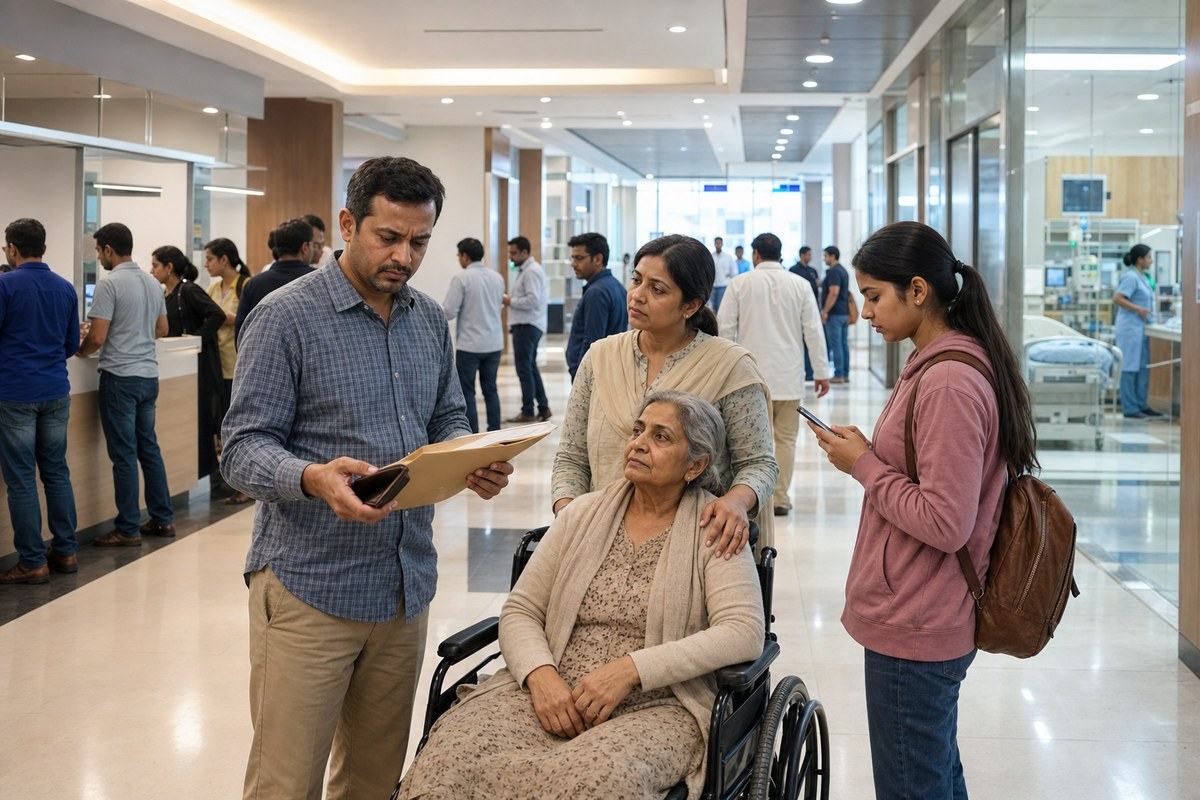
The Pharmacy Bandh Is Not About Apps. It Is About Trust Being Sold by the Strip.
Quick Answer
The conflict between local chemists and online pharmacies is not just a contest between shops and apps. Medicine safety depends on prescription validity, licensed custody, storage, traceability, substitution, counselling, privacy, and accountability from manufacturer to the patient's hand.
Key Terms
- Online Pharmacy
- Community Pharmacy
- Chain of Custody
- Prescription Validation
- Medicine Storage
- Traceability
- Substitution
- Patient Safety
Frequently asked questions
Why is medicine delivery different from ordinary e-commerce?
Medicines can require valid prescriptions, controlled storage, identity checks, counselling, substitution rules, recall capability, and a traceable licensed chain of custody.
What trust does a community chemist provide?
A known local pharmacy can offer continuity, immediate questions, practical counselling, accountability, and knowledge of the patient, though those benefits still depend on competent and ethical practice.
Can online pharmacies improve access safely?
Yes, if licensing, prescription review, storage, delivery, privacy, traceability, pharmacist access, substitution, and complaint handling are enforced rather than treated as optional friction.
Uses the speech voice supplied by your browser or device.

Acronyms used in this post: AIOCD — All India Organisation of Chemists and Druggists, the national body representing retail and wholesale chemists in India. CDSCO — Central Drugs Standard Control Organisation, India’s national drug regulatory authority. GSR — Government Statutory Rules, a formal government notification used to create or amend rules. ADHD — Attention Deficit Hyperactivity Disorder, a condition for which stimulant medicines may sometimes be prescribed. WHO — World Health Organization, the global public health agency of the United Nations. FDA — Food and Drug Administration, the United States drug regulator.
Medicine is not shampoo with a fever.
That is the small fact our clever age keeps forgetting. Shampoo may be fake and you will get dandruff, irritation, or a wounded sense of betrayal. A fake antibiotic is another beast. It may fail quietly inside a child’s body. A fake cancer drug is not fraud; it is cruelty with an invoice. A recycled expired sedative is not a “bad customer experience.” It is a criminal act with a delivery slot.
So when retail chemists call a bandh against online pharmacies, it is tempting to laugh. Another dharmaghat. Another shutter down. Another procession of middle-aged men with files, banners, and the wounded dignity of people who suspect the future has been eating their lunch.
But pause a little.
Not for them only. For yourself.
Because the real story is not “chemist shop versus app.” That is the cartoon version, useful for television debates and people who enjoy making everything into a cricket match. The real story is this: who touched your medicine before it touched your tongue?
A brick-and-mortar pharmacy is not pure. Let us not garland it like a freedom fighter. Anyone who has lived in India knows the neighborhood chemist can be part pharmacist, part family counselor, part unofficial doctor, part magician, part man who will sell antibiotics with the casual air of someone handing over toffees. The old system has plenty of sins. Some are small. Some are not.
But a physical shop has a face.
That face matters.
There is a license on the wall. There is a counter. There is a shop name. There is a locality. There are regular customers. There is memory. The shopkeeper may know your father’s diabetes, your mother’s blood pressure, your own tendency to panic at midnight and buy antacids as if acidity were a constitutional crisis. It is not a perfect control. But it is a control.
Online, the face becomes a screen.
And screens are wonderful things. I am not some romantic uncle declaring war on technology while using WhatsApp all day. Online pharmacies can help patients. A bedridden person needs delivery. An elderly widow in a small town needs access. A working daughter may need to order insulin for her father while trapped in office traffic. A properly regulated online pharmacy could be a blessing.
The dangerous word is properly.
Without proper regulation, online medicine delivery becomes a long corridor with many doors and very few nameplates. Behind one door may be a licensed pharmacy doing honest work. Behind another may be a warehouse with poor storage. Behind another may be recycled stock. Behind another may be counterfeit strips. Behind another may be a prescription upload system so flimsy that even a mildly bored schoolboy could trick it before finishing his muri.
And then there is the darker matter: drugs that people do not buy merely to get well.
Sleeping pills. Anxiety medicines. Stimulants. Painkillers. Cough preparations. Psychiatric medicines. Medicines that sit at the edge of treatment and misuse, like a man standing too close to the railway track.
The online prescription system, when weak, can become theater. Upload something. Answer something. Click something. Wait for approval. A few hours later the packet arrives, and society congratulates itself on digital transformation. Meanwhile, the old question remains sitting in the corner like an unpaid electricity bill: was this medicine truly needed, properly prescribed, properly checked, and properly dispensed?
That question is not anti-business.
It is civilization.
The chemists are angry about GSR 817(E) and GSR 220(E). One belonged to the unfinished attempt to frame rules for e-pharmacies. The other came from the pandemic period, when doorstep medicine delivery was allowed under emergency conditions. During COVID, this made sense. Nobody wanted an elderly man with a lung problem standing in a queue, coughing into the hot afternoon while the virus wandered about like an invisible pickpocket.
But India has a special talent. Emergency arrangements arrive with a mask on, then quietly become permanent furniture.
What begins as temporary relief becomes a business model. What begins as patient access becomes investor scale. What begins as convenience becomes a loophole with a marketing budget.
And here the chemists are not entirely wrong.
They may be fighting for their livelihood, yes. Of course they are. A man whose shop is being eaten by an app will not suddenly speak in the pure language of public health. He has rent, staff, family, GST filings, distributor credit, and blood pressure of his own. But a self-interested person can still point at a real danger. If a house is on fire, it does not matter whether the first man shouting “fire” also owns a water tanker.
The danger is chain of custody.
That phrase sounds like something from a police file, but it is simple. When a strip of tablets reaches you, can we prove where it came from, who manufactured it, which batch it belongs to, when it expires, who stored it, who sold it, who checked the prescription, and who will answer if it harms someone?
For ordinary soap, this may be excessive.
For medicine, it is the whole game.
Without chain of custody, you are trusting packaging. And packaging is the easiest part to fake. A box can look respectable. A logo can look official. A strip can shine. A website can have smiling doctors and blue buttons and language so clean it smells faintly of a corporate seminar. None of that proves the tablet is what it says it is.
The world already knows this. WHO has warned for years about substandard and falsified medical products. FDA warns Americans about unsafe online pharmacies. Interpol has run international operations against illegal online medicine sales. This is not Bengali paranoia from a tea stall. This is a global industry. Crime has discovered logistics, websites, payment systems, couriers, and customer segmentation. Crime now wears sneakers and understands user experience.
India’s version is more complicated because our formal and informal systems are married to each other in a long, unhappy household.
We have brilliant pharma companies. We also have weak enforcement. We have honest pharmacists. We also have casual over-the-counter misuse. We have regulators. We also have inspection shortages, political pressure, slow courts, and that familiar Indian fog in which responsibility enters wearing a shirt and exits as mist.
Meanwhile, the patient is not a philosopher. He is just trying to buy medicine.
Today in the southern fringe of Calcutta, where I sit with a fan pushing warm air around like a tired clerk moving files, a man buying medicine is not thinking about global pharmaceutical crime. He is thinking: will my father’s tablet come today? Will the shop be closed? Is the online price cheaper? Can I trust it? Why is one strip cheaper by thirty percent? Is it a discount or a warning?
That last question is the small knife.
A discount can be honest. A discount can also hide opacity. It can be procurement power. It can be investor subsidy. It can be old stock. It can be a trap. The customer cannot easily tell. In a good system, he should not have to be a detective. But in India, the citizen is always asked to become a detective after the State has misplaced its spectacles.
This is why the bandh is both meaningful and doomed.
Meaningful, because the chemists are pointing to a real regulatory hole.
Doomed, because the real perpetrators are not standing behind retail counters.
The deeper problem sits in governance. It sits in a system where rules remain half-written, enforcement remains underpowered, and large business finds gaps faster than ordinary citizens find justice. Online pharmacy is not just national business. It is tied to platform economics, logistics networks, data capture, payment systems, investor capital, and global models of pharmaceutical commerce. Small chemists may shout. Citizens may suffer. But the people who profit from ambiguity often sit much higher, in rooms where the tea is better and the chairs do not wobble.
Corruption does not always look like a man taking a bribe in a brown envelope. That is the old cinema version. Modern corruption often looks like delay. Like silence. Like a rule not notified. Like a file not moved. Like a grey zone preserved because grey zones are profitable. Like enforcement that wakes up only when the corpse count becomes embarrassing.
That is the unpleasant smell in this story.
Not technology. Not even commerce.
Complicity.
A serious country would not solve this by simply banning online pharmacies. That would be too crude, and probably impossible. Patients need access. Digital systems can help. Rural India, elderly India, disabled India, working-class India — all need better medicine access, not lectures from people who can send a driver to the market.
But a serious country would also not allow prescription medicines to behave like discounted phone chargers.
Every online pharmacy order should be traceable to a licensed pharmacy, a real pharmacist, a valid prescription, a prescriber identity, a batch number, an expiry date, and a storage record where needed. High-risk drugs should have stronger checks. Prescription reuse should be controlled. Returns should be tightly managed, because returned medicine is where tampering and expired stock can sneak back into the river. Platforms should not be allowed to say, “We are only intermediaries,” and then enjoy all the profits of being trusted healthcare providers.
Trust cannot be outsourced to an app screen.
The same standard should apply to the local chemist too. No sentimental exemption. If a brick-and-mortar shop sells prescription drugs loosely, stores badly, substitutes dishonestly, or participates in diversion, it should face real consequences. The point is not to protect old shops from new shops. The point is to protect patients from everybody.
That is the adult position, though adult positions rarely trend.
The childish version says online is modern, retail is backward.
The opposite childish version says retail is honest, online is criminal.
The truth, as usual, is less decorative and more useful: both can be good, both can be crooked, and both must be forced into visible accountability.
Because the tablet does not care where it came from. Your liver does. Your nervous system does. Your infection does. Your child’s fever does.
A medicine supply chain is like drinking water. You do not judge it by the last tap only. You ask where the water came from, which pipe carried it, who maintained the reservoir, where the sewage line runs, and why the water smells funny every third monsoon. If someone says, “But look, the tap is shiny,” you are allowed to be unimpressed.
That is online pharmacy today. A shiny tap attached to pipes we have not properly inspected.
The retail chemists’ bandh may inconvenience people. It may also be partly self-serving. It may not solve anything. But it has opened a door to the correct room. Inside that room is not a sentimental portrait of the neighborhood chemist. Inside is a harder question.
Who owns the risk when medicine becomes commerce at internet speed?
Not the patient. The patient has owned enough already.
P.S. References: Indian Express reporting on the May 20 retail chemists’ strike and objections to GSR 817(E) and GSR 220(E); Press Information Bureau updates on CDSCO actions and e-pharmacy regulation; CDSCO draft e-pharmacy rules from 2018; GSR 220(E) pandemic doorstep-delivery notification; Drugs and Cosmetics Act, 1940 and Rules, 1945; WHO material on substandard and falsified medical products; FDA guidance on counterfeit medicine and unsafe online pharmacies; Interpol Operation Pangea reporting on illegal online pharmaceutical trade; Amazon India public information on Amazon Pharmacy.
Healthcare IT consulting
Working through a difficult clinical data or interoperability problem?
I advise on HIE and EHR architecture, HL7/FHIR interoperability, clinical data migration, terminology, analytics, and AI data readiness.
Word Cloud
Related reading
Selected by shared topics and section, with closer publication dates breaking ties.