The AI Moat Is the Missing Salary
Uses the speech voice supplied by your browser or device.

Acronyms used in this post:
AI — Artificial Intelligence, software that performs tasks associated with human thinking, language, prediction, pattern recognition, planning, or decision-making.
AGI — Artificial General Intelligence, the proposed class of AI that can perform a broad range of economically useful tasks across many domains.
GPU — Graphics Processing Unit, a chip originally built for graphics but now widely used in AI because it can perform many calculations in parallel.
HR — Human Resources, the department and machinery that manages hiring, firing, payroll, benefits, compliance, and the soft upholstery around corporate brutality.
CEO — Chief Executive Officer, the person officially at the top of a company.
VC — Venture Capital, high-risk investment money placed in companies expected to produce very large returns.
UBI — Universal Basic Income, a proposed system where people receive a regular income from the state regardless of employment.
The AI business model is not a mystery. It is a salary with a red circle around it.
That is the thing to understand before all the music starts. Before the panels, before the launches, before the smiling demo where a cheerful machine plans your holiday, writes your email, teaches your child fractions, summarizes your blood test, and produces a picture of a panda in a bowler hat. These are not the business model. These are the flowers in the lobby.
The vault is elsewhere.
The vault is labor.
No serious person can look at the money being poured into AI and conclude that the grand prize is a twenty-dollar subscription from people asking for recipes, poems, and help with Excel. That is tea-stall money. Nice tea-stall money, perhaps. But tea-stall money does not build planetary data centers. It does not buy mountains of GPUs. It does not justify the feverish language of AGI, sovereign AI, AI agents, model ecosystems, enterprise transformation, and all the other incense smoke now rising from Silicon Valley.
The only economic story large enough is labor displacement.
Not assistance.
Not empowerment.
Replacement.
Let us say it without the corporate talcum powder. A human worker is expensive. Every month the worker returns as a cost. Salary. Benefits. Leave. Training. Complaints. Family emergencies. Illness. Boredom. Judgment. Resistance. Sometimes even dignity, which HR departments generally treat as an unplanned integration failure.
A machine does not ask for weekends.
A machine does not wonder whether the company’s mission statement has the moral depth of a biscuit wrapper.
A machine does not sit in a tea shop after being laid off, staring at a chipped glass and calculating rent.
That is why the machine is attractive.
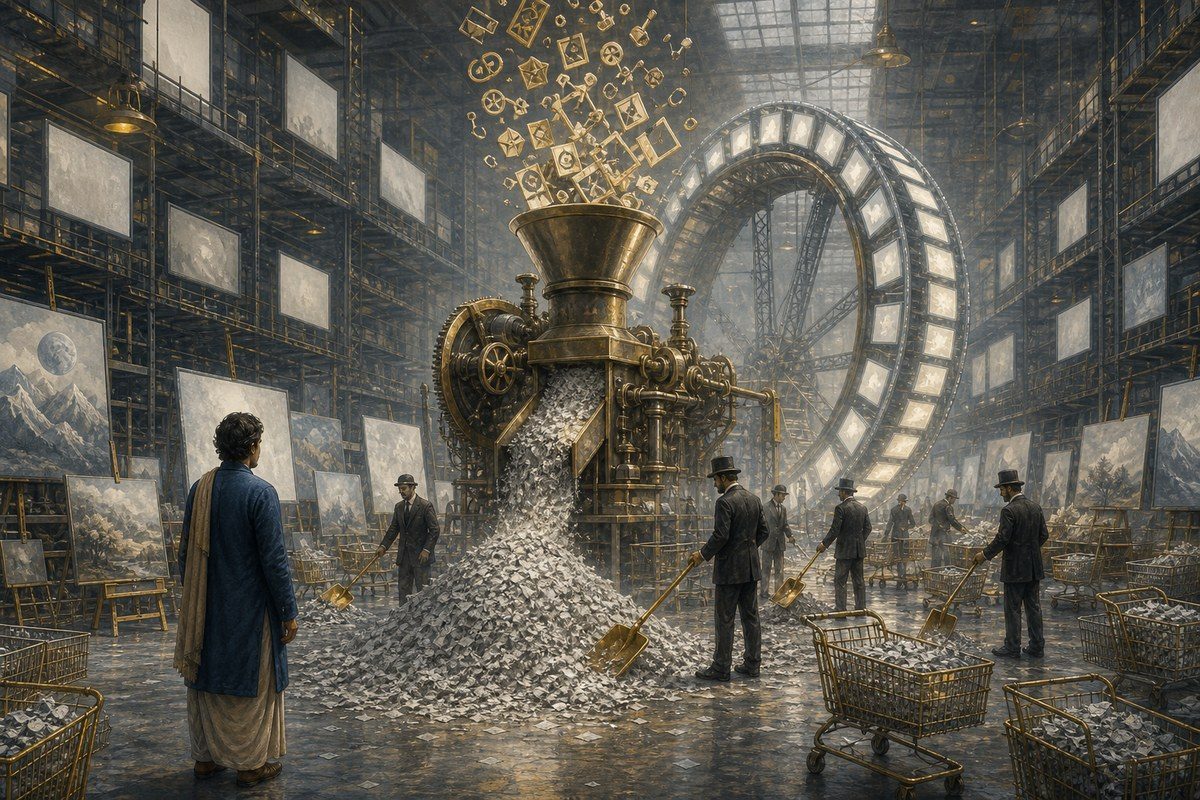
The AI moat is not that the model can speak beautifully. Beauty is decoration. The moat is that an employer can route work to software instead of to a person. When that happens at scale, the AI company does not merely sell a tool. It becomes the tollbooth between capital and labor. It says to every firm: here is a way to spend less on people.
That is the business.
Everything else is brochure language.
You will hear that AI will make workers more productive. Of course it will, for some workers, for some time. A sharper knife helps the cook. But if the restaurant owner discovers that one cook with three machines can do the work of six cooks, the story changes. The knife is no longer merely a tool. It is a quiet pink slip with a handle.
This is the part usually softened with optimism. New jobs will come, we are told. New industries will emerge. Workers will reskill. Humanity will adapt. A lovely bedtime story, with a small lamp and clean bedsheets. But the business model does not wait for displaced people to become new kinds of professionals. It books the savings now.
The worker is told to prepare for the future.
The company is already deducting the worker from the present.
That is the asymmetry.
The AI company wants to sell replacement capacity today. The employer wants cost reduction today. The investor wants margin expansion today. The worker is offered a vague tomorrow, wrapped in a webinar.
I am not interested in decorating that with hope because hope is not a pricing model.
The pricing model is this: if a human task costs $50 and a machine can do it for $5 well enough to satisfy the buyer, the human is in trouble. Not because the machine is conscious. Not because the machine is wise. Not because the machine has read Tagore and wept into its motherboard. The machine only needs to be cheap, scalable, and acceptable.
Acceptable is the dangerous word.
It does not have to be perfect. Most systems are not perfect now. Most offices already run on half-broken processes, confused spreadsheets, stale dashboards, heroic clerks, nervous managers, and undocumented workarounds known only to one person called Kartik-da who has not taken leave since 2017. Corporate life has never required perfection. It requires something good enough to pass upward without causing an immediate fire.
AI is being built to be good enough.
Good enough to answer the customer.
Good enough to draft the report.
Good enough to review the document.
Good enough to write the code.
Good enough to replace the junior analyst.
Good enough to reduce the call center.
Good enough to stop hiring.
That last one is important. Displacement does not always arrive as mass firing with dramatic music. Often it arrives as a job that never appears. A vacancy not filled. A fresher not hired. A contractor not renewed. A small team told to “do more with AI.” The missing job does not march in protest because the missing job never had a body.
This is how the floor disappears.
Not with a bang.
With a budget revision.
The first victims are likely to be the people who need the first rung most. Entry-level workers. Junior coders. Support agents. Content writers. Back-office staff. Analysts. Assistants. People who learn by doing the dull, repetitive, necessary work that senior people now pretend was beneath them, though it is exactly where their own judgment was formed.
A profession without boring beginner work is like a ladder with the bottom sawn off. It may still look impressive hanging on the wall. It may even be discussed at conferences. But try climbing it from the ground.
This is not nostalgia. I do not have a romantic affection for clerical misery. I have spent enough time inside offices, hospitals, data systems, ticket queues, and consulting arrangements to know that much work is badly designed and spiritually close to being trapped in a photocopier. But bad work is still income. It is also training. It is also social power. It is how a person gets a foothold in the economy without being born into a family where people say “networking” over soup.
AI threatens that foothold.
Here in the shanty edges of Calcutta, the phrase “future of work” can sound like something printed on a glossy brochure in an air-conditioned room far from the smell of drains, frying oil, damp walls, and May heat. But the matter is not distant. A young Indian with a laptop was once told the world had opened. Learn English. Learn coding. Learn digital tools. Serve clients across oceans. Compete.
Now the laptop contains the competitor.
That is the little horror story. You bought the ticket, reached the station, and found the train had hired a ghost to do your job.
Earlier waves of outsourcing moved work from expensive labor markets to cheaper labor markets. AI moves work from labor to capital. That is a much colder transfer. A job that once went from New York to Bangalore may now go from Bangalore to a model hosted in a data center. The person in Kolkata is not only competing with another person in Manila or Warsaw. He is competing with a subscription.
A subscription does not have parents.
A subscription does not need lunch.
A subscription does not develop anxiety when the client delays payment.
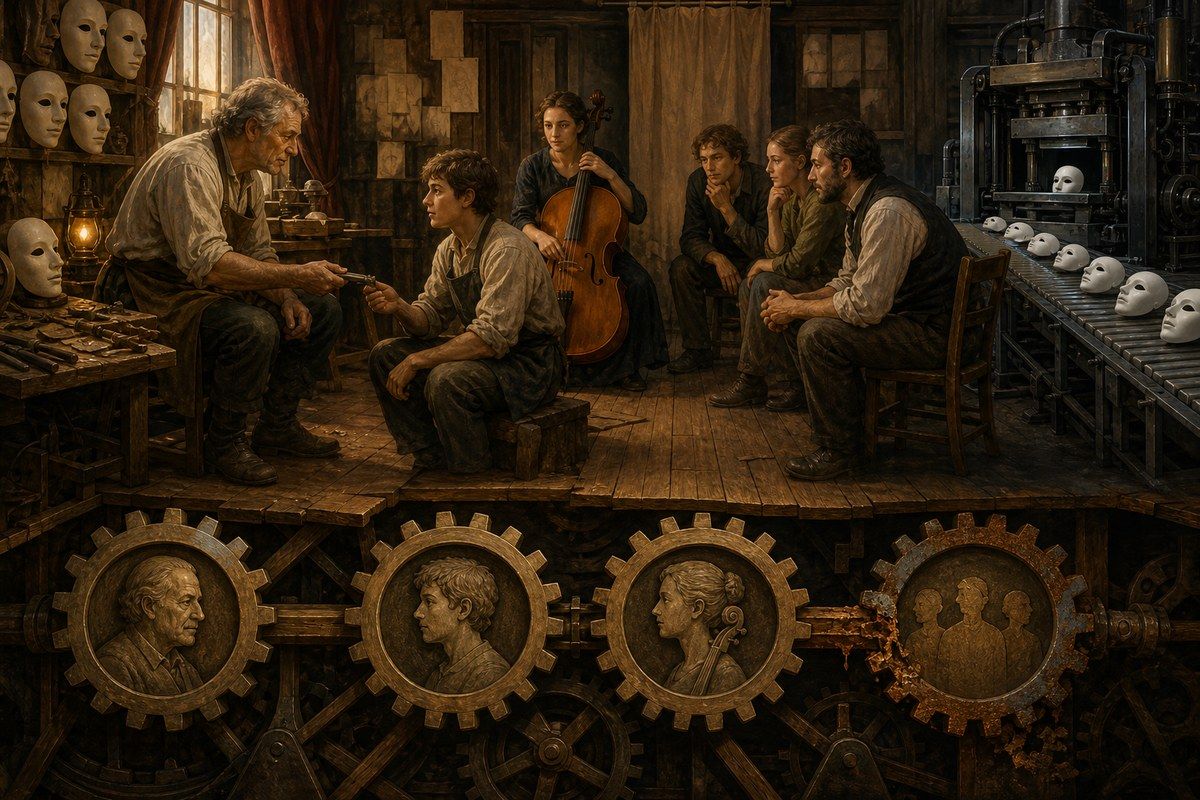
This is why all the soft language around “co-pilots” and “assistants” should be read with suspicion. The assistant phase is the beachhead. First the machine helps the worker. Then it measures the worker. Then it absorbs pieces of the worker’s job. Then management discovers the worker was not as necessary as previously assumed. The system that sat beside you moves into your chair.
The chair is the point.
Not the poem.
Not the demo.
The chair.
AI companies are not fools. They know where the money is. Enterprise buyers are not fools either. They do not buy AI at scale because they enjoy novelty. They buy it because they expect leverage: fewer people, faster output, lower unit cost, more control. Labor is messy because labor is human. AI promises labor without the human part.
That promise is the product.
The deepest moat will not belong simply to the company with the smartest model. Models improve, leak, imitate, and become commodities. The deeper moat belongs to whoever embeds AI inside the workflow: email, tickets, calendars, code repositories, HR systems, finance systems, customer support, compliance queues, document review, sales operations, analytics, procurement. Once AI sits where work is assigned, monitored, judged, and routed, it can decide whether a human needs to be involved at all.
That is not a chatbot.
That is a labor switchboard.
And once a company owns the switchboard, it owns the choke point.
Think of an old marketplace. Many sellers, many buyers, much shouting, much bargaining, much sweat. Then one fellow builds the only bridge into the market and charges everyone to cross. That bridge is the moat. In AI, the bridge is not merely access to information. It is access to automated work.
This is why the phrase “AI agent” should make workers pay attention. An ordinary tool waits. An agent acts. It takes a task, breaks it into steps, calls other tools, checks results, reports back, and gradually becomes less dependent on human prompting. The more autonomous it becomes, the closer it gets to replacing the person who used to coordinate the work.
Autonomy is not a side feature.
Autonomy is where payroll reduction lives.
A passive AI can help an employee.
An autonomous AI can become the employee.
That is the line.
It is fashionable to say humans will remain “in the loop.” But loops can shrink. At first the human does the work and AI assists. Then AI does the work and the human reviews. Then AI handles the easy cases and humans handle exceptions. Then the exception rate drops. Then one human supervises what ten humans once did. Then the human is present mostly for liability, like a potted plant with a professional certificate.
The loop becomes a leash.
Then a thread.
Then a memory.
The ordinary reader may ask: but will customers accept it? Often, yes. Not because they love it. Because modern life trains people to accept bad service if the price is hidden and the alternative is worse. We already shout into automated phone trees. We already argue with banking apps. We already receive templated apologies from companies that appear to have been assembled from damp cardboard and indifference. The bar is not high. AI does not have to create paradise. It only has to be cheaper than Rajat in support and tolerable enough that most customers give up before reaching a human.
That is a bleak standard.
It is also a commercially useful one.
The moral trick will be to call this progress. Every displacement will be described as efficiency. Every vanished role will become optimization. Every frightened worker will be told to embrace change. The language will be clean because the act is not. Corporations have a genius for laundering violence through nouns. Firing becomes restructuring. Wage pressure becomes competitiveness. Surveillance becomes productivity analytics. Replacement becomes transformation.
Transformation of whom?
Into what?
For whose margin?
These are the questions buried under the confetti.
And no, this does not mean AI companies must hate humanity. Motive does not require cartoon villainy. A system can do harm while every individual inside it feels innovative, hardworking, visionary, and slightly under-caffeinated. The VC wants returns. The CEO wants dominance. The engineer wants to build. The customer wants savings. The government wants national advantage. The employer wants fewer costs. Each step has its own local logic.
Add them together and the worker is standing in the road.
That is how modern systems harm people. Not always through moustache-twirling evil. Through aligned incentives pointing at someone else’s livelihood.
The grand myth is that intelligence itself is the product. It is not. Intelligence is the engine. The product is substitution. If AI could think brilliantly but never replace a paid task, the investment frenzy would collapse into a hobby for rich nerds and philosophy departments. The reason the money roars is that human beings are economically valuable to replace.
That sentence is ugly.
It is also the sentence around which the industry turns.
The worker’s value becomes the target. The salary becomes the prize. The profession becomes a market to enter, map, automate, and extract. The AI company looks at the economy and does not see people first. It sees tasks. Tasks with costs. Costs with margins. Margins with investors waiting.
Break the job into tasks.
Automate the tasks.
Reduce the headcount.
Capture the savings.
That is the machine under the machine.
There will be talk of safety. There will be talk of ethics. There will be talk of human-centered design. Some of it will be sincere. Some of it will be useful. Much of it will be the small mint leaf placed on top of a very large bill. Because the economic drive remains. If the company can replace labor and does not, another company will. If one employer hesitates, a competitor will move. If one country slows, another country will boast of speed. This is how everyone excuses the race while claiming privately to be worried about the finish line.
The result is not an accident. It is a direction.
A direction toward fewer workers having bargaining power.
A direction toward more wealth accruing to whoever owns compute, models, platforms, and distribution.
A direction toward the conversion of wages into fees paid to AI infrastructure.
A direction toward human beings being told they are still valued, while every procurement meeting asks how many of them can be removed.
I know this sounds harsh. Good. It should. The soft version has already been written a thousand times, usually by people whose jobs are not first in line. We should not flatter ourselves with the idea that every displaced person will glide into a better, cleaner, more creative role. Some will. Many will fall. Some will hang on at lower wages. Some will become contractors supervising machines that displaced their former colleagues. Some will vanish from the statistics into family dependency, informal work, depression, or the great Indian art of somehow managing.
Somehow managing is not an economic policy.
It is a wound with a smile drawn on it.
If we want to understand AI honestly, we must follow the money all the way down to the missing person in the chair. The moat is built from that absence. The value proposition is that absence. The pitch to enterprise customers is that absence, even when dressed up as productivity. The investor story is that absence multiplied by millions.
The machine does not need to hate the worker.
It only needs to be cheaper.
The company does not need to announce replacement.
It only needs to stop hiring.
The future does not need to arrive with thunder.
It can arrive as an empty desk, a cancelled requisition, a support line with no human option, a junior job that never opens, and a senior manager saying with a straight face that the team has been “empowered.”
Look there.
Not at the demo.
Not at the slogan.
Not at the smiling keynote.
Look at the salary that disappeared.
That is the AI moat.
P.S. References: McKinsey Global Institute, “The economic potential of generative AI”; Stanford HAI, “AI Index Report”; Anthropic, “Economic Index”; International Labour Organization reports on generative AI and jobs; Goldman Sachs research on AI automation and labor exposure.
Word Cloud
Related reading
Selected by shared topics and section, with closer publication dates breaking ties.