The Second Mouth
Uses the speech voice supplied by your browser or device.

THIS IS A WORK OF FICTION
The first man to divide was eating kochuri beside the tram depot at Esplanade.
This was at 8:17 in the morning, when Calcutta had already begun making its daily bargain with collapse. Office clerks were elbowing into buses with lunch carriers pressed to their ribs. Delivery boys in orange shirts skimmed through puddles like dragonflies trained by creditors. A tea stall balanced ten glass bhaars in one hand and a philosophical contempt for everybody in the other. Above them, tram wires sagged under the wet sky, and old political posters on the wall had begun to peel at the corners, as if even the leaders were trying to escape their own promises.
Dr. Niharika Sen saw the man because she was late.
She had missed the first metro at Kalighat, then the second because an elderly woman fainted on the platform and everyone looked at Niharika with that special Indian certainty that any woman in a cotton kurta and spectacles must either be a doctor, a teacher, or the person responsible. She had taken a taxi from Rabindra Sadan, then abandoned it near Dharamtala when traffic stopped around a lorry full of cement, a bus with its bonnet open, and a cow chewing a newspaper advertisement for luxury apartments in Rajarhat.
The kochuri man stood near the tea stall, one hand still holding a paper plate.
At first he made a sound like someone trying to sneeze politely in a cinema hall.
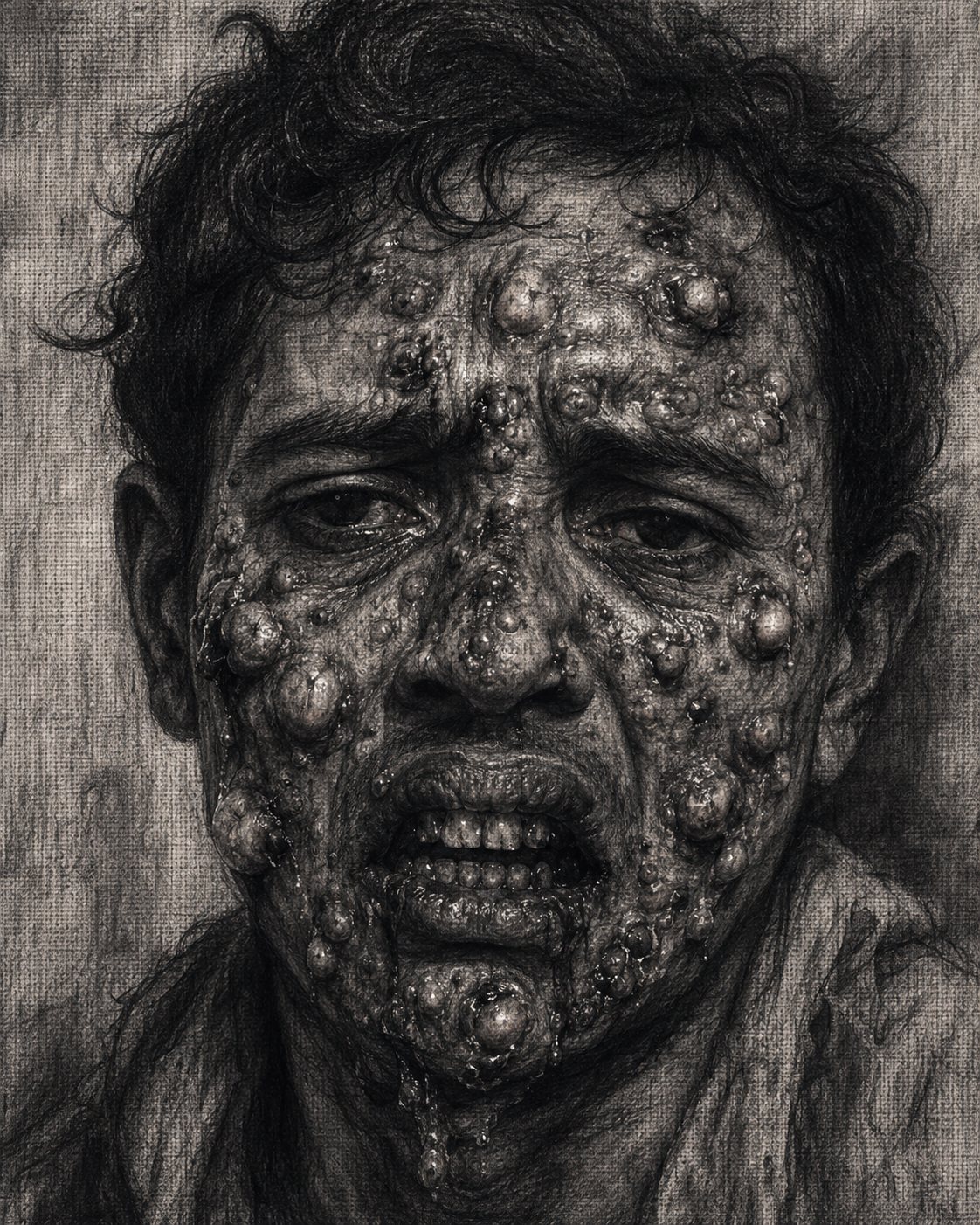
Then his forehead opened.
Not cracked. Not torn. Opened, as if an invisible thumb had pressed down along the seam God forgot to hide. His skin parted from the crown, down between his eyebrows, over the bridge of his nose. The paper plate fell. Potato curry splashed onto his sandal. Both halves of his face turned slightly away from each other, with an almost courteous hesitation, like two relatives after a property dispute.
For one foolish second, nobody screamed.
Calcutta is an old city and has seen many disgraceful things in public: electrocution, riots, film shoots, exam results, municipal repairs. People waited, as people do, for the event to become understandable.
Then the man’s skull softened and widened.
Something wet and pink rose in the gap. Not blood alone. Brain, membrane, a glossy rope of tissue twisting down from inside his skull, forming a helix between the two halves of his face. His eyes had gone cloudy. The left eye looked at Chowringhee. The right eye looked at Lenin Sarani. Neither appeared to be looking from anywhere human.
Niharika dropped her bag.
A boy at the tea stall whispered, “Didi, what disease is this?”
The man’s mouth divided last. That was the worst. Each half pulled apart with strings of saliva still connecting them, and when the two new mouths formed, both opened at once.
Hungry.
Not crying. Not pleading.
Hungry.
He bent over the fallen kochuri and ate the paper plate with it.
By noon, the video had seventeen million views.
By evening, the government announced that the clip was fake, possibly foreign-funded, and citizens were requested not to panic. By night, two nurses at Medical College had split while restraining a patient from Burrabazar, and the police barricaded College Street using bamboo poles, yellow tape, and the moral authority of men who knew perfectly well the tape would not hold.
The disease acquired names before it acquired a cause.
News channels called it Bifurcation Fever, though there was no fever. WhatsApp called it the Two-Head Virus, though the heads separated entirely if the host ate enough. A retired professor on television said it resembled mitosis, only on a macroscopic mammalian scale, which made three anchors nod in grave ignorance. In the para, people called it Dui-Mukh Rog. The Two-Mouth Disease.
Niharika worked at a private diagnostic chain near Park Circus, one of those bright, efficient places where the floors smelled of phenyl and aspiration. The sign outside promised preventive health packages for heart, liver, kidney, thyroid, and “executive wellness,” as if the body knew one’s designation. She had once been a virologist at the National Institute, then became a consultant after her father’s stroke made salary more important than purity. She still hated herself for it in quiet, punctual installments.
Her father lived with her in their old flat near Lake Gardens, in a building whose lift had been “under modernization” since the Left Front seemed permanent. He had been a schoolteacher, a man who could recite Kalidasa and repair a fuse with the same dry irritation. Now he sat in a cane chair by the balcony, one side of his body stubborn and uncooperative, watching gated towers rise beyond the railway line like visiting relatives who had no intention of leaving.
“You saw it?” he asked that night.
Niharika washed her hands for the ninth time. “I saw the first one.”
Her father turned from the balcony. Rain had begun ticking on the grill. Below, someone’s pressure cooker whistled with domestic optimism. “And?”
“And nothing. It is not nothing.”
“That is not an answer.”
“It is the only honest one.”
He smiled with half his mouth. Stroke had not taken his sarcasm; it had only made it more economical. “Honesty is what people use when they have misplaced competence.”
On her phone, messages multiplied. Doctors’ groups, alumni groups, resident welfare groups, one school group she had muted in 2018 but which had resurrected itself for disaster. A forwarded advisory claimed drinking hot water with tulsi would prevent division. Another said the virus was caused by frozen chicken. A third said it affected only people who had taken vaccines. A fourth said it spared vegetarians, after which three vegetarians split in Behala during evening aarti and the message quietly changed to “pure vegetarians.”
At 11:40 p.m., Niharika received a call from Dr. Arko Basu.
She had not spoken to him in six months, except once at a conference where he said, “Good to see you,” with the warmth of a hospital corridor. They had been close in graduate school. Very close, in the old dangerous way of people who mistake shared intelligence for shared courage. He had stayed in government research. She had left. He had never forgiven her for becoming practical. She had never forgiven him for making poverty sound like ethics.
“Nihar,” he said. “I need your old dataset.”
“What?”
“The slum surveillance samples from 2019. Respiratory swabs. The ones from Topsia, Tangra, Cossipore.”
“That project was shut down.”
“I know.”
“It was shut down because funding vanished and half the labels were wrong.”
“I know that too.”
Rainwater gurgled in the pipe outside her kitchen. “Arko, what is happening?”
A pause. Then his voice, lower. “We sequenced tissue from the College Street cases. It isn’t exactly a virus.”
“Meaning?”
“Meaning it behaves like one when it enters. After that, it behaves like an instruction.”
She sat down.
He continued, “It hijacks developmental pathways. Reactivates embryonic symmetry. Forces adult cells into division patterns they should have forgotten. The host’s metabolism goes insane. Glucose, protein, lipids—everything burns. That is why they eat. If they don’t, division stops halfway and they die screaming. If they do, they complete separation.”
“And cognition?”
“The prefrontal cortex is the first to degrade. Language, inhibition, empathy, self-recognition. Gone before the skull opens.”
“So what remains?”
“Hunger. Motor pattern. Some memory. Enough to walk home.”
Enough to walk home.
The phrase sat between them like something alive.
“Why my dataset?” she asked.
“Because this organism may have been here before. Quietly. Low-level. Misdiagnosed. We saw markers in old archived reads. I need to compare.”
“You don’t have authorization.”
“No.”
“I don’t have access.”
“You do.”
She closed her eyes. There it was, his old faith in her worst habits. He knew she had kept copies. Not for theft, she had told herself. Not for profit. For continuity. For the work. But every moral compromise in science wears a lab coat first, before it discovers the convenience of pockets.
“I’ll come tomorrow,” she said.
“Come tonight.”
Outside, a dog began barking, then stopped abruptly.
The city changed over the next three days with the efficiency of nightmare.
Hospitals filled first. Then markets emptied. Then markets filled again, because fear is strong but hunger has seniority. Fish sellers in Gariahat shouted through masks while customers pressed elbows against one another, suspicious of every cough, every hand raised to scratch the scalp. Metro announcements grew stern. “Passengers are requested to report any visible cranial fissure or abnormal facial separation.” It sounded like a line written by a committee in hell.
At Sealdah, a man split on platform four while waiting for the Krishnanagar local. The crowd surged away, then surged back when the two half-formed bodies crawled toward a pile of bananas. Someone beat them with a luggage trolley. Someone filmed. Someone shouted that the police were useless. Someone stole the bananas.
By then, Niharika and Arko were inside the old virology annex near Beliaghata, sleeping in chairs, eating biscuits, and arguing over sequences while the city outside divided into the infected, the uninfected, and the confidently misinformed.
Arko had grown thinner. His hair, once aggressively neat, had surrendered. He wore the same blue shirt for two days, and there was a small stain near the cuff which Niharika hoped was tea.
“You should go home,” she said on the fourth night.
“So should you.”
“My father is alone.”
“Then why are you here?”
Because I am afraid to watch him split.
She did not say it.
Instead she said, “Because you called.”
He looked at her then, and for a moment the lab returned to a younger time: two people at a microscope, sharing bad coffee and the arrogant belief that knowledge, if pursued hard enough, would behave. Then a scream rose from the ward below, a thick tearing scream that became two thinner ones.
The spell broke.
Their assistant, Kabir, came in carrying a tray of samples. He was twenty-four, from Barasat, with gelled hair and the frantic cheerfulness of a man supporting five relatives on contract pay. He had been delivering medicines by scooter during the second COVID wave; now he pipetted viral horror for less money than an app driver earned in surge pricing.
“Madam,” he said, “new sample from Howrah. But the ambulance people are refusing to bring more. They want cash.”
Arko rubbed his face. “Everyone wants cash.”
Kabir shrugged. “Cash has not split yet, sir.”
That was Calcutta’s true genius, Niharika thought: even at the edge of species failure, someone would make the correct small joke.
The breakthrough came from Cossipore.
One of Niharika’s old archived swabs contained a fragment identical to the current organism’s entry mechanism. Not active. Not infectious. A fossil whisper. The sample belonged to a twelve-year-old boy from a municipal school survey. The metadata was a swamp of bad spelling and missing fields, but one detail survived: his father had worked at a tannery waste unit near Tangra.
They searched more.
Tangra. Topsia. Cossipore. Garden Reach. Places where the city kept its necessary dirt. Places where leather, metal, plastic, blood, dye, solvent, sewage, and prayer all entered the same water and came out renamed as development. In official language, these were informal settlements, unauthorized clusters, economically vulnerable zones. In Calcutta language, these were people’s homes, and one should not pretend the name made the drain smell better.
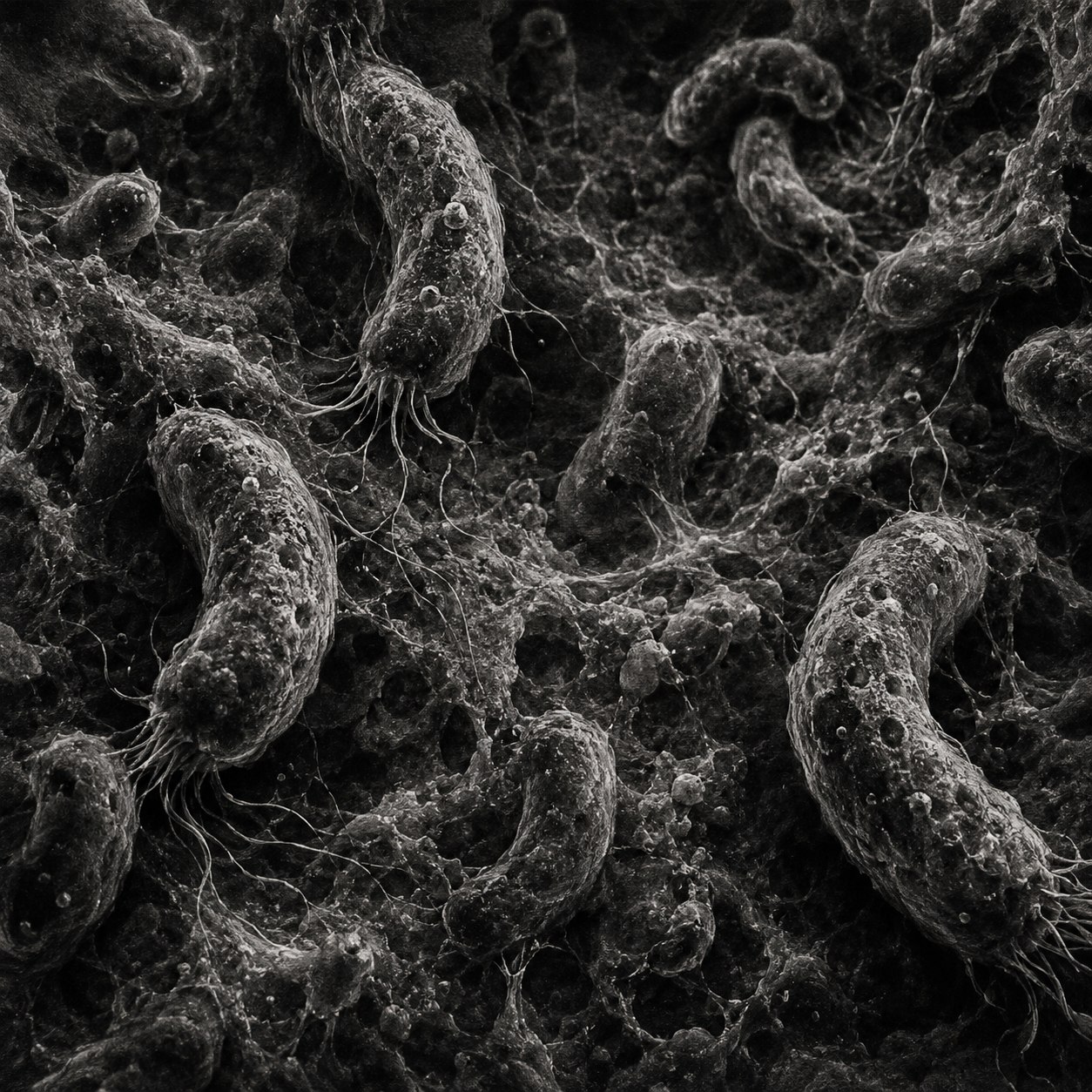
“The organism was environmental,” Arko said. “Probably fungal-viral symbiosis, maybe from industrial effluent and human tissue exposure. Dormant in humans. No outbreak because it lacked a trigger.”
“What trigger?”
He turned the monitor toward her.
The answer was not a chemical.
It was a sequence from a gene therapy vector.
Niharika stared at the screen. A coldness passed through her that had nothing to do with air-conditioning, which had failed two hours earlier.
“No,” she said.
Arko said nothing.
Five years earlier, a private biotech company had run an unauthorized trial in three clinics across the city. Not gene therapy, officially. “Immune rejuvenation.” “Cellular repair.” “Aging reversal support.” Rich words for rich people. The trial had been buried after two patients died of organ failure and one politician’s brother developed a tumor shaped like a legal problem. Niharika had consulted briefly on data cleaning. Briefly, she always told herself, as if duration could disinfect involvement.
The vector was designed to awaken repair pathways.
Instead, in people already carrying the dormant organism, it awakened an older command.
Divide.
“How did it spread?” she asked.
“Human secretions after activation. Saliva, blood, possibly sweat. Once the first vector-contaminated carrier entered the general population, the organism adapted.”
She knew before he said it.
“The first carrier,” Arko said, “was probably not from the slums.”
Of course not. Disaster in India often travels business class first, then is blamed on the pavement when it arrives there sweating.
Niharika stood. The room tilted slightly. “The kochuri man?”
“Worked as a driver for one of the trial clinics. According to police contact. He transported biological waste.”
“Was he enrolled?”
“No. He cleaned the car.”
There it was, the city’s social contract in its purest form: one class purchased immortality, another handled the leaking bags.
Kabir entered again, but this time his face was wrong.
Not split. Not yet. Too still.
“Madam,” he said, “my head is itching.”
Niharika and Arko looked at him.
Kabir tried to smile. “Maybe dandruff.”
A thin red line appeared at his hairline.
They locked him in the cold room because there was nowhere else. He agreed at first, then forgot why he had agreed. That was the speed of it. Within six minutes, he had stopped using pronouns. Within nine, he was striking the door with both fists. Within twelve, his voice changed. Not deeper, not higher. Less owned.
“Food,” he said.
Arko slid down against the opposite wall, shaking.
Niharika watched through the small glass window as Kabir’s forehead opened like wet paper. He did not scream until his nose divided. Before that, he only looked offended, as if the body had committed a breach of workplace discipline. The helix formed inside him, red and white and shining. His skull widened. His eyes emptied. Two mouths emerged from the ruin of one.
Both said, “Ma.”
Then both began biting the metal shelf.
Arko vomited into the waste bin.
Niharika did not. She had passed beyond nausea into a clean, bright region where guilt becomes arithmetic.
“His mother,” she said. “We need to warn his mother.”
Arko looked up. “We need to finish the inhibitor.”
“We don’t have one.”
“We have a candidate.”
“It barely slowed replication in cell culture.”
“It’s something.”
“It’s not enough.”
“Nothing is enough!”
Kabir struck the glass with his head. A crack appeared.
They left him there.
Niharika told herself this was triage. The word was useful. It made abandonment sound like mathematics.
That night, power failed across Beliaghata. The generator came on, coughed, died, came on again with a smell of diesel and fatigue. From the roof, the city looked bruised. Some neighborhoods still glowed: towers with backup power, hospitals, malls pretending retail was a form of civilization. Other areas lay dark except for phone screens and cooking fires. In the distance, near Ultadanga, something burned with the orange patience of a bad decision.
Her father called at 1:13 a.m.
“I am fine,” he said immediately, which meant he was not.
“Baba?”
“People are shouting downstairs. Someone in Block C. They say he has two faces.”
“Lock the door.”
“I have locked.”
“Put the almirah against it.”
“With one hand?”
She almost laughed. Almost.
Then he said, softly, “Niharika, when your mother died, I thought the house had split. Same rooms, two lives. One where she was there, one where she was not. I have been living in the wrong half since.”
“Don’t talk like that.”
“I am old. I can talk in any direction I want.”
“I’m coming.”
“No. Finish what you are doing.”
“I don’t know how.”
He breathed for a while. The line crackled. Somewhere near him, someone screamed, then another voice answered with animal hunger.
“Niharika,” he said, “when you were small, you used to ask if people could become two. One to go to school, one to stay home.”
She closed her eyes.
“I told you no,” he said. “I may have been wrong.”
The line went dead.
She took the institute jeep without permission. Arko tried to stop her, then got in beside her because love, even damaged love, is often indistinguishable from poor judgment.
They drove through a city tearing away from itself.
At Moulali, a man ran naked except for a torn vest, his body split to the sternum, two heads snapping at the rain. Near Park Circus, three infected crouched over a goat. At Rashbehari, a puja pandal from last year still stood half-dismantled, goddess eyes painted wide above bamboo ribs, watching men with bamboo sticks beat a creature that had once been a traffic sergeant. The creature did not defend itself. It ate the sticks.
At Lake Gardens, the lane was flooded ankle-deep.
Their building gate hung open. The watchman’s chair was overturned. Someone had written STAY INSIDE in chalk on the stairwell wall, and below it someone else had written, in smaller letters, INSIDE WHAT?
The flat door was intact.
Niharika found her father in the balcony chair.
At first she thought he was asleep.
Then he opened his eyes.
“Late,” he said.
Relief struck so hard she leaned against the wall.
Arko checked the rooms. Empty. No blood. No signs of entry. Outside, sirens moved through rain.
Her father looked at Arko. “You again.”
“Yes, sir.”
“Still thin. Bad sign.”
“Yes, sir.”
Niharika knelt beside the chair. “Are you hurt?”
“No.”
“Anyone came?”
“No.”
“Then why did you call?”
He looked past her, out through the balcony grill at the dark city. “I wanted to hear you before I forgot which one of us was real.”
A red line ran from his hairline to the bridge of his nose.
Niharika did not move.
Arko whispered, “Nihar.”
Her father raised his working hand. “No drama. I have spent seventy-eight years in Bengal. Enough drama has already been deducted at source.”
She took the inhibitor from Arko’s bag. Their candidate. Untested. Weak. Perhaps useless. Perhaps harmful. She filled the syringe with hands that knew the motion even while the mind refused the fact.
Her father watched her. “Will it save me?”
“No.”
“Good. Then we can avoid false advertising.”
“It may slow it.”
“For what?”
She had no answer.
“For you to study?” he asked.
She flinched.
There are cruelties only parents can perform because they know exactly where the child ends and the wound begins. But his eyes softened. “Do it.”
She injected him.
For twenty-three minutes, the line did not widen.
They sat together while rain washed the balcony grill and the city made noises no city should make. Arko stood by the door, holding a kitchen knife, ridiculous and brave. Somewhere below, a pressure cooker whistled and whistled until it became clear nobody was coming to turn it off.
Then her father spoke.
“I can feel it thinking.”
Niharika leaned closer. “What?”
“Not words. A pressure. Like two hands opening a book.”
“Baba—”
“It is not making a copy,” he said. “That is what you think.”
His forehead began to part. Slowly. The inhibitor had bought time, not mercy.
“What is it doing?”
His left eye drifted away from his right. The bridge of his nose widened. A wet shine appeared in the seam.
“It is correcting loneliness,” he said.
Arko said, “We need to go.”
But Niharika could not move.
Her father’s voice thickened. “Every cell remembers division. Before family, before country, before language, before shame. One becomes two. Two become many. That is the first promise. We built civilization by pretending the promise ended.”
The split reached his mouth.
For a moment, two faces looked at her from one head: one terrified, one peaceful.
Both whispered, “Eat.”
Then the chair broke.
Arko dragged her back as the thing that had been her father lunged forward, not with malice, not even with recognition, but with the simple, ancient appetite of multiplication. It struck the balcony grill, tearing skin from both new foreheads. The two mouths bit the iron.
Niharika ran.
She did not remember the stairs. She did not remember the jeep. She remembered only Arko’s hand on her wrist and the absurd thought that she had left her father’s slippers by the bed.
Back at the institute, Kabir had escaped the cold room.
The door had given way. The corridor was smeared with blood and bite marks. The samples were gone, scattered, crushed, or eaten. In the lab, the incubator door hung open. The cultures had been contaminated.
Arko began laughing.
Not loudly. Not madly. Worse. Softly, like a man appreciating a well-constructed joke.
“What?” Niharika said.
He pointed to the monitor.
During their absence, the sequencing run had completed. Kabir’s sample, taken minutes before splitting, contained a new mutation. Not random. Not merely adaptive. The organism had incorporated part of the inhibitor’s structure into its own replication pathway.
Their treatment had taught it patience.
The next wave would split more slowly. Cognition would last longer. People would remain themselves during division.
Long enough to open doors.
Long enough to lie.
Long enough to say, I am fine.
The emergency broadcast began at dawn. All citizens were instructed to remain indoors, avoid physical contact, report symptoms, and not spread rumors. The Chief Minister appeared on television looking exhausted but combed. Behind her stood doctors, police, and men in white kurtas who had the solemn expression of people already preparing to blame one another in private.
Niharika watched without sound.
Arko slept in a chair, or pretended to. Outside the institute gates, a crowd had gathered. Some were infected. Some were not. It had become harder to tell. A woman in a yellow sari held a baby and begged to be let in. A man with a red line down his face argued that it was only a scratch from a cupboard. Two boys pushed an old mother in a wheelchair. Delivery riders, clerks, sweepers, patients, guards, all pressed together in the gray morning, wanting science to do what gods and governments had failed to do: know whom to save first.
Niharika touched her own forehead.
There was no line.
Only an itch.
Small. Almost comic.
Like dandruff.
She went to the bathroom and looked in the mirror. Her face was tired, ordinary, single. Behind it, the lab lights flickered.
When the red thread appeared at her hairline, she did not scream. She thought of the kochuri man, of Kabir saying cash had not split yet, of her father in the balcony, of all the old divisions the city had lived with so comfortably—rich and poor, clean and unclean, inside and outside, human and not-quite-worth-counting.
The disease had not invented anything.
It had merely made the metaphor biological.
Arko knocked on the door.
“Nihar?”
She watched the line descend between her eyebrows with exquisite care, like a vermilion mark drawn by a bride who had finally stopped believing in marriage.
“Nihar, open.”
Her hand reached for the latch.
So did the other one.
Word Cloud
Related reading
Selected by shared topics and section, with closer publication dates breaking ties.