The Thin-Fat Bengali and the Treacherous Little Belly
Acronyms used: BMI — Body Mass Index, a rough height-weight number that often misses hidden belly fat. HbA1c — Hemoglobin A1c, a blood test that estimates average blood sugar over about three months. HDL — High-Density Lipoprotein, often called good cholesterol. LDL — Low-Density Lipoprotein, often called bad cholesterol. TG — Triglycerides, a blood fat commonly raised in insulin resistance. BP — Blood Pressure, the force of blood against artery walls. IR — Insulin Resistance, when the body needs more insulin than normal to handle blood sugar. NAFLD — Non-Alcoholic Fatty Liver Disease, fat build-up in the liver not mainly caused by alcohol. T2D — Type 2 Diabetes, the common diabetes pattern linked with insulin resistance and declining insulin control.
The Bengali belly does not always arrive like American obesity, with drums, flags, a marching band, and a soda cup large enough to bathe a spaniel. It often arrives quietly, like a cousin from Krishnanagar who says he will stay only two nights and is still on your sofa after Puja.
This is the body I keep seeing in Calcutta after returning from San Antonio. In Texas, big was often openly big. Big shoulders, big thighs, big portions, big cars, big people entering Walmart like naval vessels docking in a warm inland sea. There was nothing subtle about it. The body announced itself. The chair negotiated with it.
Here the damage is sly.
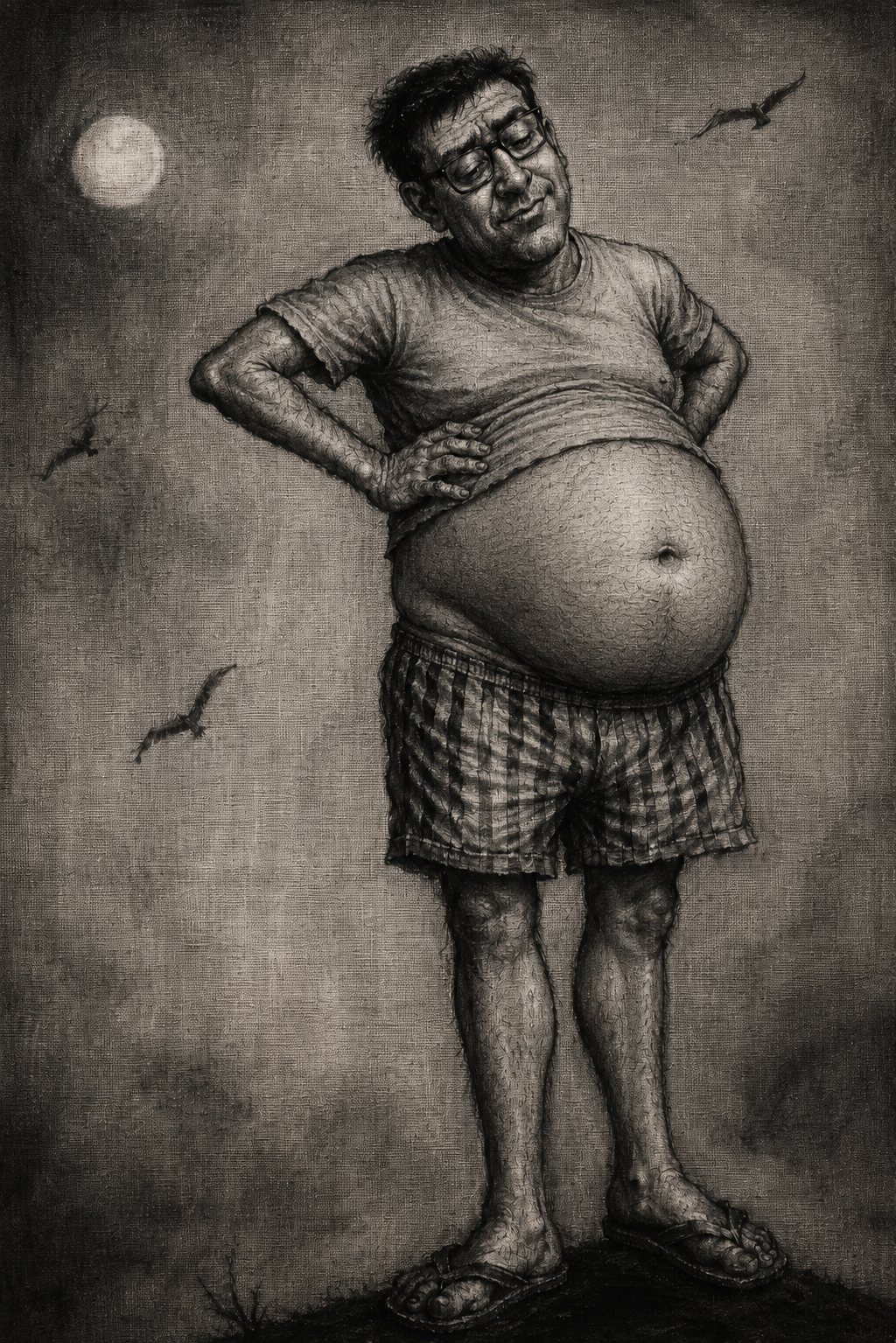
A man stands at a tea stall near a cracked drain. His wrists are thin. His calves look like they were drawn with two quick pencil lines. His face may even be lean. Then the shirt rises a little, or the baniyan clings in May heat, or he bends to pick up a plastic bag of vegetables, and suddenly there it is: the belly. Round, firm, forward, confident. A small republic under cotton.
You think: he is not fat.
But that is the trap.
The thin-fat Bengali is not the man who looks dangerously large. He is the man who looks almost fine until you understand where the danger is hiding. The arms have not joined the conspiracy. The legs remain innocent. The belly alone has taken over the municipal office, the land records department, and the local club committee.
This matters because the body is not a weighing machine with emotions. It is a living arrangement. Fat stored under the skin is one story. Fat stored deep inside the abdomen is another. That deep fat, the one wrapped around organs and crowding the liver, is not decorative fat. It is active, noisy, chemically irritating, and very good at making the body worse at handling sugar.
I am not writing this from a gym-brochure morality. I am writing this as a middle-aged Bengali man in the less cinematic edges of Calcutta, where the day starts with tea, noise, phone anxiety, money worry, the ceiling fan making a small bureaucratic complaint, and the question of whether one has enough energy to become a citizen before noon.
Some mornings even making tea feels like applying for a government permit.
Then one looks outside and sees the city moving: the rickshaw-puller, the office clerk, the retired uncle, the delivery boy, the tuition teacher, the man in checked shorts, the woman carrying market bags, the half-sleeping dog, the political poster peeling from a damp wall, the news on the phone screaming about some new national emergency as if yesterday’s national emergency had taken casual leave.
And beneath all this, the bellies.
Not comic bellies only. Not prosperity bellies. Metabolic bellies.
The old Bengali explanation is wonderfully useless. “Gas.” Everything is gas. Stomach pain is gas. Anxiety is gas. Acid reflux is gas. The collapse of civilization may also be gas. A man can carry a belly shaped like a clay water pot and someone will say, with solemn diagnostic authority, “Ota gas.”
No. Not always.
Sometimes it is fat where you do not want fat. Sometimes it is IR. Sometimes the liver is storing what the mirror has failed to confess. Sometimes the pancreas is working like an underpaid clerk in a government office during audit season, stamping, stamping, stamping, while the queue outside grows longer and angrier.
Insulin is supposed to help move sugar out of the blood and into cells. In a healthy arrangement, it knocks, the door opens, sugar enters, and the day continues. In IR, insulin knocks, the door says, “Come tomorrow.” So the body sends more insulin. For a while this works. Your fasting sugar may still look respectable. Your family may still say you are not fat. Your doctor may still tell you to “watch diet” in that vague way doctors sometimes do, like a man warning you about rain while refusing to discuss umbrellas.
Then the floor gives way.
HbA1c creeps upward. TG becomes mischievous. HDL sulks. BP climbs. The liver becomes fatty. The afternoon rice coma becomes a daily opera. You eat, you sit, your eyelids become two exhausted tram conductors pulling down the shutters.
And still everyone says, “But he is thin.”
That sentence has harmed more South Asians than many visible villains.
South Asians can develop metabolic trouble at lower BMI than many Western populations. This is not because we are uniquely cursed by the gods, though after dealing with broadband customer service one may suspect a cosmic vendetta. It is because many of us carry less muscle, more central fat, and a more dangerous fat distribution at a body size that looks ordinary to the eye. The scale says one thing. The waist says another. The liver says a third thing, but quietly, because the liver has always been a private sort of organ.
BMI is useful in the way a street map from 1987 is useful. It may get you roughly into the neighborhood. It will not tell you which lane is flooded, where the goats are blocking traffic, or which building has no staircase after the second floor. BMI does not know whether your weight is muscle or fat. It does not know whether your belly is round while your limbs are thin. It does not know whether your liver is becoming a storage room for bad decisions, bad luck, and too much starch.
Waist matters.
The tape measure is not glamorous. It has no app, no subscription plan, no influencer partnership, no motivational music. But it tells a rude truth. If the waist keeps growing while the arms and legs remain like bamboo poles, something is happening that deserves attention before the laboratory report becomes a small obituary for common sense.
Now we must speak of rice, carefully, because rice in Bengal is not food only. Rice is weather, mother, childhood, fever recovery, lunch, memory, and surrender. A Bengali plate without rice can feel like a court summons without a case number. What is one supposed to do with fish curry? Drink it from a cup like a defeated poet?
Rice is not evil. No food with such deep civilizational service should be dragged into court alone. The problem is the portion, the timing, the company it keeps, and the body receiving it. A mountain of rice entering a low-muscle, high-stress, poor-sleep, belly-fat body is not the same event as a modest serving of rice eaten by a muscular farmer after a morning of actual physical work.
Same grain. Different story.
This is where modern life cheats us. Our grandparents often ate starch but moved more, lifted more, walked more, squatted more, slept under fewer blue screens, and did not spend half the day locked in a chair staring at rectangles while worrying about invoices, elections, medical bills, job portals, and the latest app notification from a company that believes your peace of mind is an exploitable mineral.
We inherited the rice.
We lost the movement.
And then we added biscuits.
The biscuit is a small criminal. It looks harmless, almost embarrassed by its own existence. Two with tea. Then two more. Then one because the packet is open. Then another because life is short and the news is unbearable. Milk tea with sugar, several times a day, plus biscuits, plus rice, plus potato, plus sweets after someone’s birthday, exam result, office promotion, cataract surgery, or visiting relative from Bangalore — this is how IR is built not with a banquet but with punctuation.
A little here.
A little there.
A whole life.
Mishti deserves its own police file. Bengal has never met a feeling it could not wrap in sugar. Joy? Mishti. Apology? Mishti. Guest? Mishti. New job? Mishti. Bad day? Mishti. Puja? Mishti. Tuesday? Also mishti.
I am not against sweets. I am against sweets becoming wallpaper. A sweet on an occasion is life. Sweetness as background noise is metabolic vandalism.
The false villain is rice alone.
The real villain is a pattern: too much refined starch, too little muscle, too little protein, poor sleep, stress, family history, central fat, sitting, cheap snacks, sugary tea, and the polite cultural conspiracy that says a belly is normal after forty.
Normal, yes.
Harmless, no.
Muscle is the missing hero in this story, and not the ridiculous movie-poster muscle where a man oils himself until he resembles a freshly fried begun bhaja. Ordinary muscle. Boring muscle. Useful muscle. The kind that helps you climb stairs, carry gas cylinders, stand from a chair without making the sound of an injured harmonium, and store glucose after meals.
Muscle is storage space. If you have less of it, sugar after a meal has fewer places to go. The body then leans harder on insulin. Over years, that bargain becomes expensive.
This is why walking helps but may not be enough. Walking after meals is excellent. Ten minutes after lunch can be more useful than a heroic plan abandoned after two days. But some resistance work matters too. Wall push-ups. Chair squats. Slow stair climbing. Carrying grocery bags evenly in both hands. Using water bottles as weights. It does not need a gym. It does not need Lycra. It does not need a man shouting “beast mode” on YouTube while standing in a room larger than most Kolkata flats.
It needs repetition.
The body believes what you do repeatedly, not what you declare on Monday.
Food also does not need to become foreign. Nobody is asking the Bengali to abandon macher jhol and live on boiled sadness. The plate can remain Bengali and become less treacherous. Less rice. More fish or egg or curd or chicken if eaten. More vegetables. Dal, yes, but with the understanding that dal is not a magic protein river. Less sugar in tea. Fewer biscuits. Sweets moved back to occasions. Fruit eaten whole rather than as juice. A short walk after meals. Some strength work. Sleep treated not as laziness but repair.
Simple does not mean easy.
Easy is ordering another packet.
Simple is knowing what must be done and then fighting the day, the mood, the budget, the family kitchen, the heat, the fatigue, and the small inner lawyer who says, “From tomorrow.”
I know that lawyer. He has an office in my skull.
The ordinary middle-aged single man in Calcutta does not wake up inside a wellness retreat. He wakes up to damp walls, unfinished work, relatives asking questions with surgical precision, the stomach slightly sour, the phone already glowing, and the world behaving as if every human being has a personal assistant, a nutritionist, a driver, and a cheerful endocrine system.
So no, the answer cannot be moral scolding.
But neither can it be surrender.
A waist measurement is a beginning. So is HbA1c. So are fasting glucose, lipids, BP, liver enzymes, and a real conversation with a doctor who understands that South Asian risk often wears a thin shirt. If there is family history of T2D, a growing belly, high TG, low HDL, fatty liver, sleepiness after meals, or rising BP, waiting for symptoms is like waiting for the roof to fall before admitting the ceiling has cracks.
The most dangerous moment is the comfortable middle. Not sick enough to panic. Not healthy enough to ignore. Still walking. Still working. Still eating. Still laughing. Still saying, “Reports are not too bad.”
That is where prevention lives.
Not in the hospital.
At the tea stall.
At the rice pot.
At the biscuit tin.
At the tape measure.
At the ten-minute walk after lunch when the lane smells of frying oil, wet dust, petrol, and someone’s overconfident incense stick.
The thin-fat Bengali is not doomed. That is the important part. IR can improve. Waist can shrink. Muscle can return. NAFLD can improve. Sugar control can change. The body is not a court judgment; it is a negotiation. A stubborn one, but still a negotiation.
The belly is a message. Sometimes funny. Sometimes frightening. Often both.
In San Antonio, I saw obesity arrive like a parade. In Calcutta, I see it arrive like a rumor. Slipping under shirts. Hiding inside normal weight. Smiling through family jokes. Sitting at the tea stall, dipping biscuits into sweet milk tea, while the pancreas quietly works overtime in the back room.
Catch it there.
Before the rumor becomes the diagnosis.