Trying to Write About Healthcare IT While the Ceiling Paint Falls Into the Dal
Quick Answer
Writing about healthcare IT in India means describing standards and architectures while admitting that many institutions still lack reliable records, identity, staffing, maintenance, governance, and continuity. Technical ambition matters, but it must begin from the systems that actually exist rather than the diagram we wish existed.
Key Terms
- Healthcare IT
- Digital Health
- Interoperability
- Health Information System
- Data Infrastructure
- Implementation
- System Maintenance
- India
Frequently asked questions
Why can healthcare IT diagrams mislead in weak systems?
They can assume stable source records, identifiers, connectivity, staffing, governance, and maintenance that are missing or inconsistent in the environment where the design must operate.
Does limited infrastructure make technical standards irrelevant?
No. Standards can guide growth and prevent new silos, but implementation must be staged around local capacity, incentives, workflows, failure modes, and long-term support.
What should practical healthcare IT writing explain?
It should connect architecture to real institutions, data quality, ownership, costs, staffing, governance, maintenance, patient consequences, and the compromises required to keep a system working.
Uses the speech voice supplied by your browser or device.

Acronyms used in this post:
Healthcare IT = Healthcare Information Technology, the software and data systems hospitals and clinics use to run clinical, billing, operational, and reporting work.
EHR = Electronic Health Record, the digital chart where patient care gets documented.
FHIR = Fast Healthcare Interoperability Resources, a modern healthcare data exchange standard.
HL7 = Health Level Seven, an older but still dominant messaging standard used between hospital systems.
HIE = Health Information Exchange, systems meant to share patient information across organizations.
The problem with writing about healthcare IT in a blog is that the real thing smells faintly of damp paper, panic, cheap printer toner, and institutional lying.
You cannot really explain it cleanly.
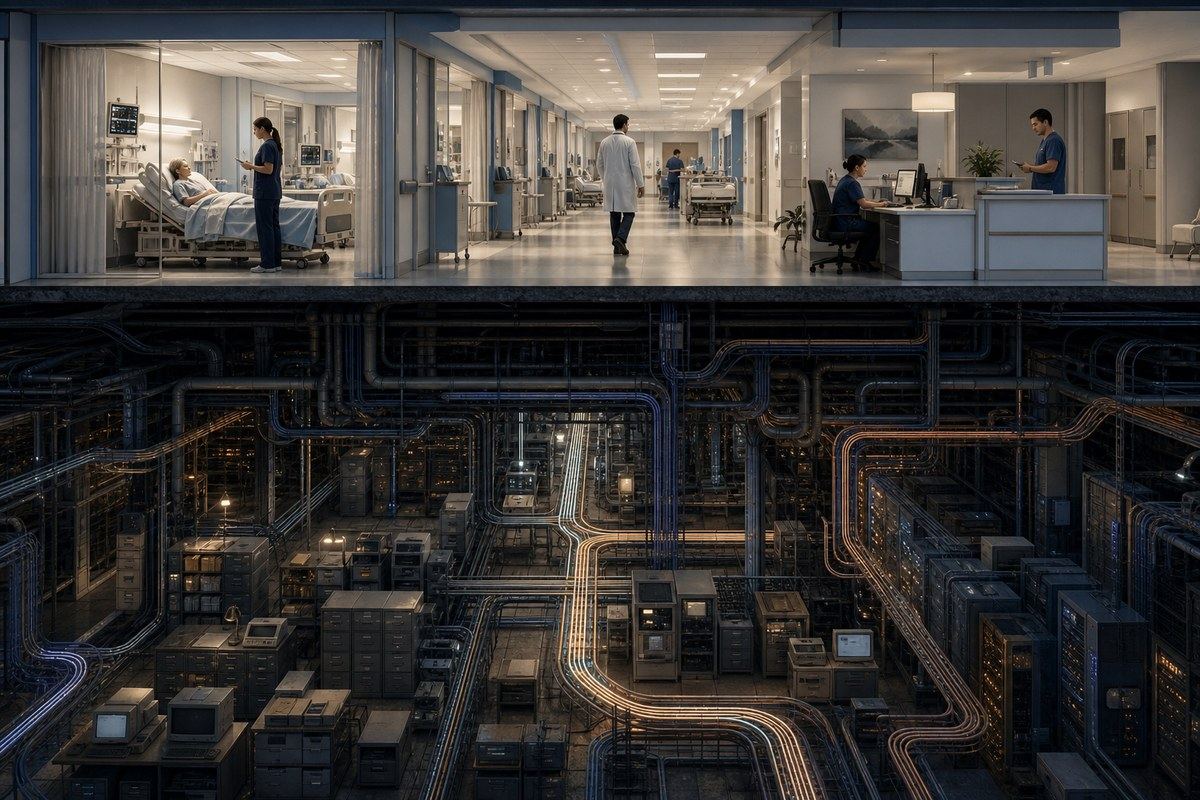
From far away, healthcare IT looks glamorous enough. Artificial intelligence. Digital health. National health stack. Interoperability. Predictive analytics. Dashboards glowing blue like a spaceship in a Christopher Nolan film. Politicians standing in front of LED screens pointing at graphs that rise upward as if illness itself has been placed under administrative control.
Then you zoom in.
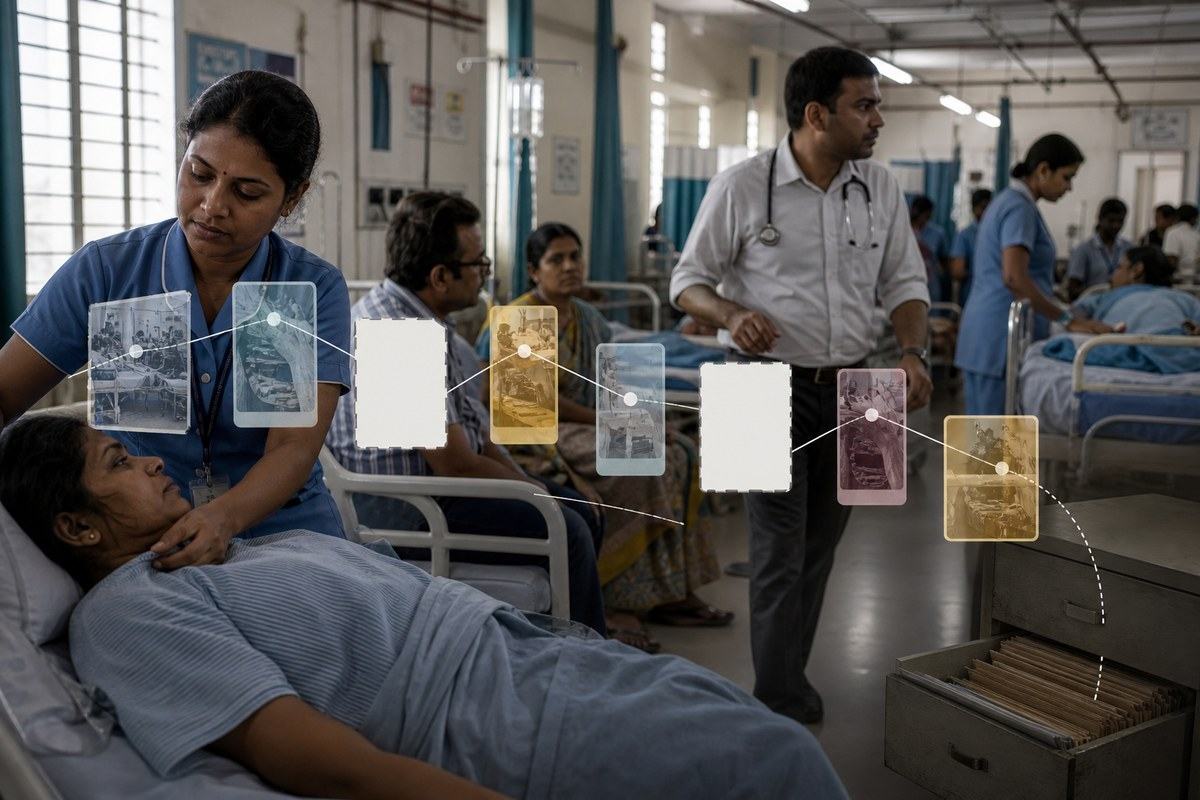
And suddenly you are in a cramped hospital corridor where one exhausted clerk is copying patient information from one computer into another because the two systems do not talk to each other even though both cost crores. A doctor is yelling for a missing CT scan. The internet is down. The billing printer has jammed again. Somebody’s uncle is sleeping on the floor beside the patient bed under a rotating ceiling fan that sounds like a Soviet helicopter attempting retirement.
That is healthcare IT.
Not the conference brochure version. The actual version.
And here is the difficulty. If I stay at thirty thousand feet while writing, the article becomes corporate mashed potatoes. Safe. Smooth. Tasteless. LinkedIn people clap politely like seals at a marine park. But if I descend to street level and start explaining the actual muck — the duplicated records, fake interoperability, broken patient identity systems, endless PDF files pretending to be “digital transformation” — readers begin drifting away like passengers quietly leaving a wedding where the fish curry has gone bad.
You think I exaggerate.
I do not.
A scanned PDF in India is often considered advanced digitization. We are one motivational speech away from calling a stapler “artificial intelligence.”
Meanwhile somewhere in Shenzhen, a metro line gets built in the time it takes Kolkata municipality to debate whether a pothole officially exists.
And there. The moment China enters the conversation, Indian nationalism begins vibrating like a pressure cooker.
“Why don’t you go to China then?”
This is the standard response. It arrives with the reliability of monsoon mosquitoes.
But that is precisely the point. I did not come from China. I came from the north side of Calcutta. Last I checked, Shyambazar had not yet become a Chinese province, though frankly if Beijing fixed the drainage near some of these lanes people might at least stop needing tetanus shots during monsoon season.
The strange thing is that India and China were not always standing this far apart. Older Bengalis remember this. There was once a vaguely similar rural texture to both countries. Dusty roads. Cycles. Shared bathrooms. Agricultural rhythms. Entire afternoons smelling of boiled rice and damp earth.
Then one country became frighteningly competent at infrastructure and manufacturing while the other became world champion in panel discussions.
We debate magnificently.
India can hold a symposium on why the municipal water pipe has not worked since 1998. China would probably replace the pipe before lunch and then build a six-lane expressway beside it just to stay in practice.
Now before the patriotic commandos arrive with tricolor profile pictures and aneurysms, let me say this plainly: China has serious problems too. Surveillance. Rigidity. State overreach. Fear. Lack of political openness. Nobody sensible romanticizes that.
But only a fool refuses comparison altogether.
If your neighbor’s house stopped collapsing and yours still leaks during every rainstorm, it is not treason to ask what cement he used.
Healthcare IT sits directly inside this larger civic story. That is the part people miss.
A hospital system does not magically become organized inside a fundamentally disorganized society. Software is not holy water. You cannot sprinkle Oracle, Epic, Cerner, cloud computing, machine learning, and PowerPoint over civic dysfunction and expect Switzerland to emerge from the smoke.
Data reflects culture more honestly than speeches do.
That is one of the great hidden truths of healthcare IT.
People think medical data is some objective scientific substance sitting quietly in servers like neatly packed rice sacks. It is not. Medical data is generated by frightened humans, tired nurses, overworked doctors, insurance incentives, billing rules, legal fears, bad software design, missing training, and whatever workaround someone invented during a night shift in 2017 that somehow became official policy.
The database becomes a fossil record of institutional confusion.
One hospital identifies a patient by phone number. Another by government ID. Another by spelling. Another by whatever the receptionist heard through a mask behind a noisy fan.
Suddenly one diabetic patient becomes four separate people in the analytics system.
Then management says, “Data quality issue.”
No. Not quite.
That is not dirt. That is representation failure. Different disease entirely.
Saying “the data is bad” is often like blaming the thermometer because the kitchen caught fire.
And this is why writing technical blogs becomes exhausting. Because the deeper truth is always messier than the marketing version.
FHIR can transport healthcare information beautifully. HL7 messages can move millions of records daily. Dashboards can calculate things down to six decimal places. But transport is not meaning.
A train carrying boxes is not the same thing as knowing what is inside the boxes.
One system says “diabetes.” Another says “suspected diabetes.” Another says “family history of diabetes.” Another says “billing code related to diabetes.”
Computers happily exchange all four as though reality itself were neatly folded into rows and columns.
Meanwhile a real human being is sitting in a plastic chair outside radiology eating glucose biscuits from a crinkled packet because he skipped lunch to pay for the scan.
That man is the actual healthcare system.
Not the dashboard.
I sometimes think this is why ordinary readers get uncomfortable with healthcare IT writing. The subject eventually forces you to look at uncomfortable machinery underneath modern life. It is like lifting the lid off your apartment water tank and discovering things in there with opinions.
And maybe that is why I keep writing these blogs despite knowing full well that most readers would probably rather watch reels about productivity hacks or billionaires waking up at 4 AM to consume chia seeds while doing ice baths beside a mountain.
My own mornings are less cinematic.
Usually some crow begins screaming outside around six. The lane below smells faintly of frying oil and drain water. Somebody nearby is already arguing about money. Tea boils. Electricity flickers once like a warning from the gods. I check consulting emails half asleep wondering whether another contract will quietly disappear because some executive somewhere discovered “AI transformation strategy” after listening to a podcast on a flight to Dubai.
Middle age is strange that way.
You become aware that entire civilizations can decline while still sounding confident.
That is modern India in miniature sometimes. Loud optimism wrapped around exhausted systems held together by jugaad, aspiration, caffeine, WhatsApp, and the supernatural patience of ordinary people.
And before somebody says I am being too negative, let me say this too: India still has astonishingly smart people. Brilliant doctors. Engineers. Researchers. Nurses who perform miracles under conditions that would make American hospital administrators faint directly into a risk management committee.
But brilliance scattered randomly across a broken system does not automatically produce a functioning civilization.
A violinist can be gifted. An orchestra can still sound like utensils falling down a staircase.
The healthcare IT lesson hiding inside all this is painfully simple.
You cannot build reliable digital systems on top of unreliable civic foundations forever.
Eventually the cracks rise upward.
Patient identity breaks. Records fragment. Hospitals become islands. Data loses meaning. Clinicians stop trusting systems. People create workarounds. Workarounds become policy. Policy becomes architecture.
And then one day some consultant in a blazer says the country needs “digital transformation.”
At which point half the room quietly opens Excel.
Still, I keep writing.
Maybe because I want at least a few ordinary people to understand that healthcare IT is not really about computers. It is about how societies organize trust. Who gets treated. Who waits. Who pays. Who disappears into paperwork. Who survives long enough to become a statistic.
And perhaps also because I am tired of the dishonest optimism floating around India right now like cheap perfume in a crowded bus.
You are apparently required to say India is becoming a superpower every seventeen minutes or your citizenship gets reviewed by uncles on Facebook.
But walk through enough government hospitals. Sit in enough municipal offices. Watch enough young Indians desperately trying to leave. Watch enough educated middle-aged men quietly collapsing economically despite doing everything “right.” Then the gap between slogan and reality becomes impossible to ignore.
Not unlike those old Calcutta houses where the front balcony still looks respectable from the street but inside the walls are wet, the wiring is ancient, and one good monsoon could send the bathroom through the floor into the sweet shop downstairs.
That, unfortunately, is also a kind of systems architecture.
Healthcare IT consulting
Working through a difficult clinical data or interoperability problem?
I advise on HIE and EHR architecture, HL7/FHIR interoperability, clinical data migration, terminology, analytics, and AI data readiness.
Word Cloud
Related reading
Selected by shared topics and section, with closer publication dates breaking ties.