Universal Basic Income in India After Work Stops Being a Promise
Uses the speech voice supplied by your browser or device.

Acronyms expanded in this post:
- AI: Artificial Intelligence. software that generates, classifies, predicts, summarizes, or acts on patterns in data.
- IT: Information Technology. the practice of building, operating, and supporting computing systems.
- UBI: Universal Basic Income. a policy idea where people receive a regular basic cash payment.
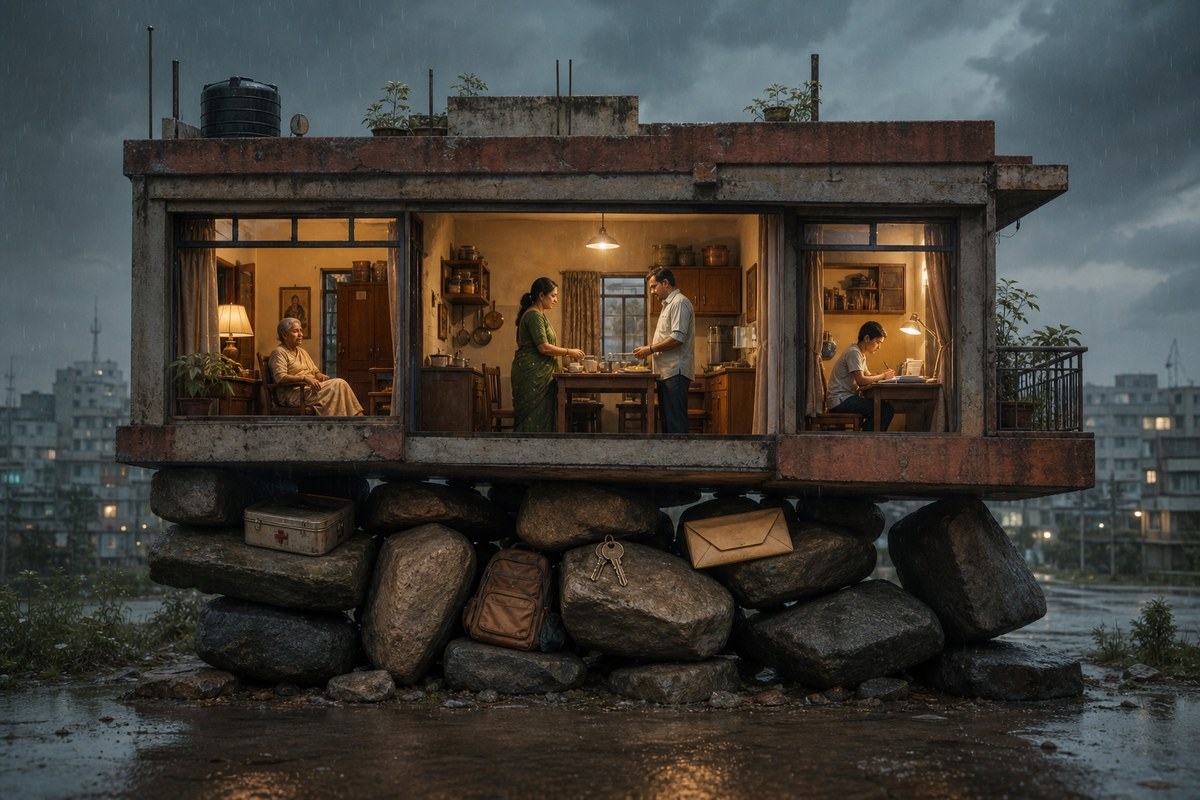
Universal Basic Income [UBI, a regular cash payment made to people without a work test or poverty test] becomes a serious Indian question only when the old national bargain breaks: study hard, learn a skill, behave yourself, and somewhere, somehow, the economy will find a chair for you before the music stops. That bargain is already limping. If Artificial Intelligence [AI, software systems that perform tasks associated with human judgment, pattern recognition, language, prediction, and decision support] and robotics begin removing not merely drudgery but employable dignity from clerks, coders, drivers, nurses’ assistants, call-center workers, junior analysts, accountants, translators, tutors, warehouse staff, and the great educated crowd of résumé-bearing aspirants, then UBI stops being a drawing-room thought experiment and becomes a question of civil peace.
This assumes something important. Normally, new technology does not simply destroy work; it also creates demand elsewhere. This is the old Jevons paradox in a modern waistcoat: make a process cheaper and society may consume much more of it, producing new industries, new tasks, and new forms of employment. Cheaper computing created not less software work but more of it. Cheaper transport created not less travel but a planetary itch to move humans, vegetables, furniture, gossip, and parcels at all hours. But suppose this time the paradox is overcome. Suppose AI and robotics do not merely cheapen production but swallow enough cognitive and physical tasks that new demand fails to absorb the displaced. Suppose the economy becomes wonderfully productive and socially barren, like a mango tree that produces fruit but drops it behind a locked wall.
India is a particularly combustible place for that future because unemployment here is not only the absence of wages. It is the collapse of family investment, marriage arithmetic, caste aspiration, coaching-center debt, urban rent, masculine identity, and the parental myth that education is a bridge rather than a pier ending abruptly over black water. Educated unemployment is cruel in a special way. The illiterate poor are often exploited immediately; the educated poor are first encouraged to wait, improve, certify, apply, refresh portals, sit for exams, and slowly discover that the ladder they were told to climb has been painted on the wall.
The official Indian labor picture often looks calmer than lived reality because a person can be statistically employed while economically stranded. A few hours of work, unpaid family labor, irregular self-employment, gig work without bargaining power, or a tiny subsistence activity can soften the unemployment rate while leaving the household in a state of permanent improvisation. This is not a minor statistical quibble. In a country where the informal sector is less a sector than a weather system, measurement can turn distress into a neat table. The table may be correct by definition and still indecently far from truth.
A UBI in such a setting is not first a poverty scheme. It is a floor under citizenship. Poverty schemes ask, “Are you poor enough to deserve help?” UBI asks, “Should survival be made hostage to labor-market demand?” That distinction matters. Means-tested welfare in India has always carried a familiar smell: forms, middlemen, missing names, wrong names, dead names, caste panchayat pressure, local strongmen, biometric failure, server failure, bank correspondent failure, and the oily little miracle by which the least powerful person in the village must repeatedly prove what everyone already knows. UBI removes some of that theater because it does not require the poor to perform poverty for the state.
But universality is expensive, and anyone who says otherwise is selling incense smoke in a spreadsheet. The Indian state already runs a vast semi-welfare machine: Public Distribution System [PDS, the subsidized food grain distribution network], Mahatma Gandhi National Rural Employment Guarantee Act [MGNREGA, the rural employment guarantee law], fertilizer subsidies, food subsidies, pensions, scholarships, liquefied petroleum gas support, housing assistance, farm income transfers, and Direct Benefit Transfer [DBT, cash routed electronically to beneficiaries]. This is not a clean architecture. It is a crowded bazaar of schemes, each with its own eligibility logic, leakage pattern, political constituency, and administrative priesthood. A real UBI would either sit on top of this system, becoming fiscally enormous, or replace parts of it, becoming politically explosive.
The strongest argument for UBI in India is not that the current welfare state is useless. It is not. Food subsidies matter. MGNREGA matters. Pensions matter. School meals matter. Public health provision, where it works, matters more than cash. The argument is that India’s welfare state is fragmented by design and humiliation by habit. People are not integrated into a social contract; they are processed through a maze. A modest basic income would not replace hospitals, schools, food security, disability support, or employment guarantees. It would reduce the number of ways a citizen can be administratively erased.
This becomes sharper under mass technological displacement. Workfare is a strange answer when work itself has become scarce. Skill programs become cruel when the economy needs fewer people at the end of the training tunnel. Employment-linked incentives may help at the margin, but they assume employers still need bodies if nudged with subsidy. If automation lets firms expand output without expanding payroll, the old policy grammar fails. You cannot train everyone into the narrow balcony where the remaining jobs sit.
The deeper issue is distribution. If AI and robotics raise output while reducing labor’s share, then the fight is not between workers and machines. Machines do not vote, bribe, lobby, or draft tax policy. The fight is between citizens and owners of automated capital. A robot does not impoverish a driver by existing. The political economy around the robot does. Who owns it? Who taxes its output? Who captures the productivity gain? Who pays for the social wreckage? If those questions are left to the market alone, the answer will arrive dressed as efficiency and carrying a knife.
This is where India’s inequality numbers need careful handling. A low consumption-based Gini index can suggest a surprisingly equal society, but consumption is not the same as income, and income is not the same as wealth, and wealth is where power sleeps in silk pajamas. Poor households can look less unequal in consumption because everyone is compressed near subsistence, while the upper end accumulates assets, land, equity, political access, legal insulation, and dynastic advantage. A society can appear modestly unequal in daily spending and be ferociously unequal in ownership of the future. That is not a statistical contradiction. It is a social x-ray taken from different angles.
Poverty has also fallen by important measures, and that should not be sneered away. Fewer people in extreme deprivation is a real human achievement. But poverty reduction does not settle the UBI question. It may even sharpen it. The person just above the poverty line is not secure; he is merely standing on a wet stone. One medical bill, one job loss, one flood, one failed exam cycle, one parent’s illness, one platform policy change, one collapsed small business, and he slides back into the brown water. India has many such people: not destitute enough for moral drama, not secure enough for dignity.
Then comes corruption, the permanent termite in the timber. A UBI in a clean republic is a payment system. A UBI in a kakistocratic and kleptocratic order is a battlefield. Kakistocracy means rule by the worst or least competent; kleptocracy means rule by theft, extraction, and capture. India need not be described as wholly one thing or another to recognize the tendency: public institutions bent toward partisan control, investigative agencies used selectively, regulators made timid, media disciplined by ownership and fear, electoral finance made murky, procurement turned into a feast, and citizenship increasingly filtered through obedience. A welfare scheme inside such a system is never just welfare. It is also a leash, a loudspeaker, and a ledger.
This is the central danger. UBI could liberate citizens from petty gatekeepers, or it could become the most elegant patronage machine ever built. If the payment is universal, automatic, legally protected, and difficult to suspend, it strengthens citizenship. If it is routed through discretionary dashboards, political branding, biometric chokepoints, opaque exclusions, and pre-election generosity, it becomes digital feudalism with better graphics. The same rail line can carry grain or soldiers.
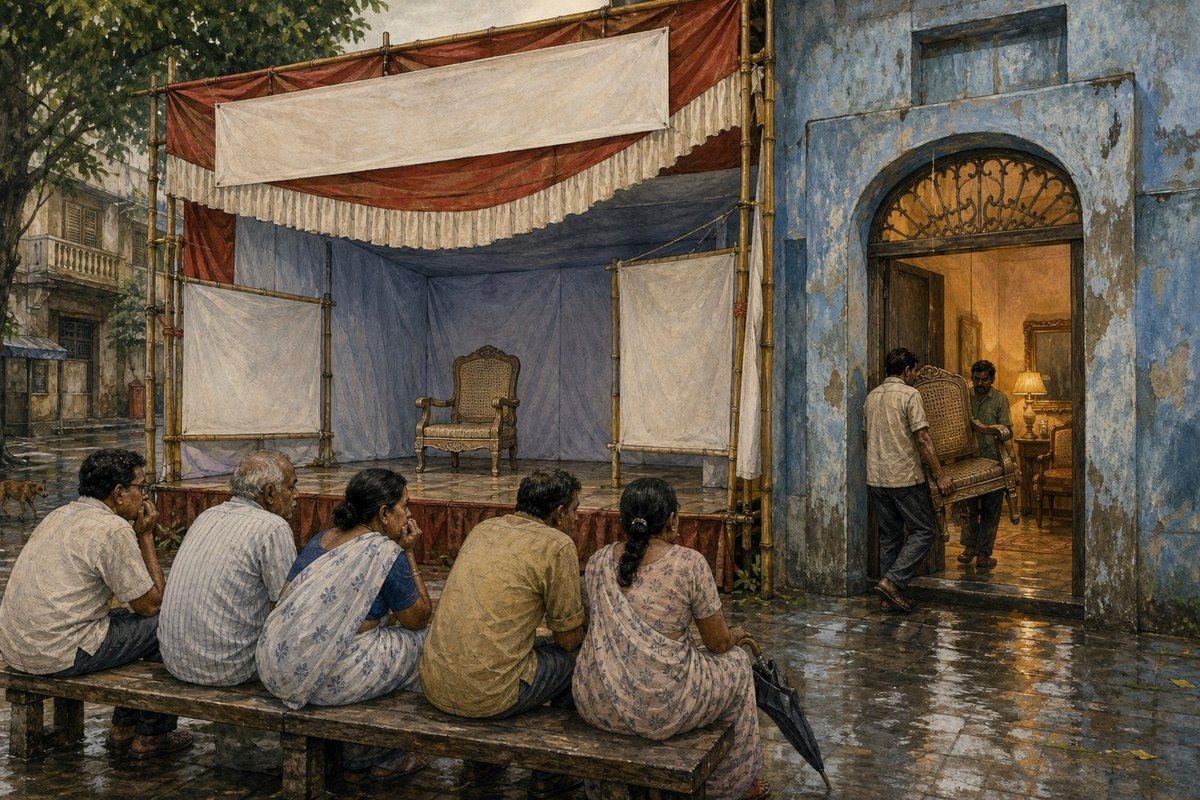
A subverted democracy is especially dangerous because it keeps the outer rituals of consent while hollowing out the protections that make consent meaningful. Elections continue. Speeches continue. Courts continue. Press conferences continue. But the citizen slowly learns that rights are negotiable, institutions are selective, and facts must queue behind power. In such a country, UBI cannot be discussed as a neutral fiscal instrument. It must be designed as anti-capture architecture.
That means several things. First, the payment must be a statutory entitlement, not a benevolent scheme named like a garland. A citizen should receive it because law says so, not because a ruler is photographed releasing installments from a stage. Second, eligibility should be simple enough that exclusion becomes rare and contestable. Third, suspension should require due process, not database suspicion. Fourth, payment rails must be auditable without turning citizens into surveillance livestock. Fifth, grievance redress must exist outside the same local machinery that caused the failure. Sixth, cash must not become an excuse to gut public goods. A poor person with a small transfer and no functioning clinic has not been empowered; he has been handed bus fare to a locked hospital.
A serious Indian UBI would probably not begin as a full universal adult income at a generous level. That would be fiscally heroic, which is a polite way of saying politically unlikely and possibly reckless. More plausible is a layered design: a modest quasi-universal income floor for adults, stronger child and elder benefits, disability supplements, automatic top-ups during verified regional shocks, and retention of food security, public health, public education, and employment guarantees. The boring phrase is “social protection architecture.” The human phrase is: do not replace the roof because you bought everyone an umbrella.
There is also a federal question. India is not a single administrative organism; it is a thundering federation pretending to be a tidy file. Kerala, Bihar, Tamil Nadu, Uttar Pradesh, West Bengal, Maharashtra, Gujarat, and the North-East do not share the same state capacity, fiscal base, labor structure, demographic pressure, or political culture. A national UBI designed without state-level variation would either be too small to matter in expensive regions or too strained to finance in poorer ones. Yet too much state discretion invites inequality of citizenship. The practical route may be a national floor with state supplements, much as some countries combine central guarantees with regional welfare additions. This would require fiscal federalism that is honest, not the current habit of turning revenue sharing into ideological wrestling.
The employment question cannot be abandoned. UBI should not become hush money for a jobless civilization. Humans need income, yes, but they also need participation, competence, routine, recognition, and the peculiar sanity that comes from being useful to someone beyond one’s own anxious household. If AI and robotics reduce formal employment, India will need public work reimagined beyond digging ponds and laying rural roads. Care work, ecological restoration, urban maintenance, elder support, public health outreach, school assistance, archival digitization, local language data stewardship, disaster preparation, and civic infrastructure repair are not fake work. They are the neglected metabolism of a country. The problem is that India often refuses to pay for what keeps it alive.
A basic income paired with public service options may be more humane than either alone. UBI gives bargaining power. Public work gives social anchoring. Together they say: you will not starve because the market has no use for you this quarter, and you will not be treated as waste because the machine can type faster than you. This matters especially for educated and skilled people who are not poor in the traditional welfare imagination but are vulnerable to downward mobility. The unemployed graduate in a rented room, the mid-career software tester displaced by automation, the nurse trained for a shrinking private hospital payroll, the call-center worker replaced by a multilingual model, the accountant eaten by automated compliance software: these people may not fit old poverty categories, but their political despair can become volcanic.
Financing is the immovable boulder. A meaningful UBI would require some combination of subsidy rationalization, higher taxation of top incomes and wealth, better property taxation, carbon and resource rents, data and automation-linked levies, inheritance taxation, improved compliance, and less theatrical spending on vanity infrastructure. None of this is easy. The rich will call it punishment. The middle class will fear it is next. Corporations will predict capital flight. Politicians will prefer schemes they can announce repeatedly. Bureaucracies will defend the complexity that gives them relevance. The poor will be told cash makes them lazy by people whose own inherited assets have been napping productively for generations.
A robot tax is emotionally satisfying but technically tricky. Taxing robots as robots invites evasion because automation is not always a metal creature with arms. It is software, workflow redesign, outsourcing to platforms, predictive scheduling, self-checkout, warehouse routing, model-based document processing, and a thousand quiet substitutions. Better to tax rents, profits, capital gains, monopoly power, land value, carbon use, and high-end wealth more effectively than to chase every machine with a moral invoice. The goal is not to punish productivity. It is to prevent productivity from becoming a private elevator rising through a public ruin.
The corruption problem returns here with boots on. If India cannot tax concentrated wealth because political finance depends on it, UBI becomes either underfunded symbolism or deficit-financed fog. If procurement remains captured, savings from subsidy reform disappear into contractor empires. If public data are unreliable, targeting fails. If grievance systems are weak, exclusions become invisible. If courts are slow, rights become decorative. If media are compromised, failures become anti-national rumors. A UBI debate that does not discuss institutional decay is like debating fire insurance while the fire brigade is busy selling petrol.
Still, the answer is not cynicism. Cynicism is often just laziness with a literary education. The answer is constitutional design at payment-system depth. A defensible Indian UBI would need independent fiscal reporting, parliamentary control over formula changes, published exclusion logs, open audit trails, privacy-preserving identity checks, offline fallback mechanisms, local-language grievance channels, ombuds institutions with teeth, and a prohibition on political branding of statutory transfers. Citizens should not have to thank a leader for receiving what the law owes them. Gratitude is not a governance model.
The moral case is simple but not sentimental. If a society permits technology to replace labor in the name of national productivity, it must also redesign claims on that productivity. Otherwise, it is not modernization. It is enclosure. The field has been fenced, the machines have been brought in, the harvest has increased, and the villagers are told to improve their skills in flute playing.
For India, UBI is therefore neither magic nor madness. It is a possible stabilizer in a future where work may no longer distribute income widely enough to hold society together. But it will only be emancipatory if built against the grain of corruption, patronage, surveillance, and democratic decay. In a healthy republic, basic income is social insurance for an automated age. In a subverted republic, it can become a ration card for obedience. The difference lies not in the elegance of the idea, but in the architecture of power around it.
The final question is not whether India can afford UBI. The sharper question is whether India can afford a future in which millions of educated and skilled people are made economically unnecessary while wealth concentrates behind automated walls and politics decays into spectacle, extraction, and command. A country can survive poverty longer than it can survive mass humiliation among people who were promised modernity and handed a login error. UBI will not repair democracy. But without something like it, a technologically triumphant India may discover that the machines work beautifully, the dashboards glow, the billionaires applaud, and the citizens outside the gate have begun to understand the joke.
Related Posts
Word Cloud
Related reading
Selected by shared topics and section, with closer publication dates breaking ties.