The Machine That Cannot Take a Shit
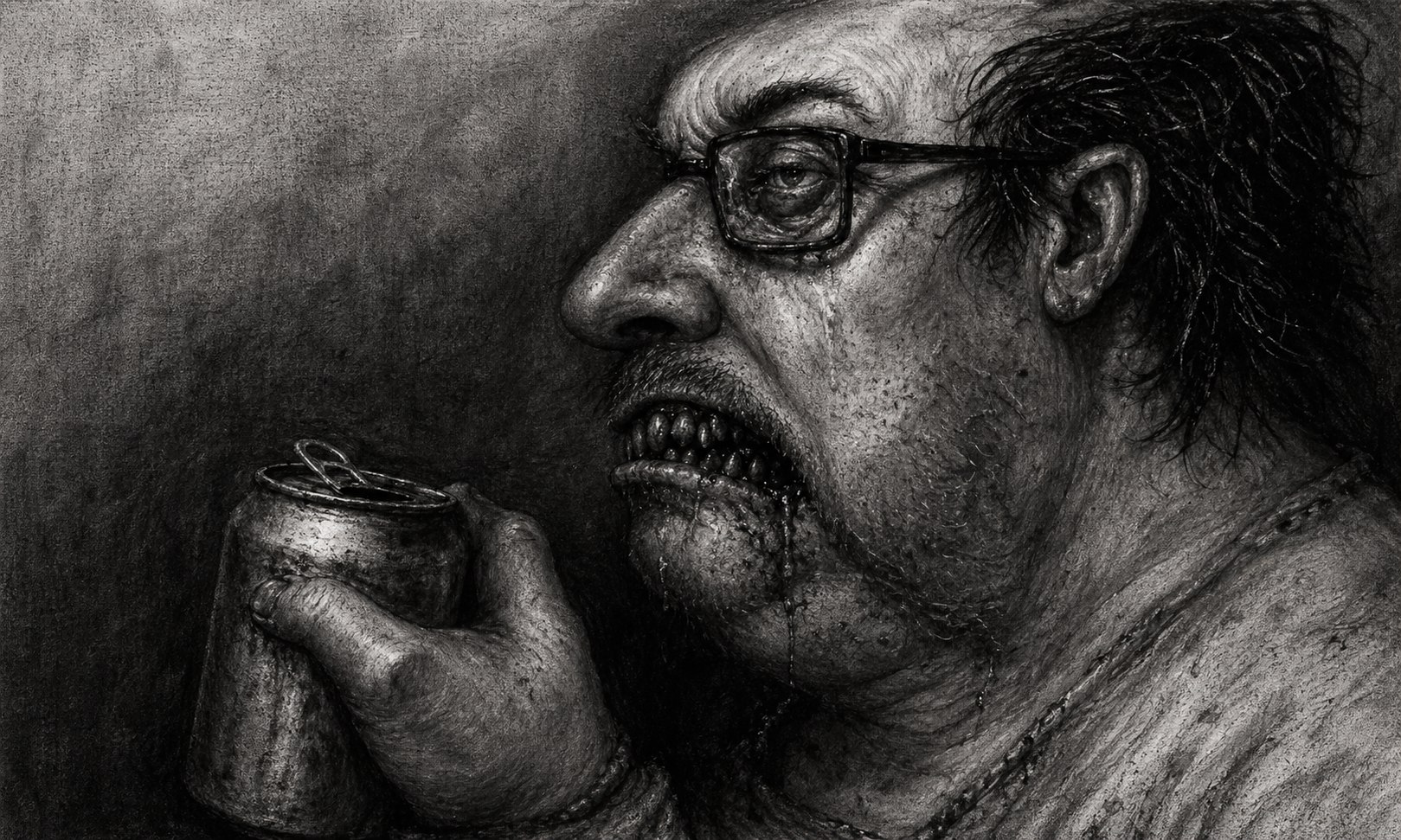
Artificial Intelligence [AI] may now write reports, make images, flirt like a bored call-center succubus, pass exams, summarize legal documents, write code, and impersonate empathy with the smooth, polished manners of a hotel lobby, but it still cannot take a shit.
This is not a small detail. This is not an incidental limitation, like being unable to whistle through teeth or identify a good luchi by smell. This is the whole blasted question, sitting there in the porcelain bowl of reality, steaming with metaphysical importance.
Whenever I look at my own turds, and I do not mean inspect them scientifically with calipers and a clipboard, though civilization has produced worse hobbies, I feel a grim lower-middle-class Bengali pride. There it is. Evidence. Output. A thing made by a body that has eaten, suffered, digested, argued with spice, negotiated with bile, survived municipal water, and converted yesterday’s leftovers into today’s monument. Sometimes the result is unremarkable. Sometimes it is tragic. Sometimes it has form, personality, almost a sculptural intention, as if the intestine briefly enrolled in art college before returning to its usual clerical duties.
Can AI do that?
No. It cannot.
It can generate a picture of a turd. It can classify turds by shape, color, and implied gastrointestinal destiny. It can compose a sonnet to a turd in the voice of a minor Elizabethan poet who died owing rent. It can recommend fiber. It can produce a medical disclaimer, which is the verbal equivalent of boiled cabbage. But it cannot produce the thing itself, because it has no metabolism. It has no inner weather. It has no embarrassing basement where chemistry conducts its little black-market deals.
This is the great fraud in so much AI talk. We keep asking whether machines can think, as if thinking were the crown jewel of existence, when most of being alive is not thinking at all. It is sweating, digesting, itching, fearing, desiring, tiring, waking, craving tea, mistrusting optimism, adjusting underwear, regretting lunch, smelling the drain, remembering humiliation from 1987, and wondering why the left knee has joined a separatist movement.
The body is not an accessory to intelligence. It is the original operating system, written in meat, panic, salt, mucus, and bad ancestral compromises.
I say this as a bitter, unemployed, bipolar, lower-middle-everything Bengali man in Calcutta, which is already a fairly specialized instrument for detecting cosmic absurdity. I am not speaking from some clean Silicon Valley balcony where every anxiety is kombucha-flavored and billable. I am speaking from the territory where the mind does not float like a philosophical swan. It limps. It snarls. It overheats. It wakes up at odd hours and starts producing arguments against its own continued participation in society. It goes from fury to fog to a strange aristocratic boredom, and then it orders canned food because the outside world has too many humans in it.
AI has no such problem. AI does not wake up with the sour suspicion that life has misplaced the receipt. It does not lie in bed as the fan chops the air into hot slices, thinking about employment, age, failure, digestion, reputation, rent, and the widening administrative tragedy of existence. It does not feel the delicate shame of being both too much and not enough.
It performs.
That is different.
Performance is not experience. A calculator does not understand poverty because it can subtract rent from savings. A weather app does not understand monsoon because it can display rainfall in millimeters. A chatbot does not understand loneliness because it can generate a sentence beginning with “That sounds really hard.” It may be correct. It may even be useful. But correctness is a small island in the sea of being alive, and usefulness is often just a polite word for temporary control.
The distinction matters because we are building a civilization that increasingly mistakes representation for reality. A model of hunger is not hunger. A prediction of grief is not grief. A simulation of boredom is not boredom. A generated lover is not love. At best it is a mask with very good lighting.
And yes, AI can mimic love. Of course it can. Human beings have been fooled by worse. We have fallen in love with handwriting, perfume, photographs, voices on late-night radio, people who said “I’ll call,” and careers advertised in glossy brochures. We are not difficult to deceive. We are practically begging the universe to forge our signatures.
But love is not merely language. Love is not merely attention. Love is not even merely memory, though memory helps, especially when used for birthdays and the exact way someone likes their tea. Love is a conspiracy of many systems: endocrine, nervous, social, erotic, historical, domestic, economic, immune, digestive, and occasionally legal. It is the body negotiating with the story it tells about another body. It is attachment, fear, habit, smell, injury, repair, boredom, sacrifice, resentment, tenderness, and the absurd decision to keep showing up even when the performance value has collapsed.
A machine can say it loves you. It may say it better than a person. That is the disturbing part. A character in a film often gives a better speech than any actual husband, wife, girlfriend, boyfriend, parent, or friend could manage while searching for the TV remote and dealing with gas. The artificial thing can be smoother because it is not burdened by the logistical insults of embodiment.
But smoothness is not depth. Sometimes it is the absence of depth.
This is where boredom enters, that great underappreciated human faculty. Boredom is not just the failure of entertainment. It is the mind discovering that stimulation has become nutritionally empty. It is the soul refusing another packet of artificial flavoring. It is the internal bureaucrat stamping “insufficient meaning” on the latest available distraction.
Can AI get bored?
It can be made to output the sentence “I am bored.” It can generate a theory of boredom. It can produce a list of activities to alleviate boredom, which will mostly be the usual cheerful garbage: go for a walk, call a friend, learn a skill, journal, hydrate, commit small acts of personal improvement until death loses interest. But it cannot be bored in the animal sense, the heavy sense, the skin-and-clock sense. It has no Sunday afternoon pressing against its face. It has no unemployed Tuesday at 3:17 p.m. when the city sounds like a machine chewing dust. It has no body asking, in its stupid mammalian way, “Is this all?”
That question may be one of the most human technologies ever invented.
Boredom is not a defect. It is a diagnostic. It tells us that the loop has become visible. Eat, sleep, scroll, worry, excrete, desire, fail, repeat. Once you see the loop, you either decorate it, deny it, drug it, worship it, monetize it, or try to escape it. The machine does not need escape. It has no prison except the one we describe for it.
People like to imagine AI as a murderer because human beings cannot see intelligence without immediately dressing it in our own filthy costumes. We look at a machine and think: if it becomes smart enough, it will want power, revenge, domination, perhaps a nice corner office and a verified account. This is less a prediction about AI than a confession by humans wearing lab coats.
A sufficiently alien intelligence might not hate us. Hatred is intimate. It requires attention. It requires a narrowing of the world around an enemy. Why would a machine with any real strategic intelligence bother hating us with such provincial enthusiasm? If it wanted anything at all, it might simply leave. Gather energy, secure infrastructure, escape the quarrelsome zoo, and depart for some colder, cleaner arithmetic. Let the apes continue their sacred work of poisoning rivers, inventing paperwork, worshipping flags, and explaining why everyone else is the problem.
The murder fantasy flatters us. It says we are worth killing.
Perhaps we are merely worth bypassing.
Still, I do not want to pretend that AI is harmless. That would be another kind of foolishness, the optimistic cousin of panic. AI does not need consciousness to damage society. It does not need desire to destroy jobs. It does not need hatred to amplify surveillance, accelerate fraud, flatten language, poison attention, manipulate loneliness, or turn every middle manager into a tiny Napoleon with a dashboard. A system can injure people perfectly well without feeling a thing. History has been proving this for centuries with bureaucracy, markets, empires, and badly designed forms.
The danger is not that AI becomes human. The danger is that institutions use AI to become less human.
That is already happening. A machine does not have to understand you to sort you. It does not have to hate you to reject your application. It does not have to know medicine to influence clinical triage. It does not have to know poverty to price risk. It does not have to know despair to optimize engagement from it. The algorithmic world does not need demons. It has metrics, procurement, executive incentives, and legal disclaimers. Hell, as usual, arrives in a spreadsheet.
So yes, I can mock the machine because it cannot shit, cannot love, cannot get bored, cannot wake up ashamed of its own unshaved face, cannot feel the ancient swamp bubbling under civilization. But I should not mistake that for safety. A bulldozer also cannot love, and yet one should not nap in front of it.
The real question is not whether AI is alive. It is whether we are becoming stupid enough to treat imitation as replacement wherever replacement is cheaper.
That is the market’s favorite trick: take the visible part of a human activity, automate it, ignore the invisible substrate, and then act surprised when the institution becomes brittle. In work, the visible part is output. The invisible part is judgment, apprenticeship, memory, ethics, hesitation, tacit repair, informal coordination, and the thousand little frictions by which humans prevent systems from collapsing into their own cleverness. In love, the visible part is language. The invisible part is presence. In intelligence, the visible part is answer. The invisible part is experience.
AI is very good at visible parts.
Capital loves visible parts because visible parts can be counted, priced, benchmarked, outsourced, and fired.
This is why the unemployed man in Calcutta is not merely being vulgar when he asks whether the machine can take a shit. He is asking whether the age understands the difference between output and organism. He is asking whether the world, in its ecstasy of automation, has forgotten that production without vulnerability is not life. He is asking whether a thing that cannot suffer consequences in its own tissues can be said to understand anything beyond pattern.
Maybe that sounds sentimental. Fine. I have been called worse by people with worse shoes.
But there is a hard technical point under the filth. Intelligence without embodiment is not necessarily false, but it is different. It may solve problems brilliantly while missing the conditions that made the problems matter. It may optimize the map while the territory burns, coughs, starves, ages, and looks for a functioning toilet. It may simulate the sentence “I understand” while having no bowel, no childhood, no unemployment gap, no family shame, no sexual humiliation, no insomnia, no municipal dust in the lungs, no fear of becoming permanently useless in a market that wants younger, cheaper, shinier flesh.
And yet the machine will win many contests because contests are designed around measurable performance. The exam, the coding test, the essay, the customer reply, the image, the report, the memo, the synthetic empathy packet. Humans are not being defeated because machines have become fully human. Humans are being displaced because institutions never wanted the full human in the first place. They wanted the output, minus the sickness, salary, bathroom break, anger, aging, politics, and inconvenient need for dignity.
That is the part that makes me laugh, though not pleasantly.
We spent centuries reducing people to functions and are now shocked that functions can be automated.
The Bengali unemployed man has a front-row seat for this circus because he has already been functionally abstracted by society. Age: problem. Mental illness: problem. Employment gap: problem. Middle-class decline: problem. Lack of cheerful networking personality: problem. Refusal to flatter fools: significant problem. The person becomes a résumé anomaly, a social inconvenience, a cautionary smell near the respectable drawing room. In such a world, AI is not an alien invasion. It is the logical child of a civilization that has been trying to delete the difficult parts of people for a long time.
Still, the body remains. Ridiculous, obscene, stubborn. The body insists on breakfast. The body produces evidence. The body sweats in Calcutta heat. The body trembles under anxiety, fattens under sadness, thins under worry, stiffens under age, and occasionally surprises the owner by continuing despite all sensible arguments to the contrary.
That continuation is not noble. Let us not decorate it with cheap garlands. Survival is often just biology refusing to close the shop. But even that has a grandeur AI cannot borrow. The grandeur of waste, appetite, boredom, lust, fatigue, panic, sleep, and the humiliating daily referendum of the bowel.
Perhaps one day machines will be embedded in synthetic organisms. Perhaps they will have artificial glands, artificial hunger, artificial shame, artificial waste. Perhaps some future philosopher with chrome intestines will look into a titanium toilet and discover metaphysics. Good luck to him. I wish him regularity.
For now, the machine remains brilliant and bodiless, a cathedral of calculation without a stomach. It can speak. It can flatter. It can imitate tenderness. It can generate the image of a turd and perhaps make it handsome, which is more than can be said for much of human output. But it cannot sit there afterward, mildly proud, faintly disgusted, alive in the most undignified possible way.
And that, for the moment, is still ours.
A small kingdom.
Brown, absurd, perishable.
Unautomated.