Calcutta Smog and the Coming Winter
Acronyms expanded in this post:
- AQI: Air Quality Index. a public-health number that summarizes pollution risk.
Calcutta is still months away from winter, which means the city has entered that brief and charming period when everyone can pretend the air is merely unpleasant rather than conspiratorial. Today, May 5, 2026, the heat is still doing its usual Bengal work, pressing itself against the window grilles like a creditor, but the coming winter is already visible if you have lived through enough past winters and retained the use of memory. The city will cool, the wind will slacken, the sky will lower itself by several moral inches, and the accumulated exhalations of traffic, dust, garbage smoke, construction, diesel, cooking fuel, small industry, and municipal indifference will settle over us like an ancestral shawl woven from phlegm.
Winter air in Calcutta does not arrive as weather. It arrives as documentation. It reminds you what the city has been doing all year and what it has been failing to do for several decades. The summer scatters some sins upward. The monsoon washes a few into drains, where they join the rest of the civic autobiography. But winter is the auditor. It closes the windows, lowers the ceiling, and says, gently but firmly, “Now inhale the balance sheet.”
The past winters have been instructive in the way bad teachers are instructive: by repetition, humiliation, and the complete absence of remediation. Every year, the air thickens. Every year, people discover particulate matter with the astonishment of villagers encountering a gramophone. Every year, someone posts a skyline photograph in which the Victoria Memorial appears to be dissolving into old soup. Every year, we discuss the Air Quality Index [AQI, a simplified public-health scale that translates pollutant concentrations into a risk number] as if a rising number were a philosophical opinion rather than a warning that the body has already begun receiving through the eyes, throat, chest, and skull.
The number is useful. It is also a polite fiction. AQI compresses an ugly mixture of gases and particles into a digestible civic token, like turning a cholera outbreak into a restaurant rating. It helps the public understand risk, but it does not capture the full biography of the air. It depends on what is measured, where it is measured, how instruments are calibrated, how often readings are reported, and which pollutants are included in the official sermon. The unmeasured does not become harmless because it has been excluded from the dashboard. Calcutta has long excelled at this kind of administrative magic: if the map does not show the drain, then perhaps the smell is a rumor.
The coming winter will again prove that pollution is not a seasonal visitor but a year-round tenant with winter privileges. The particles are already being manufactured. Road dust already rises from broken surfaces and half-mended edges. Buses already snort. Autos already cough. Trucks already drag diesel breath through neighborhoods that have learned not to complain too precisely. Garbage fires continue their little democratic ceremonies. Construction dust travels without passport. Old buildings shed powdered history. Small workshops burn, cut, grind, solder, polish, and improvise. The city functions by abrasion.
Then winter comes, and meteorology performs the cruel trick.
Temperature inversion is the part that sounds technical until you translate it into street Bengali: the dirty air cannot escape. Normally, the ground warms the air near the surface, and warm air rises, carrying smoke, dust, fumes, and other airborne mischief upward, where winds can disperse them. In winter, especially during calm nights and early mornings, the ground cools quickly. The air near the surface becomes cooler than the air above it. This creates a lid. Pollutants that would otherwise rise now squat close to the ground like stubborn relatives on a charpoy. The city wakes up inside its own residue.
This is why morning walks in winter can feel less like exercise and more like voluntary participation in an autopsy. People march along lakes, parks, and avenues with woollen caps, mufflers, diabetes discipline, and the heroic optimism of those who believe that movement must be good even when the air has the texture of burnt newspaper. The elderly cough. Children wheeze. Tea stalls continue operations because civilization in Bengal may collapse, but tea will not. Somewhere a man will explain that Calcutta air was always like this, which is false in detail but emotionally understandable. Nostalgia is often the last refuge of the bronchially defeated.
The television treatment will be predictable. Delhi will remain the national smog celebrity, the Amitabh Bachchan of particulate doom, while Calcutta plays the reliable character actor, appearing in secondary charts and local anxieties. But Calcutta’s problem is not made smaller by Delhi’s extravagance. A man does not become healthy because someone in another city is coughing blood more dramatically. The comparison is politically convenient and medically useless.
The civic machinery will perform its yearly dance. Advisories will appear. Sensitive groups will be told to avoid outdoor exertion, which is excellent advice for people whose lives do not require outdoor exertion. Schools may issue cautious messages. Offices will recommend remote work for those whose work can be made remote, which is another way of saying that the middle class will be offered a filter while the poor will be offered philosophy. Traffic police, delivery riders, street vendors, construction workers, sweepers, guards, drivers, domestic workers, and pavement dwellers will continue to serve as the city’s unofficial air-sampling network.
A city reveals its class structure by who is allowed to avoid the air.
There is an architectural truth here, and it applies beyond pollution. Systems fail not only because bad things happen inside them, but because responsibility is broken into pieces small enough for everyone to deny ownership. Transport says it is not industry. Industry says it is not construction. Construction says it is not road dust. Road dust says it is not garbage burning. Garbage burning says it is not household fuel. Household fuel says it is poverty. Poverty says it is planning. Planning says it is politics. Politics says it is public behavior. Public behavior says it is helplessness. Helplessness says nothing, because it is busy coughing.
That is how a system becomes permanent.
Calcutta’s winter air is not merely an environmental issue. It is a representation problem. We mislabel representation failures as data quality failures because it is psychologically easier to blame the reading than the world that produced it. A sensor shows poor air, and someone asks whether the sensor is placed correctly. Sometimes that question is legitimate. Measurement matters. Calibration matters. Location matters. But when enough instruments, bodies, windowsills, throats, and mornings agree, the problem is no longer that the city has been represented unfairly. The problem is that it has been represented at all.
This is the indignity of measurement. It deprives suffering of plausible deniability.
The past winters showed us the pattern. First comes the mild irritation: dry throat, watery eyes, a faint metallic taste in the morning. Then the city grows visually uncertain. Distant buildings blur. Sunlight arrives filtered through a dirty cataract. The sky loses depth. The evening lights develop halos, not the religious kind, though Bengal will of course find a way to make even suspended sulfate and nitrate particles feel metaphysical. Then come the WhatsApp remedies. Steam. Tulsi. Ginger. Honey. Cloves. Masks worn under the nose. Air purifiers discussed like dowry items. Somebody’s uncle will declare that people today are weak and that in his youth everyone breathed coal smoke and became strong, which may explain much of the subsequent politics.
Meanwhile, the actual work remains boring, expensive, and necessary: cleaner transport, stricter dust control, serious waste management, reliable monitoring, enforcement that does not wilt after three days, cleaner small-industry processes, better street design, fewer idling engines, less open burning, and public-health messaging that does not treat citizens like decorative mammals. None of this is glamorous. None of it produces a ribbon-cutting photograph heroic enough for a ministerial calendar. It requires maintenance, coordination, budgets, staff, boring inspections, and the unpleasant art of telling people no.
That last item is where civilizations often perish.
The realistic constraint is that Calcutta cannot clean its winter air by one magnificent act of municipal thunder. It cannot ban one thing, scold one class, worship one technology, or purchase one miracle machine and be done with it. The city is too old, too dense, too informal, too economically tangled, too dependent on small combustions and improvisations. Much of what pollutes also keeps people fed. This does not excuse the pollution. It explains why slogans fail. A clean solution would require the city to be less like itself, and cities do not become less like themselves without money, time, coercion, negotiation, and a degree of administrative competence that cannot be summoned by chanting “smart city” into a dead microphone.
Still, there are choices. Not pure choices. Not heroic choices. But choices. Measure more honestly. Publish more clearly. Control dust as if dust were real, which is apparently still a frontier idea. Treat garbage burning as a public-health hazard, not a quaint neighborhood habit. Electrify what can be electrified without pretending electricity is morally clean if generated elsewhere by filth. Improve buses because a functioning bus is not a socialist antique but a respiratory intervention. Protect outdoor workers because the poor are not disposable lungs attached to a labor market. Stop treating winter pollution as an episode and start treating it as the seasonal concentration of year-round failure.
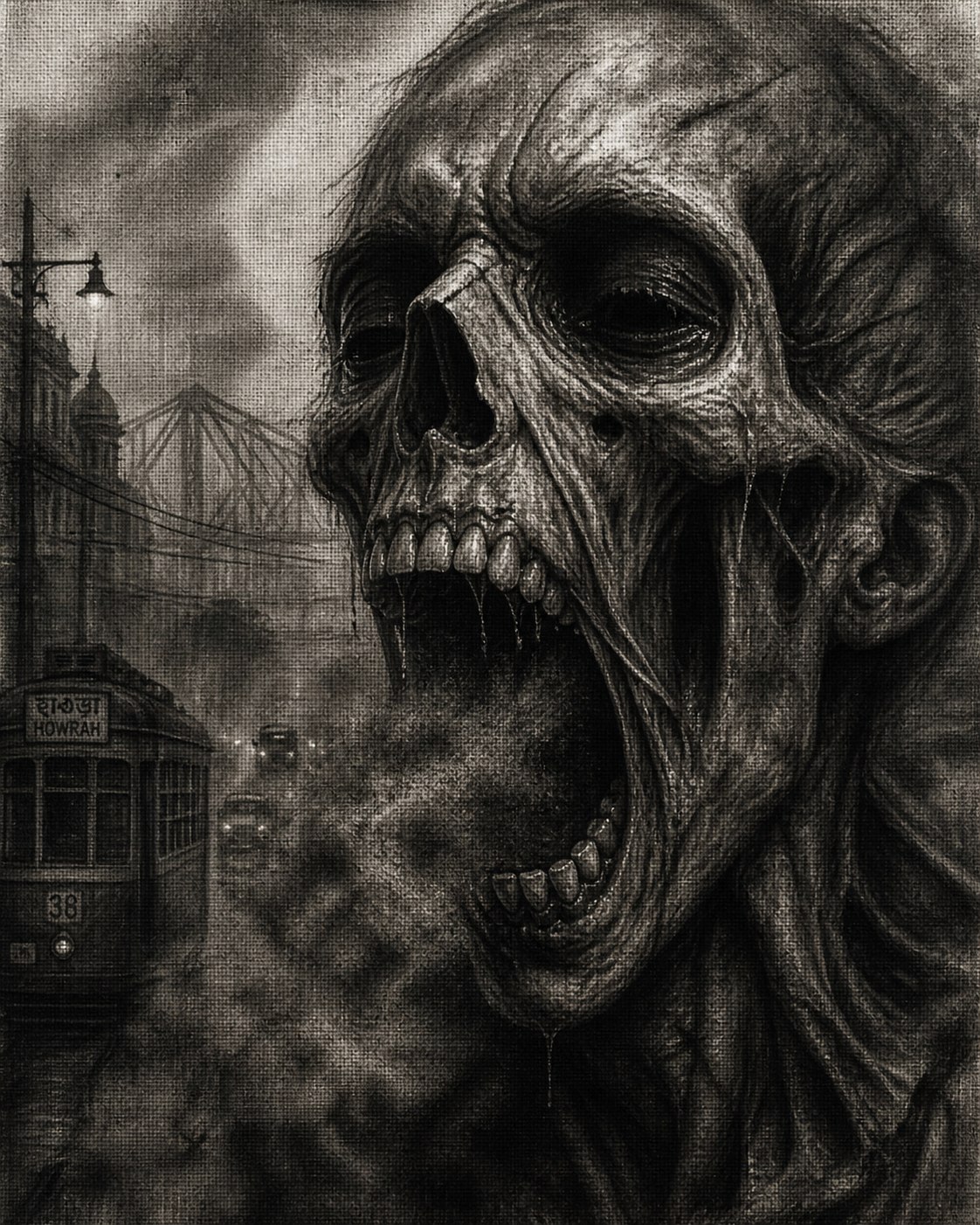
By December, if the old rhythm holds, Calcutta will again produce mornings in which the city looks half-erased. The Maidan will soften at the edges. The Hooghly will wear a gray lid. The tramlines, where they still survive like elderly philosophers ignored by app-based civilization, will disappear into a haze that looks almost romantic until you remember romance is not supposed to inflame the alveoli. People will say, “It is foggy today,” because fog sounds natural and poetic, while smog sounds like somebody should be sued.
That is the little linguistic fraud by which we survive. Fog is God’s gauze. Smog is policy with a lung infection.
Today, in the furnace end of spring, winter still feels far away. But the coming winter is already being built, particle by particle, by engines, fires, dust, indifference, and the thousand tiny permissions by which a city injures itself without quite intending to. Past winters were not accidents. This winter will not be an accident either. It will be a report card written in the air, and like most report cards in Bengal, it will be read aloud, argued over, blamed on the examiner, and then placed carefully in a drawer until the next examination.
The lungs, unfortunately, do not use drawers.