The Nine O'Clock Filter
Checking article narration…

THIS IS A WORK OF FICTION
The filter in the ceiling of the Metro control room was dripping something that smelled like boiled eggs and copper, and Rana had been staring at it for eleven minutes because his hands were too busy holding his own stomach to reach for the phone.
He had not eaten eggs in three days. He had not eaten anything in almost ten hours, not since the vending machine samosa at 11 PM, and yet the smell was coming from above him, thick and warm, settling on his tongue with a texture he could feel. He swallowed. His throat clicked. The drip came again—slow, deliberate, a single drop falling from the HEPA vent onto the blue plastic chair where the night-shift supervisor usually sat, and the drop was not clear. It was the color of weak tea, and when it hit the plastic, it did not splash. It beaded. It sat there like something with a skin.
Rana’s radio crackled. “Central to all stations, filter replacement confirmed, all units operational, thank you for your patience.”
He looked at the timestamp on the monitor. 08:47. Thirteen minutes until the worst of the morning rush, when thousands of people would push through the turnstiles at Park Street alone, breathing hard from the stairs, faces lifted to the ceiling fans, grateful for the cool air.
His stomach cramped. He tasted bile. He thought: I should call someone. Then he thought: I should not be the one who calls. He had been written up twice this quarter for false alarms. The new Operations Manager, Mr. Sen, had stood in this very room last Tuesday and said, “Rana, you have a talent for finding catastrophes that do not exist. Please find some that are cheaper.”
The cramp came again, sharper, and Rana felt a hot pressure behind his belt that made him stand up too fast. He froze, half-bent, listening to his own body with the focused terror of a man who suspects his house has been entered while he slept. Nothing happened. The pressure faded. He straightened, sweating, and saw that the drop on the chair had developed a second skin, a film across its surface that trembled when the ceiling fan turned.
He reached for his phone. It rang before he touched it.
“Rana.” It was Sen’s voice, flat, already disappointed. “Why are you not at your post?”
“I am at my post, sir. The filter—there is something wrong with the new filter. It is leaking. It smells like—”
“Like what, Rana? Like panic? Like another drill?”
“Like blood, sir. And eggs. It is dripping on the chair.”
Silence. Then: “Do not touch it. Do not touch anything. I am coming down.” The line went dead, and Rana felt a small, shameful relief—someone else would see it now, someone else would carry it. He sat on the stool by the monitor, as far from the dripping chair as the room allowed, and pressed his hand against his stomach, which gurgled like a drain.
At 08:52, the drip stopped.
Rana looked up. The vent was dry. The smell remained, but the dripping had ceased, and in its place came a sound he had never heard from an air conditioner before: a long, soft inhalation, as if the machine were breathing in through its own metal throat. Then it exhaled. Warm air, wet air, air that smelled of the inside of a mouth.
He stood. His knees shook. He walked to the door of the control room and looked out through the wire-mesh window at the platform below.
More passengers were arriving. Office workers, schoolchildren, a woman in a sari the color of marigolds, an old man with a walking stick. They moved toward the benches, toward the stairways, toward the cool air that was now flowing from every vent in the station, and Rana saw them lift their faces to it, grateful, unconscious, breathing deep.
He saw the woman in the marigold sari stop mid-step. He saw her press her hand to her mouth. He saw the old man double over his walking stick, and a young man in a tie drop his briefcase and clutch his stomach, and a schoolgirl of perhaps nine years bend at the waist with a sound that Rana could hear even through the glass—a wet, tearing retch that emptied her onto the platform in front of her classmates.
It was 08:54.
The radio came alive with voices, too many voices, overlapping: “…Park Street, we have multiple passengers down, repeat, multiple passengers vomiting…” “…Maidan station, same thing, it is the air, something in the air…” “…Esplanade, I have a platform full of people, they cannot stop, it is coming out of both ends, I need medical, I need—”
Rana’s own stomach clenched so hard he fell to his knees. The pressure behind his belt returned, but this time it did not fade. He felt his sphincter fail with a humiliating, liquid ease, felt the warmth spread in his trousers, felt his mouth fill with saliva that tasted of copper and eggs, and he crawled to the wastebasket and vomited into it with a force that felt like his organs were being squeezed by a fist. Between heaves, he heard Sen’s voice on the radio, calm, administrative: “All stations, this is Operations. Lock down the ventilation controls. Do not allow anyone to leave the platforms. Do not—”
Do not allow anyone to leave.
Rana wiped his mouth with his sleeve. His hands were shaking so badly he could not grip the door handle. Through the mesh, he watched the platform become a slaughterhouse of embarrassment, of bodies betrayed in public, of men and women soiling themselves where they stood, children screaming as their stomachs emptied without permission, the marigold sari darkened at the hem with something that was not water. The smell hit him even through the door—shit and vomit and fear, a smell with a temperature.
And underneath it, still, the boiled eggs and copper.
He got the door open. He fell into the corridor. The air here was worse, thicker, and he understood with a clarity that felt like ice water in his chest that the air was the weapon, that the filters were the weapon, that someone had put sickness into the lungs of the city and waited for the nine o’clock rush on a working day, when the trains would be full and the platforms packed and every mouth open in complaint about the heat, the delay, the price of eggs.
His radio was still in his hand. He pressed the button. “Sen,” he gasped. “Sen, it is in the filters. The new filters. Who ordered them? Who signed for them?”
A pause. Then Sen’s voice, quieter now, almost gentle: “Rana. Go to the medical bay. Do not ask questions you cannot afford to hear answered.”
“I need to know who—”
“You need to stop talking on an open channel.”
The line went dead.
Rana hauled himself up the wall. His legs were weak, his trousers heavy and cooling against his skin, and the shame of it was so total, so consuming, that for a moment he forgot to be afraid of dying. He thought of his wife, who would be at the market now. He thought of his daughter, who took the 9:15 train from Rabindra Sarobar to her coaching class. He thought of the filter in their bedroom, the one he had installed himself last month, the one with the government seal and the holographic sticker that he had checked twice because he was a careful man, a man who checked things.
He pulled his phone from his pocket with wet fingers. No signal. The network was down, or overwhelmed, or deliberately killed. He looked at the time. 09:03.
The corridor lights flickered. From the ventilation grille above him came that sound again—the long inhalation, the patient exhalation—and Rana understood that the machine was not broken. The machine was working perfectly. It had been built to do exactly this, to deliver exactly this payload, and it would continue to do so until someone stopped it, and no one was coming to stop it, because the people who could stop it were the people who had signed for it.
He thought of the delivery truck that had come on the fourteenth, the new uniforms on the technicians, the way they had worked too quickly and left no packaging behind. He thought of the invoice he had seen on Sen’s desk, the vendor name he had not recognized, the total amount that had seemed too low for forty stations.
He thought of the phrase Sen had used: Do not ask questions you cannot afford to hear answered.
Rana made it to the medical bay. The door was locked. He pounded on it with his fist, leaving a smear he was too sick to be ashamed of, and when no one came, he slid down the wall and sat on the floor in his own filth and laughed, because the alternative was screaming, and screaming would make him breathe deeper.
At 09:17, the ventilation system completed its cycle. The sickness in the air thinned to a memory, to a smell that would linger in the curtains and the seats and the hair of everyone who had been there. The survivors—most of them would survive, he would learn later, most of them would live to carry this—began to help each other, to share water, to weep in the arms of strangers who were too emptied out to care about dignity.
Rana did not go home. He could not. He sat outside the medical bay until they found him at noon, and when they asked him what had happened, he told them about the drip, and the smell, and the sound of the machine breathing.
They wrote it down. They nodded. One of them, a young doctor with tired eyes, said, “You did well to report it.”
Rana looked at him. “Did I?”
The doctor did not answer.
Three days later, Rana was back at work. The station had been cleaned. The filters had been replaced again—genuine filters, this time, he was assured, filters with proper certificates and proper prices. The platforms were full. The trains ran on time. No one spoke of the incident except in whispers, in the language of food poisoning, of a bad batch of water, of mass hysteria.
Sen called him into the office. Closed the door. Offered him tea.
“You are a good employee, Rana,” Sen said. “Conscientious. Perhaps too conscientious.”
Rana did not drink the tea.
“There will be a small adjustment to your record,” Sen continued. “A promotion, actually. Night supervisor. Better pay. You will have the station to yourself, which I think you prefer. You are a man who likes to check things.”
Rana looked at the vent in the ceiling of Sen’s office. It was clean. It was silent. But he could see, or thought he could see, a faint discoloration on the tiles around it, a tea-colored stain that had been painted over but not sealed.
“I have one question,” Rana said.
Sen waited.
“Who signed for the filters?”
Sen smiled. It was a kind smile, almost pitying. “You did, Rana. You signed the receiving log on the fourteenth. I watched you do it. You were very thorough—you checked the hologram, you counted the units, you initialed each line.”
Rana’s hands went cold. He remembered the fourteenth. He remembered a stack of paperwork, a delivery he had not ordered, a signature he had provided because the technicians were waiting and the forms were standard and he was a man who did his job.
“You should go home now,” Sen said. “Rest. You have been through a terrible experience. A terrible, unforeseeable experience.”
Rana stood. His legs were steady now. His stomach was calm. But as he reached the door, Sen spoke again, and his voice had changed—lost its administrative softness, gained something that sounded like relief, like the relief of a man who has been holding a door shut for a very long time and has finally been allowed to let go.
“Rana. The new filters. The ones we installed yesterday. Did you check them?”
Rana did not turn around. He could not. He stood with his hand on the door and felt the air move against his face, warm and wet and smelling of nothing at all, which was the worst smell in the world, because it meant the machine had learned to hide.
“Yes,” Rana said, and his own voice sounded like it was coming from the vent, from the throat of the building, from everywhere at once. “I checked them. They are perfect.”
He went home. He kissed his wife. He watched his daughter do her homework. At 11 PM, he went to the bedroom and stood on the bed and unscrewed the vent cover with the screwdriver he kept in his bedside drawer for this purpose, for the checking, for the vigilance that had become his religion since the fourteenth.
The filter inside was white. Clean. New. The serial number was different.
The installation sticker said the fourteenth.
He had not installed this one. He had not ordered it. But there it was, humming softly, breathing in and out, and when he put his face close to it—close enough to smell, close enough to kiss—he caught it again, faint as a rumor, the smell of boiled eggs and copper, and beneath that, beneath even that, the smell of his own breath, returned to him, as if the machine had been keeping it, as if it had been breathing with his lungs since the night he signed for what he did not order.
Rana screwed the cover back on. He lay down beside his sleeping wife. He closed his eyes and listened to the filter work, and he did not sleep, and he did not scream, and when morning came, he got up and made tea for his family, and he was very careful not to breathe near the steam.
At 8:47 AM, the filter in the ceiling of his bedroom began to drip.
Rana watched the drop fall onto the pillow where his daughter had slept until ten minutes ago, and he did not wipe it away. He watched it bead, and tremble, and develop its second skin, and he thought: I checked them. I checked them all.
The drop sat on the pillow like a small, clear eye, and it did not blink, and neither did he.
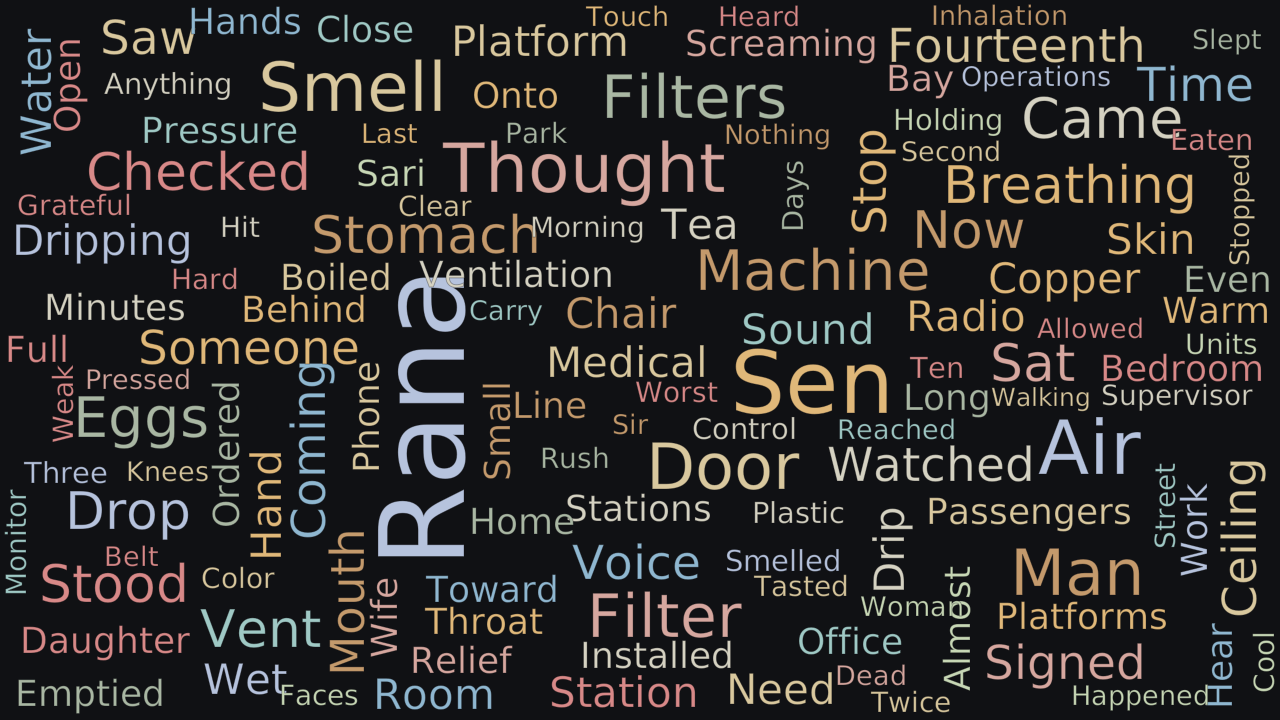
Word Cloud
Related reading
Selected by shared topics and section, with closer publication dates breaking ties.

Comments
Read the conversation or leave a thought for review. Comments load when this section is in view.