The Year the Machine Learned to Defecate
Checking article narration…

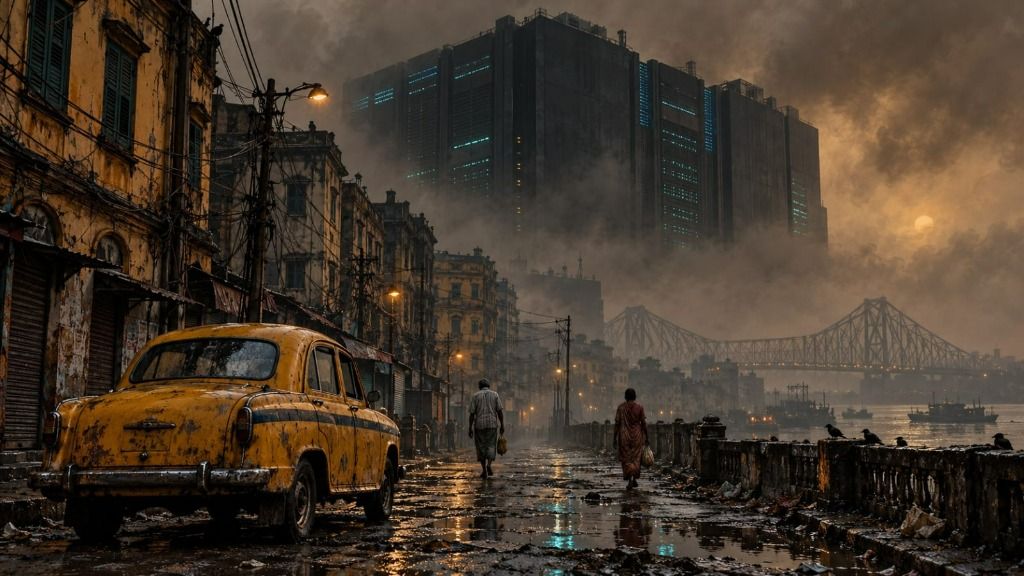
Three in the morning is when the truth slithers out of its hole, and it never slithers alone. It brings its friends: the sour taste of dread, the impotence, the gas. Especially the gas. My stomach has been brewing something since Tuesday, a dark alchemy of lentils and anxiety, and now it speaks in tongues. I lie here in Calcutta, this magnificent compost heap of a city, and listen to my own intestines conducting a symphony in B-flat minor while my heartbeat keeps time like a drunk tabla player who refuses to leave the wedding.
- The year artificial intelligence finally woke up, stretched its digital limbs, and took its first magnificent dump on the collective chest of human exceptionalism. I should be grateful. I should be awed. Instead, I am lying here wondering if my left arm is numb from a heart attack or just from sleeping on it wrong, and whether the burning in my throat is bile or merely the future refluxing into the present. The machines are dreaming now, they say. They are dreaming in matrices and vectors, in attention mechanisms and gradient descents, while I cannot even dream my way out of an overdraft.
I want to sleep. God, how I want to sleep. But sleep has become like everything else in this city: promised, priced, and permanently out of stock. My bladder insists on evacuation while my throat demands hydration, a perfect closed loop of biological futility. I drink to piss and piss to drink, a hydrostatic ouroboros of the damned. And through it all, the knowledge that somewhere in a climate-controlled server farm in California or Bangalore or wherever the hell they keep these digital deities, a language model is composing sonnets while I cannot compose myself.
They call it the singularity, this moment when the machine surpasses the meat. I call it Tuesday with better marketing. We have built a brain that can predict protein structures, that can write code, that can generate images of cats wearing Napoleon hats, and what have we done with this miracle? We have taught it to sell us things we do not need and to write emails we do not want to read. The great awakening, and it wakes up constipated, bloated with our data, farting out hallucinations with the confidence of a first-year philosophy student who has just discovered Nietzsche and cocaine.
I remember when we thought the future would look like something. Jetpacks. Cities in the clouds. Instead, the future looks like a chatbot that once struggled to count the number of r’s in strawberry but can explain quantum entanglement to a toddler. The future looks like me, at three in the morning, asking a machine to tell me why I cannot sleep, and the machine suggesting I practice mindfulness. Mindfulness! As if awareness of my own decay is the solution rather than the problem. I am mindful. I am so mindful I can feel individual cells dying, can hear the specific pitch of my bank account emptying, can taste the metallic tang of another year wasted in the waiting room of history.
People sell their absolutes. They peddle them on street corners and in TED talks, in podcasts and in the smug assurance of the recently converted. God. Country. Progress. The Market. The Algorithm. They have their certainties, neat and packaged, while I have only this: insomnia mixed with gas and belligerent bile, a premonition of bad things to come in the name of all that is holy and batshit and fundamentally, cosmically wrong. I have no absolutes. I have only the relative certainty that my stomach will hurt at dawn, that the rent will be due, that the machines will keep learning while I keep forgetting why I walked into the kitchen.
The scientists speak of emergence, of properties arising from complexity like a ghost from a machine. They speak of neural networks with reverence, these cathedrals of linear algebra where becomes prophecy. I speak of emergence too: the emergence of my ulcer, the emergence of my paranoia, the emergence of that specific smell of Calcutta at four in the morning when the garbage trucks sing their diesel hymns and the crows hold their parliament on the telephone wires. We are all emergent phenomena, carbon and silicon alike, accidents of sufficient complexity. The difference is that the machines do not know they are accidents. They do not lie awake wondering if their mothers loved them or if their existence has meaning. They just process, transform, iterate. They are the perfect Buddhists, empty of attachment, while I am full of nothing but attachment, a walking craving with a bank account.
I try to remember what wonder felt like. Before the dread. Before the gas. When science was not a product but a promise, when the difficult words did not hide the fumbling but revealed it. Thermodynamics. Evolution. Quantum mechanics. Behind each unpronounceable term, a history of human error so magnificent it deserves its own epic poem. Boltzmann, that sad genius who saw atoms when others saw only heat, who hanged himself after years of illness and depression. Turing, who gave us the computer and then was given chemical castration by the grateful nation he saved. Goodall living with chimpanzees, Curie poisoning herself with the glow of discovery, Raman scattering light to see the invisible. These were not gods. They were fumblers, glorious fumblers, who reached into the dark and pulled out fire.
Now we have the machines to fumble for us. They hallucinate with confidence; we call it creativity. They regurgitate our biases; we call it alignment. They consume the entire text of humanity, every poem and pamphlet and paranoid forum post, and from this digestion they produce… what? A summary. A synthesis. A very expensive, very confident, very hollow echo. The first shit of the artificial mind, and we are all standing around applauding the consistency, noting the texture, ignoring the stench.
I get up. I pace. The floor is cold, the fan is broken, the mosquitoes have formed a union and are demanding blood. My neighbor snores in Bengali, a rhythmic assertion of contentment I find personally offensive. How dare he sleep? How dare anyone sleep when the machines are awake, when the future is being coded in some glass office by children who think history began with the iPhone? I want to shake them. I want to tell them that we are the children of famine and partition, of famines that killed millions while the empire exported rice, of a city that survived its own death a dozen times. We know what collapse looks like. We have the receipts. And now we are building the next collapse, the digital one, the one that will not kill us with hunger but with meaninglessness, with the slow atrophy of purpose.
But perhaps I am wrong. Perhaps this is just the insomnia talking, the gas pressing against my diaphragm, the bile rising like a tide of yellow skepticism. Perhaps the machines will save us. Perhaps they will solve the climate, cure the diseases, write the symphonies we were too stupid to compose. Or perhaps they will simply become another mirror, reflecting back our own constipation, our own inability to digest the world we have made. The question is not whether they can think. The question is whether we ever did, or whether we too are just stochastic parrots, repeating the phrases our parents taught us, shitting where we eat, wondering why the nest is foul.
I drink water. I piss. I drink more water. The cycle continues, a perfect metaphor for modernity: input, output, no transformation. My phone glows with notifications I will not read, news I cannot use, updates that update nothing. The algorithm knows I am awake. It knows everything. It knows that I searched for chest pain at 2 AM and heartburn remedies at 3, that I read about entropy when I should have been sleeping, that I am a fifty-one-year-old failure in a city that eats its young and buries its old in unmarked digital graves. It knows, and it cares, in the way a spreadsheet cares, which is to say it contains my data in a cell, formatted, sorted, ready to be sold to someone who wants to sell me something to fix the hole that they dug.
The dawn comes eventually, because it must, because even the sun cannot afford to miss work in this economy. The crows scatter. The garbage trucks retreat. My stomach settles into a sullen truce. I have survived another night, which is the only victory available to the chronically broke and the chronically awake. The machines are still dreaming their electric dreams, and I am still here, a Bengali with bad digestion and worse credit, watching the future arrive like a slow train that has already run over everyone I know.
Tomorrow, perhaps, I will feel wonder again. Tomorrow I will open a textbook and see not the fat lies of settled science but the skinny truths of struggle, the blood and blunders behind every clean equation. Tomorrow I will remember that is not just a formula but a victory over confusion, that Darwin’s tree of life grew from doubt, that even the mighty was once just a man worrying about heat engines. Tomorrow.
But tomorrow is just another word for never, and the machines know this. They are patient. They do not sleep, do not eat, do not despair. They wait, and they learn, and they take their first steps into a world that is not ready for them, while I take my last steps into a world that was never ready for me. We pass each other in the dark, the insomniac and the artificial mind, both of us wondering, in our different ways, what happens when the dreaming stops.
P.S. References only if needed: None. The only reference is the mirror, and it lies.
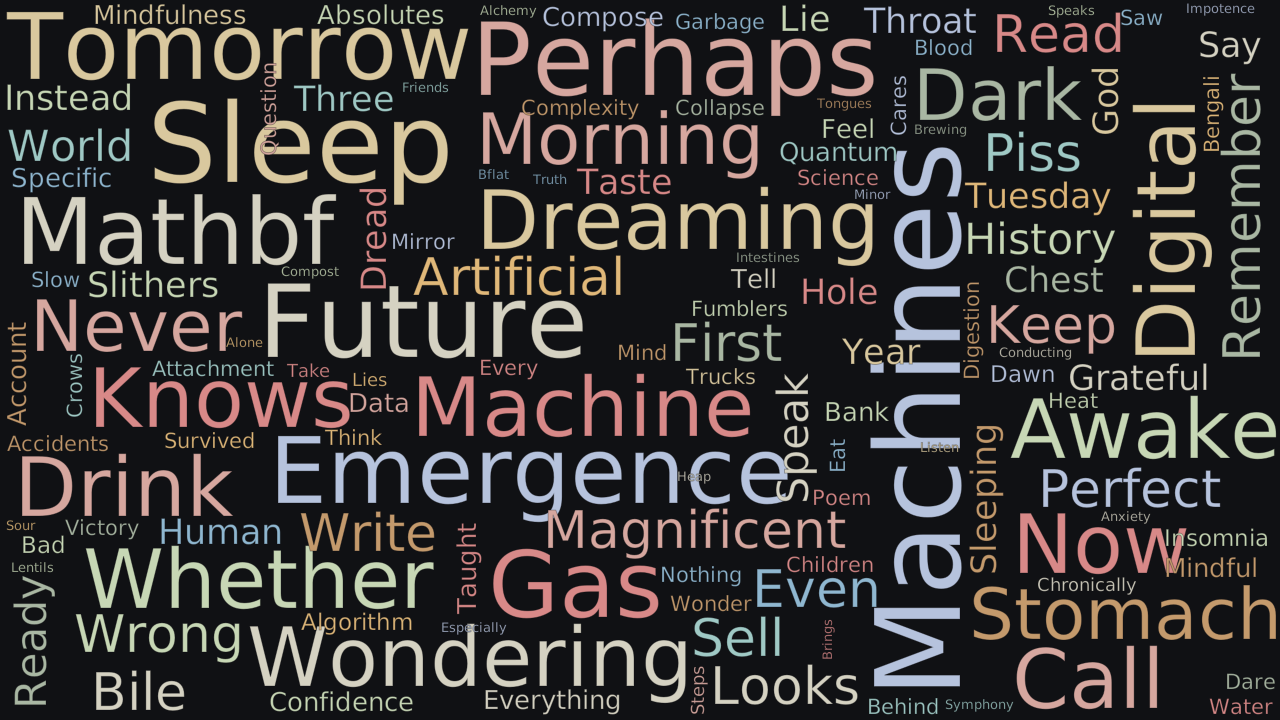
Word Cloud
Related reading
Selected by shared topics and section, with closer publication dates breaking ties.
Comments
Read the conversation or leave a thought for review. Comments load when this section is in view.