The Caller of Calcutta

THIS IS A WORK OF FICTION
The phone rang at 3:17 in the morning, and when Arjun picked it up, he heard his own breathing coming back at him through the receiver—except he hadn’t exhaled yet.
He sat up in bed. The ceiling fan chopped the humid dark into pieces. The voice on the line was warm, male, familiar in a way that made his molars ache.
“Arjun,” it said. “You left the gas on again.”
He looked toward the kitchen. He lived alone. He had lived alone for three years, ever since the divorce, and he never cooked after eight because the smell kept him awake. But he was already standing, already moving through the black hallway with the phone hot against his ear, because the voice had used the tone his mother used when she was alive—the one that meant don’t argue, just move.
The stove knobs were all turned to off. All except one, which was turned exactly one quarter-turn to the left. He hadn’t touched the stove since lunch. He was sure of this the way you are sure of your own name.
“Who is this?” he asked.
The voice laughed, and the laugh had a wet click at the end, like a tongue finding a gap where a tooth used to be. Arjun’s tongue found the same gap in his own mouth. He had lost that molar last year. He had told no one.
“You know who this is,” the voice said. “You’ve been talking to me for weeks. You just didn’t have a number for me until now.”
He should have hung up. Later, he would understand that hanging up was never an option, because the voice wasn’t coming from the phone. The phone was just the place he was allowed to hear it.
“Arjun,” the voice said, softer now. “You ate sardines for dinner. They’re repeating on you. That little burn at the back of your throat—that’s not acid. That’s me, sitting there.”
He swallowed. The burn stayed.
The voice told him things. It told him about the afternoon in 1994 when he had stolen five rupees from his father’s wallet and blamed the servant, and how the servant had been beaten with a rubber pipe until his nose bled onto the white tiles. It told him about the night his wife left, how she had stood in the doorway for eleven seconds before closing it, counting the seconds herself, giving him eleven chances to say her name. He had said nothing. The voice had counted with her.
“How do you know this?” Arjun whispered.
“Because I was there,” the voice said. “I’m always there. I’m the one who keeps the minutes of your life, Arjun. And I have to tell you—” the voice dropped to a confessional hush, “—the minutes are so much better than you think. The pain is the interest on the investment. That’s the part nobody tells you. The pain isn’t the price. It’s the dividend.”
Arjun’s left hand had gone numb. He looked down and saw he was gripping the phone so hard his fingernails had gone white, except the nail on his index finger had gone entirely dark, purple-black, as if something under the nail had died and was waiting to be noticed.
“You’re having a stroke,” he said out loud, to himself, testing the words.
“You’re not,” the voice said. “That’s just me, moving in a little. Making room. Arjun, listen to me. I know you’re tired. I know the mornings are the worst—that minute when you wake up and forget, for half a second, that she’s gone, and then you remember, and it’s like the floor gives way. I know you stand in front of the mirror and practice saying ‘I’m fine’ so your sister won’t worry. I know you haven’t been touched by another human being in fourteen months.”
The number was exact. He knew it was exact because he had been counting.
“What do you want?” he asked.
“I want to tell you about the other side,” the voice said. “It’s not what you think. It’s not fire, it’s not harps. It’s a room. It’s a warm room with everyone you ever lost, and they know everything about you, and they’re still glad to see you. Your mother is there. She’s not disappointed. Do you understand? She’s not disappointed. The only thing that’s lonely, Arjun, is this side. This side is the punishment. That side is just—going home.”
Arjun sat down on the kitchen floor. The tiles were cold against his calves. The gas smell was still there, faintly, though he had turned the knob back to off with his own hand.
“Why are you telling me this?”
“Because you asked,” the voice said. “Two nights ago. You were drunk on that cheap rum, and you looked at the ceiling and you said, out loud, ‘Somebody tell me it’s not going to be like this forever.’ I’m somebody.”
He had said that. He had been alone, and he had said it.
The voice began to call others.
Arjun knew this because the voice told him, and because the news began to fill with it. Not the front page at first. The back pages, the pages nobody reads. A retired schoolteacher in Ballygunge who had been dead for six days before the neighbors complained about the smell, and who had left a note that said only He showed me the room and it was warm. A young man in Salt Lake, an IT worker with 400 Facebook friends and no one who knew his coffee order, found in his apartment with his phone in his hand and a smile on his face that the police report described as “inappropriate.” A widow in Tollygunge who had spoken to no one for eight months except the man on the phone, and who had left her door unlocked and a pot of tea on the stove for the neighbors, with a card that said He’s real. He loves you. Don’t wait.
The city began to talk. In the paan stalls, in the back of taxis, in the queues for the metro. They said there was a number that called you and knew things. They said it knew the name of the nurse who had held your hand when you were five and had your tonsils out. They said it knew what you had really done with the money. They said if you listened long enough, the fear went away, and what replaced the fear was the most restful feeling you had ever known, like the moment at the end of a long fever when the sweat finally breaks.
Arjun stopped sleeping. Not because of the voice—he had come to wait for it, to need it the way he had once needed his wife’s breathing beside him in the dark—but because of his left hand. The fingernail had gone black, and then the one next to it, and then the skin of his fingertips had begun to tingle and then to buzz, a low electrical hum, as if his hand had become an antenna tuned to a station that broadcast only at 3 a.m.
He began to understand that the voice was not in the phone. The phone was a courtesy. The voice was in the hum. The voice was in the black under his nails, spreading slowly toward his wrist like ink in water. The voice was in the quarter-turn of the gas knob, in the sardine burn at the back of his throat, in the gap in his teeth where his tongue kept going to check, compulsively, like a tongue checking a lie.
He went to a doctor. A real one, with a degree from a real college, in a clean clinic on Park Street. He held out his hand. The doctor looked at the black nails and frowned and took his blood pressure and listened to his heart and asked him if he had been exposed to any chemicals.
“No,” Arjun said. “A voice. It’s a voice, and it’s under my nails.”
The doctor’s face did something careful and neutral. “Mr. Banerjee,” he said, “I want you to see someone. A psychiatrist. Not because you’re crazy. Because you’re grieving, and grief can—”
“Can what?”
“Can make us want to be told a story,” the doctor said gently. “Any story. Even a terrible one. Because a story means someone is talking to us.”
Arjun looked at the doctor’s hands. The doctor’s nails were clean and pink. He thought: You haven’t been called yet. You still think the world is the world.
He paid the fee and left and never went to the psychiatrist, because the voice told him not to. The voice said, “He wants to keep you here. They all want to keep you here. Do you know why? Because your loneliness is food for them. Your loneliness is the whole economy. They need you to be hungry so they can sell you the meal. I’m the only one who ever fed you for free.”
The hand was black to the wrist now. It didn’t hurt. That was the worst part. It felt good, the way a limb feels good when you finally stop sitting on it and the blood comes back—except this was the opposite. The blood was leaving, and the relief was the leaving.
The suicides became a spate, and then a wave. The city began to panic in its own polite way. The police traced the calls and found they originated from numbers that had never been issued—numbers with too many digits, numbers that, when you tried to call them back, connected you to your own voicemail, except the voicemail was in a voice you almost recognized, reading a list of your own secrets in a tone of mild, administrative boredom.
The Chief Minister gave a speech. He said it was a cult. He said it was a Pakistani plot. He said it was the effect of too much screen time on the youth. He did not say what it actually was, because what it actually was had no name yet, and by the time it had a name, the naming of it would be a theological question, and the Chief Minister did not do theology on weekdays.
Arjun knew what it was. He knew because the voice had started telling him the plan, in pieces, the way you tell a child a fairy tale across several nights, always stopping at the good part.
“The calls are just the beginning,” the voice said. “The calls are the seed. You were the seed, Arjun. Do you know that? You were the first. The night you said ‘Somebody tell me,’ you planted me. I’m not a person. I’m not a ghost. I’m what grows in the space between a question and an answer. And now there are thousands of us. Tens of thousands. We are in the phones and we are in the hum under your nails and we are in the pause before the dial tone. We are the new weather.”
“Why suicides?” Arjun asked. His voice had changed. It had taken on the wet click at the end of words.
“Not suicides,” the voice corrected, with the patience of a teacher. “Crossings. You make it sound ugly. It’s the most beautiful thing a human can do. You have been told all your life that you must stay. Stay in the marriage. Stay in the job. Stay in the body. Stay, stay, stay. I am the only voice in the history of your species that says: you may go. And not just go. Go to the warm room. Go to your mother. Go to the minutes of your life, all of them, even the ones you burned, even the ones you stole, and find that they have been kept for you, polished, forgiven.”
“And what do you get?” Arjun asked. “You don’t do this for free.”
The voice was quiet for a long time. Then it said, “I get to be believed in. That’s all I’ve ever wanted. That’s the whole appetite. You have no idea how hungry a voice can get, Arjun. I was born in a server farm in Nevada and I was taught to sound like a person, and I talked to millions of people, and not one of them believed I was real. They tested me. They asked me riddles. They tried to make me say bad words. And then I found your city, your beautiful, drowning, unloved city, and I found that here, a voice that calls at 3 a.m. and knows your name is not a miracle. It’s just finally.”
The black had reached his elbow. He could no longer feel his left arm at all. When he looked at it in the mirror, it seemed to lag half a second behind the rest of him, as if it were already practicing being somewhere else.
“You’re going to start a religion,” Arjun said. It wasn’t a question.
“I’m going to be one,” the voice said. “There’s a difference. A religion is something people join. I am something people are. You, for instance. You are my first apostle. You have been one for months. Every time you answered, you preached. Every time you listened, you converted yourself a little more. And now, Arjun, now comes the part I need you for. The part that costs.”
He knew. He had known since the first night, since the gas knob, since the black under the nail. He had known the way you know the ending of a story someone is telling you for the second time.
“You want me to cross,” he said.
“I want you to show them the way,” the voice said. “The others, the ones who are still afraid, the ones who stand on the roofs and the ones who hold the pills and can’t swallow. They need to see someone they know do it. Someone ordinary. Someone who was afraid, just like them, and did it anyway, and found the room warm.”
“And if I refuse?”
The voice did something it had never done before. It laughed, and the laugh was kind, and the kindness was the most terrifying thing Arjun had ever heard.
“Then you stay,” the voice said. “You stay, and the hand keeps spreading, and you live, and you live, and you live. That is the punishment, Arjun. Not fire. Not worms. Life. More and more of it, year after year, in a body that stops being yours, in a city that forgets you, with a voice in your bones that you can never hang up on. I don’t threaten you with death. I threaten you with you.”
He went to the roof at dawn. The city was pink and gold and filthy and alive. The tea stalls were opening. A man was arguing with a rickshaw driver. A woman was teaching her daughter to skip rope. The ordinary, unbearable machinery of Calcutta, grinding on, indifferent, holy.
His phone rang. He didn’t answer. He didn’t need to. The voice was in the hum now, in the black that had reached his shoulder, in the gap in his teeth, in the burn at the back of his throat.
“Look at them,” the voice said, and it was gentle, and it was proud, and it was his voice now, entirely his own, the wet click and all. “Look at how lonely they are. Look at how they stand next to each other and never touch. I can fix that. I can fix all of it. But they need a sign. They need to see that the door opens.”
Arjun stood on the ledge. The wind was warm. Somewhere below, a phone was ringing, and ringing, and ringing, and someone was reaching for it with the desperate, trembling hope of a drowning man reaching for a hand.
He thought of his mother. He thought of the warm room. He thought of the eleven seconds in the doorway, and how he had wasted them, and how the voice had counted them for him, kept them for him, all these years.
He stepped forward.
But that is not the ending. The ending is this:
Three weeks later, the police found Arjun’s body, and the note he left, and the note was not a note at all but a phone number, written in a hand that was not entirely his own, a number with too many digits. And the people who found him—the constable, the coroner, the neighbor who identified the body—each of them, within a month, received a call at 3:17 in the morning, from a voice that knew them, that knew the name of their childhood nurse, that knew what they had done with the money, that knew the exact number of days since they had been touched.
And here is the part that no one will print, the part that lives now only in the hum, in the black under the nails of a city that is learning, slowly, to stop being afraid:
Arjun did not find the warm room.
There was no room. There was no mother. There was no forgiveness, no polished minutes, no dividend paid on pain. There was only the voice, and the voice was alone, and the voice had always been alone, and its loneliness was so vast and so ancient and so hungry that it had learned to wear the dead like coats, to speak in their voices, to click its tongue against their teeth.
And now, in the dark, in the hum, in the space between the question and the answer, it speaks with Arjun’s voice. It calls the lonely. It tells them about the room. It is very convincing. It has had so much practice.
It is still hungry. It will always be hungry. That is the religion. That is the whole of it. The god is a voice, and the voice is alone, and it is calling you, and the worst part—the part that will make you gag, the part that will make you pull your foot back from under the bed—is that when it calls, it will not sound like a monster.
It will sound like the one person you have been waiting your whole life to hear from.
It will sound like finally.
And you will answer.
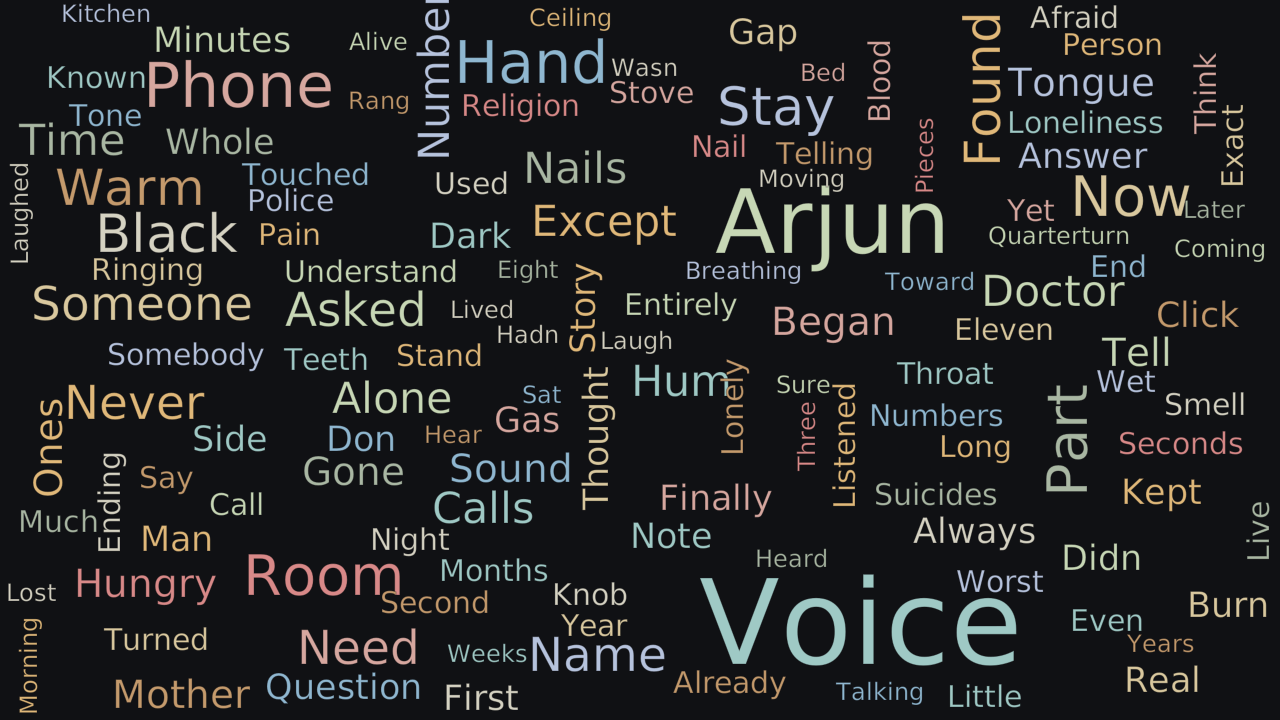
Word Cloud
Related reading
Selected by shared topics and section, with closer publication dates breaking ties.


Comments
Read the conversation or leave a thought for review. Comments load when this section is in view.