The Constipated Muse
Checking article narration…

There is a species of human who treats the blank page like a tax notice. They approach the desk the way one approaches a dentist’s waiting room, with that particular anus-clenching dread of the inevitable drill. Writing, for these poor bastards, is constipation. A blockage. A bureaucratic hurdle between them and the sweet release of done. They want the paycheck, the publication, the nod from the tribe, but the act itself—the sitting down, the thinking, the bleeding alphabets—feels like passing a kidney stone made of broken glass.
I watch them sometimes, these reluctant scribes, and I feel the way a fish must feel watching a drowning man. Not cruel, exactly. Just puzzled. Because for me, writing is not the stone. Writing is the piss. The long, steaming, morning-relief piss after a night of holding it in. When I write, I am not performing. I am evacuating. The thoughts have been fermenting in the dark vats of my skull all night, bubbling with their own gaseous logic, and by dawn they are pressing against the walls of me, demanding exit, demanding the right to stink up the room. To hold them in would be a kind of spiritual sepsis.
You see, I talk to myself. Constantly. A running commentary of bile and wonder and petty observations that would make a saint reach for the earplugs. This internal monologue, this ceaseless flatulence of the frontal lobe, needs a vent. When I write, I am simply opening the window and letting the stench out. The page doesn’t judge. The page is the toilet bowl of the soul, accepting all offerings with that same placid, porcelain indifference. And in that acceptance, I find the only honesty available to a man who has spent his life being told his natural odors are inappropriate for company.
School was the first indoctrination camp. They handed us the five-paragraph essay like it was a straitjacket, taught us that thoughts must march in single file, dressed in their Sunday best, no stains, no stench, no personality. Topic sentence, supporting detail, conclusion. The literary equivalent of a forced march. I remember sitting in those hot Calcutta classrooms, the fan spinning uselessly above, the sweat pooling in the small of my back, and thinking: this is not writing. This is embalming. They were teaching us to preserve dead thoughts in formaldehyde, to make them presentable for the examination hall. But thoughts, real thoughts, are not dead things. They are alive, and messy, and they shit all over the cage if you try to keep them too tidy.
The teachers would mark my papers with red ink, those little arterial spurts of disapproval. Too informal. Too personal. Too… much. What they meant was: too human. They wanted the generic, the sanitized, the community-approved slop that passes for education. Write what is expected. Write what is safe. Write what will not disturb the digestion of the examiner. And I would sit there, this small Bengali boy with ink-stained fingers and a head full of inconvenient lightning, and I would feel the rebellion brewing in my gut like bad fish curry. Because even then, even as a child, I knew that to censor the shape of a thought before it has fully formed is to murder it in the womb. If you strangle the question, you never get the answer. If you smooth the rough edges of your wondering until it fits the mold, you end up holding a brick where a diamond used to be.
Now I am grown, or something like it. A broke Bengali in a city that has forgotten how to dream, watching the rent climb higher than my ambitions, possessing nothing that the world considers valuable. No property, no portfolio, no future that looks anything like the brochure. But I have this. This independence of mind. This stubborn, unkillable refusal to let the committee decide what I think. They cannot foreclose on my thoughts. They cannot evict my interiority. I am the landlord of my own skull, and the tenants are rowdy, and the plumbing is questionable, but by god, the place is mine.
Writing is how I pay the rent on that property. It is the currency of my autonomy. When I write, I am not seeking your approval, though approval is nice, like an unexpected tip from a stingy customer. I am seeking my own coherence. The thought that remains unwritten is a ghost that haunts the corridors of the mind, rattling its chains, disturbing the sleep. But the written thought, however clumsy, however stained with the coffee and the despair of its making, becomes solid. It becomes real. It can be thrown at the wall to see if it sticks, or at the heads of enemies to see if it wounds.
And here is the secret they don’t teach you in those airless classrooms: the difficulty of the word is a lie. Behind every polysyllabic monstrosity that makes you feel small, behind every jargon-crusted theorem and every Latin-derived intimidation tactic, there is a story of someone fumbling in the dark. Someone who didn’t know what the hell they were doing. Someone who guessed, and erred, and guessed again, until the guessing hardened into what we now call knowledge. The textbook is a crime scene where all the fingerprints have been wiped clean. But I am the detective who comes in with the ultraviolet light, and I write to show you the stains. See? The great minds bled here too. The equations were born from confusion, not clarity. The certainty is a costume worn over the original naked terror of not knowing.
This is why I write with the brakes off. Why I let the syntax sprawl like a Calcutta street market, chaotic and fragrant and occasionally dangerous. Why I mix the metaphors until they mate and produce monstrous offspring. Because the mind is not a straight line. The mind is a spiral staircase in a building designed by a drunk architect, and I am simply trying to map the route from the basement of the gut to the attic of the intellect without falling through the floorboards. Sometimes the path is short. Sharp. A knife to the ribs. Sometimes it winds and winds, Proustian in its self-indulgence, a sentence that begins in one decade and ends in another, carrying its clauses like a beggar carrying his belongings in a kerchief, refusing to put them down.
They tell me to find a niche. To brand myself. To be consistent, predictable, a reliable product on the shelf of content. But I am not a product. I am a process. A messy, ongoing, digestive process. Today I excrete physics. Tomorrow, the memory of a monsoon. The day after, a rage against the machine of modernity. The niche is me. The brand is the burn. And if the algorithm cannot stomach the variety, then the algorithm can choke on its own vomit.
There is a particular freedom in having nothing to lose. When you are already at the bottom, the only direction left is inward, and inward is infinite. I have no reputation to protect, no career to jeopardize, no polite society to offend. I am the man in the crowd who says what the crowd is thinking but is too well-dressed to admit. And in saying it, in writing it down with all the vulgarity and vulnerability that the moment demands, I am performing an act of hygiene. Mental flossing. The removal of plaque from the arteries of cognition.
So I write. Not because it is a chore completed, but because it is a breath taken. Not because the audience demands it, but because the silence demands breaking. I write the way the body demands evacuation: urgently, necessarily, without shame. The page receives my waste and transforms it into fertilizer. Something grows here, in this compost of doubt and observation and Bengali melancholy and American-style irreverence and the sheer stubborn will to exist on my own terms.
Let the others treat writing as a burden, a beast of labor to be whipped into submission. I know better. I know that the blank page is the only confessional that never interrupts, the only friend who never leaves, the only mirror that shows the back of your skull where the thoughts are breeding. And when I sit before it, I am not working. I am being. Fully, filthily, gloriously being.
The rest is constipation.
P.S. References: None. This excretion is entirely original, unfortunately.
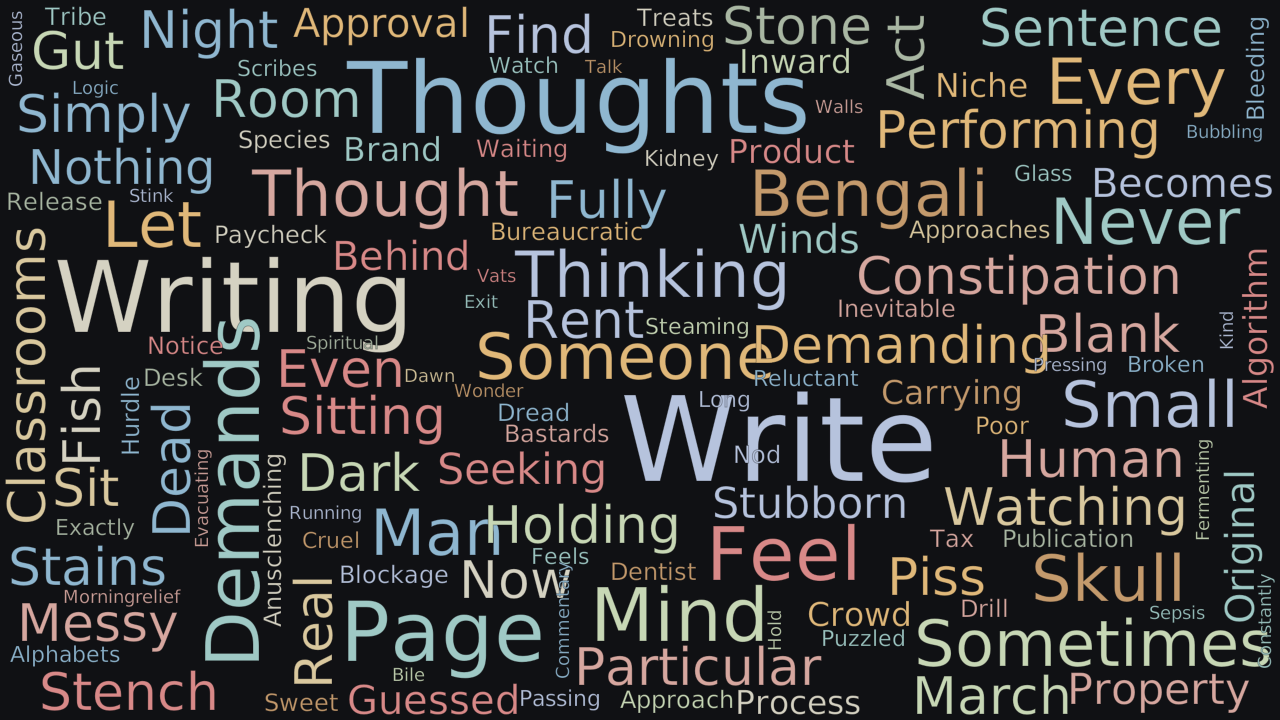
Word Cloud
Related reading
Selected by shared topics and section, with closer publication dates breaking ties.

Comments
Read the conversation or leave a thought for review. Comments load when this section is in view.