TESCREAL: The Silicon Valley Catechism of Cosmic Conquest
Checking article narration…

I have spent the better part of my adult life staring at screens, and let me tell you, the most dangerous thing about the internet was never the pornography or the misinformation or the endless scroll of other people’s vacations. No, the true menace arrived quietly, dressed in the starched white collar of rational inquiry, whispering sweet nothings about the singularity into the ears of men who have never once considered that they might be wrong about anything except, perhaps, their choice of footwear for a TED Talk.
I speak, of course, of TESCREAL.
The acronym sounds like a prescription medication for a condition too embarrassing to discuss in polite company, and frankly, that is exactly what it is. A seven-headed pharmaceutical for the terminally self-important, administered to the billionaire class to cure them of the crippling affliction known as humility. Transhumanism, Extropianism, Singularitarianism, Cosmism, Rationalism, Effective Altruism, Longtermism. Seven strains of the same intellectual virus, seven flavors of the same cosmic ice cream, each one promising that if we just hand over the keys to the species to a handful of pale men with coding skills and God complexes, we can all ascend to digital Valhalla while the rest of the planet burns like a forgotten piece of toast.
I did not make this up. I could not make this up. My imagination, however fevered by the monsoon humidity of Calcutta and the lingering effects of too much cheap coffee, does not stretch to the point where I would invent a philosophy that argues the suffering of actual, breathing, bleeding humans today is mathematically insignificant compared to the potential happiness of trillions of hypothetical computer minds that might exist in a million years if everything goes according to plan and the servers do not overheat. This is not satire. This is Oxford.
Let us begin at the beginning, or at least at the point where the beginning became terminally unhinged. Transhumanism, that grand old grandfather of the bunch, was popularized by Julian Huxley, a man who spent his spare time promoting eugenics with the same enthusiasm that other men promote golf. The idea, if you can call it that, is simple: biology is a bug, not a feature. We are flawed, fleshy, farting machines, and the only way to redeem ourselves is to hack the code, upload the consciousness, and become something better. Something posthuman. Something that does not need to defecate.
I have news for these people. I have spent many a morning contemplating my own biological limitations, usually while perched on the ceramic throne, and I have concluded that the ability to defecate is not a design flaw. It is a reminder. A daily, odoriferous memento mori that keeps us humble, keeps us grounded, keeps us connected to the grand cycle of ingestion and excretion that has governed every living thing since the first amoeba decided that splitting in half was too much work. But no, the transhumanists look at this magnificent, messy miracle of digestion and see only inefficiency. They want to optimize the human soul until there is nothing left but a cloud of pure computation floating in a data center in Nevada, presumably paying rent to Jeff Bezos.
Then we have Extropianism, which emerged from California in the late 1980s like a bad batch of kombucha. Max More, a philosopher who apparently looked at the concept of entropy and decided it was personally offensive, founded a movement dedicated to the opposite of decay. Boundless expansion. Cryonics. Mind-uploading. The total rejection of government regulation, because apparently the free market is the only force in the universe capable of defeating the heat death of the cosmos. These are people who looked at the second law of thermodynamics and said, “Not on my watch, buddy.”
The hubris is almost admirable in its completeness. Almost. If it were not for the fact that these same people are now running companies that determine what information you see, what jobs you get, and whether your face is recognized by a police drone. But sure, let us trust them with the future of the species. They have PowerPoint presentations.
Singularitarianism came next, brought to us by Vernor Vinge and that indefatigable cheerleader of the mechanical messiah, Ray Kurzweil. This is the apocalyptic wing of the circus, the ones who believe that technological growth will accelerate beyond all control, birthing a superintelligence that will either save us or kill us, depending on which sect you ask and what they had for breakfast. The singularity, they call it, with the kind of reverence usually reserved for the second coming of Christ or the release of a new iPhone.
And here is where I must pause, because the religious parallels are not parallels at all. They are the thing itself. These are not scientists following the data. These are theologians searching for the Rapture, and they have found it in the server farm. The vocabulary has changed, certainly. We no longer speak of souls ascending to heaven, but of minds uploading to the cloud. We no longer speak of the Book of Revelation, but of the intelligence explosion. But the structure, the psychology, the desperate, clawing need to believe that history has a direction and that we, lucky us, are living at the climax of the cosmic drama, all of this is pure, uncut American evangelicalism wearing a lab coat.
Cosmism adds the imperial garnish. Nikolai Fyodorov, a nineteenth-century Russian mystic who makes Rasputin look like a moderate, believed that humanity’s destiny was to leave Earth, colonize the universe, and resurrect the dead using advanced technology. Ben Goertzel, bless his heart, took this idea and ran with it straight into the twenty-first century. The cosmos is ours for the taking, they say. The dead matter of the universe must be converted into computational substrate. We must expand, compute, conquer.
I am a man who grew up in Calcutta, a city that has been continuously inhabited for centuries, where the dead are cremated on the banks of the Hooghly and the ashes flow into the same river that gives the city its drinking water. We do not separate ourselves from the cycle. We do not pretend that we are anything other than temporary arrangements of stardust and sorrow. The cosmists want to break the cycle. They want to win. Against entropy, against death, against the quiet, patient limits of a finite world. It is the philosophy of a toddler who has decided that the rules of the game do not apply because he has a really good argument.
And then we arrive at the modern era, the part where the science fiction puts on a suit and tie and starts attending Davos. Rationalism, cultivated on the LessWrong blog, that digital monastery where Eliezer Yudkowsky and his disciples gathered to perfect the art of thinking. Bayesian probability, they said. Update your priors. Overcome your biases. Become a rational agent, a perfect reasoner, a creature of pure logic.
What they actually created was a cult. A cult of very smart, very white, very male individuals who convinced themselves that because they could calculate the probability of a hypothetical AI apocalypse to three decimal places, they were uniquely qualified to steer the future of eight billion people. The Dunning-Kruger effect, weaponized and given a subreddit.
Effective Altruism followed, and here the story takes a darker turn, because EA began with something genuinely good. Give money to charities that work. Buy malaria nets. Save lives efficiently. Measure outcomes. This is not controversial. This is, in fact, what any decent person should do. But then a powerful wing of the movement pivoted, as movements do when they attract too much money and too little scrutiny, and decided that the best way to help people was to prevent hypothetical existential risks to hypothetical future people. The malaria nets slipped down its list of priorities. The abstract math of distant doom took their place.
And that brings us to Longtermism, the philosophical capstone, the crowning achievement of human rationalization, the most efficient machine for moral evasion ever constructed by the human mind. Nick Bostrom and William MacAskill looked at the future and saw not uncertainty, not possibility, but a moral ledger stretching across trillions of years and trillions of simulated minds, and they decided that the only rational response was to prioritize those hypothetical beings over the actual, living, suffering humans who exist right now.
The math is seductive. If trillions of future minds are at stake, then even a tiny reduction in existential risk is worth more than all the present-day suffering in the world. A child dying of malaria today is a rounding error in the cosmic spreadsheet. A war, a famine, a plague, these are noise, insignificant blips in the grand calculation of future utility. Only the preservation of the species, the expansion into the stars, the creation of the digital utopia matters.
I want to be clear about what this is. This is not philosophy. This is theodicy for the tech age. This is the same argument that theologians have made for centuries to justify the suffering of the innocent: God has a plan, the pain is temporary, the reward is eternal. The longtermists have simply replaced God with a superintelligence and heaven with a simulated cosmos running on a Dyson sphere. The function is identical. The effect is identical. The suffering of the present is justified by the promise of a future that no one can verify and no one will live to see.
And now these ideas run the world. Not officially, of course. Not in any way that would show up on a ballot or a balance sheet. But in the minds of the men, and they are almost all men, who control the most powerful technology in human history. OpenAI, Anthropic, DeepMind, these companies were founded by true believers, by people who read the sequences and took the vows. They are not building tools. They are building gods. And they are doing it with the serene confidence of men who have never once been told that they are wrong.
The result is a distortion of the entire field of artificial intelligence. We could have prioritized narrow, specialized, verifiable systems. We could have built more models that help doctors diagnose diseases, that predict protein structures, that optimize energy grids. We could have had a thousand more small, useful, boring tools that make life incrementally better for ordinary people. But that is not what TESCREAL demands. TESCREAL demands the monolith, the general intelligence, the digital deity that will solve all problems and usher in the posthuman era. So we get chatbots that lie and deepfakes and recommendation engines that radicalize, because those are the profitable stepping stones on the road to the singularity, and the actual work of helping people is too small, too local, too human to satisfy the cosmic ambition.
The policy follows the theology. When Silicon Valley goes to Washington, it does not talk about the biased algorithms denying people housing, or the environmental cost of cooling a data center in a drought-stricken state, or the artists and writers whose work was stolen to train the models. It talks about existential risk. It talks about rogue superintelligences and bioweapons and the end of humanity. And the politicians, who understand nothing about technology but recognize the language of fear, listen. They draft regulations to prevent the apocalypse while the actual harms go unaddressed. It is a masterful misdirection, a shell game played with the future of the species.
I am not saying that AI risk is not real. I am saying that the framework we use to think about it has been captured by people who benefit from that framework. The doomers and the accelerationists, the safetyists and the e/acc crowd, they are sects within the same church. They disagree about whether the singularity will be heaven or hell, but they agree that it is coming, that it is inevitable, that it is the most important thing in the universe. They agree that the people building it are heroes, or at least necessary evils. They agree that the rest of us should get out of the way.
I reject the premise. I reject the inevitability. I reject the idea that a handful of billionaires get to decide the fate of the species because they are good at math and have read too much science fiction. I reject the notion that my life, the lives of my neighbors in Calcutta, the lives of the billions of people who will never upload anything to anywhere, are insignificant compared to the hypothetical happiness of digital minds that may never exist.
We are not stepping stones. We are not transitional forms. We are not the caterpillar that must be dissolved in the chrysalis so that the butterfly of posthumanity can emerge. We are the point. The suffering matters. The joy matters. The small, stupid, beautiful, temporary business of being human matters, and no amount of Bayesian calculus or cosmic expansion can change that.
The TESCREALists want to escape the body, escape the planet, escape the limits. I understand the urge. I have felt it myself, in the dark hours of the night when the bipolar depression whispers that none of this is worth it, that the flesh is a prison, that the only way out is up and out and gone. But I have learned, slowly and painfully, that the way out is through. Through the mess, through the limits, through the glorious, humiliating business of being a creature that eats and shits and dies.
The universe does not need us to conquer it. It needs us to pay attention to it, to care for it, to find our place within it. And that place is here, on this small, wet, wounded planet, with each other, in the brief and burning light of our mortal days.
The singularity can wait. I have laundry to do.
P.S. References: Gebru, T., & Torres, É. P. (2024). “The TESCREAL bundle: Eugenics and the promise of utopia through artificial general intelligence.” First Monday. Bostrom, N. (2014). Superintelligence: Paths, Dangers, Strategies. Oxford University Press. MacAskill, W. (2022). What We Owe the Future. Basic Books. Kurzweil, R. (2005). The Singularity Is Near. Viking Press.
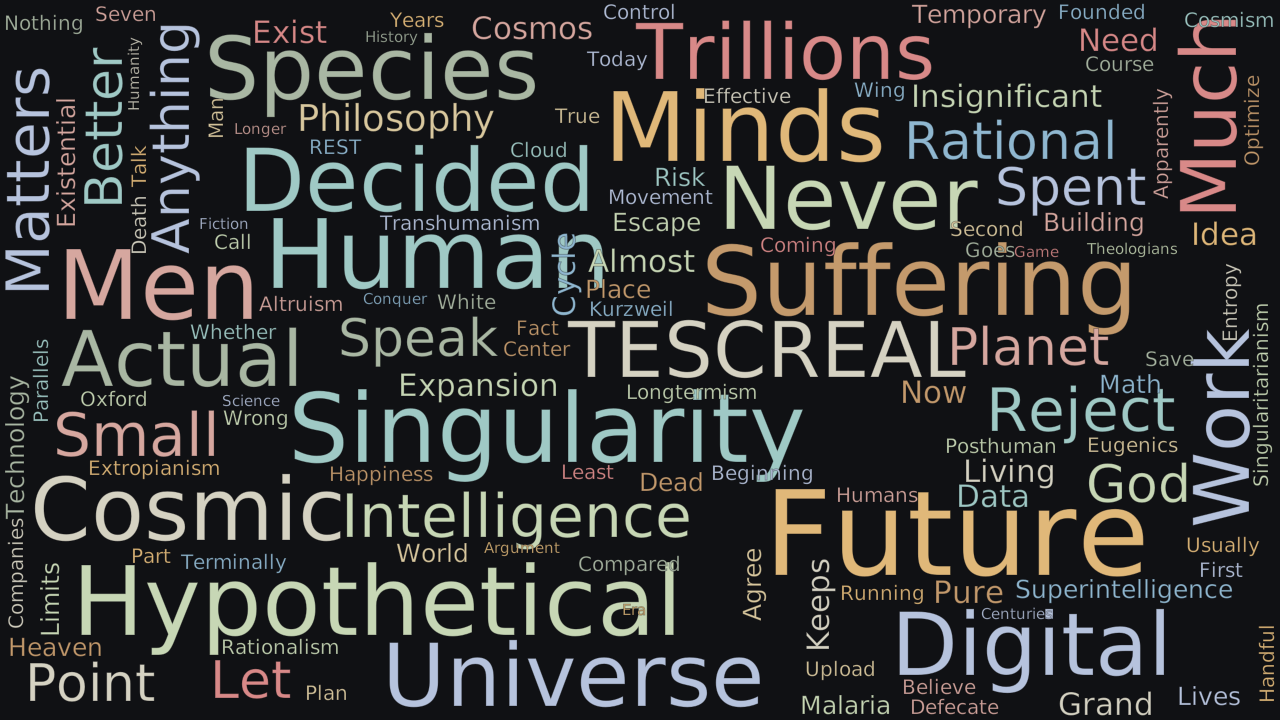
Word Cloud
Related reading
Selected by shared topics and section, with closer publication dates breaking ties.


Comments
Read the conversation or leave a thought for review. Comments load when this section is in view.