The Great Indian IT Crematorium
Checking article narration…

Microsoft is offering some sixty thousand employees money to fuck off, with India included in the invitation. A voluntary exit, they call it, complete with financial support and career planning, because after years of making yourself useful to the company you may need professional help figuring out what to do once it is prepared to pay for your absence. Apparently this will help people “shape their next chapter.” I imagine quite a few were hoping to continue with the chapter in which the salary arrived and the bills got paid. They had perhaps even made commitments on that assumption, had children, bought a home, allowed themselves to believe that learning whatever new shit the company needed them to learn would keep them employable. And now somebody is explaining how much freedom they are about to have.
The body is still warm, so let us not pretend we are surgeons. We are butchers with a thesaurus, and the carcass on the slab is the promise attached to the Indian IT dream, that great bovine god of the middle class, fed on arbitrage and milked by hope until somebody began examining the udders for blood. It lumbered through my youth, through the coaching centers of Calcutta, through the belief that memorizing the syntax of Java as if it were Sanskrit would eventually deliver you into a world where the toilet flushed upward and the salary arrived in dollars. You studied, you got in, you worked, and the machinery would carry you somewhere better. You might have to spend your youth inside it, but at least you would come out with something.
I speak of arbitrage, that beautiful, filthy word. It sounds like a French dessert, but much of the business came down to renting a human brain in Hyderabad at rupee rates and leasing it to a client in Houston at dollar rates. For decades, this helped power the alchemy of the Indian middle class, the transmutation of sweat into software, of midnight oil into mortgage payments. Body shopping, they called its crudest form, with a candor that would make a pimp blush, though we preferred “resource augmentation,” as if human beings were spare tires or oil filters to be screwed into the chassis of Western capitalism. And screw them we did, into cubicles that smelled of stale coffee and desperation, into night shifts that left our bodies unsure whether the sun rose in the east or merely compiled in the west.
But here is the rub, the sand in the Vaseline, the turd in the punchbowl of progress. The ladder did work. People bought homes, educated children, got their parents treated. That is why they trusted it. That is why they borrowed against the next twenty years of their lives. You cannot spend decades encouraging people to organize their entire existence around this arrangement and then act faintly irritated when they discover that it can stop supporting them.
Artificial intelligence, that cheery, chuckling, silicon-brained bastard, can write code, find bugs, draft tests, and generate the PowerPoint decks we once filled with meaningless agile jargon. The sales fantasy is that a client who needed ten engineers will now need one engineer and a subscription to something that does not sleep, does not unionize, does not demand a Diwali bonus. Actual software is more troublesome. Somebody still has to understand what the client meant, what the old system does, and whether the machine’s confident improvement has quietly fucked the accounts. But the threat does not require the fantasy to come true in full. If fewer people can deliver the same work, the client can ask why he is still paying for all those hours. The firm can squeeze the team. It can stop replacing people who leave. It can simply decide that the next batch of graduates is unnecessary.
The margins do not have to collapse like a lung full of tar. TCS reported a 24 percent operating margin for the quarter ending September 2026. There is no need to invent a funeral for every company. The people can be in trouble while the business is doing perfectly well, and that is part of what makes this so fucking difficult to explain to somebody who keeps pointing at the revenue chart.
Yet the prophets of this new dawn, these AI-cheery chucklefucks with their venture capital grins and their TED Talk cadences, assure us that new jobs will be created. When? For whom? And what is the man supposed to live on until one of these jobs becomes his? They speak of “upskilling” as if it were a sacrament, as if a forty-year-old programmer with a home loan and a daughter in medical school can simply upskill into a prompt engineer or a data ethicist or whatever snake oil title they are peddling this quarter. He may learn perfectly well. He may have spent his entire career learning. None of this explains what he eats while becoming the exciting new version of himself that a recruiter might or might not want.
The ladder they offer now is a greasy pole, and every time he slips, somebody explains that his grip was insufficiently entrepreneurial.
I have seen the future, and it is a rusted fire escape in a Calcutta monsoon, slick with algae and good intentions. There may well be jobs waiting at the top. They may be in another city, require another qualification, pay less than the obligations he already has. The forty-five-year-old with COBOL in his head may still know something a bank badly needs. COBOL has not obligingly vanished because a conference speaker has discovered the future. But being useful does not guarantee that somebody will hire you where you can live, at a wage you can survive on, before your money runs out. The transition becomes a cliff when the people describing it have forgotten that you need somewhere to put your feet.
The mathematics of this cruelty does not require a grand equation about humanity becoming unnecessary. If the savings last three months and finding the next income takes nine, there are six months someone has to live through. More jobs somewhere else, eventually, at some other salary, do not pay for those six months. The rent continues. So does the need to eat. A forecast of future prosperity is a difficult thing to swallow, even with water.
And yet the middle-class hope persists, that stubborn, dour, Bengali hope that says perhaps the water will recede, perhaps the flood will not reach the second floor, perhaps the government will announce a scheme, perhaps the gods of the old economy will resurrect themselves from the ashes of burned offer letters. This hope is a survival mechanism for those who cannot afford to examine every possibility for too long. We have survived famines, partitions, and the British, we tell ourselves, so surely we can survive a few lines of Python written by a machine. Our capacity to endure is always being offered as evidence that we can be made to endure a little more.
I am fifty-one. I live alone in Calcutta. My working life has involved healthcare systems, clinical data, statistics, and the unglamorous work of making systems agree about what the hell they mean. My problems did not begin with AI. I have been without steady employment for years, with consulting when it came, and I am not going to rewrite that history to give the machine credit for everything. But I know what it is to sit with knowledge you can still use and no dependable way to turn it into next month’s expenses.
I am still learning. I am still trying to build things.
What exhausts me is the suggestion that this should settle the matter, that because I can learn another tool, make another demonstration, solve another problem, there must therefore be a living waiting at the end of it. There may be. I am trying to find it. Meanwhile, the effort comes out of the same person who has already been doing this for years, who still has to eat and pay rent and buy medicines while becoming whatever he is supposed to become next. I would like, at some point, to be allowed to finish becoming and get paid.
The tragedy gets into your sense of what you are. We defined ourselves by our utility, by our ability to solve tickets, to close Jira issues, to make the code compile by Friday. We were the vanguard of the globalized dream, the proof that India could compete, that brown hands could type white futures. And now we are being told that much of the typing can be done more cheaply, more quickly, with fewer of us attached to it. There is something particularly humiliating about having spent your life being told to become useful and then finding yourself required to explain, again, why your usefulness should entitle you to an income.
The shiny Western life we coveted, that superficial sophistication of IKEA furniture and Starbucks coffee and foreign vacations photographed for Facebook, had plenty of vanity in it. But the salary was not a mirage. Neither was the ability to pay for a parent’s treatment, or replace something broken without first holding a financial inquest over its corpse. The ordinary relief of knowing that next month was probably manageable was real. It is easy to mock the cup of coffee. It is harder to explain what happens to a person when even that small assumption of continuity goes.
And as the sewers of progress back up and flood the streets of our ambition, we are told to swim. Learn faster. Network harder. Be resilient. Some people have savings, property, a spouse’s income, somebody they can call. Others have already spent the buffer. The water does not reach everybody at the same height, and the man standing on the roof has some fucking nerve criticizing the technique of the man whose mouth is already full of sewage.
I will not pretend that the flood is a baptism, that the waters are rising to cleanse us for a new beginning. There will be people who make fortunes out of this. There will be useful things built, diseases better understood, work made easier, possibilities I would like to be alive and solvent enough to explore. None of that explains why the people being pushed out must accept their own ruin as a reasonable contribution to the proceedings.
The Indian IT industry may survive and prosper while the promise attached to it is dismantled, slowly, politely, with a PowerPoint presentation and a smile. And we, the people who arranged our lives around that promise, are being asked to admire the efficiency of the blade, to upskill ourselves into acceptance. But I refuse the anesthetic. I will keep my eyes open as the water rises, as the code compiles, as the people who sold us the old future begin charging admission to the new one. I will document the drowning with the bitter, bilious humor of a man who suspects the lifeboat is already full and has just discovered that the captain is a chatbot.
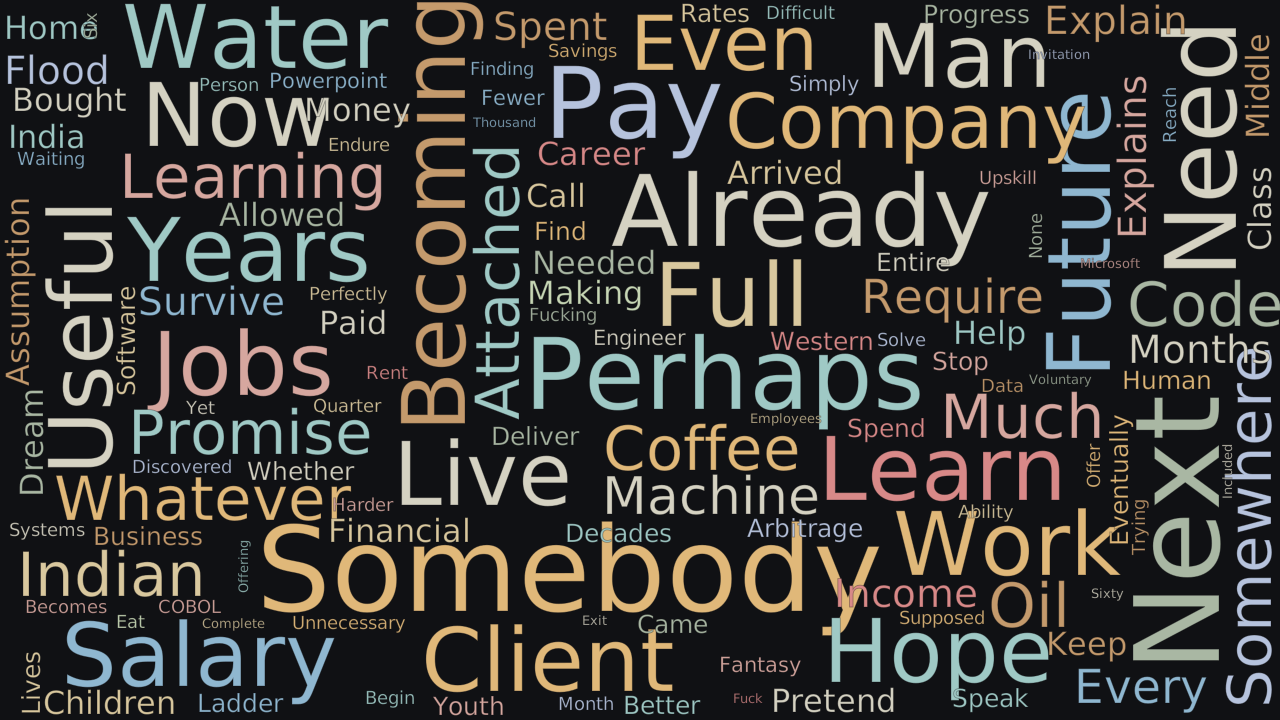
Word Cloud
Related reading
Selected by shared topics and section, with closer publication dates breaking ties.



Comments
Read the conversation or leave a thought for review. Comments load when this section is in view.