An idea becomes easier to understand when you can see what it rests on, where it leads, and which questions it leaves open. Bring a piece of writing, follow a branch, and keep the original words within reach.
Mindmap Studio.
See the connections.
Start with the source.
Paste the passage you want to understand. Keep its evidence close as the map takes shape.
PDF page selection
Set the physical page range before opening a PDF. Scanned pages need extracted text.Local mode arranges exact passages into a reading outline in your browser. Choose AI for conceptual interpretation, argument mapping and research analysis.
New analysis creates a separate revision. Your current map stays in Undo. Up to 8 sources and 200,000 characters.
How ideas become knowledge
Preparing your canvas…
Scope & limitations
- An authored demonstration of reading and mapping, not an AI analysis or a research literature review.
- Cross-links are illustrative interpretations of the two cited passages. Evidence of wording does not establish the truth of an assertion.
Checking article narration…
Begin with a question
The example opens with a small essay about inquiry: asking questions, gathering evidence, building explanations, testing arguments, connecting ideas and communicating what remains uncertain. It is an original demonstration text included with this tool. Its coloured branches offer several ways into the same subject.
Select Sources to add your own material. Paste an article or transcript, open a text or Markdown file, or select pages from a text-based PDF. Caption files preserve their timestamps. For a scanned PDF, provide extracted text or OCR output. The preview lets you inspect what the app can actually read before analysis begins.
A video or article link can accompany the text as a reference. The application does not retrieve the linked material. Paste the passage or captions you want to examine; a title alone cannot support an interpretation.
Use the focus field to name your question. You might want to understand the main argument, compare evidence, examine assumptions, or prepare a teaching outline. Overview, Detailed and Research settings control the requested depth.
Two ways to read
Local outline arranges source passages in your browser. It preserves exact evidence and gives you a starting structure to edit. Its extraction rules do not perform the deeper conceptual interpretation requested of an analyst.
AI conceptual analysis, when available, identifies themes, claims, relationships and possible implications. It requires consent before transmission. The free service has shared usage limits and may be unavailable. You can also copy a research prompt, use it with a model of your choice, and import its validated project JSON.
Long inputs have explicit limits. Coverage records show how many source segments were considered, and limitations explain omissions. A partial reading should remain recognisable as partial.
A branch is a way in
The Mind map view follows a hierarchy. Expand a branch, inspect a smaller idea, or move a piece to a more useful place. Long explanations belong in the inspector, where they can remain readable without stretching the entire map.
The Knowledge graph reveals connections between branches. A claim may support one argument and challenge another. Select a labelled relationship to read its rationale and available evidence. Filters help you explore a source, relationship type or selected idea’s neighbourhood.
The Outline provides a reading-order alternative and keyboard-accessible editing. Analysis gathers the overview, concepts, relationships and study questions. Switching views preserves the same underlying ideas.
Keep the words nearby
An explicit idea is directly stated in the source. An inferred idea interprets identified material. A speculative idea proposes a possibility. These labels describe how an idea relates to its source; they do not guarantee that the source itself is correct.
Open an evidence card to read its exact passage in context. When you rewrite a claim, review whether the original passage still supports it. Changing the wording of an explicit claim marks the interpretation for review.
Relationships need the same care. “Associated with” does not establish “causes”. Disagreement between sources can be useful information, and a question need not be resolved to deserve a place on the map.
Keep a working copy
Your edits are saved on this device. Use Undo and Redo to move between revisions. New analysis keeps the previous map in Undo instead of silently discarding your work.
Download project JSON to preserve the editable model, full source text, evidence and private notes. Treat that file as containing the material you supplied. Markdown and Mermaid exports provide portable reading and diagram formats, while image exports make a map easier to share.
A public snapshot removes source bodies, URLs, evidence excerpts and private notes. Its labels, descriptions and relationship explanations may still contain source-derived content, so review the snapshot before adding it to a published article. Saving locally does not publish anything.
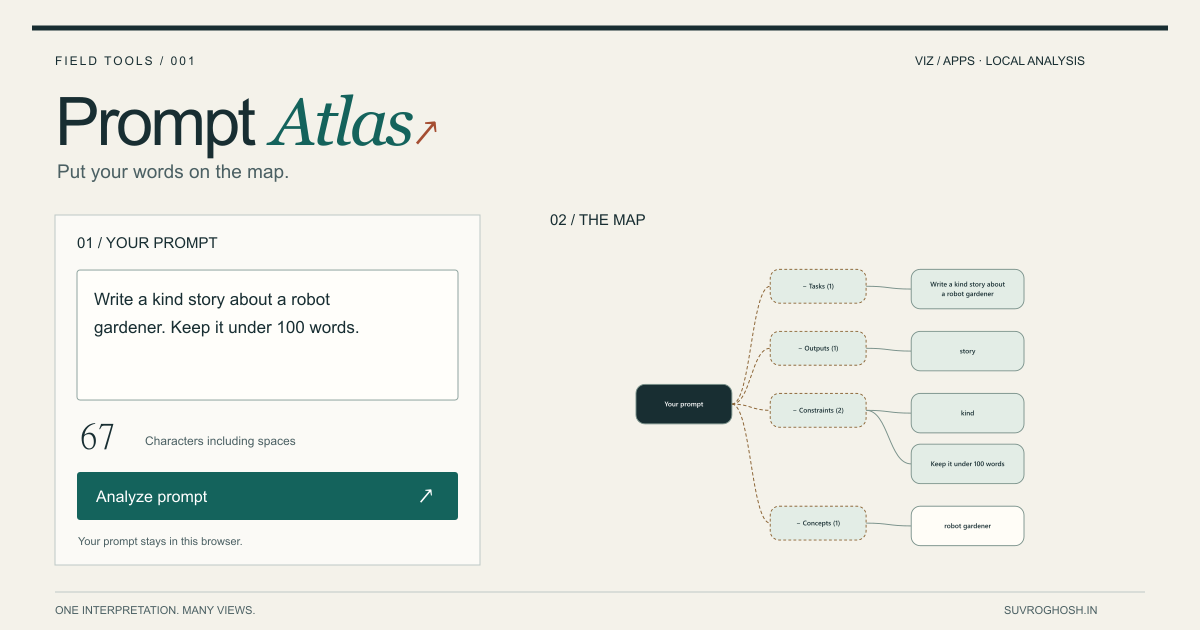
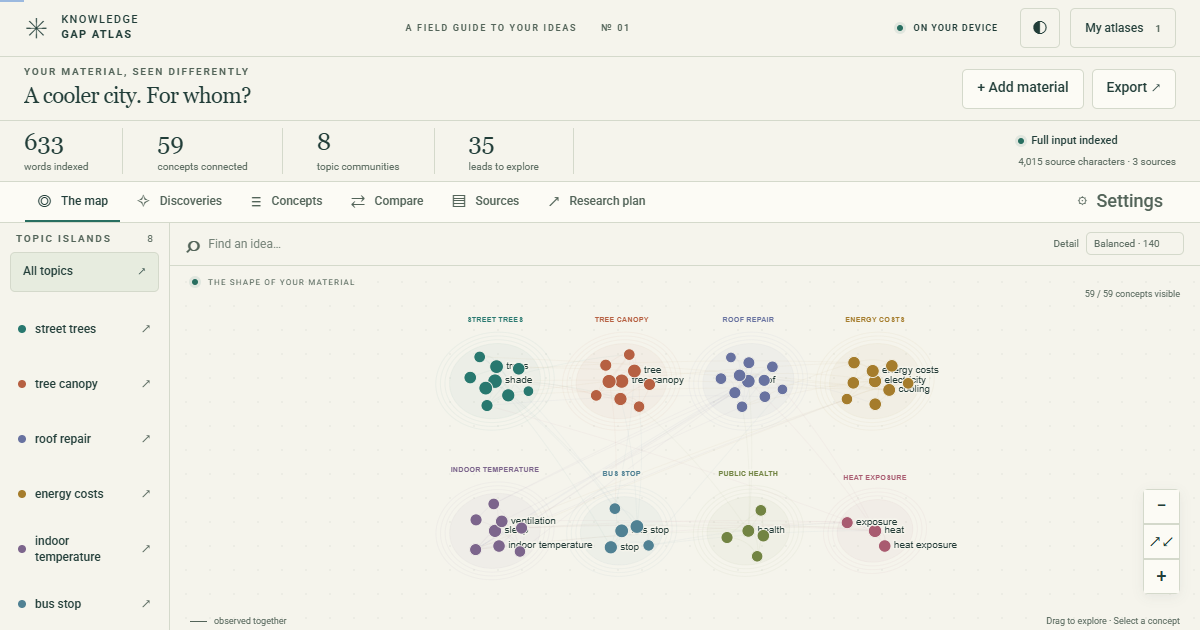
The hierarchical editor builds on Mind Elixir Core. The surrounding source workflow, evidence model and knowledge graph are integrated into this blog. You can also explore Prompt Atlas for prompt structure or Knowledge Gap Atlas for topic coverage across a corpus.
A map on the page
This is the example as a published snapshot. Its text outline is available without the interactive canvas, and exploring it leaves the original unchanged.
How ideas become knowledge
Read the complete text outline
- How ideas become knowledge explicit
This original demonstration describes a careful reading practice: begin with a question, preserve the source, organise ideas, examine arguments, explain connections and revise interpretations.
- Begin with curiosity explicit
A useful inquiry starts with a question specific enough to investigate and open enough to change.
- Ask a useful question explicit
A useful question names what is uncertain instead of disguising a preferred answer as a question.
- Make uncertainty visible explicit
Writing “I do not know yet” keeps an unanswered question distinct from a confident conclusion.
- Make uncertainty visible explicit
- Name your purpose explicit
The purpose of an inquiry might be to understand, compare, explain, decide or design.
- Set the boundary explicit
A boundary names the time, place, people and material that an inquiry will cover.
- Notice surprises explicit
An observation that does not fit an expectation can become the beginning of a new question.
- Keep an open notebook explicit
A notebook can preserve initial questions so that later answers do not erase how the inquiry began.
- Ask a useful question explicit
- Gather with care explicit
Gathering material includes recording where it came from, what it covers and what it leaves out.
- Preserve the source explicit
Keep a source passage in its original form so that a later interpretation can be checked against it.
- A quotation is an anchor explicit
A quotation shows what a source says; it does not by itself establish that the statement is true.
- A quotation is an anchor explicit
- Record the location explicit
A page, paragraph or timestamp makes a claim easier to find in the original material.
- Distinguish voices explicit
Separate what a source author says from what a quoted speaker or later reader says.
- Mark missing context explicit
An excerpt may omit qualifications that appear elsewhere, so its boundary belongs beside its analysis.
- Keep contradictions explicit
Sources that disagree should retain their separate claims and attribution until the disagreement is examined.
- Preserve the source explicit
- Give ideas a shape explicit
A mind map arranges ideas into a readable hierarchy while a knowledge graph records relationships across that hierarchy.
- Find the central question explicit
The root of a map should give the reader a clear account of the inquiry being explored.
- Maps are interpretations explicit
Grouping an idea under a heading is an editorial choice, even when the idea itself is directly quoted.
- Maps are interpretations explicit
- Name the main themes explicit
Major branches should reflect the material rather than a template imposed on every source.
- Define concepts in context explicit
A definition should explain how a term is being used in this particular material.
- Connect across branches explicit
A cross-link can show that an idea in one branch supports, challenges or depends on an idea elsewhere.
- Preserve different meanings explicit
Two passages using the same word can express different concepts and should not be merged merely because their labels match.
- Find the central question explicit
- Examine the argument explicit
Examining an argument means separating its claims, evidence, assumptions and possible objections.
- Find the claim explicit
A claim is a statement the source asks its reader to accept.
- Ask what would change your mind explicit
A claim becomes easier to examine when the reader can name evidence that would count against it.
- Ask what would change your mind explicit
- Inspect the support explicit
Support may include observations, measurements, examples, testimony or reasoning; these play different roles.
- Surface assumptions explicit
An assumption connects steps in an argument without always being stated directly.
- Consider another reading explicit
An alternative interpretation can expose an ambiguity without proving the original interpretation wrong.
- Respect causal limits explicit
An association between two observations does not by itself identify a causal mechanism.
- Find the claim explicit
- Make understanding useful explicit
An explanation becomes useful when another person can follow its structure and inspect its support.
- Explain in plain language explicit
Clear language lets a reader spend attention on the idea instead of decoding unnecessary jargon.
- Offer more than one view explicit
A text outline and a visual map can describe the same structure for readers with different needs.
- Offer more than one view explicit
- Teach the connections explicit
A teaching outline should show why ideas connect as well as what each idea means.
- Make a concrete example explicit
An example can illustrate an idea, while its limits prevent the example from standing in for every case.
- Turn questions into practice explicit
A study question can ask a learner to compare, explain or apply an idea rather than only repeat a label.
- Keep evidence within reach explicit
A reader should be able to move from a compact map label to its explanation and source passage.
- Explain in plain language explicit
- Leave room to revise explicit
A knowledge map remains useful when it records uncertainty and can change as new material arrives.
- Label interpretations explicit
An inferred connection should identify the passages and reasoning that motivated it.
- Learning is revisable explicit
A revision should make clear what changed and why, so that a polished map does not hide its uncertainty.
- Learning is revisable explicit
- Separate possibilities explicit
A speculative possibility belongs in an exploratory layer, apart from what the source explicitly states.
- Keep open questions explicit
An unresolved question can identify a productive next step without pretending that the source supplied an answer.
- Review a changed source explicit
When the source changes, check the interpretations and quotations that depended on its earlier wording.
- Save an editable version explicit
An editable version preserves the structure needed to revise a map beyond its exported picture.
- Label interpretations explicit
- Begin with curiosity explicit
Connections across branches
- Preserve the source → supports → Inspect the support inferred
Preserved passages let a reader inspect what is offered as support.
- Record the location → enables → Keep evidence within reach inferred
Recorded locations let a reader return from an explanation to its source.
- Connect across branches → supports → Teach the connections inferred
Cross-links make connections available for teaching.
- Surface assumptions → associated with → Label interpretations inferred
Recognising assumptions and labelling interpretation are complementary reading practices.
- Keep contradictions → supports → Consider another reading inferred
Preserving disagreement keeps alternative readings available for examination.
- Ask a useful question → associated with → Keep open questions inferred
An initial question and an unresolved question both make uncertainty visible.
- Save an editable version → enables → Review a changed source inferred
An editable map gives the reader a way to revise source-dependent interpretations.
- A quotation is an anchor → associated with → Respect causal limits inferred
Both passages limit what can be concluded from an observation or quotation.
An original demonstration essay about inquiry, published as a read-only map.
This published snapshot omits original source bodies and evidence excerpts. Explicit, inferred and speculative labels record the author's classification; source support cannot be independently checked in this view.
Quick reference and FAQ
Bring an article, a transcript or a PDF excerpt. Arrange its ideas, inspect the words behind them, and explore the same material as a mind map, a knowledge graph or an outline.
Key Terms
- Mind map
- Knowledge graph
- Evidence
- Inference
- Source analysis
Frequently asked questions
Does Mindmap Studio send my material to an AI provider?
Local outline mode works in your browser. Optional conceptual AI analysis requires consent for each request and sends your sources through this site's server, with selected excerpts sent through Vercel AI Gateway to NVIDIA. NVIDIA may retain the submitted material for model improvement. Availability depends on the configured free service and shared usage limits.
Can I paste a video link?
A link can be saved as a source reference. Add the video's transcript or captions for analysis. Mindmap Studio does not watch linked videos or invent inaccessible content.
What is the difference between the mind map and knowledge graph?
The mind map organises ideas into a hierarchy. The knowledge graph shows labelled relationships across that hierarchy. Both views use the same editable ideas and source references.
Where are my maps saved?
Edits are saved in this browser's local storage database. Download the editable project JSON for a portable backup. It includes your source text, evidence and notes. A public snapshot omits source bodies and private notes but still needs a content review before publication.
Word Cloud
Related reading
Selected by shared topics and section, with closer publication dates breaking ties.
Comments
Read the conversation or leave a thought for review. Comments load when this section is in view.