Diwali Depression
Checking article narration…

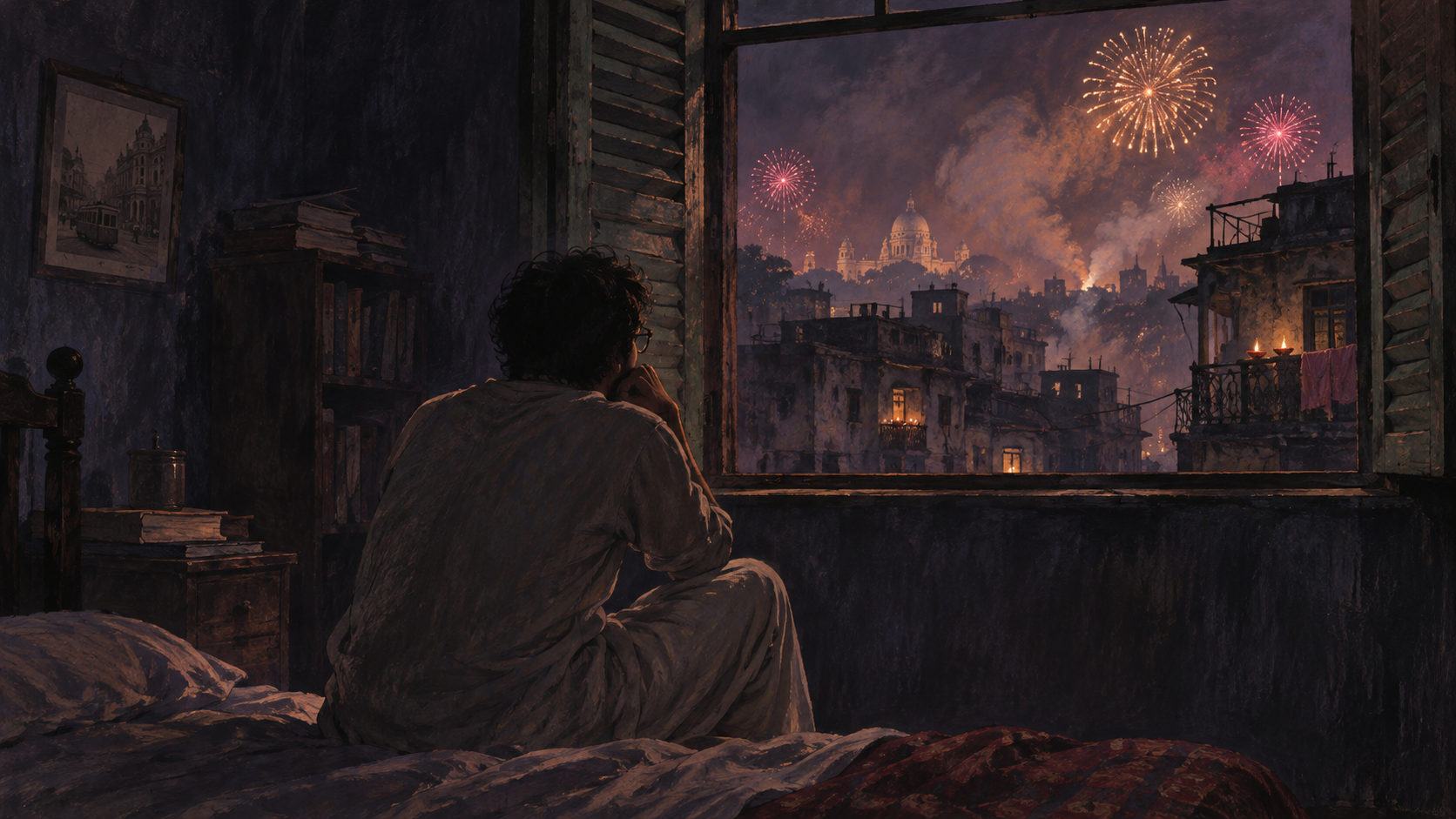
The loudspeaker is vomiting bhajans again. I can hear the goddamn harmonium wheezing like a dying accordion, and some devotee with a voice like a cement mixer is trying to reach Shiva through sheer volume. Outside, the crackers are popping. Not the polite, Anglican pop-pop of wealthy Ballygunge, but the full-throated, testicular, window-rattling explosions of a festival that has apparently decided my nervous system is public property. I am sitting here in my room, trying to remember how lungs work, and the air outside tastes like cordite and communal triumph. Happy Diwali, you bastards. Happy, happy, happy. May your eardrums bleed in stereo.
I have bipolar type II, which is a fancy medical way of saying my brain chemistry is a sadistic bartender who keeps switching my drinks without telling me. Right now, he has served me a double depressive on the rocks, and the ice is melting into my lap. The DSM-5 would call this a “major depressive episode,” but that is clinical language, scrubbed and sanitized for the insurance forms. What it actually feels like is this: my blood has been replaced with wet cement, my thoughts are moving through molasses, and every single sound from the outside world arrives as a personal assault. The bhajans are not just bhajans. They are the sound of other people belonging. The crackers are not just crackers. They are the sound of other people celebrating a victory I do not feel. I am indoors, suffocating, while the neighborhood is outdoors, ejaculating light and noise into the smog-choked sky. And I am supposed to feel festive. I am supposed to feel grateful. I am supposed to feel.
Here is the physics of my torture. Sound is pressure, literally. It is the compression and rarefaction of air molecules, a longitudinal wave that bullies its way through the atmosphere at roughly at twenty degrees Celsius. When that devotee hits the high notes, he is creating regions of high pressure and low pressure, little atmospheric fistfights that travel from the loudspeaker cone to my tympanic membrane in about three milliseconds per metre. My eardrum vibrates, the ossicles hammer away, the cochlea converts this mechanical violence into electrochemical signals, and my auditory cortex lights up like a damn Christmas tree. The brain does not ask permission. It simply hears. And when the input is a religious song blasted at with a total harmonic distortion that would make Bob Moog weep, the amygdala—that ancient, reptilian kernel of fear—decides this is a threat. Cortisol floods the system. Heart rate spikes. The already-depressed hippocampus shrinks a little more, whimpering in its corner. This is not spirituality. This is acoustic assault.
The crackers are worse. A firecracker is a controlled explosion, a deflagration of black powder or flash powder that rapidly releases gas and heat, creating a pressure wave. That sharp crack you hear is a miniature blast, a pressure spike that can hit at close range. The World Health Organization says that anything above for eight hours can cause permanent hearing damage. The firecracker does not care about your eight hours. It can deliver damage in an instant, a dagger of sound that reaches the inner ear and can leave you with tinnitus, that high-pitched whine that is the ghost of frequencies you may never hear again. I already have tinnitus. I got it from years of listening to music too loud, trying to drown out the world with Sonic Youth and Swans. Now the world is drowning me out with its own cacophony, and I cannot even escape into silence because silence does not exist in Calcutta during Diwali. Silence has been outlawed by consensus. Silence has been replaced by the collective ejaculation of a million atom bombs, or “atom bombs” as the firecracker industry calls them, because nothing says celebration of light over darkness like naming your product after the weapon that vaporized Hiroshima.
I should explain the festival, for the uninitiated, the lucky bastards who live in countries where the night sky is dark and the air is breathable. Diwali, or Deepavali, is the Hindu festival of lights, celebrating the return of Lord Rama to Ayodhya after fourteen years of exile and his victory over the demon king Ravana. The people of Ayodhya lit lamps to guide him home. It is a beautiful story, a myth of homecoming and the triumph of good over evil. But somewhere between the Ramayana and the present day, the lamps became electric bulbs, the bulbs became neon, the neon became LED strips that consume more electricity than a small village, and the symbolic light became a pyrotechnic arms race. The spiritual meaning has not been lost, exactly. It has been buried under layers of sulfur dioxide, particulate matter, and commercial hysteria. The goddess Lakshmi is worshipped for wealth, so the festival has become a capitalist orgy, a Black Friday with better mythology. Buy gold, buy electronics, buy sweets that will rot your teeth and your pancreas. And buy crackers. Buy the atom bombs, buy the hydrogen bombs, buy the “ladies’ finger” and the “anar” and the “chakri” that spins on the ground spitting sparks like a mechanical dervish. Buy them all, because how else will you prove that you are not poor, that you are not joyless, that you are not me?
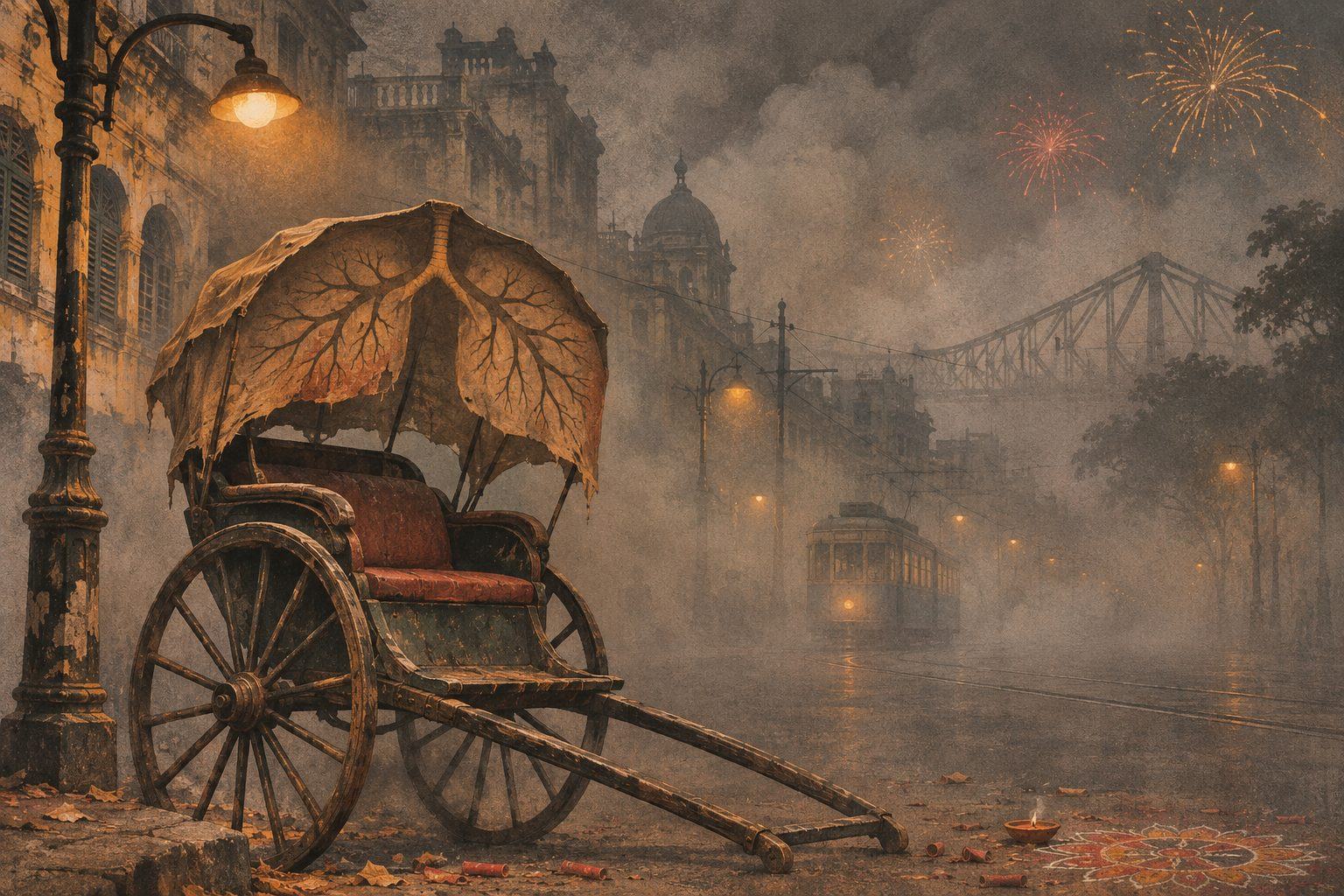
The air quality index in Calcutta right now is probably hovering around , which is “hazardous” in the same way that a bullet to the head is “inconvenient.” The particulate matter, the and , those tiny assassins that bypass the body’s defenses and lodge deep in the alveoli, are having a field day. My lungs, already compromised by years of living in this city, this beautiful, terrible, overcrowded lung-destroyer of a city, are working overtime. I can feel the tightness in my chest, the asthma that I inherited from my father’s side, or maybe from the city itself, because in Calcutta, respiratory disease is a heritage, a patrimony passed down like a cursed antique. The crackers release barium, strontium, copper, and potassium chlorate. The colors you see in the sky, those greens and reds and purples, are heavy metals burning. You are not watching light. You are watching chemistry, toxic chemistry, and you are inhaling the byproducts. The green is barium chloride, which is poisonous. The red is strontium nitrate, which is also poisonous. The blue is copper oxide. You are breathing in a rainbow of poison, and you are smiling, and you are saying “Happy Diwali,” and I am inside, wearing an N95 mask that does not fit properly because I have a weirdly shaped nose, and I am resenting you with every fiber of my being.
The religious songs are a different kind of poison. They are not toxic to the lungs, but they are toxic to the soul, or at least to my soul, which is currently as porous as a sponge and just as capable of holding shape. The bhajans are supposed to be devotional, a form of bhakti yoga, the path of devotion. But when they are amplified through a loudspeaker that has been mounted on a pole by the local club, which is run by a man who thinks decibels are a measure of piety, they become something else. They become territorial marking. This is our festival, the sound says. This is our god, our street, our city. You will listen to this whether you want to or not. You will participate in our joy, or you will be marked as the other, the curmudgeon, the anti-national, the sick man who cannot take a joke. The sound is a fence, and I am on the wrong side of it. I am the dog in the yard, barking at the moon, except I do not even have the energy to bark. I just sit here, typing, while the Kirtan reaches a crescendo that would make Phil Spector’s wall of sound look like a polite cough.
There is a concept in acoustics called the “cocktail party effect,” the ability of the human brain to focus on a single conversation in a noisy room. It is a form of selective attention, mediated by the superior olivary complex in the brainstem, which allows you to localize sound and filter out background noise. I used to be good at this. I could sit in a crowded coffee shop and read, letting the chatter fade into a warm, brown noise. But depression changes the filters. The cocktail party effect breaks down. Every sound becomes foreground. The bhajan singer is not background music; he is a drill sergeant screaming in my ear. The cracker is not a distant pop; it is a gunshot in the next room. My brain has lost its ability to gatekeep sensory input. Everything gets through. Everything hurts. This is called hyperacusis, or maybe it is just called being alive in the twenty-first century with a broken brain and a broken heart.
I should mention the firecrackers’ history, because I am a pedant even in my misery. Gunpowder was invented in China, probably by Taoist alchemists looking for an elixir of immortality, which is ironic because they discovered the exact opposite. The formula, saltpeter, sulfur, and charcoal, was documented in the ninth century, and by the tenth century, the Chinese were using it for fireworks. Marco Polo supposedly brought it to Europe, or maybe the Mongols did, or maybe knowledge just leaks across borders like water through a cracked dam. The point is that the firecracker is a thousand years old. It is a technology that has not fundamentally changed in a millennium. We have sent probes to Mars, we have sequenced the human genome, we have created artificial intelligence that can write poetry, but when we want to celebrate, we still set off small explosions because we are, at heart, cavemen who have learned to make bigger sparks. The psychology is primitive. Noise equals power. Light equals safety. The bang scares away the demons, or the animals, or the neighbors. It says, I am here, I am alive, I can make fire. It is a ritual of dominance disguised as a ritual of joy.
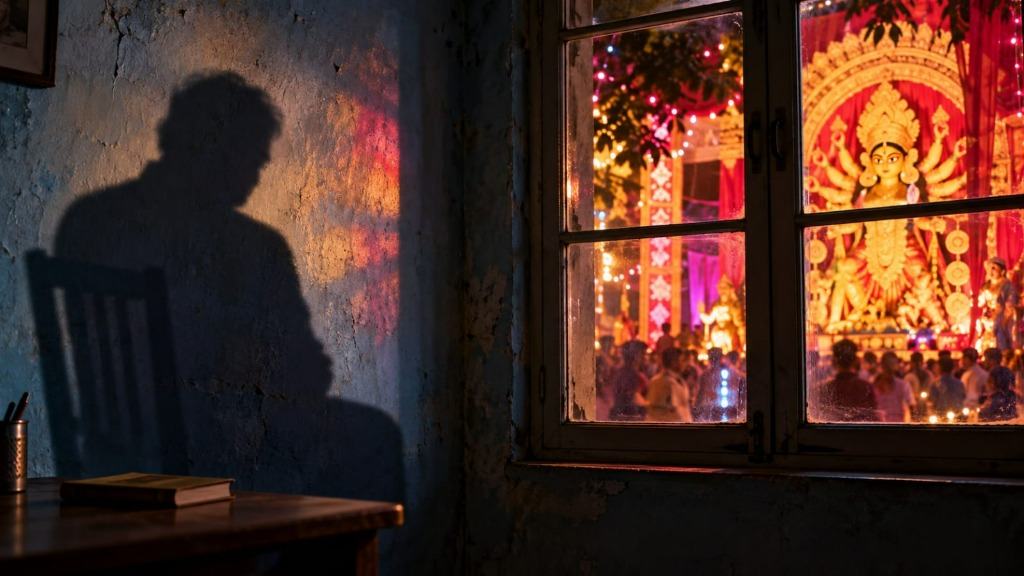
And I am failing at the ritual. I cannot make fire. I cannot make joy. I can only make this essay, which is a poor substitute for a sparkler, but it is all I have. The depression makes me feel like a ghost at the feast, a skeleton at the wedding. I look out the window and see families walking to the pandal, dressed in new clothes, the women in silk sarees that cost more than my monthly rent, the children holding sparklers that drip molten iron onto the pavement, and I feel nothing but a vast, oceanic emptiness. This is anhedonia, the inability to feel pleasure. It is a symptom of depression, a shutdown of the reward circuitry in the brain. The ventral tegmental area stops releasing dopamine. The nucleus accumbens goes dark. The prefrontal cortex, which is supposed to regulate these emotions, is too busy ruminating on every mistake I have ever made to notice that the world is burning outside. I am chemically incapable of celebration. I am a man without a country on the day of national rejoicing.
The irony is thick enough to cut with a knife, and I am using it to cut myself. Diwali celebrates the victory of light over darkness. But I am surrounded by light, artificial, aggressive, toxic light, and I feel darker than ever. The external illumination only highlights the internal gloom. It is a basic principle of optics: a bright light in a dark room makes the shadows darker by contrast. The photons are not helping. They are just photons, electromagnetic radiation with wavelengths between and nanometers. They do not carry meaning. They do not carry hope. They carry energy, sure, and that energy is currently being converted into heat and chemical reactions in the troposphere, but it is not reaching me. I am in a black hole, and the event horizon is made of fairy lights.
I tried to meditate earlier. I sat on my bed, cross-legged, trying to focus on my breath, the classic anapanasati technique that the Buddha supposedly used to achieve enlightenment. I inhaled. I exhaled. I tried to observe my thoughts without judgment. But the breath was shallow, constricted by the asthma and the anxiety, and the thoughts were not thoughts but a swarm of hornets, and the bhajans kept intruding, and the crackers kept exploding, and the whole exercise felt like trying to read Proust in the middle of a mosh pit. I gave up after ten minutes. My mind is not a quiet pond. It is a sewer during a monsoon, overflowing with refuse.
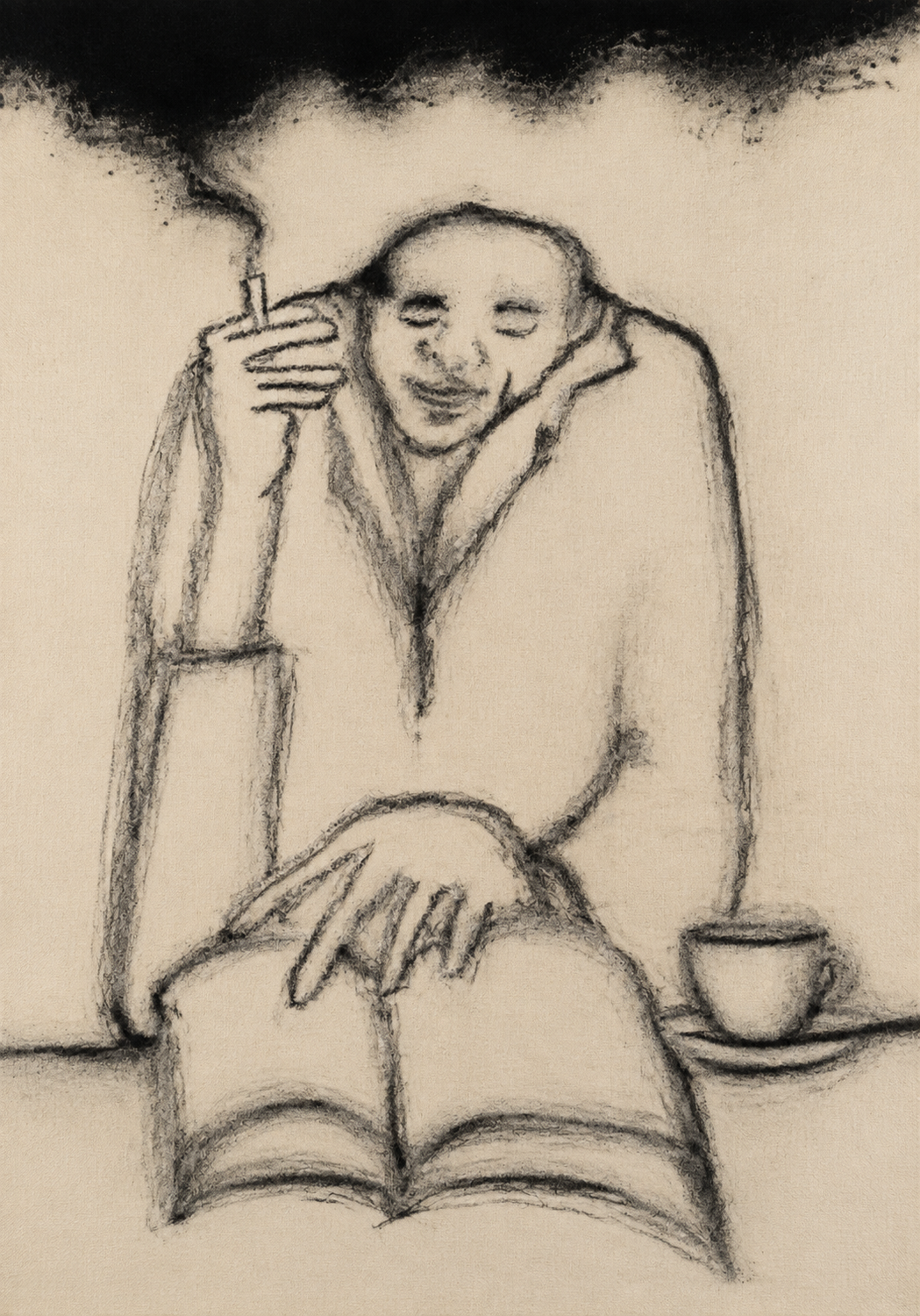
So I am writing this instead. Writing is my pressure valve, my way of converting the internal combustion into external work. If I cannot sleep, if I cannot breathe, if I cannot join the human race in its annual orgy of light and noise, then I can at least describe the cage. I can be the canary in the coal mine, except the coal mine is a city of fourteen million people, and the canary is a depressed writer with a laptop and a grudge. The words are my crackers. They are small, explosive, and ultimately pointless, but they make a noise, and for a moment, that noise is mine. It is not a devotional song. It is not a celebration of wealth or victory. It is the sound of a man saying, I am still here, I am still angry, and I am still, against all evidence, alive. Happy Diwali, motherfuckers. May your light blind you, and may your noise deafen you, because then, finally, we will all be in the dark together, and we can finally, finally sleep.
P.S. References: The decibel levels and health effects are documented by the World Health Organization’s Environmental Noise Guidelines. The chemistry of fireworks is standard pyrotechnics, as detailed in Conkling’s “Chemistry of Pyrotechnics.” The acoustic trauma thresholds are from OSHA standards. The neuroscience of depression and anhedonia is covered in any decent psychiatry textbook, which I have read too many of, because I am trying to fix myself with knowledge, which is like trying to fix a broken leg by reading about orthopedics. It helps, but you still cannot walk.
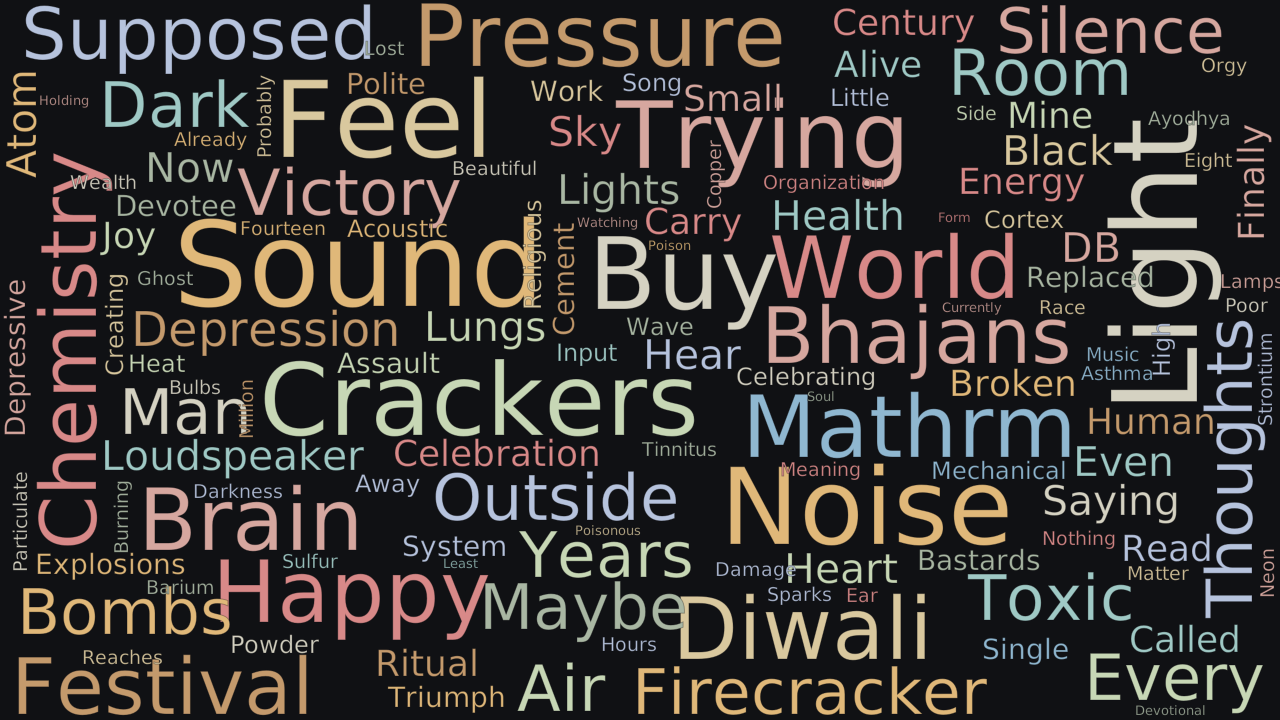
Word Cloud
Related reading
Selected by shared topics and section, with closer publication dates breaking ties.
Comments
Read the conversation or leave a thought for review. Comments load when this section is in view.