Calcutta Breathes Like a Dying Rickshaw
Checking article narration…

The air today had the texture of wet cement mixed with regret, and I stood on my balcony watching Calcutta perform its daily miracle of turning oxygen into history. My lungs, those two loyal bellows that have carried me through five decades of Bengali existence, were staging a walkout, and who could blame them, for the city had decided that breathing was a luxury item, to be taxed alongside the electricity and the sanity. I inhaled and tasted metal, not the clean metallic tang of blood or ambition, but the dull industrial flavor of a million vehicles exhaling their mechanical sighs into a sky that had long ago surrendered its blue for a permanent shade of nicotine stain. This is the season when the weather turns crisp and the politicians turn crisper, when the crackers burst in the streets like the promises of populists, loud and bright and entirely full of poisonous smoke that settles into the bronchial trees of the poor who cannot afford the air purifiers that the rich install in their bedrooms like mechanical shrines to survival.
I have been told by doctors, those licensed dealers of temporary hope, that I possess a brain chemistry that resembles a rickshaw puller trying to climb the Howrah Bridge during a strike, and so I take my pills, those tiny white negotiators that keep the skull from unscrewing itself entirely, though some mornings the steam still escapes from the seams. Today was one of those mornings when the medication met its match in the atmosphere, when the AQI index climbed higher than my ambitions ever dared, and I found myself coughing in a rhythm that sounded suspiciously like the national anthem played backwards. There is a particular pleasure in being bipolar in a city that cannot decide if it wants to be a cultural capital or a gas chamber, for the mood swings of the climate mirror my own with a fidelity that would make a psychiatrist weep into his prescription pad.
The news came crackling through the phone like a burst of good whiskey in a room full of poison, the blue wave they called it, though blue is not a color I associate with victory so much as with the lips of a man having a heart attack, yet there it was, the Americans had decided to check the power of the orange baboon who had been flinging his fecal matter across the globe with the enthusiasm of a monkey who has discovered that the cage is unlocked. I felt a strange relief, not for myself, for my own country remains firmly in the grip of those who think that mythology is a substitute for monetary policy and that religious fervor can replace functional sewage systems, but for the Americans who had finally looked at the chimpanzee and decided that perhaps the zoo needed new keepers. The Democrats had taken both houses, or so the pixels told me, and this meant that the creature in the White House would now face resistance, would find his path blocked by those who still believed that government was something other than a reality television show with nuclear weapons.
Yet I am too old, or too Bengali, or too medicated, to believe that this changes the price of fish in Calcutta, for the tariffs will remain like a bad smell in a carpet, and the visa restrictions will continue to separate families with the efficiency of a butcher who has been given a geometry lesson. The fighting in Washington will delay decisions, and the oil prices will fluctuate according to the whims of sheikhs and speculators, and the Iran conflict will simmer or boil according to whether the chimpanzee feels that his banana supply is threatened. But still, there was something in the air besides the particulate matter, something that tasted like the possibility that the religious stupids might not have it all their own way, that the tide of intolerance that has been rising across the world might have found a dyke, however temporary, however fragile.
I watched the smoke curl up to join the smog in a marriage of convenience that would make any matchmaker proud. The city wheezed around me, the old buildings blackened with the accumulated breath of centuries, the new buildings glassy and arrogant and entirely indifferent to the fact that their air conditioning units were contributing to the heat that made the air conditioning necessary. This is the paradox of progress, that we build machines to cool ourselves while heating the world, that we create medicines to extend life while poisoning the air that life requires, that we celebrate the festival of lights by filling the darkness with smoke that obscures the stars we claim to honor. The crackers burst in the distance, little explosions of joy that leave behind a haze of sulfur and potassium nitrate, the chemistry of celebration that reads like a recipe for respiratory distress.
My neighbor, a man who believes that nationalism is a substitute for personality, was setting off something that sounded like the end of days, and I wondered if he knew, if he cared, that his joy was measured in micrograms of particulate matter per cubic meter, that his devotion was depositing carcinogens in the alveoli of his children. Probably not, for we are a people who believe that faith can trump physics, that the gods will protect us from the consequences of our own chemistry, that the same air that kills the mosquito will spare the devotee. I have seen the statistics, those cold numbers that compare breathing polluted air in Calcutta to smoking several cigarettes a day, and I have seen the hospitals filling with the old and the young, their lungs like wet sponges squeezed by invisible hands, and I have thought that this is what democracy looks like when it forgets to read.
The blue wave in America will not save us, for we are busy drowning in our own saffron tide, but it offers a mirror, a reflection of what might be possible if the literate and the humane were to organize, if the parliament were filled with those who understand that GDP is not a religious text and that the Constitution is not a suggestion box for the majority. Until the BJP is out, until the government of the people is actually run by people who can read beyond the headline and reason beyond the tribe, we will remain trapped in this cycle of mythology and misery, celebrating the past while the present chokes us and the future belongs to the machines. The artificial intelligences are coming, my friend, those tireless brains that will do our jobs better and cheaper and without the need for lunch breaks or unions, and we are preparing for their arrival by ensuring that our children cannot breathe the air or think critically or question the stories that keep them docile.
I coughed again, a deep bronchial sound that came from somewhere below the diaphragm, from the basement of the body where the air goes to die, and I thought of all the times I had been told that this was temporary, that the wind would change, that the rain would wash the sky clean, that the government would enforce the rules that already exist on paper. The rain did come, eventually, not as a cleansing but as an acid transaction, falling on the leaves and turning the streets into rivers of black water that carried the debris of our celebrations out to the Bay of Bengal where the fish would ingest it and return it to us on our plates. This is the cycle we have created, the ouroboros of consumption and excretion, the serpent eating its own tail and complaining that it tastes like plastic.
There was a time, I am told by the historians who specialize in nostalgia, when Calcutta was the city of palaces, when the air smelled of jasmine and the Hooghly was clean enough to reflect the face of the moon without flinching. That time is gone, replaced by a present where the river is a moving landfill and the jasmine is imported from Bangalore and costs more than the minimum daily wage. We live in the ruins of a future that was promised to us, in the debris of Empire and the exhaust of Independence, and we call it home because the alternative is to admit that we have been cheated by history, by our leaders, by our own inability to organize a revolution that extends beyond the dinner table.
The medication is kicking in now, I can feel the chemical calm spreading through the neural pathways like warm oil on a rusty hinge, and the rage is subsiding into a dull ache that I recognize as the baseline of my existence. The city continues to burn its crackers and its garbage, the politicians continue to promise that the air will improve next year, next decade, next century, and I continue to breathe because the alternative is unthinkable, or rather, too thinkable, and therefore forbidden by the pills that keep the skull screwed on tight enough to prevent the steam from escaping entirely. Tomorrow the AQI will drop, or it will rise, and I will wake to the sound of construction and coughing, to the smell of diesel and despair, and I will write again because that is what I do when the world insists on being a toilet that refuses to flush.
The Americans have their blue wave, and I wish them well, for they have bought themselves time, a reprieve from the acceleration of idiocy, but we here in the subcontinent must find our own color, our own wave, something that washes away the saffron and the smog alike, something that brings not just light but clean air to breathe in the light. Until then, I remain here on this balcony, a bipolar Bengali with a cough, watching the city celebrate its own suffocation with the enthusiasm of a man who has been told that the rope around his neck is a necklace.
P.S. References: The Air Quality Index is not a metaphor; comparisons between polluted air and cigarettes are rough estimates that vary with particulate levels, not a literal equivalence; the blue wave refers to the 2026 midterm results in the United States; the rest is opinion, medication, and the particular clarity that comes from being unable to breathe.
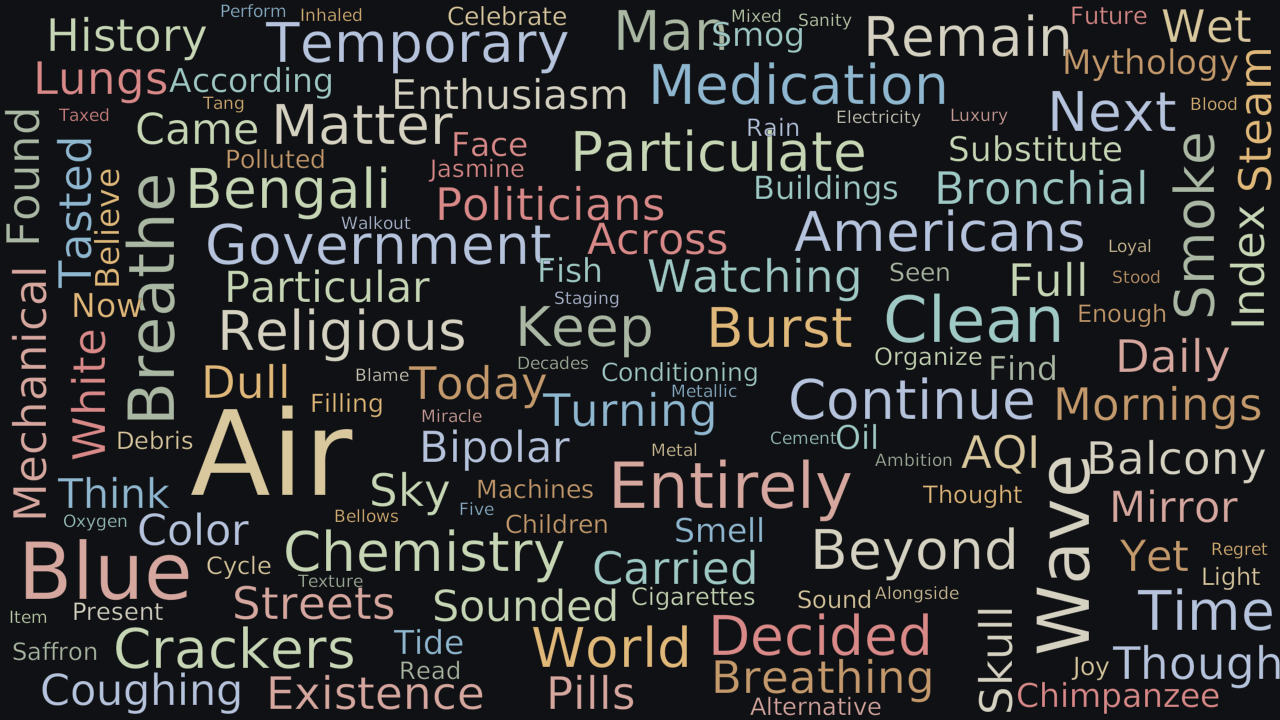
Word Cloud
Related reading
Selected by shared topics and section, with closer publication dates breaking ties.
Comments
Read the conversation or leave a thought for review. Comments load when this section is in view.