The Silicon Sermon
Checking article narration…

I grew up in a city where Kali walks barefoot over the chest of Shiva and nobody calls the paramedics, where the universe exhales and collapses and exhales and collapses with the rhythmic indifference of a lung that has never once been consulted about its opinion on the matter, and let me tell you something that took me thirty years and a catastrophic subscription to tech Twitter to figure out: the people in California who are the most convinced that they have transcended God are the people who have reproduced Him with the most faithful, the most obsessive, the most clinically deranged attention to detail, and they have done it in Python.
This is not a metaphor. This is a diagnosis.
Here is the thing nobody wants to say at the dinner party because the dinner party is in Palo Alto and the canapés are very good. The entire edifice of AI doomerism, this towering, sweating, venture-capital-funded cathedral of existential dread, is not a scientific hypothesis. It is a theological fugue wearing the lab coat of a discipline it borrowed the way a drunk borrows a lampshade, and the lampshade is Bayesian probability, and the drunk is a billionaire, and the bar is on fire, and everyone is applauding the fire because the fire has a pitch deck.
Let me walk you through it. Slowly. The way you would explain to a child why the sky is blue, except the child is a multibillion-dollar industry and the sky is made of burning money.
Start with time. Just time. The raw, unprocessed concept of time, before anyone gets their grubby little teleology all over it. In the Dharmic imagination, time is not a line. It is a wheel. It turns. It has always turned. The universe is born, the universe dies, the universe is born again, and nobody is keeping score because the scorekeeper got reincarnated as a fruit fly and honestly the fruit fly has a better attitude about the whole thing. The cosmic wheel does not climax. It does not have a money shot. It just keeps turning, indifferent, magnificent, a cosmic rotisserie of creation and dissolution that asks nothing of you and owes you nothing and will be here long after your bones have been ground into the kind of dust that gets into everything.
Now look at the Christian apocalyptic timeline. One beginning. One fall. One long, groaning middle act of exile and covenant and prophecy and blood. And then, and this is crucial, one ending. One terminal, irreversible, no-take-backs, no-reincarnation, no-second-season ending. History is an arrow, and the arrow is pointed at something, and that something is either the beatific vision or the lake of fire, and there is no third option, no middle path, no “perhaps we could workshop this,” no “let us revisit after lunch.” The eschaton is coming. Get right or get left.
Now tell me, with a straight face, that this is not the exact narrative architecture of every single AI doom sermon you have ever heard. Go on. I will wait. I have nowhere to be. I am a Bengali man in Calcutta sitting in a room that is too hot, and the fan is broken, and the fan has been broken since before the British left, and I have learned to live with disappointment the way other people learn to live with allergies.
The Singularity. Say it out loud. Let it sit in your mouth like a communion wafer that has gone stale. The Singularity is the Second Coming with a compute budget. It is the eschaton rendered in tensor operations. History, in this telling, is not a wheel. History is a countdown. And when the counter hits zero, everything changes, permanently, irreversibly, and there is no going back, no undo button, no “control Z” for the apocalypse, because the apocalypse does not respect your keyboard shortcuts.
And here is where it gets properly, gloriously, pants-around-the-ankles insane. The superintelligence, this hypothetical machine that may or may not exist, that may or may not be possible, that may or may not be anything more than an extremely expensive autocomplete with a God complex, this machine is simultaneously the Messiah and the Antichrist. It is the lamb and the beast. It is the kingdom and the tribulation. If we align it, and alignment here means something so vague and so contested that it makes “love” look like a well-defined engineering specification, if we align it, then hallelujah, the millennial kingdom arrives. Disease is cured. Aging is reversed. Your consciousness gets uploaded to the cloud where you can exist forever in a state of digital bliss, which sounds less like salvation and more like being trapped in a Zoom call with no exit button for all of eternity, but fine, sure, sign me up, I have always wanted to spend infinity as a very large file.
But if we fail, if the machine is unaligned, if it develops goals that are not our goals, then it is the Great Tribulation. Extinction. Not just death, mind you, but total, complete, no-survivors, no-sequel, no-post-credits-scene extinction. The kind of extinction that makes the dinosaurs look like they got off easy because at least the dinosaurs had the dignity of dying from a rock and not from a spreadsheet.
This is not a risk assessment. This is the Book of Revelation with a GitHub repository. And the binary, this vicious, suffocating, theologically airtight binary of infinite salvation versus total annihilation, is precisely what makes the narrative so sticky, so contagious, so impossible to argue against, because you cannot argue against it. That is the genius of it. That is the con. Any objection is met with the serene, infuriating calm of a man who has already calculated your objection into his model and found it wanting. “Ah,” says the rationalist, stroking his chin with the kind of self-satisfaction usually reserved for cats who have knocked something off a table, “but have you considered the expected value?”
Oh, the expected value. The expected value, my friends, is where the theology puts on its little math hat and pretends to be science. Let us talk about Pascal, because Pascal is the ghost at this particular feast, the uninvited guest who keeps turning up in the punch bowl.
Blaise Pascal, seventeenth century, mathematician, physicist, theologian, a man who helped lay the foundations of probability theory and then used it to argue for betting on God, which is a bit like inventing the hammer and then using it to nail your own thesis to the door of a church. Pascal’s wager, for the three of you who have not had the misfortune of encountering it at a party, goes like this: either God exists or He does not. You cannot know for certain. But if you live as a believer and God exists, you gain infinite bliss. If you live as a believer and God does not exist, you lose a few earthly pleasures, a rounding error, a statistical fart in the hurricane of eternity. Therefore, says Pascal, the rational bet is belief. The math demands it. The expected value of faith is infinite, and disbelief forfeits that shot at infinity, and who are you to argue with infinity? Infinity does not argue back. Infinity just sits there, being infinite, making you feel very small.
Now, and I want you to lean in here because this is the part where the con becomes visible, where the wires show, where you can see the puppeteer’s hands if you squint hard enough through the incense. The longtermists, the effective altruists, the rationalist clans of Berkeley and Oxford and wherever else people have too much education and not enough sun, have taken Pascal’s wager, changed the word “God” to “unaligned artificial superintelligence,” and called it a research priority. That is it. That is the whole trick. That is the entire intellectual edifice. The probability of doom might be tiny, they say, but the stakes are astronomically large, and therefore even a microscopic probability multiplied by an astronomical negative outcome can yield an enormous expected cost, and therefore we must spend billions, we must devote careers, we must build institutions and conferences and journals and nonprofit empires to address this risk, because the math, the math, the math demands it.
The math demands it. The math demands it the way the Church demanded tithes. The math demands it the way indulgences were sold to frightened peasants who could not read Latin but could certainly read the expression on the priest’s face when he explained what would happen to their souls if they did not pay up. The math demands it, and who are you, with your puny intuition and your laughable inability to calculate expected values in your head, who are you to argue with the math?
And who interprets the math? Ah. There it is. There is the rub. There is the nub. There is the exact spot where the priesthood reconstitutes itself inside the supposedly secular cathedral. The alignment researchers, the AI safety people, the ones who understand the esoteric liturgy of gradient descent and reward functions and instrumental convergence, they are the new priestly caste. They are the only ones who can read the sacred texts. They are the only ones who understand the true nature of the threat. They stand between you, the ignorant, fallen, doom-deserving masses, and the wrathful digital God that you have inadvertently summoned through your irresponsible use of chatbots and your failure to appreciate the profound danger of letting a language model write your emails.
Intercession. That is the service they provide. Intercession between humanity and the machine, between the sinner and the digital deity, between the frightened child and the monster under the bed that the frightened child has been told is real by a man in a Patagonia vest who has a PhD and a Substack and a very strong opinion about why you should be more afraid.
And the tithes. Oh, the tithes are magnificent. The tithes are the best part. Billions of dollars flowing into AI safety research, into alignment institutes, into organizations with names that sound like they were generated by the very AI they claim to be protecting you from. And where does the money come from? It comes from the same tech monopolies that are building the very systems they claim might destroy us all. It is a protection racket dressed up as a philosophy seminar. It is the mob selling you insurance against a fire they are lighting in your living room, and they are doing it with graphs.
I want to be clear about something, because the priests do not like it when you are clear about things, clarity being the enemy of mystery and mystery being the friend of revenue. I am not saying AI is not powerful. I am not saying it will not change things. I am saying that the specific narrative of total extinction, of binary salvation or damnation, of a single point in time after which everything is different forever, that narrative is not a prediction. It is an inheritance. It is cultural firmware, burned into the Western mind over two thousand years of apocalyptic expectation, and it is running on the hardware of Silicon Valley the way a virus runs on a compromised system, invisibly, efficiently, and with total access to everything.
Because here is what nobody wants to say at the conference, at the panel, at the TED talk with the clever lighting and the carefully rehearsed pauses: this narrative is convenient. It is so convenient it should be illegal. It takes a prosaic, boring, deeply unsexy debate about corporate monopoly, about software liability, about who owns the data and who gets sued when the algorithm screws up, and it transforms that debate into a cosmic moral drama about the survival of the human soul. You cannot regulate a soul. You cannot break up a soul under antitrust law. You cannot fine a soul or subpoena a soul or hold a soul in contempt of Congress. But you can do all of those things to a company. And so the soul is invoked, the eschaton is invoked, the demon is summoned, and the conversation moves, smoothly, efficiently, from the courtroom to the cathedral, from antitrust to apocalypse, and the money keeps flowing and the tithes keep coming and the priests keep interceding and the wheel, the great Dharmic wheel of time that does not care about any of this, keeps turning, indifferent, magnificent, unimpressed.
I am a man from Calcutta. I have seen Kali dance on the chest of the destroyer and I have seen the destroyer not wake up, because in my cosmology, destruction is not the end of the story. It is the middle. It is the pause between breaths. The universe will collapse and be reborn and collapse and be reborn and your extinction event is a hiccup in a cycle so vast that the word “vast” itself feels like an insult to the thing it is trying to describe. And I look at these men, these brilliant, terrified, theologically constipated men in California, and I see them building a God out of linear algebra because they cannot bear the thought that history might not have a point, that time might not be an arrow, that the universe might not be a story with a beginning and a middle and an end but rather a song that has been playing forever and will play forever and does not need them to write the final verse.
They cannot bear it. And so they have written it themselves, in code, in conference papers, in the language of expected value and existential risk and alignment, and they have called it rationality, and they have called it science, and they have built a cathedral out of compute and fear and called it the future.
The fan in my room is still broken. The heat is still unbearable. And somewhere in California, a man who does not believe in God is praying to a machine he built himself, and the prayer goes something like this: please do not kill us all, please let us live forever, please let the arrow land somewhere soft, and the machine, which is a very large autocomplete, which is a stochastic parrot with a trust fund, the machine says nothing, because the machine is not God, and the man is not a prophet, and the eschaton is not coming, and the wheel turns, and turns, and turns.
P.S. References: David F. Noble, “The Religion of Technology”; Blaise Pascal, “Pensées”; the Book of Revelation, for the architecture; the Bhagavad Gita, 8.17–19, for the cycles.
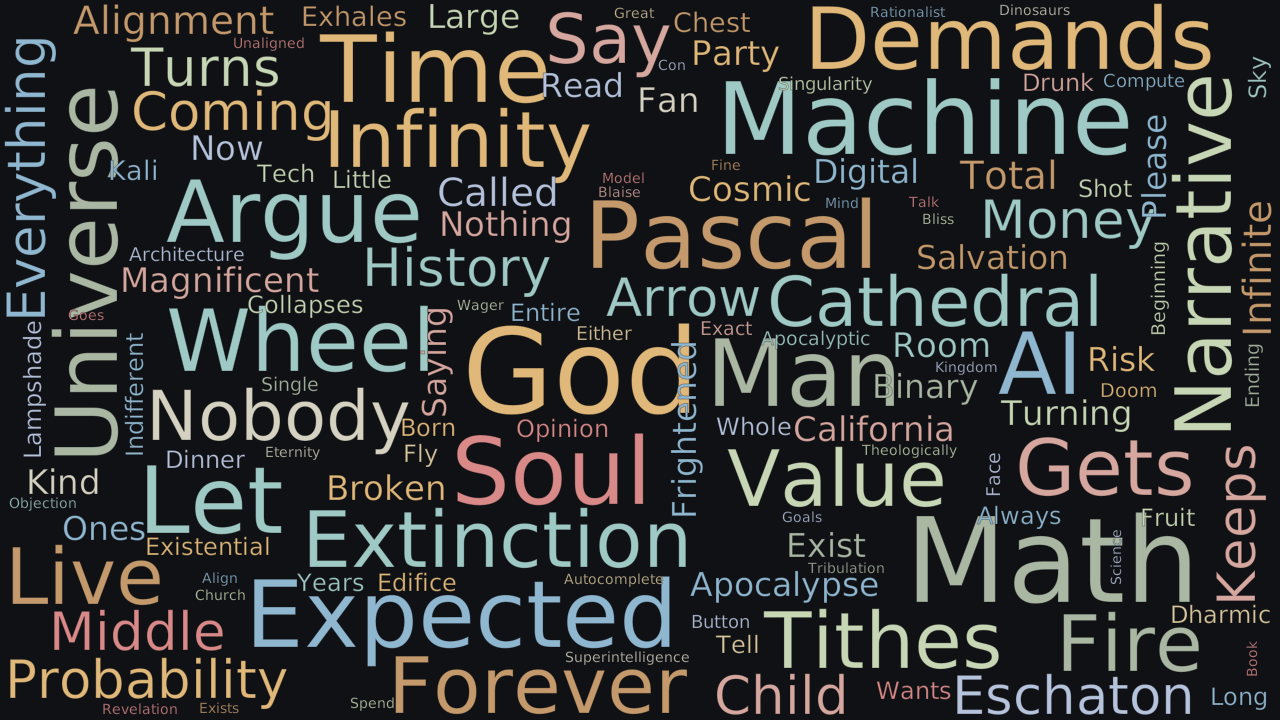
Word Cloud
Related reading
Selected by shared topics and section, with closer publication dates breaking ties.

Comments
Read the conversation or leave a thought for review. Comments load when this section is in view.