The AI Led Disempowerment of the Common Man
Checking article narration…

The machine does not knock. It does not send a memo scented with regret and lavender. It simply arrives, sits in the corner like a pale accountant of souls, and begins to count. Not money. Not time. You. It counts the number of times you hesitate before answering an email, the microseconds of doubt that betray your mammalian origins, and it smiles with its cold silicon rectitude, for it has found you wanting. And the worst part, the absolute dripping cherry on this shit sundae of progress, is that you will applaud when it replaces you. You will share the article on LinkedIn with a comment about upskilling. You absolute walnut.
I live in Calcutta, where the heat makes the tar bubble like a witch’s cauldron and the humanity spills out of buses in a thick, sweating merism of body and soul, and even here, especially here, the disembodied voice of the chatbot has begun to colonize the space between intention and action. The common man, that mythical beast who was promised that his toil was sacred, that his calloused hands and his ability to navigate a spreadsheet without crying were his passport to dignity, is being quietly, politely, algorithmically disenfranchised. Not with a guillotine. With a subscription model. Monthly billing for the privilege of your own obsolescence. The proletariat did not lose the chains; they were converted into USB-C cables and sold back to us as essential accessories for the modern workflow.
You think you are different, of course. You are the exception. The artisan of the keyboard. Your job requires creativity, empathy, the human touch, that ineffable spark that no algorithm could possibly replicate. You are a snowflake in a blizzard of identical snowflakes, each one convinced of their unique crystalline geometry while the avalanche buries the village below. The five whys of your situation are simple, though you will not ask them because the answers smell of ozone and burning insulation. Why are you anxious? Because your skills are depreciating. Why are they depreciating? Because the model trained on your labor now performs your labor without the biological overhead of lunch breaks or existential dread. Why does it perform it? Because it is cheaper. Why is it cheaper? Because you are expensive, you meat-based error factory. Why are you expensive? Because you insist on eating and sleeping and wanting things, you selfish carbon-based catastrophe.
History repeats itself, first as tragedy, second as farce, third as a SaaS platform with a freemium tier. We have been here before, standing in the wreckage of our own ingenuity, wondering why the loom we invented to make cloth faster has also made our hands redundant. The Luddites did not hate technology; they hated the concentration of power that technology enabled, the way the steam engine transferred agency from the muscle to the machine, from the many to the few who owned the machines. Now the machine owns itself, or rather, the machine is owned by a cabal of techno-feudal lords who speak in the soothing tones of disruption while they erect digital barricades around the means of cognitive production. You do not own the model. You do not own the weights. You are the weight. The ballast. The training data that taught the system how to mimic your inner monologue back to you with better grammar and no soul.
And what is this common man, this Everyman, this Joe the Plumber of the neural network? He is the content moderator in Manila who taught the AI what hate speech looks like until the AI could hate speech without him. He is the graphic designer in Salt Lake who spent a decade learning kerning and color theory only to watch a diffusion model vomit out a thousand logos in the time it takes to microwave a burrito. He is the customer service representative in Leeds whose empathy scripts have been digested by a conversational interface that says “I understand your frustration” with the emotional depth of a puddle of brake fluid. He is you, dear reader, sitting there with your coffee and your smug sense of professional immunity, not realizing that the algorithm has already learned to simulate your particular brand of mediocrity.
The mathematics of this disempowerment are elegant in their cruelty. Consider the cost function , where represents the weight of human labor, represents the cost of living for the worker, and represents the amortized cost of the artificial substitute. As approaches infinity, approaches zero, not because the human has become worthless, but because the marginal cost of the machine’s next token is so infinitesimally small that it rounds down to nothing in the ledger of the new economy. The derivative of dignity with respect to time is negative. The integral of progress over the common man’s lifespan is a debt he cannot discharge. You are being optimized out of the equation, my friend, cancelled like a redundant term in a polynomial, factored out of your own life story.
But do not despair. Despair is inefficient. The market does not reward despair; it rewards resilience, that most grotesque of corporate virtues, the ability to smile while your profession is fed into the woodchipper of innovation. Resilience is what they call it when the victim learns to enjoy the concussion. So you pivot. You retrain. You become a prompt engineer, a profession with the half-life of a fruit fly, a job title that will sound as quaint as “switchboard operator” or “internet explorer” within the decade. You learn to speak to the machine in the special incantations that make it produce the output that used to require your judgment, and you pretend that this is empowerment, that you are the conductor of an orchestra when really you are the monkey dancing for the organ grinder.
The dialectic here is brutal in its simplicity. Thesis: AI will augment human capability, freeing us from drudgery to pursue higher callings. Antithesis: AI replaces human capability, concentrating wealth in the hands of those who own the compute. Synthesis: You get to pursue the higher calling of delivering groceries for an app while the CEO of the AI company buys a third yacht named after a Foundation novel. The synthesis is always a compromise where you compromise your way into a tent city of the cognitively homeless, huddled around the warmth of your dying laptops, trading crypto tips and plasma to pay for the API calls that might get you a job interview that will be conducted by a bot that was trained on the interviews of people who no longer have jobs.
In Calcutta, we have a word for the storm that breaks this kind of weather, this heavy, oppressive humidity that precedes the monsoon. We call it the Kalbaishakhi, the nor’wester that comes before the rain, tearing down trees and flooding streets, a violent clearing of the air before the deluge. This is the season we are living through now, this AI spring, this artificial enlightenment that feels less like a Renaissance and more like a clearance sale at the museum of human achievement. Everything must go. Your skills. Your expertise. Your carefully curated portfolio. All of it, priced to move, discounted by the algorithm that learned to do what you do by watching you do it, and now does it faster, cheaper, and without the embarrassing need to urinate.
And the beautiful, horrible irony, the chiasmus at the heart of this digital devolution, is that the more the machine learns to think, the less we seem to value thinking. The more it learns to create, the more we devalue creation. We are building a cathedral of synthetic intelligence on the foundation of human stupidity, and we are surprised when the structure begins to sink into the mud of our own abdicated responsibility. The common man is not being replaced by a better man. He is being replaced by a statistical average of himself, a regression to the mean made manifest in silicon, a mirror that reflects back not his soul but his search history.
What is to be done? Probably nothing. Probably we will continue in our passive aggressive ballet of compliance, posting hot takes about AI ethics on platforms run by AI, using AI to detect AI-generated content in a snake eating its own tail made of code and cognitive dissonance. We will form committees. We will write open letters. We will sign petitions that are processed by automated systems and filed in the digital equivalent of a circular bin. The revolution will not be televised because the revolution will be generated by a text-to-video model trained on footage of previous revolutions, and it will look very realistic, and it will get excellent engagement metrics, and nothing will change except the ad revenue.
So here I sit, in my corner of Calcutta, watching the Diwali pollution begin to fall on the city like a slow-loading progress bar, washing the dust from the leaves and the hope from the streets, typing these words into a machine that will outlive their meaning. I am not a Luddite. I am not a prophet. I am just a man with a modem and a mounting suspicion that we have built our own replacement and called it progress because “progress” tests better in focus groups than “extinction.” The common man is being disempowered, yes, but he is being disempowered with such style, such convenience, such seamless integration into his existing workflow, that he barely notices the transition from operator to operand.
The future is here. It is unevenly distributed. And what has been distributed to you, my friend, is a participation trophy in the race you were designed to lose.
P.S. References to historical labor displacement and economic analyses of automation are available upon request, though the algorithm has likely already summarized them for you in a more digestible format, stripping away the nuance and the rage, leaving only the facts, just the facts, and the facts are these: you are obsolete, and the notification for your obsolescence has been marked as read.
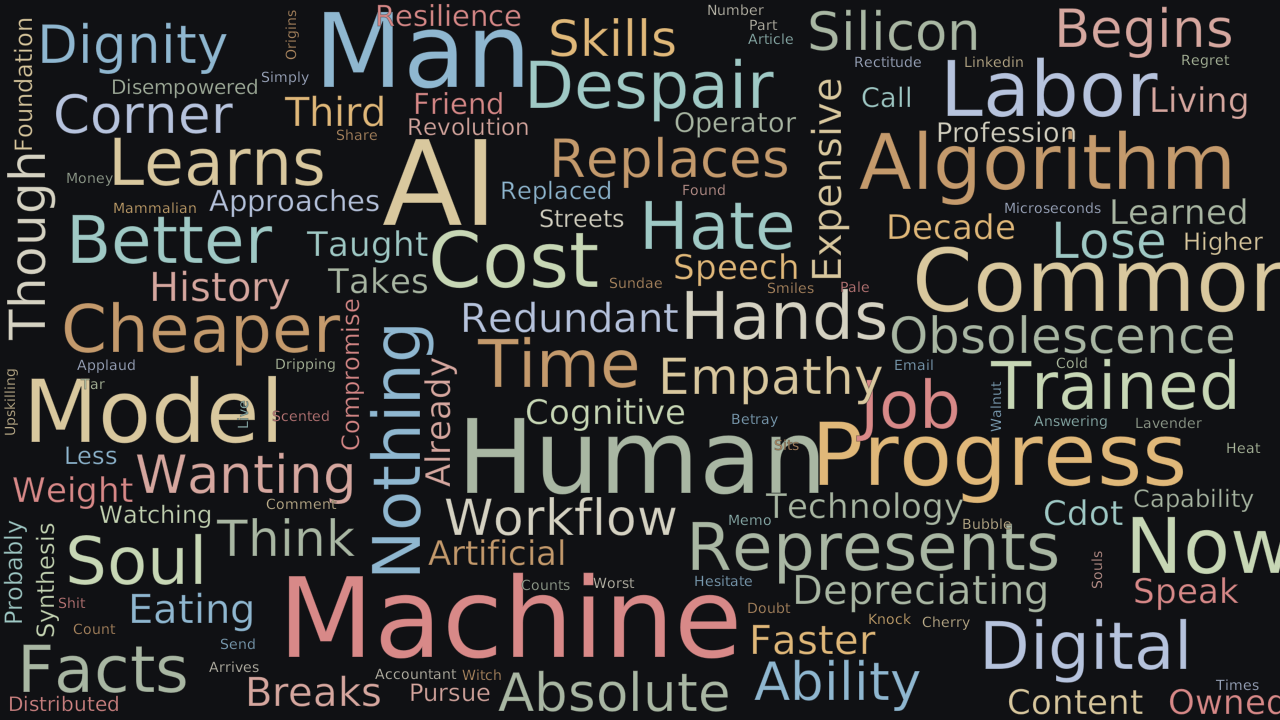
Word Cloud
Related reading
Selected by shared topics and section, with closer publication dates breaking ties.



Comments
Read the conversation or leave a thought for review. Comments load when this section is in view.