The Great Black Water Adventure: Hindoo Edition
Checking article narration…

Sometime between inventing zero and figuring out how to pack explosive diarrhoea into roadside street-food stalls, our ancient Hindoo ancestors developed an incredible paranoia about water—particularly black water. No, not the gently carbonated, suspiciously overpriced volcanic piss hipsters now drink; we’re talking about the real, evil stuff: “Kala Pani.” (Which literally translates as—brace yourself—“Black Water.” Language, people, it’s rocket science.)
Kala (meaning black, from Sanskrit kāla, also implying doom, death, and generally unfortunate shit), combined with Pani (Sanskrit pānīya, water, something you drink or drown in depending on the gods’ daily whims), formed this neat euphemism. It sounds mysterious, exotic even, but essentially describes the unholy act of crossing oceans—because, of course, nothing good ever happens across oceans: just ask Columbus or anyone who had to deal with British tourists.
To our pure-hearted, caste-conscious ancestors, traveling overseas wasn’t merely risky—it was straight-up blasphemous. Ocean voyages ranked right below incestuous orgies and eating beef samosas on the grand scale of cultural taboos. Kala Pani symbolized contamination—spiritual pollution so dreadful that even breathing the same salt-laden air was enough to send your soul plunging into karmic bankruptcy, landing you smack in the karmic-equivalent of being reborn as a malfunctioning septic tank in Bihar.
This charming belief was fervently embraced by Brahmins, who, to preserve spiritual purity, would sooner sip cow piss or read algebra for fun than dare voyage on those godless black waters. The caste elites thus remained comfortably stationary in Calcutta, narrating horror stories to warn lower-caste Hindoo daredevils against doing anything stupidly adventurous, like going to Mauritius for sugarcane jobs or accidentally discovering America.
Enter the British, those pale, tea-sipping demons who stumbled ashore to inform us that our land was now theirs, and could we please kindly fuck off or build railroads—our choice. To suppress pesky rebellions, the East India Company used the fear of Kala Pani ingeniously. They shipped freedom fighters and other inconvenient natives off to penal colonies in the Andaman Islands. For many unfortunate patriots sentenced to this watery hell, stepping onto the ships meant abandoning their gods, their caste, their family honor, and—perhaps worst of all—their regular bowel movements.
Kala Pani became the ultimate Hindoo nightmare: losing caste, becoming an outcast (patita), and—horrors—returning home to discover your own mother wouldn’t even share a bowl of rice with you. Forget leprosy; losing caste was worse. The colonial British knew that crossing the Kala Pani was socially worse than death itself—hell, it might’ve been worse than marrying a Marxist Bengali girl from Jadavpur.
And yet, in a twist of cosmically twisted irony, modern Indian immigrants practically swim across oceans now, battling visa interviews and digestive trauma, boldly going where no Hindoo had gone willingly before: America, Australia, Canada—places whose cuisines seem like elaborate colonial revenge plots designed to fuck with our digestive tracts.
Kala Pani today seems quaintly silly—yet the fear reveals our human desire to dress ignorance as tradition, superstition as sacred truth. For our ancestors, oceans were dark voids where death lurked; today, oceans are the barriers between us and first-world salaries. Perhaps the water was never truly black; perhaps our fear itself darkened it. Or perhaps—just perhaps—it was all a brilliant ancient conspiracy to avoid having to learn English grammar or, Shiva forbid, proper British table manners.
#KalaPani #Hinduism #taboo #SeaVoyage #BritishRaj #superstition #etymology #colonialhistory #fear #castesystem #suvrotica #suvroghosh
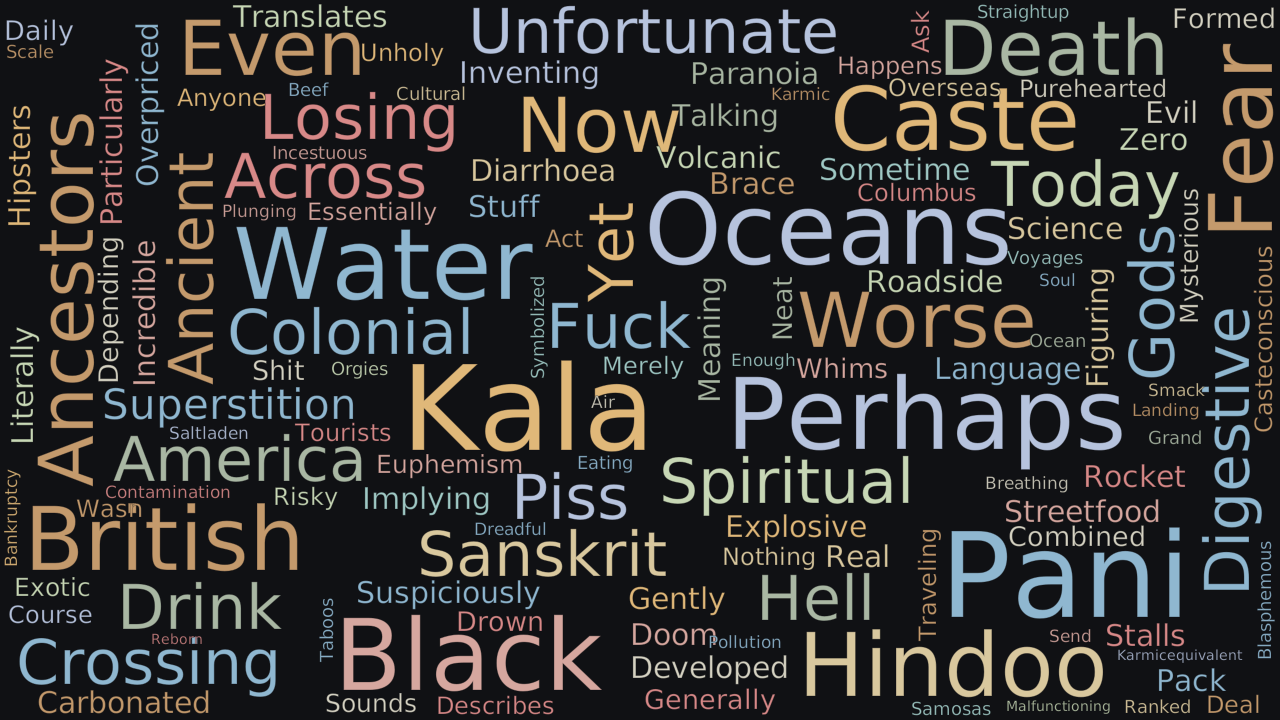
Word Cloud
Related reading
Selected by shared topics and section, with closer publication dates breaking ties.
Comments
Read the conversation or leave a thought for review. Comments load when this section is in view.