I Like Fish, But I Refuse to Worship Rot
Uses the speech voice supplied by your browser or device.

I like fish, which is already a dangerous confession in Bengal because immediately someone will ask which fish, and then the whole matter becomes a civil war with mustard oil. Hilsa people look down on rohu people. Rohu people pretend not to care. Pabda people behave like quiet aristocrats. Catla arrives like a fat uncle at a wedding and occupies the plate without apology.
So yes, I like fish. I like rice. I like dal. I like the clean, ordinary honesty of things that know what they are.
A fish does not call itself an aerospace program.
A plate of rice does not announce that it invented quantum mechanics five thousand years ago.
Even a fish head, magnificent and terrifying, with one boiled eye staring into the ruins of my afternoon, does not hold a press conference.
That is more than I can say for certain substances in this country.
We have developed a strange national habit. We take something ordinary, failed, broken, smelly, or plainly embarrassing, put a garland around it, add a Sanskrit-adjacent expression, invite three men with microphones, and suddenly it becomes civilization. Not a problem. Not evidence of neglect. Not a thing to be cleaned, fixed, questioned, measured, tested, or quietly removed with a shovel.
No.
It becomes heritage.
This is how decay gets promoted.
I am tired of it.
I am tired of living in a place where rot is not simply rot. It must be explained as tradition. It must be defended as identity. It must be televised as wisdom. It must be placed on a chair, given mineral water, and addressed respectfully by men who could not repair a municipal drain if the drain personally introduced itself.
Ordinary waste is honest. It arrives, offends, and leaves. There is dignity in that journey. It does not demand applause. It does not accuse you of being anti-national because you opened a window.
But here even waste is not allowed to remain waste. We must chant over it, certify it, bottle it, bless it, call it research, call it ancient science, call it national pride, and then become wounded in the soul when someone asks, very mildly, like a tired clerk at a ration shop, “Excuse me, but is this not still rubbish?”
And then begins the great Indian drama.
The offended face.
The historical lecture.
The ancestor.
The foreign conspiracy.
The poor laboratory mouse of reason is dragged into a court where mythology is the judge, sentiment is the lawyer, and evidence is standing outside in the heat because nobody told it the hearing time.
I sit in Calcutta, on the untidy edge of the city, where the fan chops hot air into smaller pieces of hot air, and I watch all this from a room that has seen better decades. The bookshelves sag. The mattress has resigned from life but continues in an advisory capacity. Somewhere outside, a pressure cooker whistles with more discipline than our public institutions. A neighbour’s television shouts. A dog objects to existence. The drain, as always, contributes its philosophical aroma.
And from this little room I watch people talk about national greatness.
Greatness is a wonderful word. It is cheap, portable, and requires no plumbing.
China builds, manufactures, copies, scales, spies, improves, exports, frightens, calculates, and generally behaves like a giant factory that has read Machiavelli and bought a stopwatch. I do not worship China. I have no desire to live in a state where even the clouds probably need permission to assemble. But there is a small, irritating fact here. Their madness produces bridges.
Our madness produces slogans.
And godmen.
And television debates.
And miracle claims.
And a queue of obedient citizens waiting to be fooled while being told that doubt is a Western disease.
This is where the comedy turns sour.
Because poverty in India is not only economic. It is explanatory. We are not just short of money. We are short of clean explanations. A poor man is given bad roads, bad schools, bad hospitals, bad air, bad drains, bad jobs, and then, to complete the meal, he is told he is spiritually wealthy.
This is an old trick.
Take away the fish, then praise the smell of the empty plate.
Tell the unemployed man that the nation is rising. Tell the sick man that ancient wisdom will look after him. Tell the student that memorizing slogans is the same as education. Tell the middle-aged failure that his suffering has made him deep. Tell the citizen to adjust.
Always adjust.
Adjust to heat.
Adjust to noise.
Adjust to corruption.
Adjust to incompetence.
Adjust to humiliation.
Adjust to being lied to by men whose faces have the polished smoothness of new pressure cookers and the moral weight of wet cardboard.
I know this adjustment well. It is practically my family doctor.
I am fifty-one, Bengali, single, lower-middle-class, living in the boondocks of Calcutta, with a brain that has its own electrical department and frequent load shedding. I spent years in America studying and working around systems that at least pretended to care about evidence, data, process, audit, and repair. They failed too, naturally. America is not heaven. It is a large complicated machine that occasionally sells you the manual for $500 and then blames you for not reading it.
But there was one useful habit I picked up there.
A thing had to work.
Not spiritually work. Not symbolically work. Not work because some uncle said his grandfather’s neighbour once used it and survived until ninety-two. Work in the plain boring sense. Show the result. Measure the claim. Test the mechanism. Fix the leak. Count the dead. Count the cost. Compare before and after. This is why Trump is temporary, he doesn’t add up.
Here, too often, we do the opposite. We begin with pride and work backward until reality becomes inconvenient.
This is why superstition survives so beautifully in public life. It is not merely belief. Belief by itself is understandable. Human beings are frightened creatures. Fear is older than reason. Before microscopes, before vaccines, before public health, before weather satellites, a storm looked like anger from the sky and fever looked like a demon with a private grudge. A hungry ape looked at lightning and invented authority.
I understand that.
There is even something tender about it.
But when belief becomes policy, when superstition wears spectacles and lectures chemistry, when mythology takes the chair where microbiology should sit, when pride is used as a substitute for evidence, then I lose patience. Not elegantly. Not like a professor. More like a man whose tea has boiled over for the fourth time while the power goes out and someone nearby is explaining civilization through a loudspeaker.
At that point language also boils over.
Respectable people hate that. They prefer clean language around dirty systems. They like phrases such as “implementation challenge,” “legacy issue,” “cultural sensitivity,” and “public sentiment.” These are useful phrases in moderation, the way phenyl is useful in a bathroom. But use too much and the whole house smells like a government office.
Sometimes a bad thing needs its bad name.
A lie is a lie.
Rot is rot.
A superstition in a blazer is still a superstition.
And a society that cannot say so becomes a theatre where everyone knows the tiger is a goat, but the ticket says tiger, so tiger it is.
The worst part is that I am not outside this theatre. I am not sitting in a clean balcony with opera glasses and moral superiority. I am down in the cheap seats, sweating with everyone else, waving away mosquitoes, angry at the actors, angry at the audience, angry at myself for having bought the ticket.
I am part of the compost too.
That is the part every angry man should admit before he becomes a small dictator in his own head. I am not pure reason trapped among fools. I am resentment, vanity, fear, failed ambition, class injury, bad sleep, old education, stale desire, and a nervous system that sometimes behaves like a ceiling fan with one bent blade.
Some days I wake with a headache and a mouth like burnt paper. I look at my face in the mirror above a basin that has heard many defeated toothbrushes, and there is no civilizational glow there. No heroic masculinity. No ancient wisdom. Just tired eyes, uneven stubble, thinning hair, bad teeth, and the expression of a man who has watched too many mediocre people rise through the sacred Indian technology of shamelessness.
That is another national invention. Shamelessness.
Forget rockets. Forget scriptures. Forget software exports. Shamelessness is our most scalable platform. It runs in politics, business, family, religion, education, housing societies, offices, television studios, and WhatsApp groups. It requires no maintenance and very little bandwidth.
A shameless man can look at a broken drain and speak of destiny.
A shameless man can stand beside poverty and speak of glory.
A shameless man can sell nonsense to the desperate and call it culture.
The tragedy is that people buy it because despair makes buyers of us all. When life is hard enough, any story with a little perfume becomes attractive. When the job is gone, the hospital is expensive, the school is useless, the heat is rising, and the future looks like a locked door with a missing key, a grand myth can feel like shelter.
I am not mocking the poor for wanting shelter.
I am mocking the men who sell painted cardboard and call it a house.
There is a difference.
There is a difference between culture and fraud. Between memory and manipulation. Between reverence and cowardice. Between being rooted and being buried.
That difference matters because a country cannot eat nostalgia and produce progress. It cannot replace laboratories with chants, engineering with pride, medicine with syrup, sanitation with symbolism, and education with slogan-recitation, then wonder why the young want to leave.
They are not leaving because they hate the soil.
They are leaving because the soil keeps being used as an excuse not to build a floor.
Meanwhile, we are told to be proud. Proud of what exactly? The traffic? The dust? The coaching centre certificates? The manhole covers that disappear like minor gods? The leaders who speak as if adjectives can repair bridges? The public culture where asking for evidence is treated like spitting on someone’s grandmother?
No, thank you.
I like my grandmother. I also like evidence. These are not enemies.
This is the small thing that gets lost in the shouting. To question nonsense is not to hate a country. To ask for proof is not to insult ancestors. To prefer sanitation over symbolism is not cultural betrayal. It is basic adult housekeeping. If the kitchen is burning, the correct response is not to recite family history beside the stove.
Turn off the gas.
Open the window.
Find water.
Then, after survival, discuss heritage.
This is what I want from public life: less theatre, more repair. Less incense near rot. More drainage. Less cosmic vocabulary. More functioning schools. Less pride over imaginary science. More actual science. Less adjustment. More accountability.
Simple things.
Boring things.
The sort of things that do not trend well because they lack costume, rage, and devotional background music.
But boring things keep people alive. Clean water is boring. Vaccines are boring. Honest accounting is boring. Bridges that do not fall are boring. Hospitals where infection control is not a decorative poster are boring. Schools where children learn to think instead of chant answers are boring.
Civilization is mostly boring competence.
That is the insult we refuse to accept.
We want civilization to be grand, ancient, thundering, mystical, and uniquely ours. But in daily life civilization is a clean toilet, a safe bus, a working drain, a fair exam, a doctor who knows what he is doing, a police station that does not terrify the poor, and a public official who can answer a question without producing fog from his mouth.
I am tired of fog.
I am tired of perfume sprayed on failure.
I am tired of being told that the smell is my imagination.
If something stinks, maybe it stinks.
Maybe the first act of patriotism is not standing up during a song but bending down with a broom, a test kit, a ledger, a court order, a repair manual, and enough honesty to say, “This is not sacred. This is broken.”
That sentence may not win elections. It may not fill stadiums. It may not produce goosebumps in the chest of a television anchor. But it has one small advantage.
It is true.
And truth, like fish, spoils quickly in heat.
So cook it while you can.
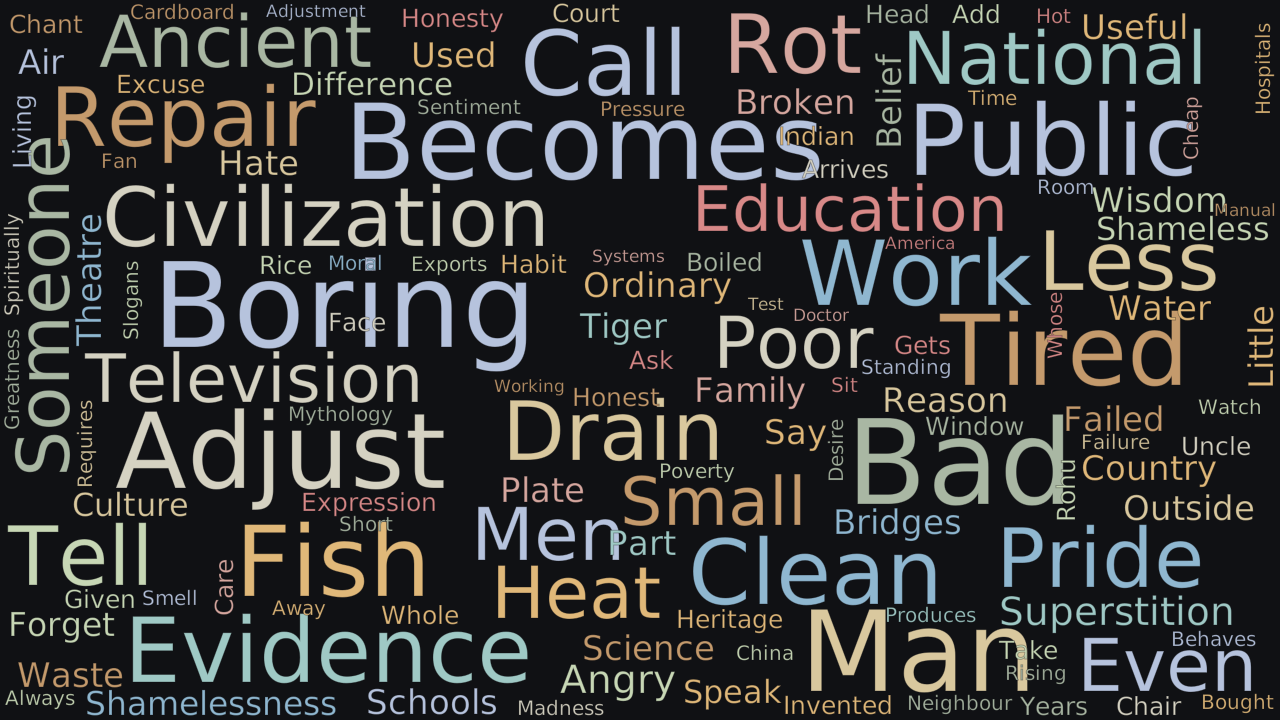
Word Cloud
Related reading
Selected by shared topics and section, with closer publication dates breaking ties.