Truth, Adjustment, and the Cost of Coming Back
Uses the speech voice supplied by your browser or device.

Acronyms used here:
UPI: Unified Payments Interface, India’s instant digital payment system, the thing that lets a tea stall, a fish seller, and a software consultant all pretend for twelve seconds that the nation is already in the future.
FDI: Foreign Direct Investment, money from outside the country put into businesses, factories, services, infrastructure, or long-term commercial activity. It is less sentimental than a patriotic song and far more easily frightened.
GDP: Gross Domestic Product, the total value of goods and services produced in a country, often waved about like a school report card while nobody asks whether the child has learned honesty.
MSME: Micro, Small, and Medium Enterprise, the small-business world where most people do not have legal departments, lobbyists, or the luxury of being cheated politely.
The first smell was not corruption. That would be too grand. Too cinematic. Too much like the opening shot of a serious documentary where a crow lands on a government building and the narrator begins clearing his throat.
No, the first smell was office tea.
Cold, thin, brown tea in a chipped white cup. Tea that had given up its ambitions. Tea with a little skin on top, like a pond in July after three days of heat and no breeze. Across the table sat a sweaty man with the calm expression of someone who had long ago murdered his conscience and now kept the body under a stack of files.
“You have to adjust,” he said.
There it was.
Not advice.
Not wisdom.
A national operating system.
In India, “adjust” is not a word. It is a tunnel. Principle goes in at one end wearing a clean shirt and comes out at the other end looking for a towel.
I had returned from abroad with that special foolishness only foreign-returned Indians possess. It is an expensive stupidity. You do not get it from a university brochure or a TED Talk. You get it by living too long in countries where a contract is not holy, but at least it is not treated as decorative wrapping paper for a plate of singara.
I thought if you said something plainly, people would answer plainly.
Small mistake.
In India, plain speech enters a room like a stray dog in a wedding hall. Everyone sees it. Everyone knows it should not be there. Nobody wants to touch it.
You say, “This invoice is wrong.”
The room cools.
You say, “This commitment was not honored.”
The smiles become plastic.
You say, “But that is not true.”
Now you have done it. You have not made a point. You have committed a social offence. You have placed a dead rat on the conference table and asked everyone to admire its accuracy.
The salaried man learns this slowly. Poor fellow, he has his own punishments. He travels in the padded local train compartment of hierarchy. Boss above, junior below, salary arriving monthly like a government sedative. If he is clever, he learns the small dance early. Nod. Smile. Swallow. Say “as discussed” in email, that little corporate umbrella held over the naked head of truth. By forty-five, he may not even notice the fungus. It has become part of the bread.
The entrepreneur learns faster.
The returning entrepreneur learns like a man biting into a green chilli he mistook for capsicum.
One day you are sitting in front of a vendor, client, middleman, banker, consultant, regulatory uncle, or one of those fellows who knows another fellow who once had tea with a man whose cousin can “manage the matter,” and you say, like a first-class idiot, “But this is not correct.”
That is when the weather changes.
Antarctica arrives, wearing a paan stain.
The room freezes. The files freeze. The smile freezes. Even the calendar on the wall, showing some god smiling kindly upon fiscal irregularity, seems to say, baba, why did you poke the sleeping snake with a toothbrush?
Truth in India is not treated as virtue.
It is treated as bad manners.
Worse, it is treated as bad business.
And business here, let us not put rose water on a dead fish, often runs like a theatre production where ethics is locked in a trunk backstage while everyone keeps selling tickets to the moral dance. There are rules, yes. We have rules the way old houses have dust. Rules in files, rules in notices, rules in portals, rules in circulars, rules in sub-clauses that look as if they were written during a power cut by a clerk with acidity.
But rules here do not always guide behavior.
They create toll booths.
Every signature becomes a small deity. Every approval becomes a hungry mouth. Every silence has rent. Every truth must pay parking.
Now, before some clean-shirted optimist starts polishing his spectacles and saying, “But corruption exists everywhere,” yes, thank you, professor. It does. Foreigners are not saints. The West has looted, lied, invaded, bombed, enslaved, cheated, and invented financial products so twisted that a village pickpocket looks like a harmless amateur magician.
But here is the catch.
Modern money may be greedy, but it is not brave. It likes predictability. It likes boring courts, boring contracts, boring tax rules, boring judges, boring procedures, boring emails that mean what they say. Capital is not romantic. It does not stand up during the national anthem with tears in its eyes. It is a nervous goat with polished shoes.
It can tolerate greed.
It can tolerate profit.
It can even tolerate a little ugliness if the ugliness comes with a timetable.
But arbitrary power? Regulatory fog? Legal delays moving like a tortoise dipped in cough syrup? Official piety mixed with unofficial collection? That it dislikes.
Money has no motherland.
The dollar does not have a childhood memory of mango pickle and summer holidays.
The dollar hears too many speeches about destiny while contract enforcement smells faintly of drain water, and quietly begins packing its suitcase.
We, of course, explain this brilliantly. Like a drunk man looking for his lost key under the streetlamp because the light is better there.
We blame global bias, conspiracy, jealous foreigners, hostile media, China, Pakistan, colonial hangover, urban elites, professors, comedians, students, atheists, feminists, and that mysterious international gang whose only hobby is waking up each morning and preventing India from becoming the golden peacock of the solar system.
Never ourselves.
Never the small frauds.
Never the fake bill.
Never the false certificate.
Never the cousin hired because he is cousin.
Never the officer bribed because “what to do?”
Never the thug elected because “at least he is our thug.”
Never the child trained to touch feet but not ask questions.
That last one is important.
We have confused obedience with morality for so long that the two have fused like badly healed bone. A man may cheat his supplier, underpay his worker, lie to his customer, threaten a critic, and then stand barefoot before a deity with eyes so moist you would think he had invented compassion between lunch and evening tea.
Religion here is often not faith. It is laundry.
You take a dirty little cowardice, dip it in flowers, ring a bell, and hang it out to dry as virtue.
I say this as an atheist, which in polite Indian society is treated roughly like saying you keep a crocodile in the bathroom. People become concerned. Not because you are wrong exactly, but because you have made the furniture uncomfortable.
The newspaper?
Ah.
The newspaper often behaves like a rooster hired by the landlord. It crows, but not too loudly. It flaps, but not near the bedroom window.
Television is worse. Television is a pressure cooker full of shaving foam. Ten people shout nationalism into each other’s noses while the real questions sit outside the studio like a poor relative at a wedding.
Why are contracts not honored?
Why are complaints dangerous?
Why does every process require “following up”?
Why does honesty arrive in a room like a medical emergency?
Why does “respect” so often mean, “Please do not expose my nonsense while I am still earning from it”?
There is a reason. A dull one, which means it is probably true.
Human beings are not truth machines. We are belonging machines. We did not evolve in philosophy departments. We evolved in groups, huts, forests, clans, kitchens, markets, and extended families where the wrong sentence could get you expelled from dinner or beaten near the pond.
The brain does not first ask, “Is this true?”
It asks, “If I say this, who will hate me?”
In India, the answer is usually: enough people to make life inconvenient.
Family. Caste. Party. Client. Boss. Local strongman. Housing society secretary. WhatsApp group. Trade association. That one uncle with blood pressure who believes every national problem began with English-medium schools and women wearing jeans.
So people lie.
Then they lie about lying.
Then they rename lying as adjustment, maturity, culture, sensitivity, practicality, strategy, or respect.
Lovely words.
Small coffins for truth.
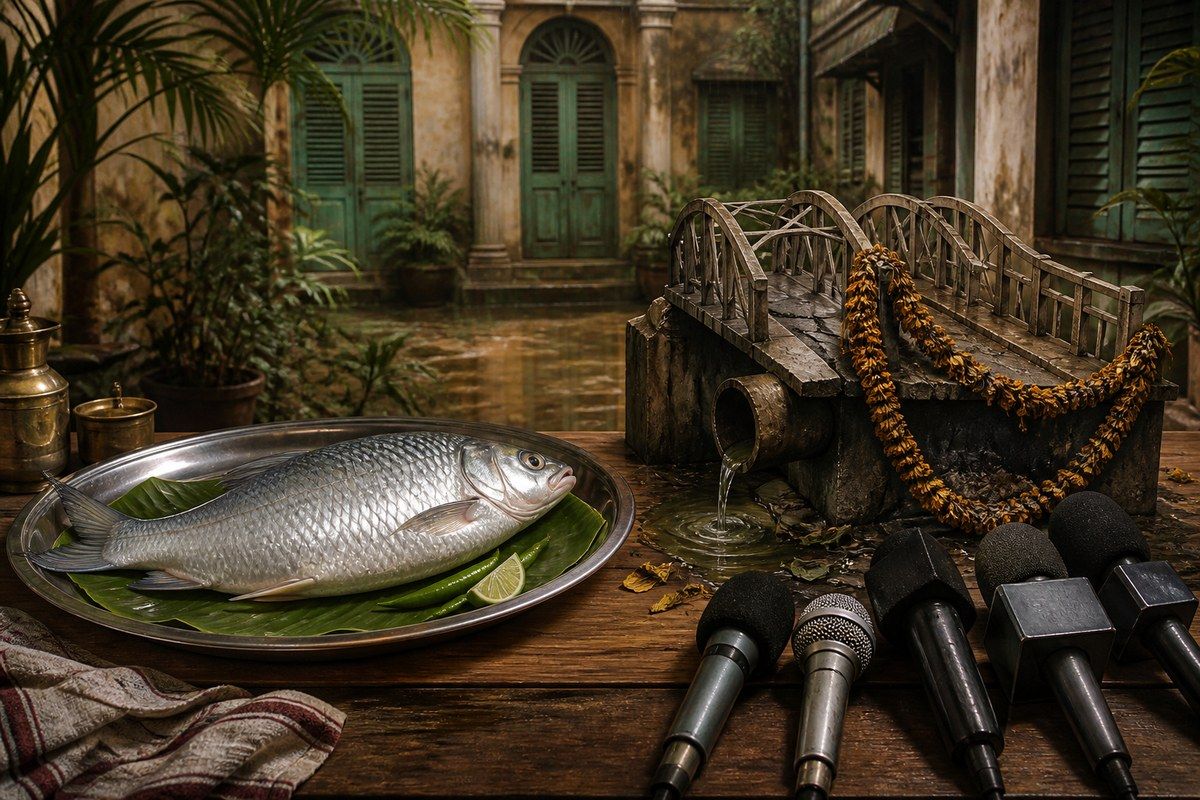
The decline is not always dramatic. It is not always a bridge collapsing, though we manage those too, followed by inquiry committees, garlands, microphones, and the usual public performance of serious faces. No, the real damage is cellular. One small mutation at a time.
One inflated invoice.
One false promise.
One candidate pushed through because he “belongs to someone.”
One journalist warned.
One officer transferred.
One businessman told not to put things in writing.
One ordinary citizen advised, “Leave it, why invite trouble?”
And then the organism walks around in a pressed shirt, speaking of ancient glory, while dishonesty eats its liver quietly.
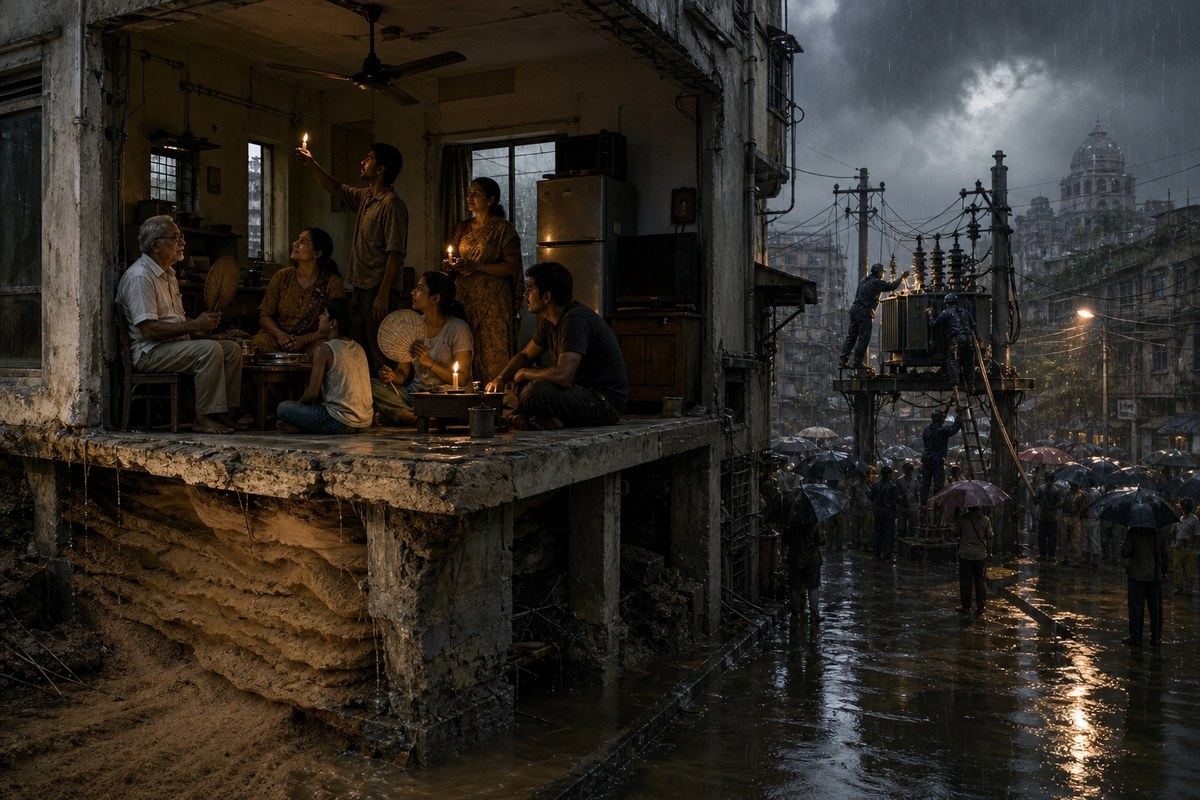
This is where the Calcutta day enters, because no essay from this city can remain purely abstract. Not in June. Not when the fan is turning like a tired argument and the power goes off just as you are about to make tea.
I sit in my room on the southern fringe, fifty-one years old, single, lower-middle-class, neither tragic enough for cinema nor successful enough for LinkedIn. The rice cooker is on the table like a loyal but unimaginative friend. The laptop is open. Some consulting work is waiting. Some bill is also waiting. Bills have great patience. They sit like cats.
Outside, a generator coughs. Somewhere a pressure cooker whistles. Somewhere a neighbor is watching a news debate where eleven men are solving the nation by shouting. Somewhere a delivery boy is climbing stairs with a packet of biryani for someone who has spent the afternoon posting about civilizational greatness.
Meanwhile the fish seller wants cash, the landlord wants rent, the pharmacy wants payment, and my brain, with its bipolar wiring and old anxiety, wants to lie down under a wet towel and resign from the human project.
In this mood, truth is not a noble statue.
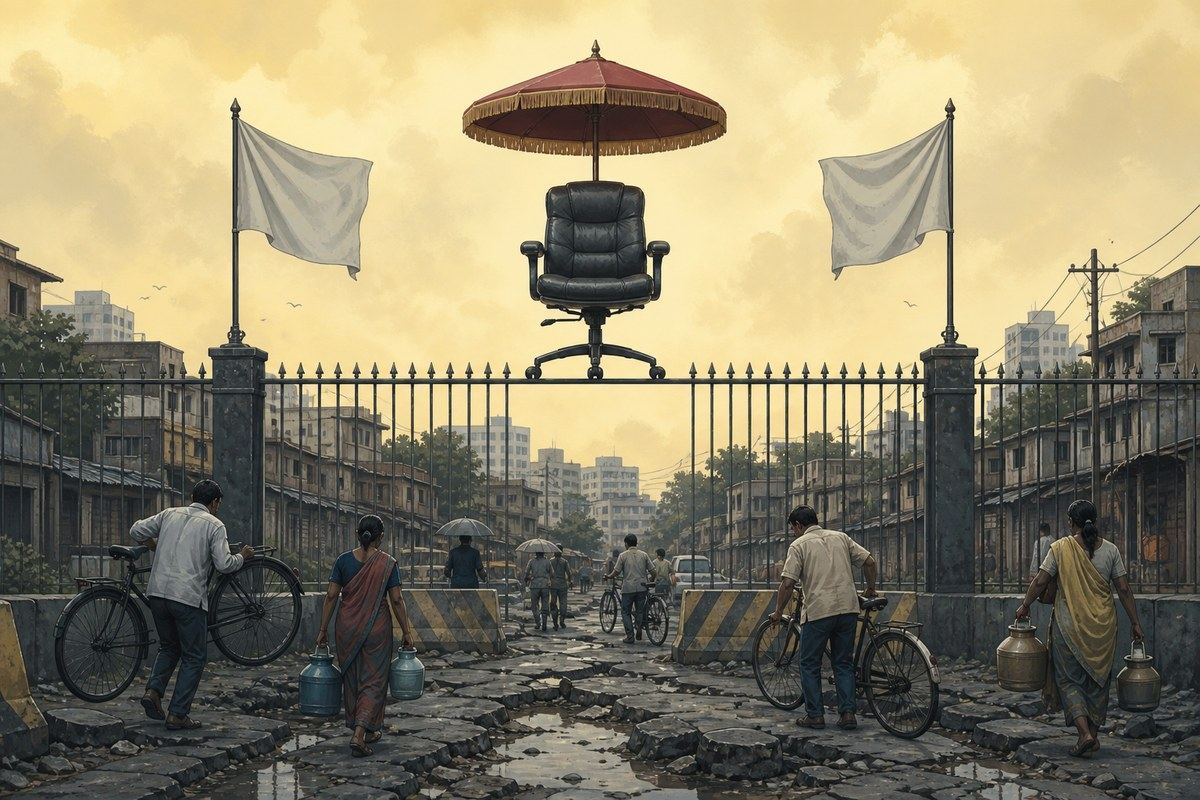
Truth is a very inconvenient chair.
You can sit on it, yes. But not comfortably.
And yet, what is the alternative?
To become smooth? To learn the smile? To say “no issue” when the issue is large enough to need its own PIN code? To nod while a man explains that fraud is not fraud but process? To pretend every lie is a coconut offered at the temple of practicality?
I tried. Not always bravely. Not always consistently. Let us not make myself into a freedom fighter of invoice accuracy. I have swallowed things. I have kept quiet. I have chosen peace over correctness. Most people do. Courage looks very attractive in other people’s biographies. In real life it often arrives with legal fees, unpaid bills, and no one returning your call.
But some lies stick in the throat.
They sit there like fishbone.
The returning man suffers from one extra disease: memory. He remembers another version of the country. Not a perfect one. Childhood is a fraudulent editor. It cuts the drains and keeps the sunlight. Still, memory keeps showing you para football, winter mornings, school bells, coconut oil in a grandmother’s hair, old houses with iron gates, book fairs, tram bells, cheap telebhaja, and that particular Calcutta afternoon light which makes even a broken wall look as if it once read poetry.
Then you come back and find the photograph laminated by a promoter, mortgaged by a cousin, and used as proof of heritage by a man selling luxury flats where a pond used to be.
Calcutta, at least, has the decency to look wounded.
Delhi behaves like Rome after two energy drinks.
Mumbai sells hunger as glamour.
Bangalore calls traffic innovation.
Calcutta sits in its sweat, philosophical, coughing, brilliant in patches, useless in patches, saying “ki korbo?” while the ceiling leaks on a framed certificate.
What to do?
That should be the national emblem.
Not lions.
Three shrugging men.
Below them: What To Do.
The optimists will object. They always do. They arrive ironed. They say India is young, digital, rising, dynamic, inevitable. Look at UPI. Look at startups. Look at satellites. Look at airports. Look at GDP. Look at malls. Look at the English-speaking workforce. Look at the demographic dividend.
Demographic dividend is a magnificent phrase. It makes unemployed young men at tea stalls sound like mutual fund returns.
Yes, there is talent.
There is talent everywhere. In slums. In villages. In girls studying under tube lights while their brothers are treated like family IPOs. In engineering colleges with broken labs. In nursing homes with peeling paint. In small shops. In railway compartments. In coaching centers. In the MSME owner who sleeps four hours and still knows his customer’s credit history better than any bank.
Talent is not the problem.
Spine is.
Not shouting spine.
Not television spine.
Not the spine that roars at Pakistan after dinner.
Not the spine that defends gods who, strangely, require lawyers, police, mobs, and prime-time anchors to protect their infinite dignity.
I mean the ordinary spine.
The unfashionable spine.
The spine to say: this is wrong. This is false. This is theft. This is cruelty. This is superstition wearing a crown. This is governance by small men with large appetites.
But truth has a cost.
And most of us, myself included, are discount shoppers of the soul.
We want integrity at clearance price.
We want courage with home delivery.
We want a clean country without making enemies.
We want justice without paperwork, reform without risk, science without irreverence, capitalism without contracts, democracy without dissent, religion without madness, masculinity without violence, and nationalism without that stale underarm smell of insecurity.
Very nice.
Also impossible.
A country is not cleaned by slogans. It is cleaned the way a filthy kitchen is cleaned after a family wedding. One sticky plate at a time. One lying uncle at a time. One unpaid worker at a time. One fake bill at a time. One frightened silence at a time.
There is no grand shortcut.
No app will fix it.
No godman will fix it.
No television anchor will fix it.
No billionaire with a podcast voice will fix it.
No foreign investor will save a country that treats truth like a mosquito to be slapped and forgotten.
The work is smaller. More humiliating. More boring.
Tell the truth in the room where lying is profitable.
Pay the person you owe.
Do not fake the number.
Do not worship the bully because he is useful.
Do not call cowardice culture.
Do not call fear maturity.
Do not train children to obey before they learn to think.
And when someone says “adjust,” ask a dangerous little question.
Adjust to what?
That is where the floor tilts.
Because sometimes “adjust” means kindness. Life needs that. A tram is late. A neighbor is noisy. A fish has too many bones. The world is imperfect and only a lunatic expects it to arrive polished.
But sometimes “adjust” means surrender your eyes.
Adjust to theft.
Adjust to lies.
Adjust to humiliation.
Adjust to the man who smiles while moving the goalpost.
Adjust to the system that eats your time, your money, your confidence, and then asks why you look tired.
That is not adjustment.
That is digestion.
And you are the meal.
So I sit here, half-boiled in Calcutta humidity, listening to the fan chop the air into warm slices, thinking of all the rooms where I should have lied and did not, or should have shut up and could not, or should have learned the national choreography of polite fraud but somehow stepped on everyone’s shoes.
The tea cools.
The generator coughs.
Somewhere a man is printing a brochure about values.
Somewhere another man is hiding the accounts.
Somewhere a sweet is being offered with money that should have paid wages.
And I, great hero of nothing, sit in my lungi and wonder whether honesty was principle, stubbornness, illness, bad business training, or simply a form of social suicide performed by a man too foolish to prosper and too tired to pretend.
Word Cloud
Related reading
Selected by shared topics and section, with closer publication dates breaking ties.