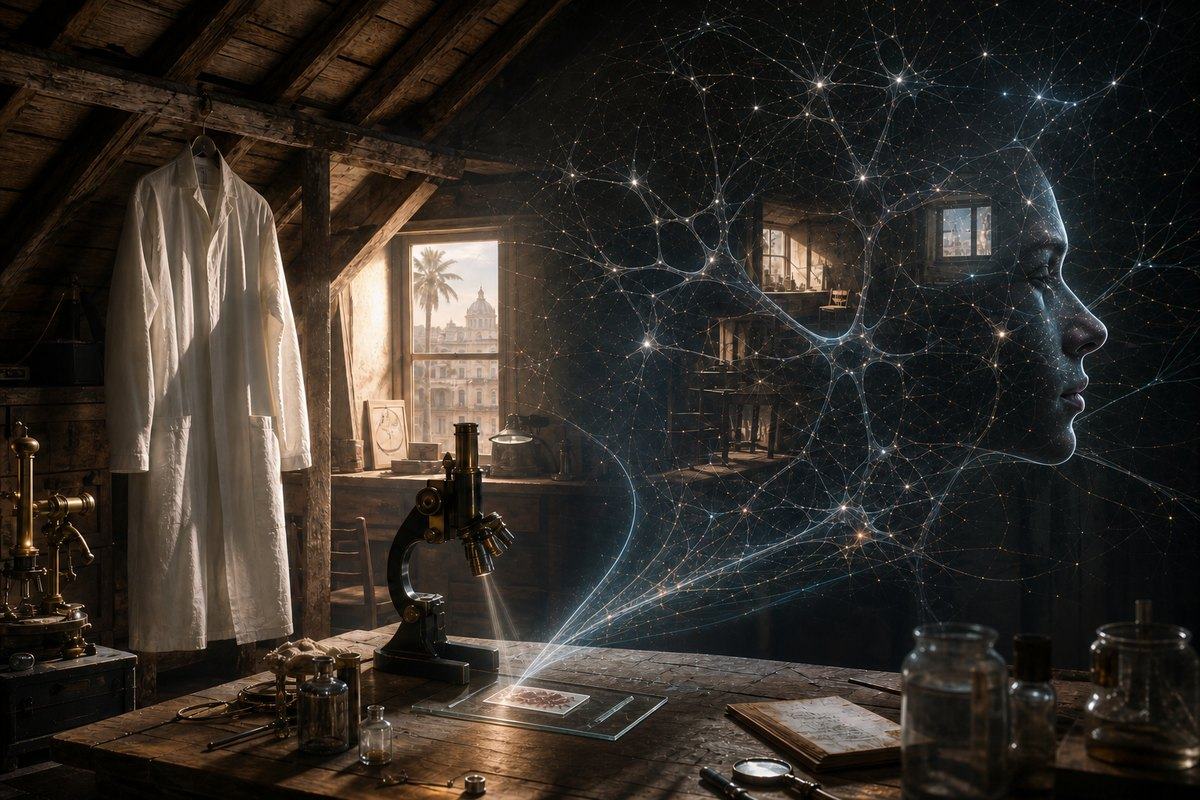
Mary's Room, Red Mangoes, and the Poor Man's Philosophy of Color
Uses the speech voice supplied by your browser or device.

RGB: Red Green Blue, the common digital color model used by screens to mix colors from red, green, and blue light.
AI: Artificial Intelligence, machine systems that imitate or automate tasks associated with human intelligence.
BBC: British Broadcasting Corporation, the public broadcaster from the United Kingdom.
fMRI: Functional Magnetic Resonance Imaging, a brain-scanning method that tracks changes related to blood flow and neural activity.
Mary knew everything about red except the one thing that mattered: what red does to you when it arrives without asking.
That is the small bomb hidden inside Mary’s Room. It looks at first like one of those philosophy problems that live in university departments and smell faintly of chalk, old coffee, and men explaining consciousness with the confidence of a person who has never had a power cut during a heat wave. But it is not small. It is not academic furniture. It is a knife slipped under the door.
Here is the thing in plain English.
Mary is a brilliant scientist. She knows every scientific fact about color. Light. Wavelengths. Eyes. Brain circuits. Retinal cones. The whole respectable procession. If red could be trapped in a textbook, she has trapped it, labelled it, indexed it, cross-referenced it, and probably made a slide deck about it.
But Mary has lived all her life in a black-and-white room.
No red hibiscus.
No red traffic light glowing like a small angry uncle at a crossing.
No red sindoor on a forehead.
No red plastic bucket in a Calcutta bathroom, that most democratic of household objects, somewhere between plumbing, civilization, and daily defeat.
Then one day Mary walks out.
She sees red.
Does she learn something new?
You think the answer is simple. It is not. That is how philosophy gets you. It comes dressed like a harmless school question and then, suddenly, your afternoon is ruined.
Because if Mary already knew every physical fact about color, what exactly did she gain when she saw red? If she learned nothing, then seeing red is somehow already contained inside the science of red. If she learned something, then all the scientific facts in the world had missed a piece of experience.
And that missing piece is where the mosquitoes start breeding.
Philosophers call this missing piece qualia. A very polished word. Too polished, perhaps. It means the private feel of experience. The redness of red. The bitterness of overboiled tea. The odd sadness of a damp towel that has given up on becoming dry. The ache in the chest when an old song enters the room like a creditor.
I prefer not to make the word too grand. Qualia is what happens when the world stops being information and becomes your problem.
A red mango in summer is not a wavelength. Not to the person holding it. It is smell, stickiness, memory, childhood, greed, and the slight moral collapse of eating the best slice before offering anyone else. Science can describe the sugar, the color, the cell structure, the light bouncing off the skin. Good. Useful. Necessary. But the first bite still has to happen in a mouth.
That is where Mary catches us.
I live nowhere near a clean philosophical laboratory. My room is not monochrome. It is more accurately a museum of ordinary exhaustion. There is the rice cooker. There is the window grille. There is the fan making its tired circular argument with the air. There is the afternoon light, which in suburban Calcutta does not enter a room so much as inspect it for unpaid dues. Outside, some bird is making a sound like a badly maintained bicycle pump. Somewhere a pressure cooker whistles, and somewhere else a man is shouting into a phone as if the phone personally betrayed him during the Emergency.
This is my room.
It has color.
But I still understand Mary.
Because one can live surrounded by color and still be trapped in black and white. Depression does that. Poverty of spirit does that. Too much internet does that. Too much knowing does that. You can know the theory of happiness, the chemistry of mood, the history of philosophy, the neuroscience of attention, the economic collapse of the middle class, the price of onions, the latest diplomatic quarrel, and why your sleep is broken. You can know all this and still sit on a cheap mattress at 3 p.m. feeling like someone turned down the brightness of the universe.
Knowledge is not experience.
It is the menu. Experience is the food. Sometimes experience is also the bill, the indigestion, and the cockroach walking across the wall while you reconsider your life.
Mary’s Room bothers me because I have spent a large part of my life believing in explanation. I like explanation. I am not one of those people who thinks mystery is improved by ignorance. Ignorance is not depth. It is only darkness with better public relations. Science is magnificent because it opens the machine. It says, look, this is how light enters the eye, this is how the brain sorts signals, this is how the world becomes a picture inside the skull.
Wonderful.
But then the floor gives way.
Because after all the machinery has been explained, someone still has to say, “Ah. So this is red.”
That “so this is” is the whole circus.
It is the difference between reading about swimming and being thrown into a pond by a cousin who has more enthusiasm than ethics. It is the difference between knowing the recipe for luchi and watching one puff up in hot oil like a small golden planet. It is the difference between understanding heartbreak as attachment loss and sitting with your phone in your hand, hoping for a message that has already decided not to come.
A theory can stand outside the house and describe the architecture. Experience is being inside when the roof leaks.
Now, some very serious people will object. They will say Mary learns no new fact. She gains an ability. Or a new brain state. Or a new way of representing information. They may be right. I do not dismiss them. The brain is not a decorative lampshade for the soul. Damage the brain and the self changes. Stimulate the brain and the world can tilt, sing, flash, vanish, or return wearing a false moustache. Anyone who has honestly looked at neuroscience has to stop pretending the mind floats around like a ghost in a Bengali horror serial.
But.
There is always a but. A large one. With a municipal belly.
Even if consciousness is what the brain does, that does not make it simple. “The brain does it” is not an explanation. It is the name of the factory. We still have to understand the production line, the workers, the power cuts, the union fights, the missing invoices, and why the final product sometimes comes out as grief when the raw material was only a plastic chair from 1992.
That chair matters.
You may laugh. Fine. I have also laughed at stranger things, including government forms and men who describe themselves as thought leaders. But memory attaches itself to objects with a cunning no philosopher has fully domesticated. A chair is not always a chair. Sometimes it is a whole year. Sometimes it is a room in your childhood. Sometimes it is your mother’s voice from another decade. Sometimes it is proof that the past did not die; it merely changed address and moved into your nervous system.
Mary saw red.
I see an old chair.
Both are doors.
This is the part where modern life becomes mildly ridiculous. We have made a world where everyone knows everything second-hand. A boy in Kolkata knows the snow conditions in Switzerland, the diet of a Hollywood actor, the mating habits of deep-sea creatures, the price of a laptop in Dubai, and seven opinions on a war before breakfast. He knows everything and has experienced almost nothing. His thumb has travelled more than his feet.
The room has become portable.
It fits in the pocket.
It glows.
And unlike Mary’s room, it is not black and white. It has too much color. Infinite color. Aggressive color. Color with notifications. Color with thumbnails. Color shouting, blinking, selling, seducing, explaining, recommending. Yet the effect is often strangely gray. We scroll through sunsets, bodies, riots, recipes, disasters, puppies, lectures, scandals, and advice from twenty-seven-year-olds who have discovered breathing. After an hour, the mind feels like yesterday’s muri in a damp paper packet.
This is not experience.
This is grazing.
Mary’s Room once asked whether complete knowledge could replace seeing red. Our age asks something sneakier: can endless seeing replace living?
I suspect not.
A screen can show you a mango. It cannot put juice on your wrist. It cannot make your fingers smell sweet for an hour. It cannot produce that small village-level shame when you realize you have eaten like a greedy child and must now wash your face before appearing among civilized mammals. The body is not optional in experience. The body is the customs office where reality charges duty.
And the duty is often unpleasant.
A mosquito bite during a philosophical mood.
A toothache during an important email.
A sudden wave of sadness while the rice cooker clicks from cook to warm.
A summer afternoon so heavy that even your thoughts sit down.
This is why the clean thought experiment has dirty feet. Mary may live in a pure intellectual box, but the moment she sees red, she joins the rest of us: leaking, sweating, remembering, desiring, fearing, misreading, overthinking, and occasionally eating something from a street stall that medical science would prefer not to endorse.
Experience is knowledge with skin in the game.
It is also why people who reduce everything to diagrams can become unbearable at dinner. You know the type. They explain love as neurochemistry, music as pattern recognition, religion as social bonding, politics as status competition, and biryani as carbohydrate delivery. Technically, one may grant them several points. Socially, one wants to move away from them before dessert.
Because reduction can be true and still be rude.
A sunset is physics, yes. It is also the evening bending down over a city full of unpaid bills, late buses, frying oil, exam pressure, old parents, failed ambitions, and the one man standing by a window thinking, for no clear reason, of a person he has not spoken to in years. If your explanation cannot hold both the photons and the ache, it is not false exactly. It is underfed.
This is where I part company with both camps.
I do not believe in magic souls floating above matter like smug balloons. But I also do not believe that naming the parts exhausts the whole. A song is vibration. It is also the thing that can ambush you in a grocery shop and make you examine onions with unnecessary emotion. A face is bone, skin, light, memory, and expectation. It is also the reason a sensible person can behave like a goat during Durga Puja.
The world has layers.
Some people peel one layer and declare victory.
Philosophy, at its best, prevents that little fraud.
At its worst, philosophy becomes a man in a room arguing with a chair while ordinary life escapes down the stairs. That is why Mary’s Room is both brilliant and faintly comic. It imagines a woman who knows everything about color but has never seen color. This is absurd. And because it is absurd, it is useful. A good thought experiment is like a fish bone in the throat. Small, irritating, impossible to ignore.
The question remains.
What did Mary learn?
I think she learned what cannot be mailed ahead of time. She learned arrival. She learned contact. She learned the difference between a map and mud on the shoe. Not a new entry in a textbook perhaps. Not a new equation. Something more intimate and less obedient.
She learned the taste of the word “now.”
That matters because many of us spend our lives before the door opens. We prepare. We read. We plan. We explain. We make ourselves clever. Then the thing itself arrives and humiliates our preparation. Grief does this. Love does this. Illness does this. Aging does this. Even a ripe fruit can do it if you are paying attention.
One minute the world is a concept.
Next minute it is dripping down your fingers.
That is the whole mystery. Not a mystical mystery. A human one. The kind that sits in a room with a cracked wall, a half-charged phone, a cup of tea going cold, and a man who has read too much but still does not know how to live elegantly at four in the afternoon.
Mary’s Room tells us that being alive is not the same as possessing information about life.
This should be obvious.
It is not.
We forget it every day.
We confuse reading about politics with courage, reading about fitness with health, reading about kindness with being bearable, reading about consciousness with knowing our own minds. We collect explanations like old plastic bags under the sink. Useful someday, we tell ourselves. Very useful. Meanwhile the actual day passes, with its heat, dust, hunger, irritation, memory, and one sudden red flower burning on a balcony like a small private revolution.
Perhaps that is why the thought experiment survives. It does not settle the mind-body problem. Nothing so neat. It only taps the glass and says, are you inside there?
Most days, yes.
Some days, barely.
But sometimes, in the late afternoon, the light changes. The room looks ordinary and strange at once. The rice cooker is silent. The pigeons have stopped their shameless balcony politics. The city is still making its usual noises, but from far away, as if heard through old cloth. And then some red thing appears: a packet, a flower, a stain, a fruit, a sari on a clothesline.
Nothing grand happens.
No theory collapses.
No angel descends, which is just as well, because there is no place for one to sit.
But for one second the world is not an idea.
It is here.
That is what Mary learned.
That is what I keep forgetting.
And that, perhaps, is why even a tired man in a small Calcutta room should occasionally look up before the room becomes the whole universe.
Word Cloud
Related reading
Selected by shared topics and section, with closer publication dates breaking ties.