Bassline, Backhoe, Breath
Uses the speech voice supplied by your browser or device.

Acronyms and terms:
RO: Reverse Osmosis, a water purification method that pushes water through a fine membrane to remove many dissolved impurities.
NRI: Non-Resident Indian, an Indian who has lived outside India, often long enough to return home with foolish hopes and the wrong shoes.
PM2.5: Fine particulate matter smaller than 2.5 micrometers, the sort of dust that does not politely stop at the nose but travels deep into the lungs.
Hz: Hertz, a unit of frequency; in sound, it tells us how many vibrations happen per second.
Bass enters a room like a relative who has not been invited but has already opened the fridge.
You first think it is sound. It is not. Sound, at least in the polite sense, enters through the ear. Bass is more ambitious. It comes through the window grille, the bed frame, the old wall, the tea cup, the molar, the stomach, the memories, the last little corner of the brain where you had hidden one clean thought for later use. Then the backhoe joins in outside, biting the road with its iron jaw, and South Calcutta becomes a badly tuned drum.
This is how a normal day begins.
Not a tragic day. Not a day with a cyclone, a riot, a great speech, a stock market crash, or a meteor coming at Behala with cosmic purpose. Just an ordinary day in a lane where somebody has decided that the road, which was dug up before the pujas and then repaired with much seriousness, must now be dug up again. India believes in reincarnation. Our roads believe in it most sincerely.
Before the pujas, men came, broke the road, spread gravel, rolled it flat, and left. The road looked new in the way a man looks honest in a passport photo. For a few weeks we all participated in the neighborhood fiction. We stepped over the edges, avoided the loose patches, praised nothing openly, because praise in Calcutta is risky. The moment you say, “At least this part is fixed,” a municipal spirit hears you and dispatches a man with a drill.
Now the road has been opened again like a stale packet of muri.
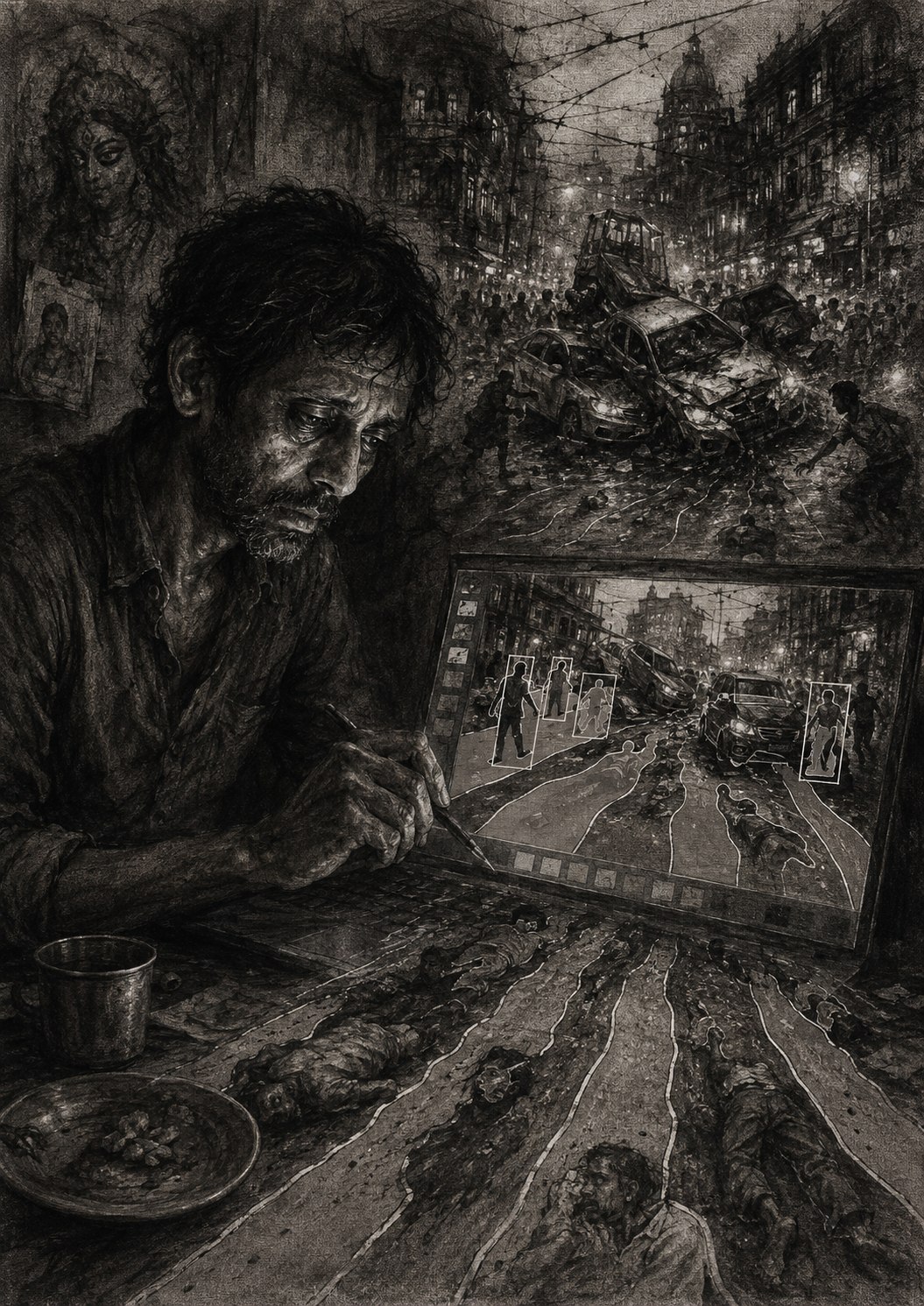
The asphalt lies in black heaps. Dust rises in lazy little ghosts. A machine coughs. A man in a reflective vest watches another man watch another man do something unclear with a shovel. The whole scene has the melancholy grandeur of a committee decision brought to life.
Meanwhile, somewhere nearby, there is music.
I use the word “music” out of courtesy. What is coming through the walls is not quite music. It is more like a large wet shoe being slapped against the inside of the city. Dhup. Dhup. Dhup. No melody, no tenderness, no human hand visible in it. Just a bassline with the emotional range of a ceiling fan regulator.
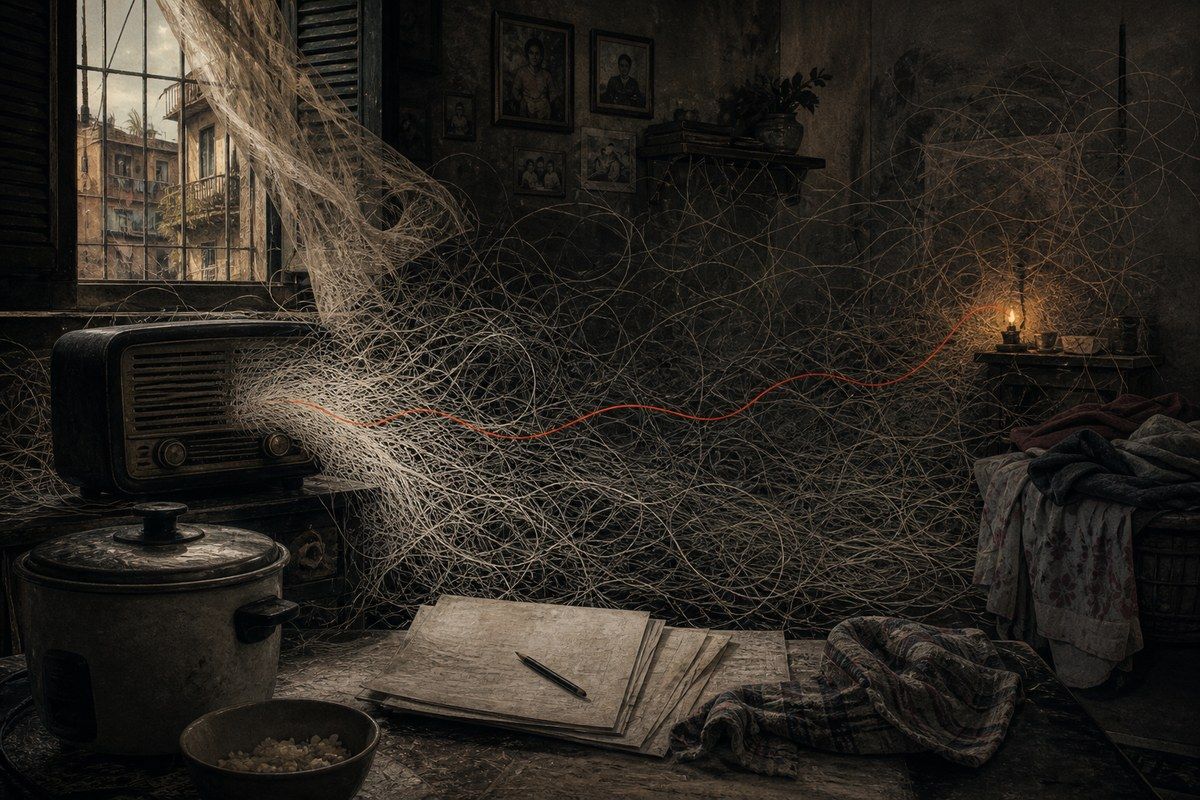
The phone cannot record it properly. This is one of those small injustices that makes you briefly understand why people become philosophers, or worse, residents’ association secretaries. You hold up the phone. You record thirty seconds. Later you play it back and hear only a few polite noises: a scooter, a crow, a distant voice, perhaps one utensil accepting its fate. The real bass is missing. The enemy has escaped the photograph.
There is a reason. Tiny phone microphones are built mainly for voices, not for capturing the underground thud of a neighborhood celebration trying to colonize your skeleton. Low frequencies are long and sneaky. They bend around corners. They pass through obstacles. They treat walls as suggestions. A 50 Hz vibration has the manners of a drunk elephant and the patience of a landlord.
So there you are, sitting in your own room, in your own small lower-middle-class arrangement of table, chair, books, medicine strips, unpaid worries, half-finished plans, old laptop, new headache, and the bass enters as if it owns shares in your skull.
I get headaches from bass. Not dramatic headaches, not the sort where one lies on a chaise longue and says beautiful last words. Mine are practical Calcutta headaches. They arrive like a clerk with a file. First they stamp the forehead. Then they sit down behind the eyes. Then they begin deleting sentences from the brain.
You try to think: I must finish that work. I must call that person. I must check that payment. I must remember whether I took the medicine. I must not snap. I must not become the man who shouts from the balcony in a vest.
Dhup.
Gone.
The sentence has left the building.
The backhoe outside is doing its own work. Its metal teeth scrape, bite, lift, drop. Dust blooms from the road and hangs in the air. It settles on the ledge, on the clothesline, on leaves, on the idea of morning itself. A cat pauses near the broken pavement, mouth slightly open, body stiff, deciding whether the air is still air or now a hostile arrangement of particles.
That cat knows something we pretend not to know.
Air is not empty. Air is a public road entering the private body. If the road is dirty, the body pays the toll.
People say “noise pollution” and “air pollution” in the same bored tone they use for school essays. The phrases have become tired from overuse. But stand in a lane with a backhoe coughing dust and a speaker sending bass through your ribs, and the words wake up. Pollution is not a chapter in a textbook. It is the thing that takes your morning and chews the corners off it.
Noise is not just sound with bad behavior. Noise is power. Noise says, “I do not need to imagine you.” Noise says, “My celebration is more real than your sleep.” Noise says, “Your old mother’s breathing, your headache, your work, your little rented room, your attempt to remain sane—these are small matters. The speaker has votes.”
That is the hidden politics of the subwoofer. It is democracy after the volume knob has had a few drinks.
In old North Calcutta, where I grew up, there was noise too. Let us not turn childhood into Sandakphu mist. There were hawkers, rickshaw bells, pressure cookers, quarrels, radios, utensils, dogs, crows, and the occasional uncle who believed his throat was a public announcement system. But the noise had gaps. A lane could breathe between disturbances. Afternoon had a shape. Even irritation came with intervals.
Now the city has become a television debate.
Everything speaks at once. The construction machine, the wedding speaker, the news anchor, the honking scooter, the drilling, the devotional chant, the pressure pump, the generator, the man selling something through a microphone that sounds as if it was rescued from the 1971 war. The whole city is one giant WhatsApp group where nobody has found the mute button.
And then the actual television anchors begin.
From neighboring flats, the news leaks out in fragments. One TV is slightly ahead, one slightly behind, and together they produce a strange echo, as if the same shouting person is trapped in different stages of rebirth. Studio faces glow in artificial light. Everybody is urgent. Everybody is furious. Nobody appears to have met evidence socially.
Breaking news breaks every fifteen minutes, mostly because it was never whole to begin with.
This is another kind of bass. Not low frequency, but low nutrition. A diet of noise shaped like information. You can almost hear the producers feeding outrage pellets into the system. Flash the graphic. Raise the voice. Interrupt the guest. Add a red arrow. Ask a question so loaded it needs a porter. Repeat until the country feels informed and slightly poisoned.
There is a reason I notice these things too much. I have read too much. I have worked too long with systems to believe that mess is always accidental. Fifteen years in the United States studying and working around healthcare data did something permanent to my head. You learn to ask boring questions. Where did this come from? Who owns it? Who checked it? What was supposed to happen? What actually happened? Where is the log? Why is the same failure repeating?
Then you return to Calcutta, and a lane becomes a database with no primary key.
The road says one thing. The dust says another. The vest says supervision. The shovel says improvisation. The schedule, if one exists, is hiding like a witness. The citizen is expected to admire activity, not ask about outcome. We are very good at visible effort. We are less enthusiastic about invisible competence.
A road being repaired again and again is not merely a road problem. It is a memory problem. The city does not remember what it did last month. Files remember, perhaps. Contractors remember. Some office remembers just enough to process a bill. But the lane, the lungs, the people, the cats, the old woman coughing inside a room—they are not part of the official memory.
This is where civic life becomes intimate. Not in speeches. In dust on the window ledge.
My mother is old and frail now. That sentence looks small, but it is a full-time weather system. Old age enters a house quietly at first. A missed step here. A cough there. A little less appetite. A little more fear. Then one day you realize the household has been reorganized around breath. Medicines, water, food, infection, panic, sleep, weakness, doctor calls, money, and the daily arithmetic of not letting the body fall below some invisible line.
People praise family values as if they are banners. In real life, family values are smaller and more boring. They are a glass of clean water. A washed cup. A door closed against dust. A pill strip checked twice. A fever watched in the afternoon. A son trying not to look frightened because the mother is already frightened enough.
Last year I bought an RO purifier for her and for myself. This is a modern Indian ritual. The public system fails, so we buy a private patch. Water filter. Air purifier. Inverter. Mosquito racket. Backup cylinder. App cab. Private tutor. Private clinic. Private security grille. Private little lifeboats tied to a public ship that keeps hitting the same rock and calling it heritage.
The RO sits there humming softly, a small white appliance with the confidence of a minor saint, though I am an atheist and do not give appliances theological promotions. Still, I respect it. It does one job. Water goes in. Better water comes out. No slogan. No speech. No garland. No committee photo.
Imagine if the road worked like that.
Something broken enters the system. Something repaired leaves it.
Too much to ask, perhaps.
In India, “elsewhere” is often a sleeping pill. If bad water kills people in another city, if a bridge falls somewhere else, if a fire traps workers elsewhere, if children breathe poison elsewhere, we absorb it as news, not warning. Elsewhere means we may continue being casual. Elsewhere means the gods of negligence have eaten, and perhaps today they will not be hungry here.
But the gods are only habits wearing fancy clothes.
The real villains are ordinary: delay, indifference, tender games, poor inspection, fear of complaint, love of noise, worship of visibility, contempt for maintenance, and that famous Indian talent for turning every practical criticism into a question of pride. Say the air is bad and someone hears insult. Say the road is badly planned and someone hears betrayal. Say the speaker is too loud and someone hears attack on culture.
Culture, in these moments, becomes a very convenient cupboard. Everything embarrassing is shoved inside it.
There is also our old habit of sprinkling metaphysics over broken plumbing. If people suffer, it is fate. If roads fail, it is destiny. If air is poison, it is the age we live in. If an old woman coughs, that is life. These sentences sound deep only because they are spoken slowly. Most of the time they are just excuses wearing shawls.
A society that cannot fix the drain often develops a rich philosophy of why the drain was meant to overflow.
And I am tired.
Not poetically tired. Not the refined tiredness of a man in a novel looking at rain. I mean the plain tiredness of a 50-year-old single Bengali man in the shanty edges of Calcutta, making some precarious consulting income, with bipolar depression and anxiety sitting in the room like two unpaid tenants. The day does not begin with ambition. It begins with negotiation. Can I make tea? Can I answer that message? Can I work before the noise starts? Can I keep my temper? Can I keep my mother steady? Can I keep myself from sinking before lunch?
Then the bass begins.
Dhup.
Very philosophical.
I sometimes envy stupid people. This is not noble, but it is true. Not cruel people. Not bad people. Just the lightly padded people. The ones who move through the world with a thick layer of internal thermocol. Noise does not pierce them. Bad arguments do not itch. False claims do not leave rashes. They do not lie awake analyzing the relationship between low-frequency sound, civic decay, and the collapse of attention.
They hear bass and say, “Party.”
I hear bass and see a civilization failing to understand boundaries.
This is not a gift. This is a subscription you cannot cancel.
The brain, poor fellow, is a prediction machine. It likes patterns. It wants the next second to make some bargain with the previous one. In a calm place, this becomes thought. In a chaotic place, it becomes vigilance. A sudden honk, a drill, a shout, a bass thump, a cloud of dust, a news anchor barking from next door—the brain stops building ideas and starts ducking blows.
Then society asks why everyone is irritable.
Because we live inside a pressure cooker and call the whistle culture.
A clean, quiet room is not luxury. It is infrastructure for the mind. A breathable lane is not decoration. It is public health. A properly repaired road is not development theater. It is the minimum table on which daily life can place its elbows.
Yet we keep treating ordinary decency as a premium product.
You can buy filtered water if you can pay. You can buy quieter windows if you can pay. You can buy an air purifier if you can pay. You can move to a better neighborhood if you can pay. You can escape the dust, the bass, the broken road, the coughing lane, the amateur fireworks of civic collapse—if you can pay enough.
And if you cannot?
Then you develop character.
India is very generous with character. It gives the poor character, the lower middle class character, old parents character, patients character, pedestrians character, schoolchildren character, asthmatics character, and cats character. The rich, mysteriously, are allowed comfort.
Around dusk the construction slows. Not stops. Stops would be too dramatic. It slows, like a man pretending he has not been eating from the fridge. The bass continues somewhere, now less triumphant but still present, a stubborn thumb on the day’s pulse. The television anchors have moved to a new emergency. The dust on the ledge has thickened.
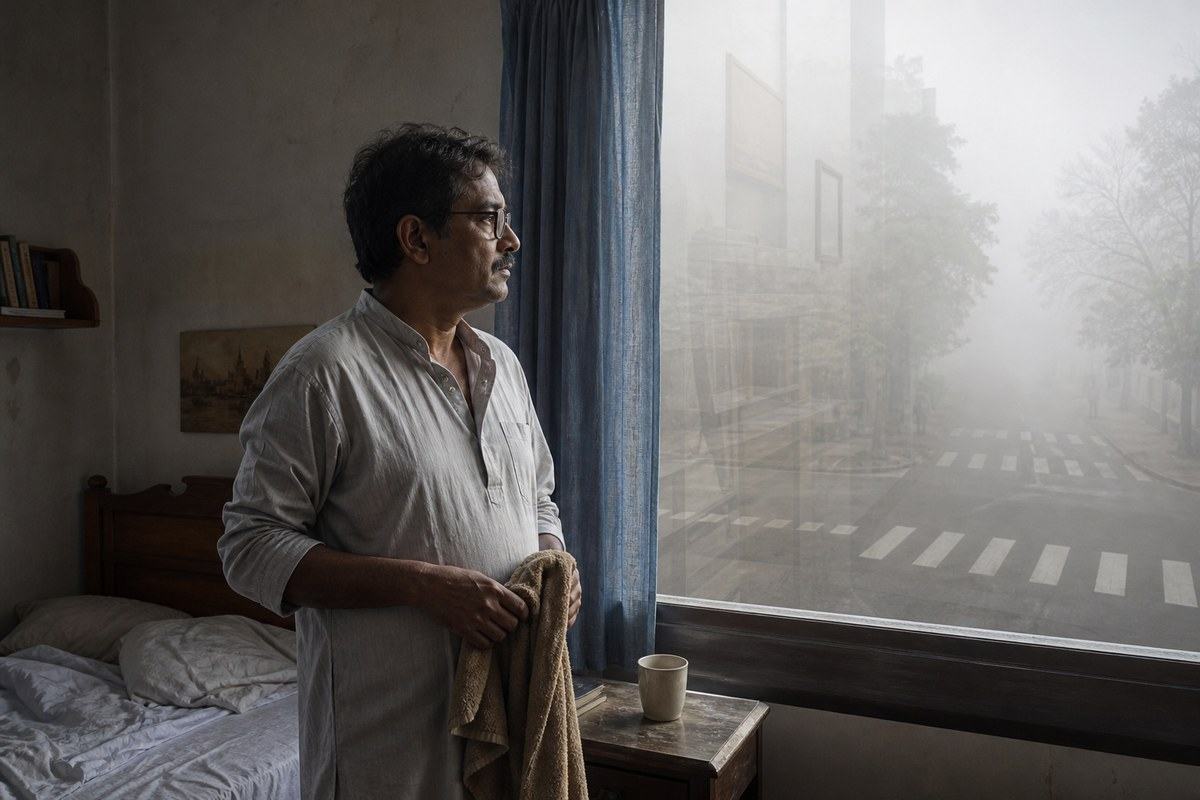
I pour a glass of water from the RO. It looks clean. Clear. Almost innocent.
That is the trick, of course. A glass of clean water can look like victory if the day has been sufficiently small and sufficiently battered. I hold it up to the light for a second, like a foolish man inspecting a diamond he cannot afford. Then I drink.
Outside, the lane is still broken.
Inside, the house is not.
Not yet.
So I take a damp cloth and wipe the window ledge. Slowly. It is a ridiculous act. The city will send more dust tomorrow. The speaker will return. The road may be dug up again before I finish this sentence. Some anchor will shout. Some official will smile. Some file will move, or not move, with the serenity of a cow in traffic.
Still, the cloth moves from one end of the ledge to the other.
Beginning. Middle. End.
In a life where so much refuses to finish, that small completed motion matters more than it should.
The cloth comes away dark.
The bass thumps on.
There is the whole city, in one dirty square of cotton.
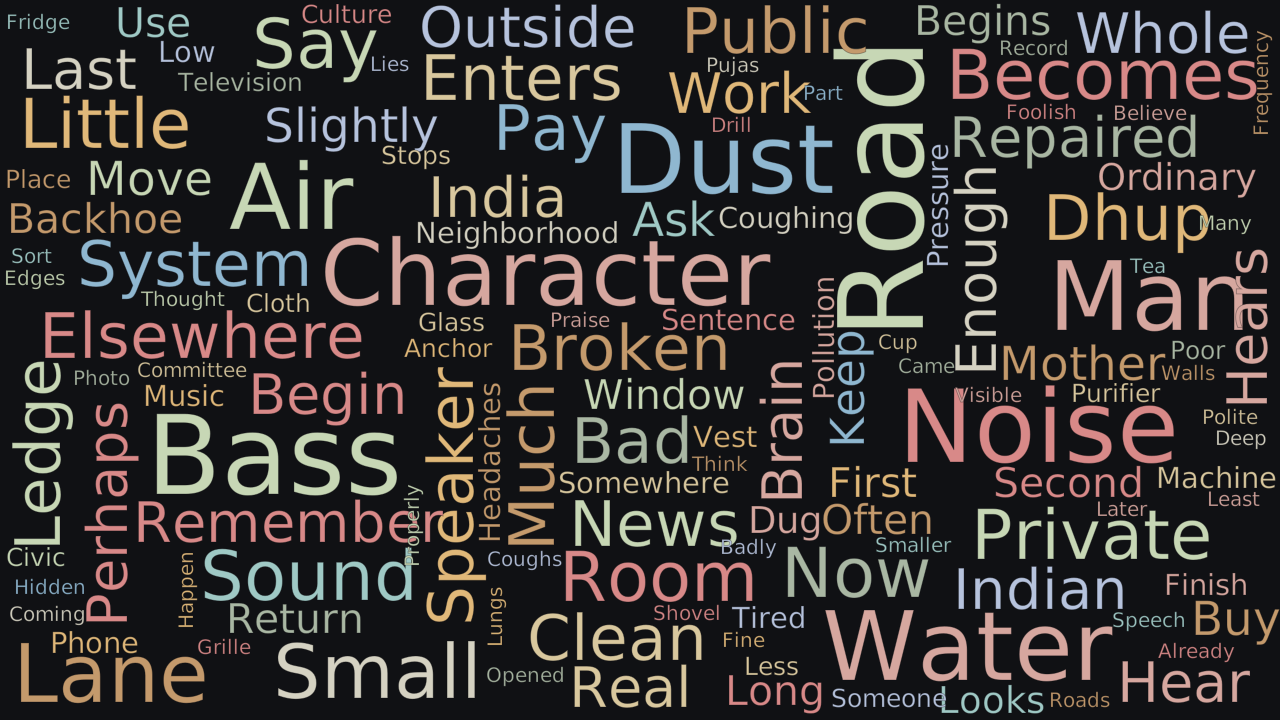
Word Cloud
Related reading
Selected by shared topics and section, with closer publication dates breaking ties.