Democracy on Installments
Uses the speech voice supplied by your browser or device.

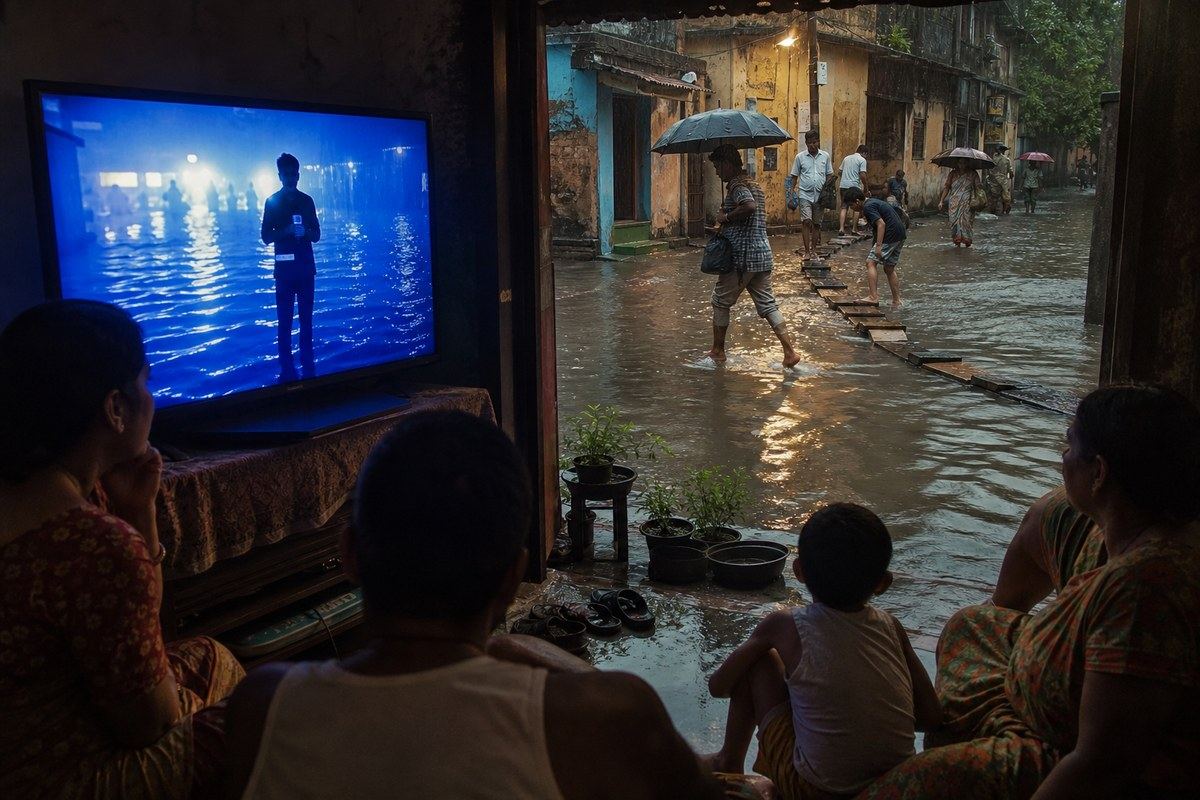
The tear gas touched the television screen before it touched anybody’s lungs, appearing first as a thin white smear crawling up the old pink masonry of Jantar Mantar, where it curled around the giant staircases with the languid obscenity of steam escaping from a municipal latrine, and because I was watching from Calcutta rather than standing there in Delhi, I received the event in its most civilized form: flattened into pixels, disinfected by distance, reduced to a rectangle with a volume button, while four hundred supporters of the Cockroach Janata Party learned that the modern Indian unit of political measurement is not the degree, the minute, the second or the astronomical declination but the interval between a loudspeaker requesting peaceful dispersal and a seasoned bamboo rod discovering the softest available portion of a pensioner.
The camera shook.
A lathi struck the bald head of a retired geography teacher with the dry wooden thock of a coconut being inspected by a fruit seller who has already decided it is rotten, and the man’s knees folded in two installments, first parliamentary, then constitutional, while his plastic tricolour spectacles flew across the pavement and disappeared beneath a police boot, which seemed less like an accident than an admirably compressed editorial because national symbols are indestructible when sixty feet tall, floodlit, garlanded and guarded by men with automatic weapons, but when reduced to the size of an ordinary citizen’s face they become brittle imported merchandise costing ₹79.99, inclusive of taxes and exclusion of dignity.
I leaned closer to the screen, although leaning closer to disaster is one of television’s smaller insanities, as if proximity to the glass might improve the moral resolution, and immediately the picture broke into squares, the teacher’s skull becoming twelve pink pixels, the lathi six brown ones, democracy converted by video compression into blocks of approximate color, because even outrage must pass through an algorithm that asks which details can be discarded without the viewer noticing.
Apparently the algorithm has studied us.
It discards quite a lot.
Jantar Mantar was built in the eighteenth century by Sawai Jai Singh II because celestial bodies, unlike ministries, could still be audited. He raised enormous masonry instruments to measure shadows, angles, planetary positions and the slow mechanical gossip of the heavens, constructing staircases that climbed not toward bedrooms, offices, terraces or tea stalls but into arithmetic itself, as though a king had ordered Euclid to design a public building after three nights of fever, constipation and metaphysical harassment.
There was something magnificent and magnificently cracked about it: men climbing architecture to ask Saturn where the celestial mucus it thought it was going.
Now citizens arrived to ask the government the same question.
The Cockroach supporters stood below those instruments in colourful Bengali kurtas, Bihari headgear, cheap sneakers, rubber slippers and one torn sandal repaired with blue electrical wire, carrying placards that said WE ARE ALSO THE PEOPLE, a sentence whose touching grammatical optimism the State was preparing to revise into WE WERE ALSO THE PEOPLE, past tense, pending verification, biometric authentication and a processing charge.
They had come to deliver a petition.
A petition is democracy’s paper suppository: carefully rolled, ceremonially inserted and rarely known to produce anything except irritation.
The party president climbed several steps of the old observatory and shouted that power must remain answerable to measurement, because even kings had understood that the sun could not be ordered to rise two hours late merely to improve the quarterly report, but the microphone squealed, the television anchor spoke over him and a red banner appeared across the bottom of the screen announcing BREAKING NEWS, those two words now meaning that nothing has broken except the viewer’s remaining capacity to distinguish information from glandular stimulation.
On another part of the screen, a science headline crawled past saying that researchers had found a form of sugar in space near the centre of the galaxy.
Sugar in space.
Tear gas in an observatory.
A petition in a gutter.
The universe, apparently, was baking something.
My mind seized this connection and ran with it, because the manic part of the brain is a dishonest tour guide who insists that every alley leads to Rome, every smell proves a theorem, every fallen slipper contains the skeleton key to history, while the depressive part follows behind with a clipboard, noting that Rome has sewage, the theorem is useless and the key opens a cupboard containing another clipboard.
The procession began moving toward Parliament.
The police line waited ahead in helmets and armour, black and anonymous, a human cell membrane equipped with riot shields, selectively permeable to ministers, contractors, billionaires, lobbyists, diplomatic vehicles, spiritual entrepreneurs and anybody arriving inside a German automobile, while remaining impermeable to a sixty-two-year-old widow carrying a handwritten complaint.
Biology is less hypocritical.
A cell membrane does not print a Constitution declaring every molecule equal. It has channels, pumps, receptors, passwords, gradients and biochemical bouncers. Sodium enters under supervision. Potassium is expelled. Glucose receives facilitated transport. A cabinet minister diffuses through the membrane with ceremonial escort. The ordinary citizen, chemically classified as surplus rural carbohydrate, is rejected and, when persistent, struck in the reproductive upholstery.
The supporters chanted that democracy was dying.
I objected only to the tense.
Democracy was not dying in one grand theatrical seizure, with tanks on avenues, midnight broadcasts and some medal-encrusted sewage gargoyle announcing that the Constitution had been temporarily suspended for its own protection. That would at least possess the vulgar honesty of a butcher displaying the carcass.
No, democracy now dies like a middle-class patient in a private hospital: deposit by deposit, procedure by procedure, organ by organ, while the billing department keeps saying the condition is stable.
One permit denied.
One road closed.
One gathering relocated.
One organizer collected before sunrise.
One journalist charged after lunch.
One bank account frozen by evening.
One hearing postponed.
One signal interrupted.
One panel discussion populated by six professional mouth-cymbals who shout with the intellectual discipline of goats trapped inside a pressure cooker.
The death comes in installments, democracy on EMI, attractively financed at zero visible interest, although the customer eventually pays through the ribs, the molars, the employment record and that tender internal organ called expectation, which is not listed in anatomy textbooks because no surgeon has yet located it, though governments remove it every day with excellent success rates.
The party president reached the barricade holding a folder containing permissions, maps, signatures, declarations, affidavits, undertakings and every other bureaucratic prophylactic required before an Indian may stand briefly upon Indian soil, but the officer did not inspect it because the folder belonged to the old republic of paper, seals, carbon copies and countersignatures, whereas the lathi belonged to the living republic and required neither documentation nor toner.
There was an announcement.
A push.
A stone struck a shield.
Every television channel instantly identified the stone’s origin according to its subscription package, although the people nearby seemed uncertain whether it had been thrown by a protester, an infiltrator, a policeman, a freelance provocateur, an ambitious party volunteer or gravity itself, that ancient foreign-funded conspiracy first publicized by an Englishman loitering beneath horticulture.
The stone became justification.
Justification became acceleration.
Acceleration became force.
The old equation arrived with its usual innocence, force equals mass multiplied by acceleration, the mass supplied by the State and the acceleration supplied by salary, hierarchy and the private terror of appearing reluctant before one’s superior.
The lathis rose.
For half a second they looked almost elegant against the bleached sky, narrow black hands on a murderous clock, and behind them stood Jantar Mantar, where shadows had once measured time without breaking anybody’s wrist, though civilization has naturally improved the apparatus.
Then the sticks descended into shoulders, backs, thighs, skulls, phones, placards and the badly engineered region between male legs where evolution suspended the continuation of the species inside a wrinkled external purse, as though natural selection had completed the brain, liver, kidneys and opposable thumb before suddenly remembering at five minutes to closing time that reproduction still needed somewhere to sit.
One man tried to run, slipped on a banner and received a blow across the buttocks so severe that his spectacles fogged, which is medically implausible but emotionally exact.
A woman raised both hands and shouted that she was a schoolteacher.
This produced no constitutional complication.
An elderly man cried that he had undergone bypass surgery.
The lathi, lacking postgraduate cardiology training, continued its rounds.
A young constable hesitated, and in that microscopic hesitation I nearly granted him an entire moral biography, which is the humiliating weakness of watching violence from a distance: one warm loose screw becomes evidence that the machine has a soul, though the machine continues crushing fingers with impeccable efficiency.
Another officer shouted.
The boy swung.
Conscience is a faint electrical impulse.
Command is a boot connected directly to payroll.
The tear-gas canisters bounced along the road coughing white smoke, little metallic priests distributing secular incense, and the crowd began leaking from every available opening—tears, mucus, saliva, sweat and perhaps the occasional surrender of the lower intestine—because beneath party colours, citizenship, ideology, education and heroic slogans, the human body remains a frightened chemical factory, wet, porous, badly sealed and unable to defend liberty without first producing nasal discharge.
The chemicals irritate sensory receptors, especially molecular alarm systems such as TRPA1, whose duty is to announce that something corrosive and profoundly rectal has entered the premises, after which the eyes flood, the chest tightens, the lids clamp shut and political conviction is converted into blind mammalian panic.
The State calls this crowd control.
A veterinarian might call it aversive conditioning.
An empire would have called it Tuesday.
The smoke drifted backward into the astronomical structures, filling the calibrated spaces, softening the angles and erasing the shadow lines built to distinguish one degree of celestial movement from another, and there, framed neatly by my television, was the country’s entire intellectual biography: an instrument constructed to sharpen observation being deliberately obscured by a substance released to prevent it.
The camera cut to Parliament, monumental and geometrically self-satisfied, while an anchor explained that security had been strengthened.
Security is another word that changes meaning according to who owns the door.
For the person inside, security is a guard.
For the person outside, it is the guard’s stick.
For the television viewer, it is an advertisement for an insurance policy shown immediately after footage of somebody coughing blood into a handkerchief.
The party president was dragged toward a detention bus by his armpits while still clutching the petition, its pages scattering beneath boots, one sheet adhering wetly to the road where blood, tear-gas residue and spilled mango drink formed a coalition more stable than anything elected in recent memory.
He shouted, “We are citizens!”
Technically true.
A dead rat is also technically a mammal.
Inside the bus they counted injuries as though balancing a household ledger: three split heads, one fractured wrist, six missing phones, four lost sandals, one absent husband, one elderly man breathing badly, one schoolteacher repeating the registration number so nobody would forget where the State had temporarily stored them.
Someone found half a packet of glucose biscuits and passed them around, one biscuit each, communion for the democratically concussed, while the man struck across the buttocks attempted to sit without allowing flesh to touch wood, hovering in a trembling half-squat, neither standing nor seated, a citizen in constitutional superposition.
The ticker continued beneath him.
Sugar found in space.
Markets uncertain.
Air quality moderate.
New phone launched with improved facial recognition.
The universe contained sugar, the phone could recognize a face, and the Republic could apparently identify neither a citizen nor an arse until both had been struck repeatedly with bamboo.
Through the bus window, the upper edge of Jantar Mantar remained visible, one pink staircase rising into the evening light, built three centuries earlier so men could locate planets and now serving as scenery while the police calculated the shortest distance between a human skull and administrative obedience.
The injured man’s knees finally failed.
He dropped directly onto the bruise and released a tiny, high-pitched squeal.
Nobody laughed at first.
Then everyone did, including me, alone with the television in Calcutta, laughing not because it was funny but because the nervous system, like government, often responds to catastrophe by selecting the cheapest available department.
The screen froze on his face.
The signal stuttered.
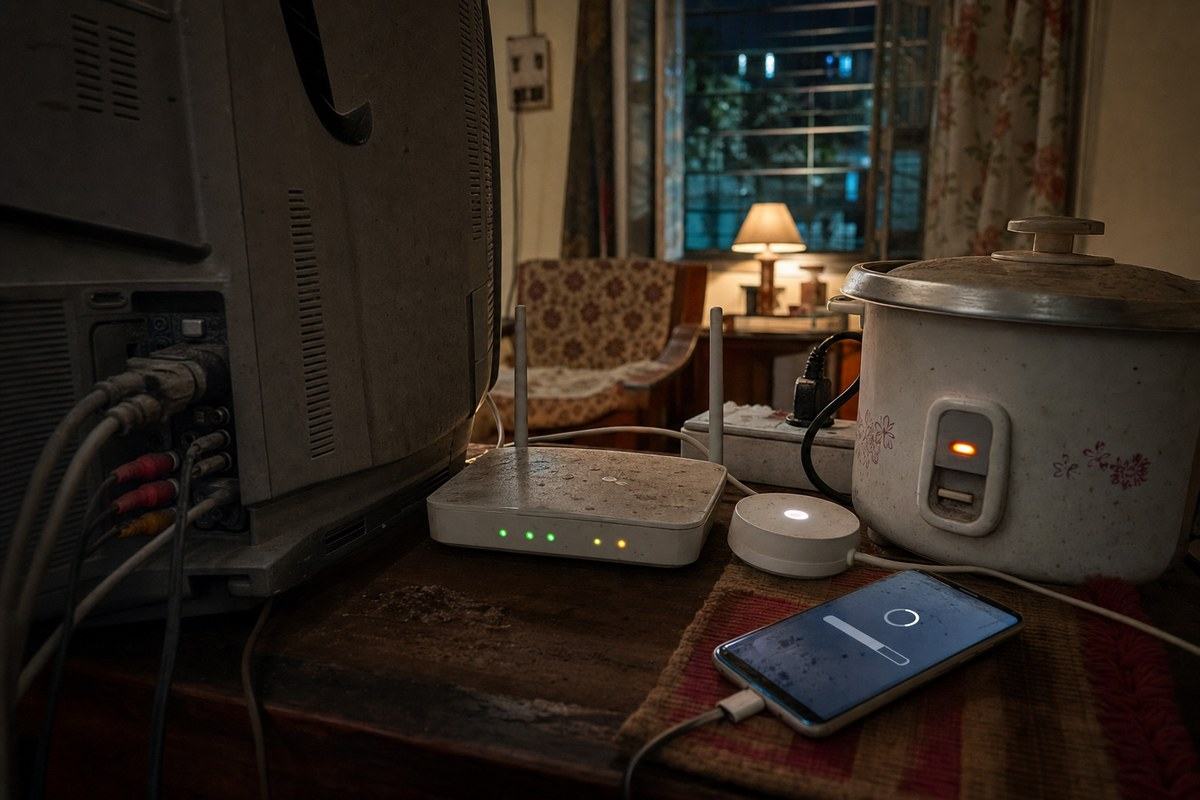
His mouth remained open in one perfect square of digital agony while the loading wheel turned over his forehead like a small, patient halo awaiting sponsorship.
P.S. References
- Historical background on Jantar Mantar and Sawai Jai Singh II.
- “Science News This Week,” Live Science, July 2026, reporting the detection of erythrulose near the Milky Way’s centre.
Word Cloud
Related reading
Selected by shared topics and section, with closer publication dates breaking ties.