ChatGPT Enters Healthcare, and Compliance Is the Easy Part
Uses the speech voice supplied by your browser or device.

The phone is warm against my palm, and the room is warmer. It is late afternoon in Calcutta, the kind of hour when the ceiling fan turns the air in slow, indifferent circles and the light coming through the window has that particular exhausted gold of a city that has been hot for months. I am sitting in a plastic chair that cost ninety rupees, scrolling through a video someone has sent me. The creator is young, confident, speaking directly into the camera from what looks like a co-working space in Bangalore or maybe Gurgaon. He is explaining something he calls a “novel framework” for making content that “cuts through the noise.” He says the word “novel” three times in the first forty seconds. The framework has five steps. The first step is to identify a “pain point that people don’t know they have.” The second is to “reframe an old truth as a new discovery.” The third is to “use contrast to create urgency.” The fourth is to “provide proof that feels scientific.” The fifth is to “package it as a limited secret.”
I watch the whole thing. I am not sure why. The video is well-lit, the cuts are tight, the voice is that particular register of friendly authority that the platforms have trained us to trust. When it ends, I set the phone down on the arm of the chair and look at the wall, which needs repainting. The paint is peeling in a pattern that resembles a map of some country I cannot name. I think about what I have just heard. The creator was not lying, exactly. He was describing something real: the machinery by which old ideas are made to look new, by which familiar knowledge is dressed in fresh language and sold back to us as revelation. He was, in a sense, giving away the game. But the game itself is what troubles me. Not the trick, but the necessity of the trick. The fact that in order to be heard at all, a person must pretend that what they are saying has never been said before.
I get up and walk to the kitchen for water. The tap runs brown for three seconds before it clears. I fill a steel glass and stand at the window, looking down at the lane. A man is selling guavas from a cart. A scooter passes, its horn a single irritated beep. The ordinary sounds of a city that has been doing more or less the same things for centuries. Somewhere in this city, a dentist is trying to explain to a patient why flossing matters. Somewhere, an accountant is reconciling books that will determine whether a small business survives another quarter. Somewhere, a healthcare IT worker is trying to make two hospital systems talk to each other, which is a problem of plumbing more than poetry, and the solutions are tedious and exacting and absolutely necessary. None of this will appear in a viral video. None of it can be packaged as a “framework.” The work is too slow, too specific, too resistant to the grammar of revelation.
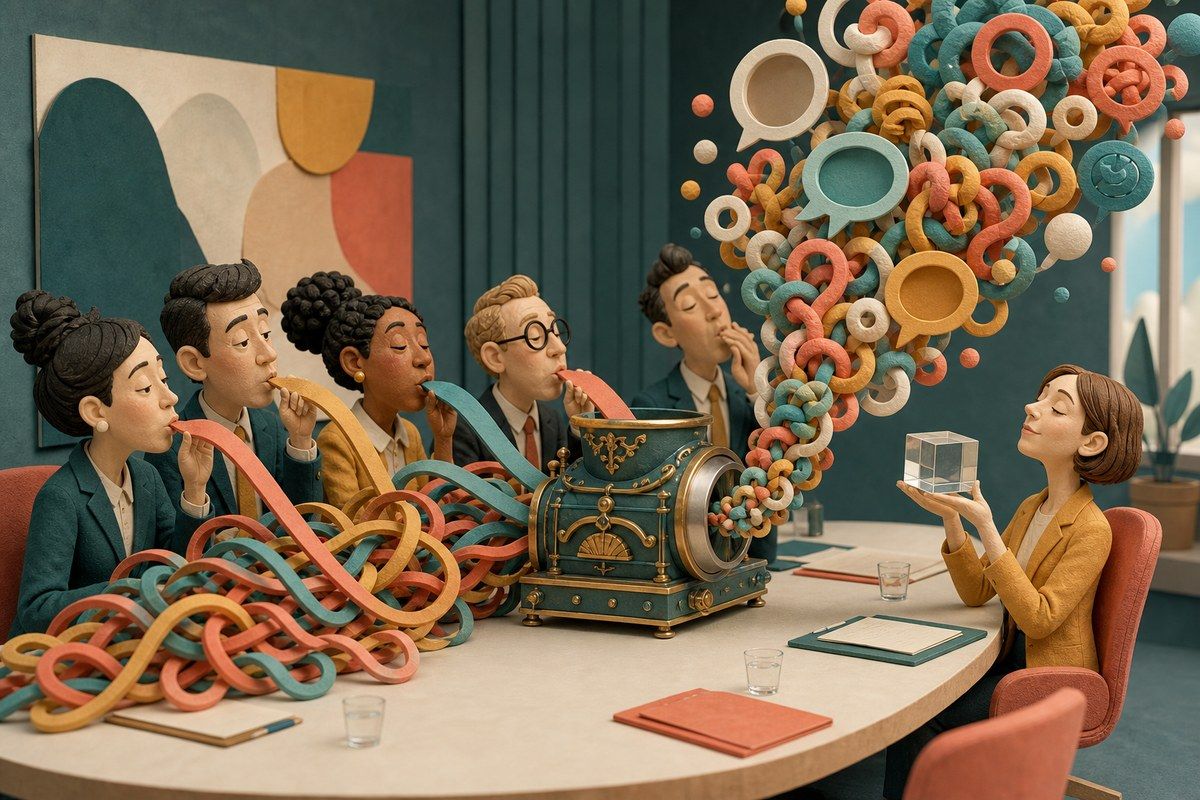
I think of the phrase the creator used: “the illusion of novelty.” It is a good phrase, precise and slightly sinister. It names something I have been noticing for years without having the words for it. The way the internet takes old wine and puts it in bottles that look like they were designed yesterday. The way a principle from Aristotle’s Rhetoric reappears as a “neuroscience-backed persuasion hack.” The way the Stoics’ advice on emotional regulation becomes a “mindfulness framework for entrepreneurs.” The way every diet is new, every productivity system is revolutionary, every self-help book discovers what human beings have known about themselves since before we had writing. The knowledge does not change. Only the packaging changes. And the packaging is not incidental. It is the whole business.
I finish the water and set the glass down. The glass leaves a ring on the windowsill, which I wipe away with my thumb. I am not opposed to good packaging. I understand that a dentist who cannot explain why flossing matters in terms a patient will hear is not a better dentist for his obscurity. I understand that interoperability in healthcare IT is genuinely difficult to explain, and that the people who do this work deserve language that makes their effort legible. There is a difference between clarification and manipulation, and it is not always easy to draw the line. Good teaching often involves finding a new angle on an old truth. Good writing often involves surprising the reader with something they already knew but had forgotten. The problem is not that old ideas are presented freshly. The problem is the systematic misrepresentation of the old as new, the industrial-scale production of false urgency, the conversion of all knowledge into content that must compete for attention in an economy where attention is the scarcest resource.
The creator in the video was not wrong about the mechanics. Contrast framing works because the human brain is wired to notice difference. Recency bias works because we overweight what happened yesterday against what happened a decade ago. Dopamine-driven reward circuits work because evolution shaped us to seek novelty, and the platforms have learned to exploit this seeking with mechanical precision. The science is real. The neuroscience is real. The behavioral economics is real. What is false is the pretense that any of this is new. The pretense that the creator has discovered something, rather than renamed something. The pretense that you, the viewer, are being let in on a secret, rather than being sold a repackaged commonplace at the price of your attention and, eventually, your trust.
I pick up the phone again, not to scroll but to check the time. It is 4:47. The electricity has been stable today, which is not always the case in this part of the city. I think about the word “novelty” itself. It comes from the Latin novus, new. But the word has always carried a hint of suspicion. In the Middle Ages, a “novelty” was often a deviation from established doctrine, something potentially heretical. The Church was wary of novelty because novelty disrupted the continuity of tradition. We have swung to the opposite extreme. Now we are wary of tradition because it does not generate clicks. The word “content” is itself a flattening. It comes from the Latin continere, to hold together. Content was what held a book together, what held a speech together. Now it is anything that fills a feed. The etymology does not determine the meaning, but it traces a path. We have moved from holding things together to filling empty space.
The room is getting darker. I do not turn on the light yet. I think about the historical precedents, because the instinct to dress old truth in new clothes is not new itself. The sophists of ancient Greece sold rhetoric as a teachable skill, and their critics accused them of making the worse argument appear the better. The pamphleteers of the eighteenth century understood that a bold claim traveled farther than a careful one. P. T. Barnum built an empire on the understanding that people would pay to be fooled, provided the fooling was entertaining enough. The patent medicine sellers of the American frontier repackaged folk remedies with new names and testimonials. What is different now is the scale and the speed. The pamphleteer could reach a city. The content creator can reach a planet. The patent medicine seller had to print labels. The algorithm generates infinite variations, tests them in real time, and serves the ones that maximize engagement. The machinery of persuasion has been automated, and the raw material it processes is our own cognitive biases, which it knows better than we know ourselves.
I think about OpenAI’s recent push into healthcare, which I read about this morning in a news alert that arrived while I was drinking my first cup of tea. The company has launched “OpenAI for Healthcare,” a suite of HIPAA-compliant tools for hospitals and clinicians, with partnerships at major institutions like Boston Children’s Hospital and Cedars-Sinai. They have also announced “ChatGPT Health,” a consumer-facing app that lets users upload medical records and receive personalized health insights. The press release is full of the right words: “enterprise-grade,” “clinical validation,” “responsible AI.” The company has worked with 260 physicians across 60 countries. The model has been evaluated on physician-led benchmarks. The data will not be used for training. All of this sounds careful and serious, and some of it probably is. But I notice the architecture of the pitch. The problem is framed as urgent and unprecedented: “The current healthcare system is under unprecedented pressure.” The solution is framed as a breakthrough: “AI in healthcare is one of the fastest-growing enterprise markets.” The old challenges of medical documentation, diagnostic support, and patient communication are presented as if they have never been addressed before, as if the decades of work in health informatics, clinical decision support, and electronic medical records did not exist. The technology is not nothing. GPT-5.2 may well help a rural doctor in Montana draft notes faster, or help a patient in Indonesia recognize the warning signs of a stroke. These are real possibilities. But the packaging insists on novelty where there is mostly iteration, on revolution where there is mostly incremental improvement. The healthcare system does not need to be “disrupted” so much as it needs to be maintained, funded, and made to work for people who are not wealthy. The boring truth is that most of healthcare is not a technology problem. It is a logistics problem, a labor problem, a political problem. The AI can help with the paperwork, but it cannot reopen a closed rural hospital. It cannot hire more nurses. It cannot make insurance companies stop denying necessary care.
I stand up and turn on the light. The bulb flickers once, then holds. The room looks the same in electric light as it did in the fading daylight, only flatter. I think about my own work, which involves software and systems and the kind of thinking that does not photograph well. I have watched colleagues rename old design patterns with new acronyms, not because the patterns had changed but because the old names no longer generated conference talks. I have seen “microservices” become “cloud-native architecture” become “platform engineering,” each rebranding carrying a faint whiff of the same old truth: that distributed systems are hard, that boundaries matter, that complexity has a cost. The renaming is not entirely cynical. Sometimes a new name clarifies a shift in emphasis. Sometimes it helps a new generation of practitioners find their way. But often it is simply the machinery of attention at work, the need to appear current, to avoid the humiliation of being ignored. I understand this need. I have felt it. There is something degrading about doing careful work that no one notices, about watching louder, shallower voices capture the conversation. The temptation to turn your craft into a trick, the trick into a framework, the framework into a product, is not a moral failing. It is a structural pressure. The platforms reward it. The metrics reward it. The economy of attention makes patience look like failure.
I sit back down in the plastic chair, which creaks. The phone has gone to sleep, its screen dark. I think about the difference between a trick and a craft. A trick works once, or a few times, and then the audience sees through it. A craft works because it is true, because it respects the material, because it understands that some things cannot be rushed. Dentistry is a craft. Accounting is a craft. Healthcare IT is a craft. Public administration is a craft. Maintenance is a craft. These are the fields that the internet finds boring, because they do not move fast, because their truths are accumulated slowly, because their practitioners do not speak in hooks and frameworks. But these fields contain some of the hardest truths about how societies actually function. A bridge stays up because engineers checked the math. A patient gets the right medication because a pharmacist read the label. A government program reaches the people it was meant for because a clerk filled out the form correctly. None of this is viral. None of it is a “life hack.” All of it is necessary.
The creator in the video said one thing that stuck with me, probably because it was the most honest thing he said. He admitted that he was tired. That he had been making content for three years and that the algorithm kept demanding more novelty, more urgency, more contrast. That he was running out of ways to say the same thing. I believed him. I think most people in that world are tired. The content machine does not rest. It consumes its own producers, demanding ever-fresh faces, ever-sharper hooks, ever-more-dramatic reframings of the same limited stock of human wisdom. The creators are not villains. They are workers in an attention economy that treats them as disposable as it treats the rest of us. The real villain, if there is one, is the system itself: the platforms, the metrics, the feedback loops that have learned to exploit our cognitive vulnerabilities with the efficiency of a predator that has studied its prey for millennia.
I think about the word “proof.” It comes from the Latin probare, to test, to prove, to make good. In mathematics, a proof is a demonstration that something must be true given certain axioms. In law, proof is the evidence that persuades a jury. In the content economy, “proof” has become something else: a screenshot, a testimonial, a graph with no axis labels, a citation to a study that may or may not say what the creator claims it says. Pseudo-evidence is easier to produce than real evidence, and in the rush of the feed, it is often indistinguishable. The creator in the video recommended using “proof that feels scientific.” Not proof that is scientific. Proof that feels scientific. The distinction is everything. It is the difference between clarification and manipulation, between respecting your audience and exploiting their trust. And the tragedy is that this exploitation works. It works because most people do not have the time or training to verify every claim. It works because the platforms optimize for engagement, not accuracy. It works because the human brain is lazy, and a feeling of certainty is easier to achieve than actual understanding.
The evening has arrived without my noticing. The sounds from the lane have changed: fewer scooters, more voices, the clatter of a kitchen being opened for dinner preparation. Someone is playing a Hindi film song from a cheap speaker, the melody familiar but the words blurred by distance and distortion. I think about the ordinary adult judgment that this system erodes. Not expert judgment, which has its own problems, but the plain common sense of a person who has lived long enough to recognize a pattern, to smell a rat, to know that if something sounds too good to be true it probably is. The internet, in its constant repackaging of the old as new, trains us out of this judgment. It teaches us to distrust our own memory, to doubt that we have heard this before, to believe that the latest framework really is different from the last one. It turns us into perpetual beginners, always starting over, always feeling the thrill of discovery without the depth of understanding. And the cost of this is not just wasted time or money. The cost is a kind of learned helplessness, a sense that no one can be trusted, that all expertise is performance, that the world is a hall of mirrors where every reflection claims to be the original.
I do not have a solution. I am not sure there is one, at least not at the scale of the problem. Individual resistance is possible, even necessary: reading old books, learning the history of your field, refusing the hook, closing the tab, accepting that some truths are boring and that their boredom is part of their durability. But individual resistance is not a policy. It does not change the algorithm. It does not pay the creator’s rent. It does not solve the collective action problem by which everyone would be better off if everyone slowed down, but no one can afford to slow down first.
I think about the Calcutta afternoon I am living in, which will not appear in any content strategy. The heat, the plastic chair, the ceiling fan, the brown water from the tap, the peeling paint on the wall. These are not metaphors. They are just the conditions of a life. The phone in my hand is a marvel of engineering, and I use it every day, and I am not naive about its costs. But there is something to be said for the stubborn materiality of this room, this city, this body that sweats and tires and needs water and sleep. The internet would like to convince us that all of life is content, that every experience is raw material for a post, that the offline world is merely a less efficient version of the online one. But the offline world has the advantage of being real. The guava seller does not need a hook. The scooter does not need engagement. The afternoon does not need to be novel. It just is, and then it passes, and that is enough.
I set the phone down again, this time on the table, face down. The screen is dark. The room is quiet except for the fan and the distant music. I do not know what I will do with the rest of the evening. Probably something ordinary: eat, read, sleep, wake up tomorrow and do more or less the same things. The creator in the video will make another video. OpenAI will announce another healthcare partnership. Someone will discover that drinking water is good for you and package it as a “hydration framework.” The machinery will continue. And I will continue to sit in this chair, in this heat, trying to remember what I knew before the internet told me to forget it.
The paint on the wall is still peeling. The map of the unknown country is still there. I look at it for a while, and then I stop looking, because there is nothing to solve, no revelation to extract, no content to create. It is just a wall in a room in a city that has been hot for months, and that is, for the moment, enough.
P.S. References: OpenAI, “Introducing OpenAI for Healthcare,” January 8, 2026. OpenAI Help Center, “ChatGPT for Healthcare.” OpenAI Help Center, “HIPAA Eligible Products and Functionality.” OpenAI, “Business Data Privacy, Security, and Compliance.”
Healthcare IT consulting
Working through a difficult clinical data or interoperability problem?
I advise on HIE and EHR architecture, HL7/FHIR interoperability, clinical data migration, terminology, analytics, and AI data readiness.
Word Cloud
Related reading
Selected by shared topics and section, with closer publication dates breaking ties.