Human Rights, Oh What a Joke!
Uses the speech voice supplied by your browser or device.

Acronyms:
NGO — Non-Governmental Organization, a private or nonprofit organization that often works in welfare, rights, development, advocacy, or public-interest fields.
UN — United Nations, the international organization formed after the Second World War to promote peace, cooperation, human rights, and international law.
Human rights usually arrive in brochures, which is the first clue that something has gone badly wrong.
Nothing truly urgent comes in glossy paper. Hunger does not come laminated. Fear does not arrive with a smiling child on the cover. A lathi charge does not pause to check whether the font is inclusive. Yet human rights, that grand moral umbrella under which all of us are supposed to stand, keep appearing in conference folders, donor reports, government campaigns, NGO booklets, school posters, and those large banners where a woman in a clean sari holds a clay pot and looks as if she has personally solved democracy by fetching water.
There is always an old man too.
He stares nobly into the distance, chin tilted, eyes moist, as if he has just understood liberty, equality, and mild constipation in the same afternoon.
Human rights, we are told, are universal.
Lovely.
So is dust.
So is stomach acid.
So is the ancient talent of powerful men to discover, at exactly the right moment, that your rights are temporarily inconvenient.
That word “temporarily” is a small masterpiece. It is like the rubber band on a packet of stale muri. It stretches forever. Temporarily detained. Temporarily silenced. Temporarily evicted. Temporarily ignored. Temporarily moved for development. Temporarily told to come tomorrow. Tomorrow, in our part of the world, is not a date. It is a drainage system into which hope quietly disappears.
You have the right to speak, provided your speaking does not irritate anyone important.
You have the right to protest, provided you do not block traffic, disturb peace, offend sentiment, damage investment, confuse schoolchildren, embarrass the government, worry the police, attract cameras, or cause one prosperous gentleman in an air-conditioned car to lower his window and say, “What is this nuisance?”
You have the right to dignity, though dignity is currently out of stock. Please check again after the next election, the next war, the next inquiry commission, the next court date, the next five-star seminar, or the next panel discussion where three well-fed men and one exhausted woman say “grassroots” into microphones while eating chicken tikka with tiny forks.
The great trick of modern civilization is not that it denies human rights.
No.
That would be crude. Too honest. Too village strongman. The modern system is far more polished. It does not say, “You have no rights.” It says, “Your rights are under active consideration.”
This is how cruelty got a haircut and learned PowerPoint.
In the old days, the tyrant wore boots. Now he may wear a blazer, a lanyard, and rimless spectacles. He does not always shout. Sometimes he nods thoughtfully. He says due process. He says national interest. He says security concerns. He says procedural limitations. He says stakeholder consultation. He says the matter is sub judice. He says many things.
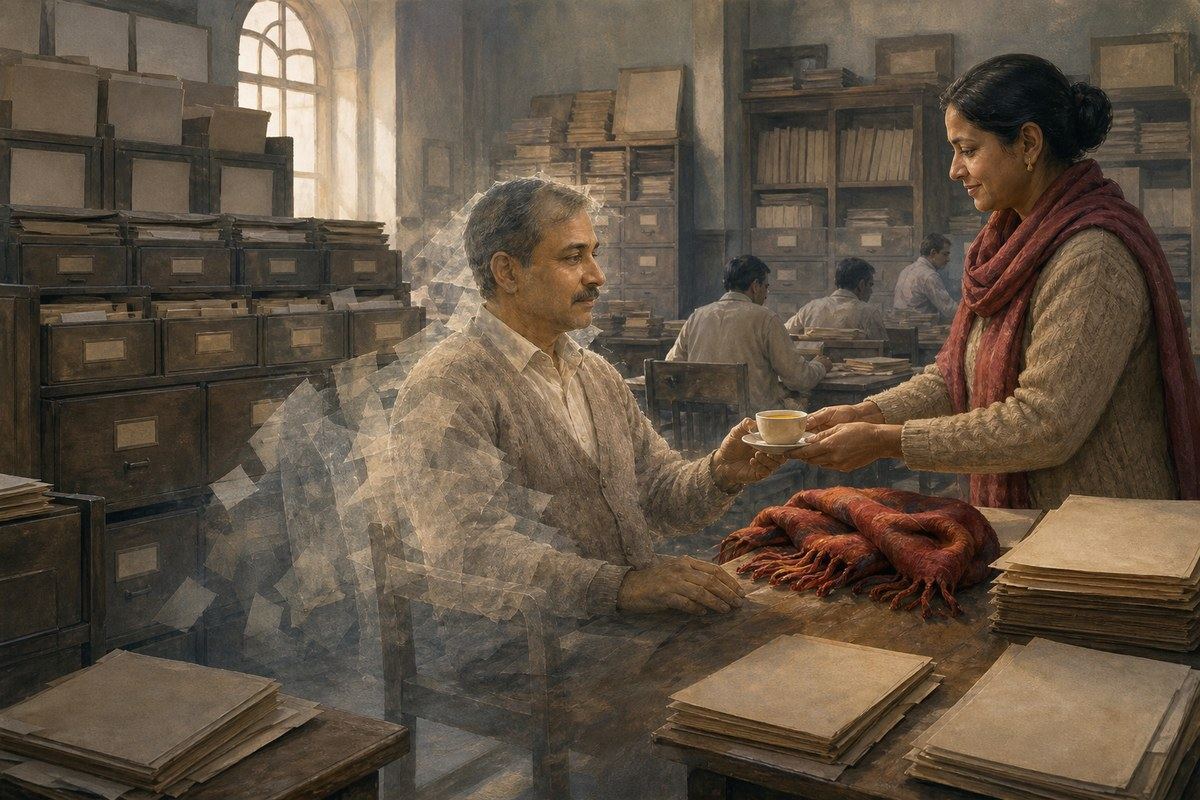
Meanwhile, the poor man waits outside the office with a folder under his arm, sweating into his shirt.
I know that folder. Every lower-middle-class Bengali knows that folder. It has plastic flaps, a broken button, two photocopies of everything, one original that must not be lost, and a faint smell of panic. It contains proof that you exist, proof that you existed last year, proof that your father existed, proof that your electricity bill exists, and proof that some clerk somewhere once spelled your name correctly by accident.
Rights, in theory, are born with you.
Rights, in practice, often require photocopy, address proof, signature, stamp, queue, patience, and a willingness to be treated like a suspicious parcel.
If you have no address because your hut was demolished, your basti was cleared, your land was acquired, your village was flooded, your roof was blown away, or your landlord changed the lock while you were at work, then naturally you must provide proof of residence.
This is not bureaucracy.
This is comedy written by a sick goat.
The brochure says every human being has dignity.
The counter says lunch time.
And this is where the joke begins to bite.
Human rights are not silly. That is the terrible part. They are among the few genuinely decent ideas our species has produced after centuries of stabbing, taxing, enslaving, invading, burning, converting, classifying, and generally behaving like monkeys who found a sword in a cupboard. The idea that every person has value simply because that person is human is not soft. It is explosive. It is dynamite wrapped in polite language.
It says the king is not divine.
It says the police are not owners of your body.
It says caste is moral sewage.
It says women are not furniture.
It says the worker is not a machine with hunger attached.
It says the prisoner remains human.
It says the minority does not need permission from the majority to breathe.
No wonder power loves human rights in speeches and hates them in real life.
A right that cannot inconvenience power is not a right. It is decoration.
A right that works only when the minister is in a good mood is not a right. It is hospitality.
A right that must be begged for is not a right. It is charity wearing perfume.
And perfume, as every Calcutta bus passenger knows, has limits.
The problem is not merely wicked rulers, though we have never had a shortage, and the factory appears to be producing fresh stock. The deeper problem is that institutions learn to digest moral language. They swallow words like dignity, justice, equality, freedom, participation, inclusion, empowerment, and accountability, then burp out a report.
Nothing changes except the cover design.
This happens everywhere. A government can say human rights. A corporation can say human rights. A university can say human rights. A police department can say human rights. An empire can bomb a country and say human rights with a straight face, which is a facial achievement of almost yogic difficulty.
The word does not save anyone.
The test is always street-level.
Can the weak say no to the strong and survive?
Can a poor woman enter a police station without being laughed at, lectured, or threatened?
Can a worker ask for wages without being replaced by another desperate worker?
Can a citizen criticize power without being marked, followed, raided, mocked, or quietly made unemployable?
Can a patient in a government hospital be treated as a person and not as a crowd management problem with a pulse?
Can a child eat before the slogan eats first?
If not, the brochure is lying.
Or worse, it is telling a beautiful truth while hiding the ugly machine that prevents the truth from happening.
I am not saying this from some heroic platform. I am a 51-year-old single Bengali man in the southern boondocks of Calcutta, where the ceiling fan makes a noise like a tired helicopter and my consulting income arrives with the confidence of a shy pigeon. I am not built for barricades. Some mornings I am barely built for tea. The world sends revolutions. I search for the clean cup.
But even from a small rented room, you can smell varnish.
Public language is often varnish. It makes rotten wood shine.
Human rights have become the good crockery of civilization. Brought out for guests. Photographed under warm lights. Never used in the kitchen.
In the kitchen, where the real human being lives, rights become smaller. They shrink in the police station. They lose weight in the hospital corridor. They turn pale in the ration shop. They vanish in front of a man with a stamp, a party flag, a gun, a ledger, a camera, or simply the power to delay your file until your grandchildren develop knee pain.
And then comes resilience.
Ah, resilience.
That glorious word used by comfortable people when uncomfortable people refuse to die on schedule.
The migrant walking home is resilient. The widow fighting for pension is resilient. The hawker chased from the pavement is resilient. The mother feeding two children with one egg is resilient. The old man waiting outside a hospital from dawn is resilient. The unemployed young man sending five hundred applications into the digital void is resilient. The poor are always resilient, because if they were not, the rest of society would have to admit something very unpleasant over breakfast.
Resilience is often admiration with its hands safely in its pockets.
It says, “How inspiring that you survived what we allowed to happen.”
This is why human rights must be dragged down from the banner and made to sit on the wooden bench beside the actual person. Not the symbolic person. Not the brochure person. Not the clay-pot woman. The real person. Sweating, frightened, underpaid, overcharged, misnamed, unheard, and carrying a folder full of documents that prove everything except his pain.
There is a strange little test I use.
When someone powerful praises rights, watch what happens when an ordinary person uses one.
Not quotes one.
Uses one.
The mood changes immediately. The smile stiffens. The voice cools. The air grows official. Suddenly there are procedures. Suddenly there are limits. Suddenly the same right that was universal five minutes ago becomes complicated, sensitive, premature, irresponsible, politically motivated, legally uncertain, administratively difficult, and bad for public order.
There it is.
That is the trapdoor.
Human rights are loved as long as they remain nouns. Freedom. Equality. Dignity. Justice.
They become dangerous when they turn into verbs.
Speak.
Refuse.
Demand.
Organize.
Question.
Leave.
Return.
Resist.
That is when the brochure catches fire.
Still, sneering at human rights is not wisdom. It is laziness wearing dark glasses. The fact that hypocrites use a good word does not make the word bad. Hypocrites also use soap. We do not therefore recommend filth.
Human rights matter because they force power to pretend. Pretending is not justice, but it is not nothing. A printed promise gives the weak a handle. A declaration gives the accused a sentence to throw back. A constitution, even a bruised one, gives the citizen a small stone to place in the shoe of authority.
“Here,” the citizen can say. “You wrote this. Now explain the beating. Explain the hunger. Explain the eviction. Explain the silence. Explain why your universal principle disappears exactly where the poor begin.”
That is why power prefers ceremonies.
Ceremonies are safe.
A ceremony does not ask for bail.
A ceremony does not demand wages.
A ceremony does not file a complaint.
A ceremony does not stand outside the locked gate and refuse to move.
A right becomes real only when it leaves the brochure and enters the messy places where respectable people do not like to look. The police van. The factory floor. The school admission line. The ward bed. The pavement stall. The widow’s pension office. The prison appeal. The demolished neighborhood. The woman’s decision to walk away. The worker’s demand to be paid. The citizen’s refusal to lower his voice.
Until then, human rights remain what they too often are.
A framed certificate in a burning house.
Very elegant.
Very laminated.
Very pending.
Word Cloud
Related reading
Selected by shared topics and section, with closer publication dates breaking ties.