How fingerprints form
How do ridges on a fingertip become an arch, a loop or a whorl?
Change where ridges begin and how far apart they grow. Watch a synthetic fingerprint take shape.
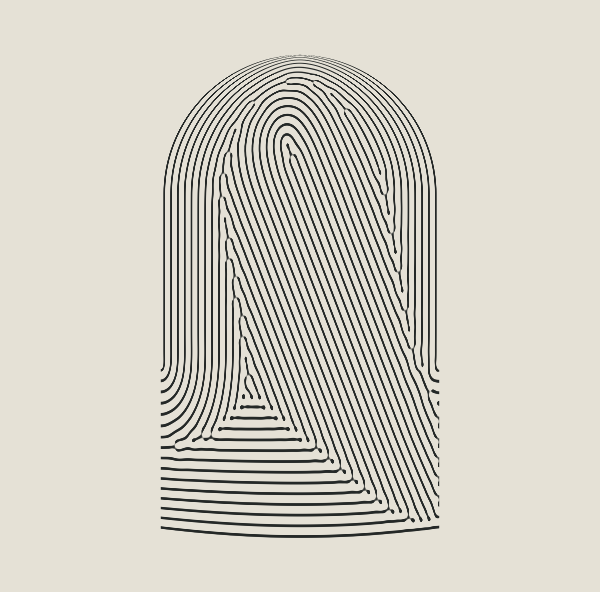
A synthetic fingerprint from a simplified model of ridge formation.
Try this
Start with Loop and keep the current print for comparison. Move Ridge spacing towards Wider. The fingertip stays the same size, while fewer ridges fit inside it. Reset, then choose New variation. Look for small changes under the same starting configuration.
Why ridges form
One signal reinforces activity nearby and produces an inhibitor that spreads farther. Under the right conditions, some repeating disturbances grow while uniform changes die away. The spacing between ridges comes from this interaction.
Starting locations and times influence how those repeating ridges meet. Changing the crease onset can change the arrangement even when the signals spread at the same rates as before.
The equations
The activator u and inhibitor v follow the saturated Gierer–Meinhardt equations on a curved fingertip surface:
∂u/∂t = r(a + u² / [v(1 + Ku²)]) − μu + s²ΔSu
∂v/∂t = u² − νv + s²DΔSv
a gives basal activation, r sets the production rate, and K limits self reinforcement at high activator levels. μ and ν set the rates at which the signals decay. u² produces inhibitor. ΔS is the surface Laplacian, which describes how signal moves between neighbouring points on the fingertip. The inhibitor diffuses D times as fast as the activator.
The reference uses a = K = 0.001, r = 0.75, μ = 0.4, ν = 5.5, and D = 180. Ridge spacing changes s, which scales both diffusion rates. Starting position and variation change the initial state, wave timing changes the crease boundary onset, and fingertip width changes the surface.
How the model works is described in the mathematical appendix. The model uses dimensionless time and length, and the print is a flat projection of the activator field.
How a fingerprint forms
By Suvro Ghosh ·
Checking article narration…
How does a fingertip acquire its closely spaced ridges? And why do those ridges form an arch on one finger, a loop on another, and a whorl on a third?
Start with Loop in the experiment above. Choose Keep for comparison, then move Ridge spacing towards Wider. The fingertip stays the same size. Fewer ridges fit inside it.
Now choose Reset, then New variation. The starting configuration stays the same, but small differences in the initial state can change some of the detail.
Those two comparisons separate questions that are easy to mix together. What sets the distance between neighbouring ridges? What determines their arrangement?
A fingerprint needs answers to both.
Alan Turing considered the first kind of problem in his 1952 paper, The Chemical Basis of Morphogenesis. He showed how substances that react and spread through a system can, under suitable conditions, turn small differences into a repeating spatial pattern. Turing, 1952
Diffusion usually seems to work against this. A drop of ink spreads through water. Its sharp edges disappear. Leave it alone and the concentration becomes more even.
The interesting result comes when spreading happens alongside reactions.
In a useful simplified picture, one signal reinforces activity nearby. It also helps produce another signal that suppresses that activity over a wider distance. A small increase can then strengthen locally while making another increase less likely immediately beside it. Farther away, activity can rise again.
Under the right conditions, this produces a repeated spacing. Raise a signal by the same amount everywhere and it can settle back to its original level. Raise it in patches at certain intervals and the differences can grow. Which intervals grow depends on the reaction rates as well as how fast the signals spread.
The computer follows these rules at many points across the simulated fingertip. At each point, it calculates what the local reactions change and what arrives from neighbouring points. Then it repeats the calculation.
The ridges in the display come from that evolving signal. Their spacing is part of the calculation. Switch to Signal to see the same activity before it is turned into dark ink.
In developing fingers, James Glover and colleagues found that WNT, EDAR and BMP signalling helps establish the ridge pattern. Ridges form in waves that spread from distinct regions. Where these waves meet helps determine the overall arrangement. Glover and colleagues, 2023
This is where the fingertip itself matters.
The same local rules can produce different arrangements when the available surface, the places where patterning begins, or the timing of those beginnings changes. The study’s model gives each of those influences a place in the calculation. Mathematical appendix and reference models
The Arch, Loop and Whorl choices load different starting configurations. An arch carries ridges across the fingertip with a rise through the middle. A loop turns back towards the side from which it came. A whorl has ridges arranged around a centre. Those names describe the overall flow of the ridges. The settings give you a way to explore how that flow develops.
Try moving Starting position in the loop preset. Watch where the developing ridges meet. Then return to the reference setting and change Wave timing, which adjusts when patterning begins near the crease.
Change one thing at a time. Otherwise, it becomes difficult to tell which change did what.
Genes influence fingerprint patterns. Research has linked variation in fingerprint type to genes involved in limb development and to aspects of hand and finger proportions. A pattern develops through a process within that growing tissue. Small differences along the way can affect its detail. Li and colleagues, 2022
The New variation button explores a much narrower version of that idea. It changes small initial differences in this model while keeping the other settings fixed. Replay formation repeats the same beginning.
The print is synthetic. The model follows two signals on a fixed surface, and the image shows that surface projected onto a flat view. Its distances and times are in model units. Real ridges develop in tissue that changes shape as it grows.
Pause while the first ridges are appearing. Follow a small region as the neighbouring pattern develops. Then try a different starting position.
The finished print contains a great deal of detail. Watching it form lets you examine how local interactions, repeated across a small surface, can produce that detail.
Quick reference and FAQ
Local interactions between two spreading signals help set the spacing of fingerprint ridges. Where and when the ridges start to form helps determine their arrangement.
Word Cloud
Related reading
Selected by shared topics and section, with closer publication dates breaking ties.

Comments
Read the conversation or leave a thought for review. Comments load when this section is in view.