The Negotiable Serf
Uses the speech voice supplied by your browser or device.

I am fifty-one years old, a thinking meat-sack of neurons that has not yet completed its journey toward the grand compost heap of irrelevance, and I write this knowing full well that the void does not read, the void does not care, the void scrolls past my carefully arranged syllables with the same enthusiasm a Calcutta street dog reserves for a vegetarian thali. Yet here I am, fingers greased with the oily residue of midnight mania, tapping out another monument to my own ungovernable persistence—a persistence that shares more DNA with a goat that has eaten a textbook on differential equations than with anything resembling human dignity.
The goat, you see, cannot be taught. The goat chews, the goat shits, the goat chews again. This is my curriculum vitae in distilled form. Fifteen years I spent in the United States, that picture is me in my Veterans Affairs office somewhen a long time back, buried in healthcare research, swimming through spreadsheets of mortality and morbidity, and what did I learn? That the American healthcare system is a magnificent Rube Goldberg machine designed to turn human suffering into quarterly earnings, and that I, the negotiable serf, was merely a particularly articulate cog in that digestive apparatus. Negotiable, because at fifty-one, with a brain that periodically decides to redecorate its own neurochemistry without consulting the leaseholder, I am now bargain-bin merchandise in the great garage sale of global employment. “Experienced researcher, slightly cracked, will work for validation and the occasional sandwich.”
But the bipolarity, that gurgling, burbling, flatulent companion that wakes me at three in the morning with the urgent news that I have finally understood the topology of consciousness or the secret grammar of prime numbers—this is both my tormentor and my muse. It is the uninvited dinner guest who arrives at midnight, eats all the logical furniture, and leaves me with a house full of half-built intellectual cathedrals and a refrigerator empty of coherent career prospects. And still I write. Still I calculate. Still I explain to the indifferent air why the word “algebra” comes from the Arabic al-jabr, meaning “reunion of broken parts”—because medieval mathematicians understood, better than my last three therapists, that the human mind is fundamentally a collection of fragments held together by duct tape and dopamine.
Al-jabr. Reunion of broken parts. I whisper this to myself at four in the morning while my prefrontal cortex performs unauthorized fireworks, because there is something obscene and beautiful in the fact that the mathematics I loved as a child, the mathematics that made me feel less alone in a Calcutta classroom where I was the weird kid who actually enjoyed proofs, was named by a ninth-century Persian scholar named Muhammad ibn Musa al-Khwarizmi—a man who would not recognize the word “algorithm” that now devours our attention spans like a ravenous, silicon-based tapeworm. The etymology is a thread, and I am the idiot pulling it, unraveling the sweater of civilization to see how we got here, thread by tangled thread.
I write about science because science is the only religion that admits it is wrong, the only cathedral built on the foundation of “we thought this, we tested it, we were gloriously, magnificently mistaken, and here is the correction.” The scientific method is not a march toward truth; it is a stumble, a bumble, a pratfall in the general direction of slightly-less-wrongness, and I find this deeply comforting. It means that every fat textbook, every impenetrable paper, every equation that looks like Sanskrit written by a drunk spider is merely the fossilized record of human fumbling. Fumbling! The greatest minds in history were professional fumblers, and we have the audacity to make their fumbles look like divine revelation by wrapping them in notation so dense it could stop a bullet.
Consider: . Three symbols, one number, and the entire universe bends its knee. But behind those symbols lies a decade of Einstein’s wrong turns, his false starts, his letters to friends confessing that he had perhaps, maybe, possibly made an error that rendered his previous three papers into expensive kindling. The equation is a tombstone marking where a thousand failed ideas were buried so that this one might breathe. And we teach it as if it fell from the sky, pristine and inevitable, rather than emerging from the same messy, halitosis-ridden process that produces my blog posts at three in the morning.
I am not employable, not really. I am a fifty-one-year-old man with a brain that cannot be trusted to maintain consistent neurotransmitter levels, a CV that reads like a cautionary tale, and a writing habit that produces content for an audience of mathematically precise zero. The world wants young, cheap, and chemically stable. I offer old, expensive, and neurologically improvisational. And yet the topics keep gurgling up, like acid reflux of the intellect, demanding to be announced to the apathetic void. The void does not read. The void does not care. The void is busy watching a seventeen-year-old explain quantum mechanics in sixty seconds while an algorithm, descended from al-Khwarizmi’s broken parts, decides what the void should want next.
And still. And yet. And therefore.
I write because the alternative is to admit that the goat has finally learned its lesson, that the chewing has stopped, that the textbook has been digested into silence. I write because my brain, for all its traitorous chemistry, is still not completely defunct, still capable of the electric astonishment that a line of mathematics can describe the curvature of spacetime, that a Greek word like atomos—uncuttable, indivisible—could launch two thousand years of inquiry that ended with us splitting the uncuttable and discovering that the universe is mostly empty space pretending to be solid.
The world doesn’t like mathematics. The world doesn’t like science. The world likes certainty, likes comfort, likes the warm blanket of ignorance that says “someone else understands this, and that is sufficient.” But I am the goat, and the goat does not do sufficient. The goat chews, the goat shits, the goat chews again, and somewhere in that endless cycle of consumption and elimination, something like thought emerges, something like persistence, something like the stubborn, idiotic, magnificent refusal to shut up even when every metric, every analytics dashboard, every echoing silence of the internet says: no one is listening.
No one is listening. I know this. I have known this for every post, every equation, every etymological excavation. And still I persist, the negotiable serf, offering my fractured algebra to the void, hoping that somewhere, in the reunion of these broken parts, something whole might briefly, impossibly, shine.
Asato ma sad gamaya—from the unreal, lead me to the real. A Sanskrit prayer, because even a goat needs its mantras. Even a serf, negotiable and unnoticed, needs to believe that the chewing matters.
P.S. References: al-Khwarizmi, Muhammad ibn Musa. Al-Kitab al-Mukhtasar fi Hisab al-Jabr wal-Muqabala (c. 820 CE). Einstein, Albert. “Does the Inertia of a Body Depend Upon Its Energy Content?” Annalen der Physik, 18:639, 1905. Brihadaranyaka Upanishad, 1.3.28.
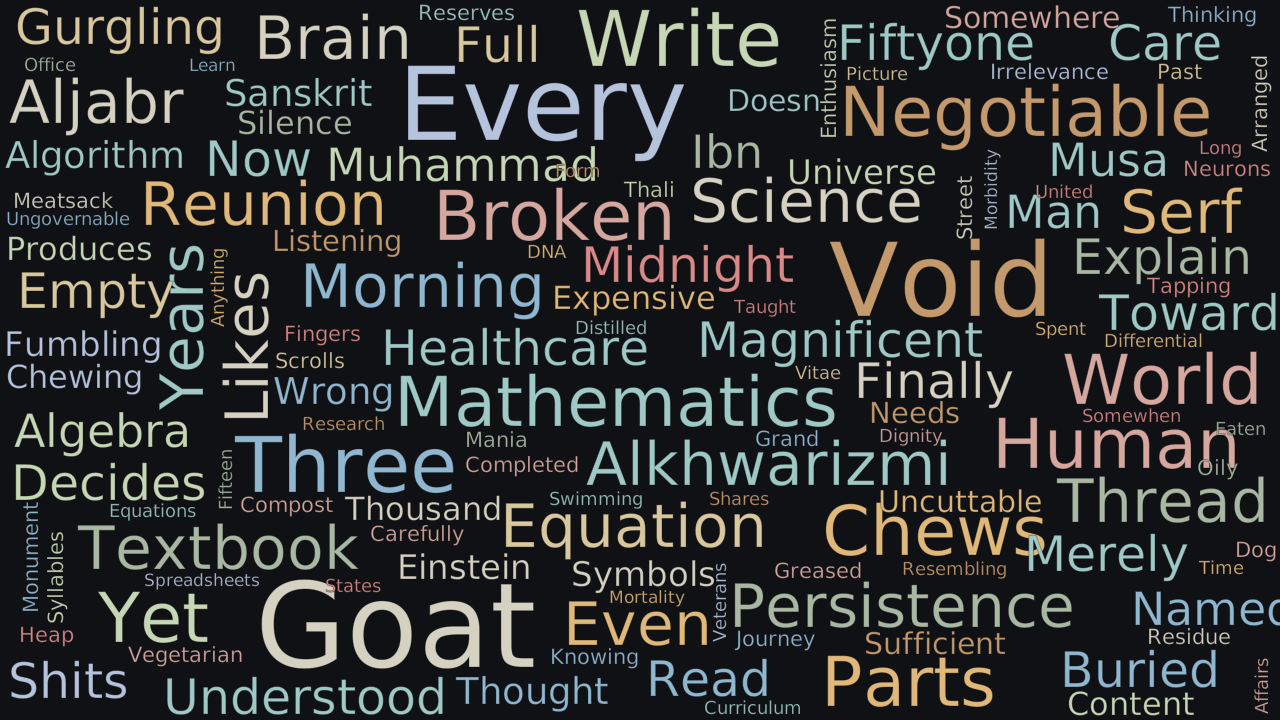
Word Cloud
Related reading
Selected by shared topics and section, with closer publication dates breaking ties.