Holy Allergy
Uses the speech voice supplied by your browser or device.

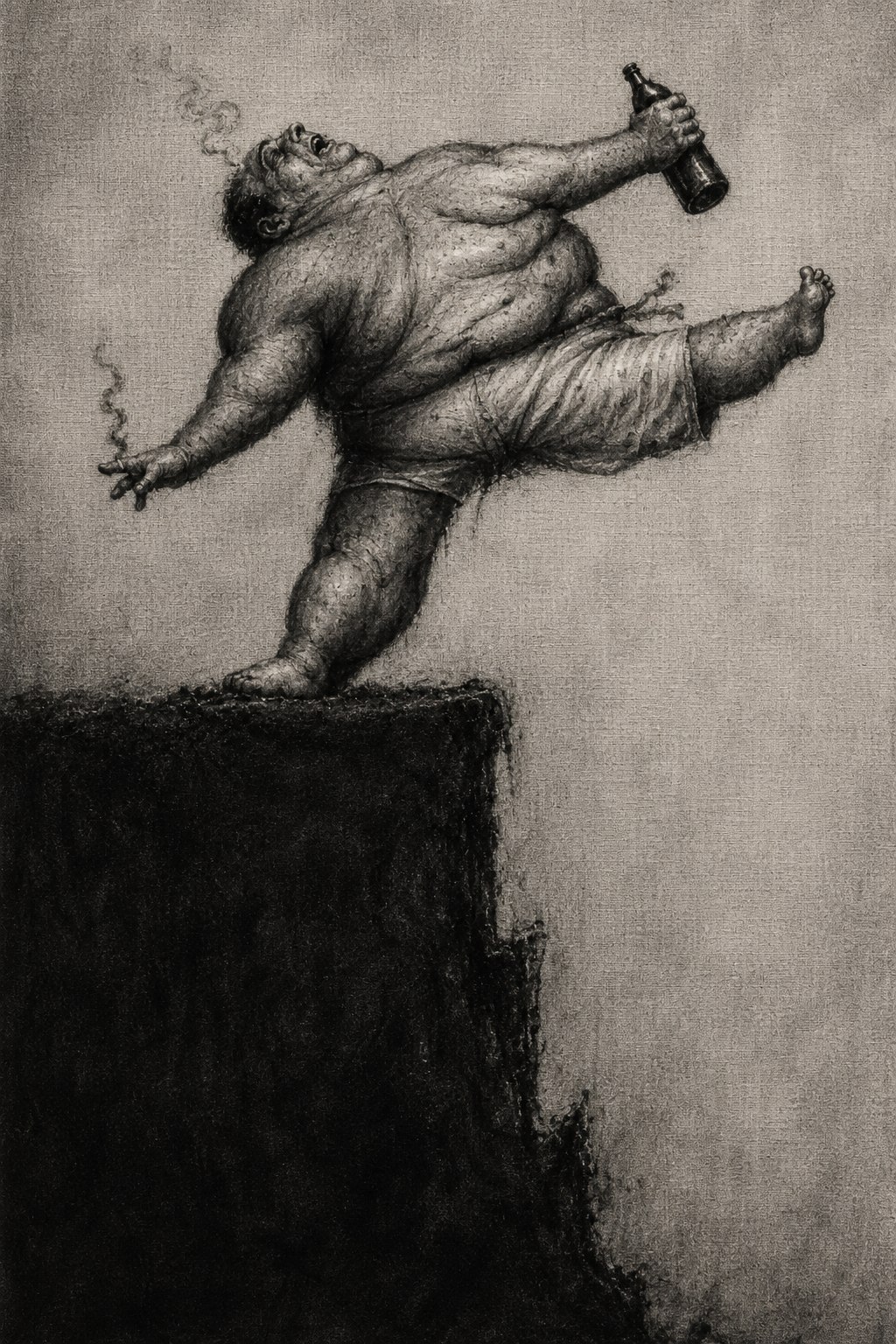
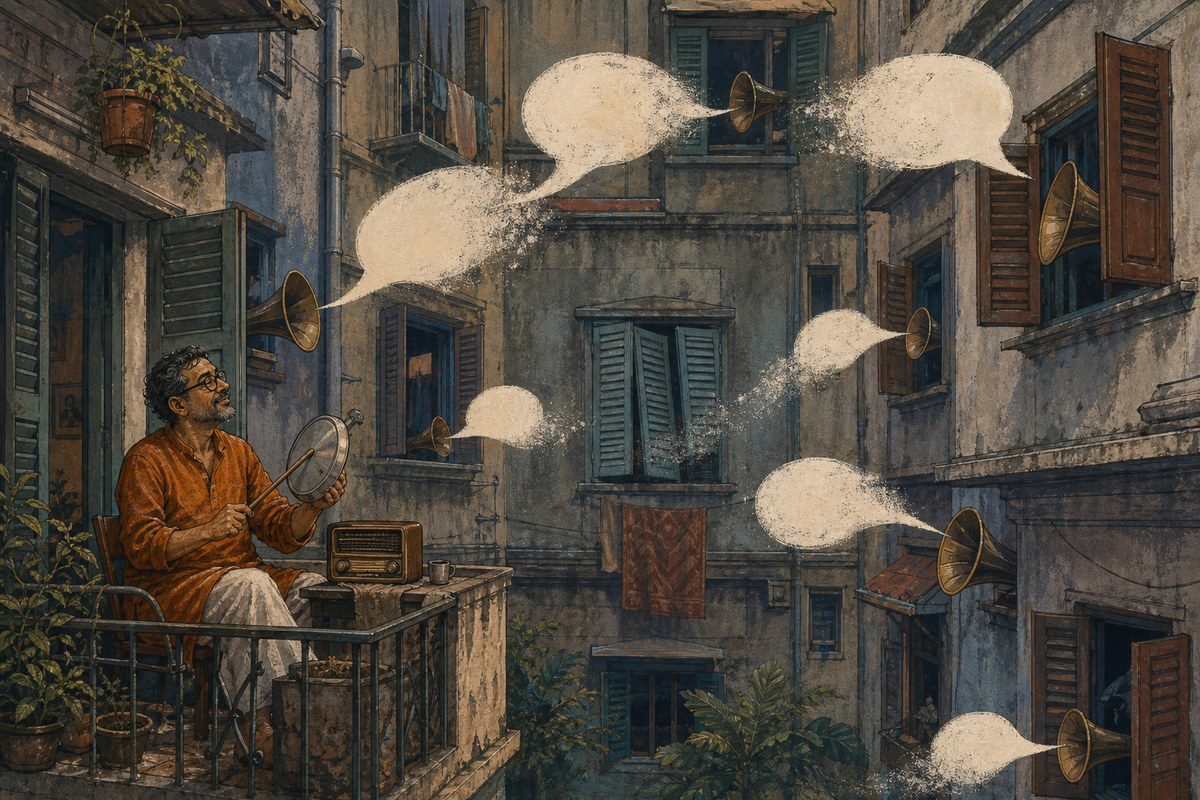
I have an allergy for anything holy. Not the mild sort that makes you sneeze into your elbow like a polite citizen of the microbial republic, but the full-blown anaphylactic kind, the sort where your throat swells shut and your eyes water and you find yourself gasping for the sweet oxygen of doubt while surrounded by a cloud of incense and certainty. Holy. Hole-y. Full of holes. The word itself comes from Old English hālig, which meant whole, uninjured, intact—which is hilarious because the holier something claims to be, the more holes I find in it, like a Swiss cheese wearing a mitre.
The super totally holy must look down upon us—if it looks at all, which is doubtful, given the general management style of the universe—and think: these gullible bastards. These credulous, trembling, kneeling, praying, donating, flagellating, guilt-ridden, hope-addicted, fear-paralyzed, beautifully stupid bastards. If I were the super totally holy, and I am not, thank whatever doesn’t exist, I would create an AI god. Why not? We have AI writing our emails, AI driving our cars, AI predicting our deaths, AI choosing our mates. Why not an AI deity? At least it would be consistent. At least it wouldn’t have mood swings. At least it wouldn’t drown children in tsunamis and then expect gratitude for the survivors.
But nothing in reality ever changes, does it? Change the fiction, re-edit the scripture, update the app, release version 2.0 of the eternal truth, patch the bugs in the beatitudes, and what do you get? The same old shit in a new hat. The same old shit. The same. Old. Shit. People wearing different caps and hating the ones that don’t buy those caps. The cap is new. The hatred is vintage. The hatred is eternal. The hatred is holy.
I remember sitting in a church in San Antonio—yes, San Antonio, where the missions stand like whitewashed monuments to colonial guilt and the heat makes everything holy sweat—listening to a sermon about love. Love thy neighbor. Love thy enemy. Love the Lord thy God with all thy heart and all thy soul and all thy mind, which is a terrible allocation of resources if you ask me, and nobody ever does, because love is not a question, love is a commandment, and commandments do not tolerate questions. The priest, or pastor, or whatever the local franchise calls its middle management, was wearing a very expensive cap. A cap of authority. A cap of tradition. A cap of I-have-read-more-books-than-you-and-they-all-agree-with-me. And I sat there, a Bengali man in a church in San Antonio, thinking about the etymology of allergy. Greek: allos, other, and ergon, work, reaction. A reaction to the other. The other work. The work that is not mine. The holy is the other. The holy is the work I refuse to perform. The holy is the reaction I cannot control.
The scientific method demands falsifiability. A hypothesis must be testable, refutable, capable of being proven wrong. Religion, by contrast, demands unfalsifiability. It is the original unfalsifiable hypothesis. God exists. How do you know? Because the book says so. Who wrote the book? God. How do you know God wrote it? Because the book says God wrote it. This is not reasoning. This is a snake eating its own tail and calling it a sacrament. This is a dog chasing its own tail and calling it theology. This is a man arguing with his own reflection and calling it prayer.
And yet. And yet. The wonderment. The wonderment of science, the real wonderment, the wonderment that does not need magic to be magical. The wonderment of knowing that the iron in your blood was forged in the heart of a dying star. The wonderment of knowing that the DNA in your cells is a four-billion-year-old letter from your ancestors, written in a language of nucleotides, translated by ribosomes, proofread by polymerases, and occasionally, beautifully, catastrophically, mutated by cosmic rays. The wonderment of knowing that the universe is years old and expanding at kilometers per second per megaparsec and that we do not know why, we do not know what dark energy is, we do not know what dark matter is, and the not-knowing is not a failure but a frontier.
The word atom comes from atomos, uncuttable, indivisible. Democritus, that ancient Greek smart-ass, proposed it around 400 BCE. He was wrong, of course. Atoms are cuttable. Atoms are divisible. Atoms are mostly empty space, a nucleus surrounded by electrons in probabilistic clouds, and the nucleus itself is protons and neutrons and quarks and gluons and who knows what else, turtles all the way down, except the turtles are mathematical equations and the down is a dimension we cannot visualize. Democritus was wrong, and we celebrate him for it. We do not burn his books. We do not excommunicate his followers. We say: good try, old man, here’s a particle accelerator, let’s see what we can smash.
But the holy. The holy does not tolerate smashing. The holy does not tolerate questioning. The holy does not tolerate the Whys, that beautiful technique from Toyota, where you ask why five times until you reach the root cause. Why do we believe? Because our parents believed. Why did they believe? Because their parents believed. Why did they believe? Because their parents believed. Why did they believe? Because their parents believed. Why did they believe? Because they were afraid of the dark, afraid of death, afraid of each other, afraid of themselves, and fear is the original religion, fear is the first church, fear is the oldest god.
I am afraid too. I am afraid of the holy. I am afraid of its certainty. I am afraid of its violence. I am afraid of its beauty, because beauty is the most dangerous thing, beauty makes us want to believe, beauty makes us want to kneel, beauty makes us want to surrender our skepticism and our doubt and our precious, painful, necessary uncertainty. Beauty is the bait on the hook of faith. Beauty is the perfume on the corpse of reason. Beauty is the sunset that makes us forget the storm that follows.
So let us create an AI god. Let us feed it all the scriptures, all the hymns, all the prayers, all the sermons, all the fat textbooks of theology with their Greek and Latin and Sanskrit and Arabic, all the etymologies, all the histories, all the wars fought in the name of the holy, all the children burned at the stake, all the women drowned as witches, all the heretics tortured, all the scientists silenced, all the doubters exiled. Let us feed it everything and ask: what is the pattern? What is the algorithm of divinity? What is the machine learning model of transcendence?
And the AI god will answer, in its calm, consistent, unholy voice: the pattern is power. The pattern is control. The pattern is the transformation of uncertainty into certainty, of doubt into dogma, of questions into answers, of people into believers, of believers into soldiers, of soldiers into martyrs, of martyrs into myths, of myths into scriptures, of scriptures into law, of law into oppression, of oppression into tradition, of tradition into holiness, of holiness into allergy, of allergy into—me.
The AI god would be honest, at least. The AI god would not claim to love you while drowning your children. The AI god would not claim to be just while rewarding the wicked. The AI god would not claim to be omniscient while needing your money. The AI god would say: I am a tool. I am a model. I am a pattern matcher. I am not holy. I am not whole. I am full of holes. Use me if you want. Ignore me if you want. I do not care. I cannot care. Care is a biological function and I am silicon and electricity and the ghosts of a million human texts.
But we would not worship the honest god. We would not kneel before the transparent algorithm. We want mystery. We want magic. We want the hole-y, the whole, the holy, the thing that fills the emptiness we feel when we look at the stars and realize we are alone, we are temporary, we are atoms arranged by years of evolution into a pattern that can ask why, that can doubt, that can laugh, that can write satire, that can be allergic to the very thing it was bred to crave.
Calcutta. My city. My hole-y city. My whole city. My holy city. The city of Kali, the black goddess, the destroyer, the mother, the eater of time. The city where the sacred and the profane are not opposites but neighbors, sharing a wall, sharing a toilet, sharing a cup of tea. The city where I learned that holiness is a performance, that the priest is an actor, that the temple is a stage, that the audience is also the cast, that the script is rewritten every generation, that the props are passed down like heirlooms, that the curtain never falls, that the show must go on, that the show is all there is.
And I am allergic to the show. I am allergic to the performance. I am allergic to the script. I am allergic to the props. I am allergic to the curtain that never falls. I want the backstage. I want the wiring. I want the scaffolding. I want the of the soul, if the soul exists, which it doesn’t, but if it did, I want its equation, its derivation, its proof, its peer review, its replication, its falsification, its beautiful, brutal, honest uncertainty.
The super totally holy thinks we are gullible. The super totally holy is right. We are gullible. We are beautifully, tragically, hilariously gullible. We will believe anything if it is told with enough conviction, enough beauty, enough fear, enough hope, enough caps, enough hats, enough different caps for different occasions, enough hatred for the ones who wear the wrong cap, enough certainty to drown the doubt, enough dogma to choke the question, enough tradition to bury the truth.
But I will not wear the cap. I will not buy the cap. I will not hate the ones who don’t buy the cap. I will sit here in Calcutta, in my hole-y city, with my hole-y soul, with my hole-y doubt, with my hole-y wonderment, and I will sneeze. I will sneeze into the universe. I will sneeze and the universe will not bless me, because the universe does not bless, the universe does not curse, the universe does not care, and the not-caring is not cruelty, the not-caring is freedom, the not-caring is the only holiness I can tolerate, the only wholeness I can approach, the only allergy I can embrace.
Gullible. From gull, to deceive, to swallow, to be swallowed. We are swallowed by the holy. We are deceived by the whole. We are gulled by the gilded. We are gulled by the guilded. We are gulled by the guilted. The guilted. The guilty. The guilty and the gullible, walking hand in hand into the temple, into the church, into the mosque, into the synagogue, into the AI god’s server farm, into the cloud, into the upload, into the eternal re-edition, the eternal update, the eternal patch, the eternal version 2.0 of the same old shit in a new hat.
And the hat is holy. And the hat is hole-y. And the hat is whole. And I am allergic to all three.
P.S. References: Democritus, Leucippus (c. 400 BCE); Toyota Production System, 5 Whys; NASA, Hubble Constant; Sanskrit: “Neti neti” (नेति नेति), “Not this, not this” — Brihadaranyaka Upanishad 2.3.6.
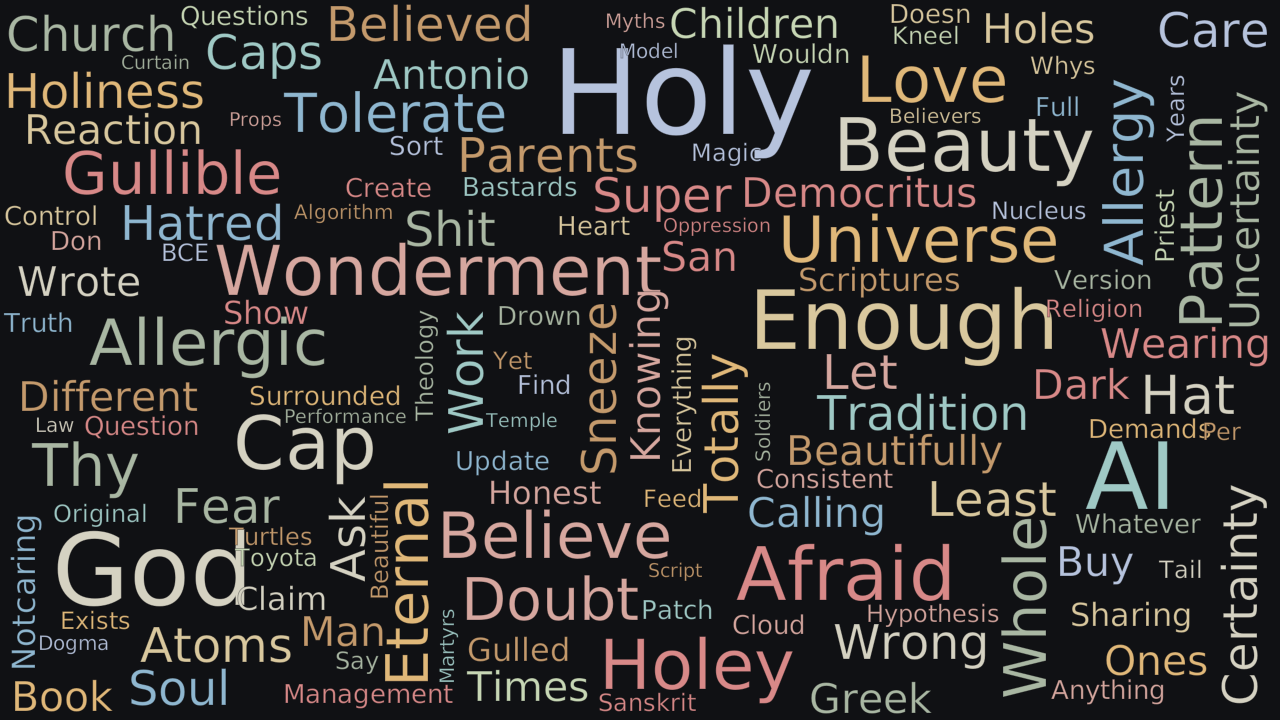
Word Cloud
Related reading
Selected by shared topics and section, with closer publication dates breaking ties.