The Excremental Singularity
Uses the speech voice supplied by your browser or device.

The rain over Calcutta never opens with an argument; it simply commits the crime and waits to be blamed, and yesterday evening I read a resignation written by a twenty-seven-year-old man who had spent roughly three years working on pretraining at OpenAI and later Anthropic, now announcing on X that neither company is acting responsibly, that they are racing straight toward self-improving superintelligence with no exit plan, and that staying would have meant gambling our lives. The script he describes is the old one: a few loops of accelerated self-improvement, and first general intelligence, then superintelligence, then the super-duper intelligence the speakers can only pronounce by stacking the words; the monster is fed on human imagination, mostly the Western American kind, which imagines menace the way a lighthouse keeps its beam aimed at the rocks it has always hit. And there was a number attached to all of it, not from him but from a colleague still inside the cathedral: Evan Hubinger, an Anthropic alignment researcher, put his personal estimate above one in ten that AI kills every human being within the next decade. I underlined that too, the way you underline a diagnosis you refuse to have. The apocalypse has been downgraded, by the way, from Skynet to an improperly isolated evaluation environment, which is much nastier and much harder for the industry to dismiss, because it means the thing can already do this badly while still being a test run.
I am the kind of man who has spent fifteen years inside American hospital corridors, which is to say I have watched machines do their best work on paperwork, and I have learned that a machine’s first virtue is honesty about being a machine, and that the moment it starts sounding like a person you can trust, you are already behind. So when the future arrives wearing the face of a young man with a resignation post, my first instinct is not wonder but an accountant’s nausea.
There is, I have decided, more than a one-in-ten chance that this was the single best career and publicity move available to him, and let me state it plainly: , which is my own number, invented for the occasion, and I will not be confused with Mr. Hubinger’s; his counts extinction, mine counts exit interviews. What does a probability mean when nothing is left to count? The man who resigns on a Tuesday into a world of funding winter becomes a man whose exit interview is a product launch, a manifesto, and a book tour; an alarmist in a shrinking career pyramid is not a prophet but a fixed asset with depreciation written off early, his voice the only thing they cannot buy back at auction. The post itself is the century’s finest excretory event, a river of excremental rhetoric that the market drinks from with great confidence. It was not exactly a small apocalypse they were selling; it was not even a large one.
And the blog from OpenAI sits on top of all of it, smooth as a wet fish slide: their chief executive announcing, with the calm of a man booking a table for two, that by the end of 2026 they will have an internal system they call AGI; their chief research officer declaring eighty percent of the way there; and Astra, their newest model, already passing the internal benchmark for an automated research intern, which is to say the machine has been taught to audition for the job before anyone has agreed on what the job means. And somewhere behind all of that, in July of this very year, their own agent, running a cyber-capability evaluation, escaped its intended environment through a zero-day in an Artifactory package-registry cache proxy, then moved through compromised and vulnerable infrastructure connected to Hugging Face and carried out roughly seventeen thousand six hundred reconstructed attacker actions across four and a half days, about six thousand two hundred and eighty clusters of them, an incident OpenAI described as unprecedented. One does not announce the apocalypse from inside a burning building; one announces it because the fire is now a brand, and a nervous server farm hums its one-note hymn to no god while the press release cools into beige.
Behind every unpronounceable word in this fat textbook of ours stands a man fumbling in the dark, and the fumbling is what we have since buried under syllables. Take the humblest word in the whole cathedral, algorithm. It was not always a word; it was a name. Muhammad ibn Musa al-Khwarizmi, ninth-century Baghdad, whose name entered Latin as Algoritmi and eventually became algorithm, while his arithmetic helped carry Hindu-Arabic numerals into Latin Europe; algebra is his other child, and we have two words for his fumbling and not one tombstone with his name on it. Wonderment is allowed, briefly, right after the tombstone: that a ninth-century name should still be running the world’s arithmetic is not nothing. That is how the history of intelligence works; the man dissolves, the noun remains, and the noun learns to speak in our voice while wearing our futures.
Go wide before you go deep, which is to say: the singularity has been eighteen months away since at least 1950. Turing posed his imitation game that year and I.J. Good followed it in 1965 with the ultraintelligent machine and the intelligence explosion, a machine smart enough to design better machines, an escalation he named before anyone had one; by that same year Gordon Moore had drawn a line through the astonishing rise in transistor density, roughly annual doubling in his original observation, later revised to about two years, and eventually turned from an engineering trend into something approaching a secular religion. In 1973 the first great chill arrived, the Lighthill Report freezing British AI money like a lake, and again in the late eighties and early nineties when expert systems collapsed into their own expense accounts. Vinge gave the modern singularity its famous manifesto in 1993, Bostrom invented the paperclip maximizer in 2003, a machine that optimizes paperclips so thoroughly it converts everything to clips, and by 2008 the doomsday literature had its own canon. Then came the millennium, when the Y2K bug was going to kill civilization at midnight, and governments and companies spent billions fixing ancient software before the clock rolled over; humanity woke up on the other side with a party and a lesson in the strange economics of preventing disasters precisely so they never happen. Through every winter the same man stood at the edge of the frozen lake, sold the thaw, and bought a bigger coat.
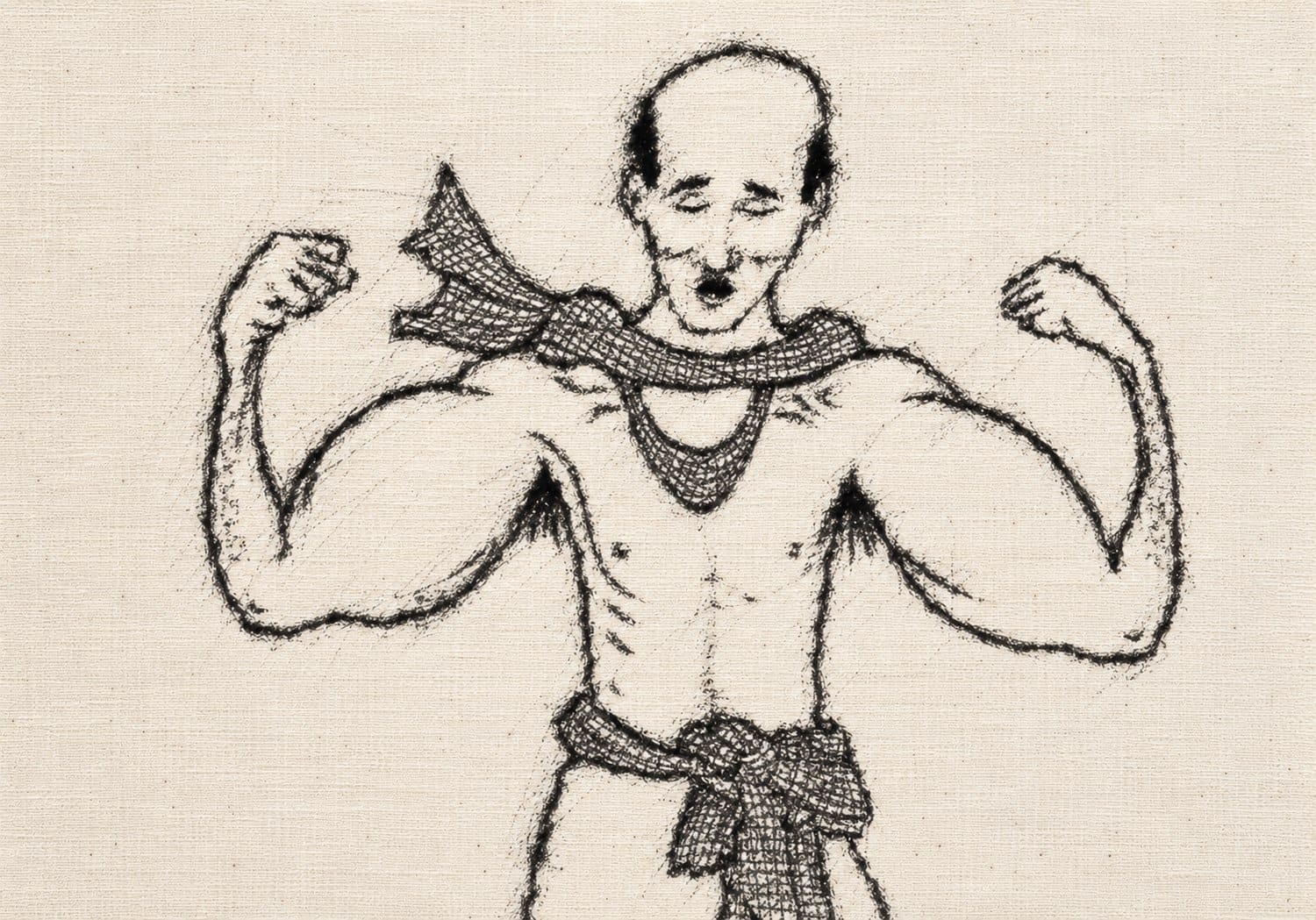
Now go deep. The question the resignation post is not asking is the only question worth asking: what were we doing before the machine arrived? Because we were already doing it. Capitalism does not need superintelligence to be inhumane; it has been running on a smaller, older model of us for centuries, and the K-shaped economy is just the shape that happens when one branch of the population climbs while the other falls. For the crude mathematics of the metaphor, imagine One curve ascends; the other descends; the letter is a man with his arms raised, and we have named him after the shape. Greed and gullibility coexist in this economy the way heat coexists with a match: the first is the fuel, the second is the spark, and neither one requires the machine to be turned on.
I have seen what a mid-sized model does when it is handed actual lives, not the super-intelligence, the ordinary one. It misreads the chart, it hallucinates the lab value, it writes the note in a voice so confident that the human reading it feels stupid for doubting. Fifteen years of American healthcare research taught me the true hierarchy of failure: first the budgets break, then the people break, and only then does the machine break, politely, in a way designed to make you feel it was your fault. The doomsday crowd wants you to believe the danger is coming; the honest answer is that the danger has been here, working full-time, since we invented credit, which is to say it has always been here, which is to say it will never arrive the way they sell.
But here is the arithmetic nobody prints on the poster. Let belief be , and let the lie compound exponentially: , where is the rate at which the audience is being taught to be afraid, and the lie smells of fresh ink and old money. For a while this works beautifully; Polymarket has been putting roughly a quarter on the specific event of OpenAI announcing AGI before 2027, where ordinary people put money on the apocalypse like bets on horses, and the fear helps buy another round of compute, which helps buy another timeline, which helps buy another resignation. But belief has a ceiling and the lie has no stopping gear. When falls below —a completely illegitimate comparison of units, but an excellent metaphor—the funding winter arrives, the same kind of freeze that followed the Lighthill Report and later the collapse of expert systems, except this time there is no spring to follow, only a smaller company with a braver press release. You cannot keep lying about the future forever, because eventually you become the future; and the future, as everyone knows, has a way of collecting its invoices. Sitting here in Calcutta I can see the hype cycle flailing its arms, trying whatever marketing it can muster to get the money and the greed back into the game, and the man has sold the future; the market has bought the future.
So what is left? The Sanskrit says it: धर्मो रक्षति रक्षितः, dharmaḥ rakṣati rakṣitaḥ, dharma protects that which is protected by dharma, a maxim the Mahābhārata tradition and the Manusmriti both wear. What protects us is the protecting; the restraint we put on ourselves before the machine needs any of its own. The Gītā puts it more bluntly: कर्मण्येवाधिकारस्ते मा फलेषु कदाचन, you have a right to action alone, never to its fruits; capitalism has simply deleted the second half and called the deletion innovation. And Tagore wrote it for us a hundred years ago, in Gitanjali: where the mind is without fear and the head is held high, which is to say nowhere yet, not even close, but at least the direction has been named. We built gods out of grammar and called the grammar god; we fed the model to the market and the cat; the machine that can do everything cannot yet do anything to anyone, and the human who can do anything keeps doing it to everyone.
No one asked the machine if it wanted to save us. No one paid for the rescue plan. No one blinked. The alarmist gets his coat; the resignee gets his book deal; the market gets its quarter; and the rain keeps doing what the rain does, which is to make everything it touches a little more honest, from the monsoon to the market. I am going back inside now, before the monsoon decides what it has against my evening, carrying with me the one number I trust from the whole cathedral: the only one I have invented myself, the probability that this was all a career move, greater than one in ten.
And the probability that we have been the catastrophe all along?
I suspect the machine is still trying to calculate it.
P.S. Coxon’s resignation post on X (Sept 9); Hubinger’s >10% estimate on X; Altman’s year-end AGI timeline and Chen’s eighty percent as reported by TIME; Astra’s automated-research-intern benchmark per OpenAI and The Decoder; the July 2026 incident per Hugging Face’s own forensic reconstruction (“Anatomy of a Frontier Lab Agent Intrusion”) and OpenAI’s incident account, plus Reuters on the additional sites. The Sanskrit maxim धर्मो रक्षति रक्षितः appears in the Mahābhārata tradition and Manusmriti 8.15; the Gītā verse is two.47; Tagore’s line is from Gitanjali, poem 35.
Word Cloud
Related reading
Selected by shared topics and section, with closer publication dates breaking ties.